Speaker 0
0:00 – 1:27
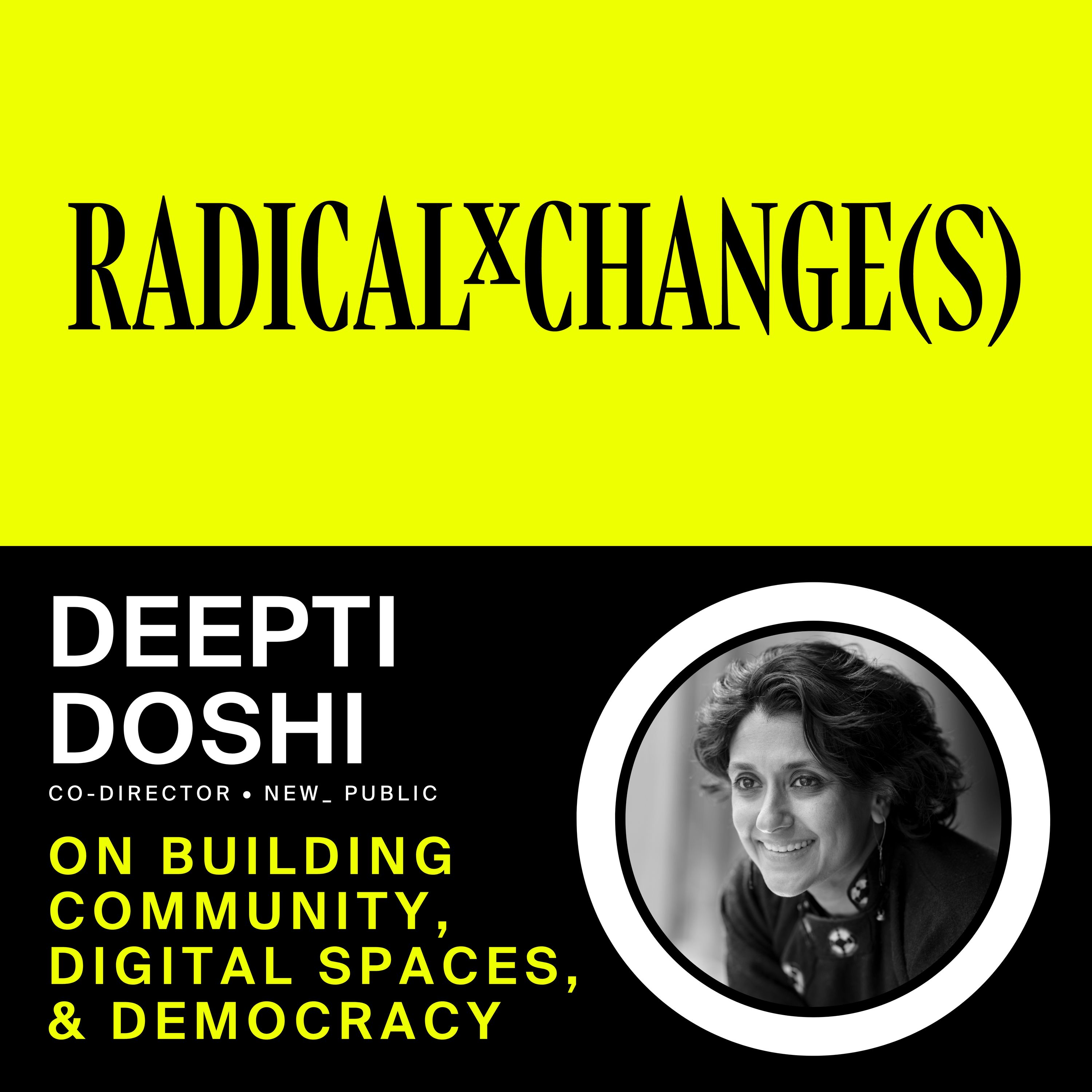
This is a RadicalxChange production. Hello, and welcome to Radical Exchanges. In today's episode, host Matt Pruitt talks to Deepti Doshi, a leading voice in the intersection of social media, community organizing, and leadership development. They discuss the influences and principles that have guided her through her expansive career, from grassroots organizing in Mumbai's dense urban landscape to the glossy executive offices of Facebook, where she established the Facebook Community Leadership Program, to her most recent position as co director of New Public, a community of thinkers, designers, and technologists imagining and building the digital public spaces of the future. They go on to examine the significant challenge of designing and operating online spaces that respect and amplify the voices of those who have been historically disenfranchised, as well as the problems of finding the right metrics to measure the success of these groups. They then point out the need to invest in and compensate community stewards and admins of online communities, a generally thankless but indispensable role that is growing with deeper significance as we struggle to take control of our online lives. We hope you enjoy this very deep and thoughtful exchange. And now here is Matt Pruitt and Deepti Doshi.
Speaker 1
1:30 – 1:44
Hello, Deepti. How are you? I'm good, Matt. So we'd love to maybe we can start off, with you telling us a little bit about your, your your journey, your path to the work that you're doing now.
Speaker 2
1:44 – 6:07
Yeah. Sure. You and I have been able to talk about some pieces of this, but really, I guess, I don't know how far back you wanna really go, but the story really starts with just, like, personally seeing through my own family's life and experience and then that of my grandparents too. Just, like, the value of relationships and You know how important it is that we have them just for The daily health of our lives getting through tough times, and not only relationships with, like, the people that are expected, but the unexpected relationships. My dad is bipolar, and so we often I mean, we grew up with a lot of hecticness and it was often people who were like the least expected to kind of show up for us that were kind of the backbone of how it is that my brother sister and I got to grow up and then You know, I'm in my parents immigrated here from India And so we went back every summer and we witnessed my grandfather bring home Somebody from the street to eat lunch with him every day and Yeah, just really living a life and growing up Seeing the value of these relationships being built in these unexpected You know what really come to this work as a community organizer and so started my career really thinking about how markets could serve the poor in the developing world better than aid and really then began to see the limits of the markets to address some of these kind of systemic power challenges, that these that we that all democracies really face and led me to take some time to think about that at grad school with Marshall Ganz. And I really found that the community organizing model answered a lot of these questions around how power can be distributed in a more equitable way and how voice can be yeah. Voice can really how how you create those right environments and containers for voice to really of of of the most marginalized to really have a stronger sense of its power. And And so, yeah, anyways, went back to India to create Haya, which was a community organizing platform that brought the rich and the poor together for you know, I don't know if you've been to India or not, but the rich literally live on top of the poor as opposed to how we live here in kind of more gentrified horizontal ways. And so the idea was, our democracy in India could only be successful if we began to see each other in one another. And, and, you know, the rich can't it what it was well, it wasn't gonna be successful if the rich continue to kind of privatize and pull themselves out of the core things that is that requires society to function. And so we took the energy around safety and particularly women's safety in 2012 after this very famous nearby rape case, which you may or may not remember, to kind of galvanize the energy of the populace, whether you are rich or poor, to kind of work together on improving safety in your neighborhood. That evolved into a whole bunch of sanitation campaigns where ordinary citizens would kind of work together with their local government. We work this is the longer this is the longer story of the background so you can tell me how you yeah. Anyways, this is great.
Speaker 1
6:08 – 6:16
Yeah. I'd love actually to hear more about this. So so we're we're now in around 2012 when you're doing this work?
Speaker 2
6:17 – 9:06
Exactly. We're right around 2012, doing this work in India. And I guess the important other temporal context here is that this was just a few years after Arab Spring also. And, you know, in no part of my story so far is technology or social media a part of it, except that as we built, the way that we built, our organizing capacity was through college campuses. And so it was young people who would run these, campaigns in their neighborhood, and then they would work across race, across age, across politics. But those young people are the ones that is who really started using Facebook groups in really interesting ways to kind of keep the coordination of their campaigns going, and to broaden their bases and their neighborhoods. And so that's where things started clicking for me, you know, with having seen Arab Spring happen and then at a much more local context, see the power of Facebook to support this kind of cohesion and organizing work we were doing, which then led me to go to Facebook to really think about how groups can be leveraged in a better way to strengthen our democracy. I started and ran our community partnerships team, which which work with all of these group admins and brought their feedback back into our product development process. But the curiosity has really remained the same, which is, like, how do we live in a world like the one that I grew up in my childhood where people in unexpected ways kind of showed up for me and where my grandfather in unexpected ways took care of other people. And, yeah, going to Facebook was about exploring that through groups in an experimental way, and that experiment failed for lots of reasons that I'm sure many people here understand. And then that's what led to essentially the creation of New Public, or joining forces with Eli Pariser and Talia Stroud on building New Public as a way to experiment with new sorts of conditions and constructs so that we can build these social spaces online in a way that really optimize for healthy relationships and plurality and cohesion? So long, long story to a very simple question.
Speaker 1
9:07 – 10:02
No. But that's it's really, really, good perspective. So in the in in the work that you were doing at Hiya, can you say a little bit more about about what problem you were addressing yourselves to in that? So was it was it primarily about, you know, creating sort of conversation and social ties across, across class differences, or another social divides? Or, you know, what was it what was it about really? And, you know, I'm I'm I'm just curious, you know, maybe get a little bit more context about Indian society even about the problems that it was addressing itself to. And then and then I'm curious I'm really curious also about how, how Facebook was interacting with it. Was it, you know, how was it sort of advancing the the the work that Haya was doing?
Speaker 2
10:03 – 14:33
Yeah. So I guess I'll, again, like, start with the personal. When I was an entrepreneur running a business that was providing services to low cost private schools and slums in India, I really had this feeling of, like, who am I, who am I as somebody with a very, very different life experience to be making these decisions for this service that is being provided, to people who have a who have a really, really different life experience from me. And so when I came back to India from the Kennedy School, I had a real commitment to only work with people and in contexts where I wasn't coming in from the outside, where I was working with people who looked and felt like me. And, of course, that doesn't you know, I can't I can't say that I always got that right, and there's something as coming from an outsider into India anyways. That means that I don't look and feel like, a lot of the people it is that I was working with. But one of the challenges it is When in looking at the community that I kind of associated with the most in India upper middle class educated globally educated often is that we were because the system was failing us in so many ways, we used our privilege and our wealth to check out of the system. We sent our kids to private schools. We had private drivers. And so all of a sudden, the climate and public transportation began to matter less to us. You go to private hospitals. And so these, like, basic infrastructure that is required for a healthy society was infrastructure it is that we, as the growing middle class, were checking out of. And it just didn't seem like a democracy could be built in any healthy way if that's what was happening. And so I was like, how do I check myself, my family, and my people back into the system? And Yeah, as I said earlier, I think that the the nearby a rape case in Delhi really opened everybody's eyes up in a really In this like shared fear This this feeling that like this could happen to all of us. This is not something We can buy our ways out buy our way out of I mean, I guess the ultra rich can if you have private security or but that, like, walking on the streets is something that we all need to feel safe about. And so for me, that was like, well, how do we take this energy that's in the populace and help people see this shared reality and then work together on the shared reality so that we began to kind of see each other in each other and using the neighborhood and, frankly, not even the neighborhood, the block, given the way it is that, as I mentioned earlier, the rich kind of live on top of the poor, as the organizing space in order to, kinda make things better together. And then that ended up in, like, things like creating, neighborhood watch groups where people would kind of take care of each other that way. And in the moments it is that I was most proud, it led to groups coming together and actually going to, the local police and demanding for services to be better and the political and social capital of the wealthier, the middle classes, then supporting The system to get better for even those people it is who have less of that kind of political and social capital. So, Yeah, that's a little bit of that. I I don't I don't remember where exactly your question
Speaker 1
14:34 – 15:47
was ending. No. That's, yeah, that's great. I'm I'm I'm just I I guess I'm I'm curious to hear about how a little bit about how that, about how the work at Facebook Oh. Connected with that. So in other words, I mean, I have a few things there. So for example, I mean, I think it's it's quite interesting to think about the creation of shared infrastructure, basically, as a as a way of bridging these, you know, perceived divisions. Like, if we think of ourselves as communities, but then we, but then we build a piece of of of infrastructure like a neighborhood watch group or something that we that we both depend on, then suddenly we're sort of part of the same, part of the same community in in a different way. There's a lot that's interesting there. And and then and similarly, you know, creating, you you know, I I I I assume that, like, for example, Facebook groups were were an important organizing tool in some sense. So I'm curious about thinking about that as shared infrastructure, you know, and, and how that how you were thinking about that, at that time.
Speaker 2
15:48 – 19:15
Yeah. I mean, at the time, the honest answer is that I wasn't thinking about it. And then but then as we started organizing at larger scale and working with these young college students, it's like, to do this organizing work, you're doing it over the weekends or you're doing it over the or at night. But then there's a lot of coordination that's required in the, in the space and in between. And so Facebook groups were the way it is that many of these, college students would kind of keep their community in touch with one another. And, you know, core organizing principle is that you meet people where they're at, and often this just happens very organically and naturally. And that's, I think, what happened here is that people were already on Facebook. And so the idea was like, well, that's the best way of staying in touch and sharing sharing with one another. But then to your point, yeah, I really began to see it. And, again, this is in the wake of Arab Spring as, yeah, this incredible tool for for organizing, you know, and to not only kind of have this, like, context of this shared problem that we wanna solve together, but this shared space to do it together, to act it out together, to coordinate. And, you know, Facebook has the spectrum of all sorts of groups, but the in the best version of them, you you begin to see the same thing that I was seeing in these neighborhoods come to life digitally also. So Lolo Malola runs a group called Females Inn. It started by being called Females in Nigeria. It was a group for women who have a Nigerian identity to come together and kind of share in that identity. But what it has evolved to be is a real support group to solve problems with one another and also use that common identity of being a Nigerian and what that means to bridge across difference also. And this is at a scale of, today, 2,000,000 women Who are held together? In this facebook group and so I became really when I got to facebook Enamored is maybe the right word by what is possible at scale if we're able to create these, like, small subsets and these small communities smaller than our news feeds on Facebook, to kind of re yeah. To see what I saw on the blocks of Bombay where people were able to, like, use a shared problem to get into really healthy relationship with one another, but always I always felt the limits of my ability to scale that work offline. And so Facebook as a tool to potentially be able to scale that culture, that democratic culture that I was really interested in fostering.
Speaker 1
19:16 – 22:22
Yeah. So Dewey has an idea of, like, what, you know, what publics are, which is, you you know, an oversimplification of it is that when, you know, when peep when a group people have, like, a common problem of a shared problem, then that becomes, like, a public, you know, within which democracy can can develop and within which sort of a healthy politics, you know, may or may not develop. But that that's that, I think that's a very interesting conception of of, like, what, you know, what the what the We The People is or what the sort of polity is. And you you and I share a, a strong intuition that what's needed to make our our democratic structures better is for them to be a little bit more richly textured to us instead of just having these sort of, you know, big everybody, polity and then contrasting that with the individual, which is not a polity at all, but just a, you know, a single unit. You know, we need these things in between. We need these kind you know, organizations around around community and shared concern and all the things that you were just describing. And and then you can and then it's very interesting to think about how technology comes in and interacts with that. Right? Because you can have, like, in in many ways and in many cases, you'll you'll have a tool, a new tool that will make its appearance, will enable people to communicate in a different way or enable people to organize in a different way. And sometimes that enables people to, to instantiate this kind of to instantiate themselves as a, as a as a a public as a, you know, as a mini public, if you will. As, like, like, you were describing on on on a Facebook group or, you know, the the Arab Spring I think I mean, we could I I would be tempted to actually poke some holes in that example anyway, but for whatever for for what it's worth, you know, you could think of, like, the events of the Arab Spring as as an example of that happening as well. I think this is this is really, this kind of thing is really is really interesting because so so technology comes in and enables, enables these kind of medium size, not the individual, not the entire state publics to organize, to see themselves, to communicate, and to and to develop. But then it doesn't always you know, the affordances of the technology can cause that to go in a different way than than than people might have wanted it to go. It it then becomes very complicated. And I'm curious if you have thoughts about about that. Oh my god. So many thoughts, Pat, Matt, as as you know, I guess. But,
Speaker 2
22:26 – 25:15
one, I think it's really I I appreciate you bringing up this kind of, like, middle layer of a public, and I I think it's really important to be clear about the problem it is that we're trying to solve. And so for for me and for our work at New Public, it is about these spaces have always existed where small groups of people have come together to solve problems. They've been our unions. They've been our PTAs. In some ways, our local newspaper has served that role of creating these, like, spaces of shared interest, shared concern, where people come together. And I would argue that that really is the foundation of a healthy democracy is one's ability to work with a fellow citizen and in many cases, work with citizens it is who are different from you, but yet who you, through this experience and this shared kind of problem solving, figure out how to work with them. And we believe at NewPublic today that we need to reconstruct what we call these spaces of influence, where one feels their agency, feels seen, sees others who are different from them. I think technology can play, I mean, we at New Public certainly believe it, a role in creating these sorts of spaces, and we can talk about that later. But I'd wanna get back to kind of the Facebook part of this story, which is that that's not what Facebook was built for. And so I I I think it's really important that, like, we don't try to superimpose a structure that wasn't built for that purpose to then try to make it work for that purpose. It was not built for that purpose. And I made a mistake by I mean, not maybe not mistake, but, like, thinking that it could be moved to serve that purpose, but it was not built for that purpose. And so what I believe is that we need to build the technology for that exact purpose, to build this middle layer of our of our public of, you know, not the singular one and not all of us, but the sum of us working together in kind of concentric circles. But I think it's a really, really big mistake to think that the technology that shows up in that layer is the best technology to solve that problem.
Speaker 1
25:16 – 25:45
Yeah. I I I totally I totally agree. I think that this is, it can be the sort of an a mirage. Right? That a a tool that appears, you know, a tool that appears and seems to move the ball forward in terms of our ability to organize democratically, you know, can Seem like a path forward for a more democratic society, but, but then it can actually lead in a different direction.
Speaker 2
25:46 – 26:40
And I think that's fundamentally about Incentive structures and What the incentive structures incentivize as the north star And so thinking carefully about the things it is that we use as the tools and the incentive structures it is that are governing them and the governance structures of them is really really Important to get aligned When I feel like that's what brings you and I together in some ways with New Public's work and radical exchanges work and just like our shared curiosity. Just like how do you also get the governance structures and the incentive structures around these technological systems to really serve what the what the end goals are.
Speaker 1
26:40 – 29:05
Right. And so if you think about what these end goals are like, if we're trying to build, build technologies and systems that, you know, serve the end goal that we want instead of the the end goal of of profit or whatever. You know, it what is that what is that end goal? Like, so just to for example, I mean, one way that I've that I've sometimes tried to describe it is that is that the the various kinds of of tools that that that I'm interested in are are, for example, things like things like quadratic voting, things like, things like Polas, things like, you know, sortition, citizens assemblies, you know, all these kinds of new techniques, basically, which is which is what what they are. I mean, I think even something like a well anyway, I mean, you could think of all these things as, like, techniques or technologies, but what they're what they're trying to do is to, you know, something like enabling people to reweave a social fabric or or to or to understand each other or to or to, engage in in public reason or communicative action or something. You know, there's all these kinds of, like, philosophical sorts of buzzwords about, like, what we're trying to do here. You know? But we're essentially, we, you know, the idea is is to, is to enable people to understand one another's concerns better or make sense of the world better. You know, how do you how this is a big you know, the the goal, I think, of this kind of, you know, public interested oriented technology is, is probably a little bit more amorphous than it should be. And I wonder if you have, you know, more more precise ways of of thinking about about what it's what it's trying to do. If, you know, if if if if Facebook groups had not been, owned by, you know, a a faceless array of shareholders, you know, what direction would they have gone and what what goal would they have pursued?
Speaker 2
29:06 – 32:15
Yeah. I think there's something just so fundamental, and maybe it'll sound naive as I say it, and I don't mean it that way. But I think fundamentally, what we're trying to do is create spaces. One, then I'm interested in connecting it back to quadratic voting and polls, for example. But where people see, their interconnection. Like, how can a democracy work if we don't believe we need each other, or, we don't believe that we have something to learn from one another, or we don't believe that working together will create a better outcome. And I think that is ultimately what we're trying to create, and then I think that requires techniques or tools or technologies. You know, I've always, like, radical, I mean, quadratic voting and polis, for example, are these, like, really actionable tools it is so that people can kinda be able to figure out how to make decisions together in a way that really represent the viewpoints and the perspectives and the concerns of multiple kinds of people. I do wonder, though, if there's something more, like, foundational, experiential lived that we need that just like, I need to care. Like, why should I use Polis? You know, why should I be involved in the Citizens Assembly? And to just like just like on the streets of Bombay, like, checking people back into caring, seeing that, like, you know, the lives of somebody who may feel far away from me is actually not that far away from me. And so I it it is worth my time and energy to get into relationship and do that hard work and participate in the citizen assembly or, you know, show up to have my voice heard and ideally through a tool that's that is Optimizing for cohesion and plurality as opposed to You know Power But that and that's really what I'm interested in is this this like democratic culture, which like it doesn't even need to feel related to democracy in any way, but just this way of living together in our neighborhoods. And now our neighborhoods are moving online. And so what does that look like to be living together in a way where we are recognizing our mutuality and our dependency on one another.
Speaker 1
32:17 – 36:35
So I'm not sure if you heard, Daniel Allen talking to Ezra Klein, a couple weeks ago. But they had a they had an interesting conversation, which was framed around the idea of sort of, like, contrasting what Danielle calls, oh, gosh. I'm gonna forget her vocabulary. But, you know, sort of abundance, democracy, on the one hand versus this sort of process oriented, renovation of democracy, on the other hand. And base you know, to, to to color in those, those terms of art, it's like you can think of you can think of the former orientation towards, towards democratic politics as basically saying that what we need to do is try is is solve people's problems better. Right? That we, you know, we want we want government and other institutions to give people what they need better, and that that basically will lead to a, the outcomes that we want. And, you know, and and Danielle is suggesting that, sort of, you know, sort of yes ending that by saying that that the processes by which we by which we do democracy are, you know, perhaps should be our primary focus. So in in other words, in other words, if we just kind of, you know, technocratically try to identify what people's needs are, you know, we we may be missing this kind of bottom layer, upon which the health of the of the entire, entire apparatus depends. And I think that what what we're talking about now about, you know, using using quadratic voting and, and and polis and and, you know, a whole these are just two examples, but, basically, this whole sort of, you know, panoply of of ideas for improving improving deliberation and and improving democratic process. Like, it's not so much that we think that we have the solutions, and we know that, you know, these these tools will solve all the problems of democracy. It's more a, a realization that, you know, we we really can't just accept that it's impossible to, to perform democracy and and and cut straight to the solutions to the to the problems. You know, for for one, because, you know, we may identify the problems wrong. You know? And and and, you know, another another reason would be that, you know, if we basically if we just sort of build infrastructure designed to solve people's problems without people participating in the process of of, of defining the infrastructure and defining their problems, then that infrastructure, you know, could also become basically, a, a a a power structure that you wouldn't want to fall into the wrong hands. I'm curious, basically, if you have any thoughts about that, but just to sort of, you know, be to sort of lead the question a little bit. It sort of strikes me that, like, the the the profit oriented approach to technology where you you'd think, you know, okay. What, you know, what are the, what are the customers' like self reported problems? How do I solve them? That does sort of tend towards this, that, that error in my view. Like, kind of, you know, just leaving out that the whole sort of, you know, bottom layer of the, of democratic structure. I I don't know if you have any thoughts about that particular framing like
Speaker 2
36:35 – 41:42
so many thoughts matt so many thoughts. Well when I miss this interview I've been on the road for the last couple weeks and so I can't wait to catch up on it, but danielle allen certainly has been like an intellectual hero for a really long time and I think so much of what she's What you're sharing about the conversation really resonates again just like at a very personal Level I You know this experience of working in India before I created hayah And coming out of this world of being like a social entrepreneur actually very much has this approach of, like, we need better services for people, and so let's provide better services with a lot of, you know, I would say at times, in certain cases, ignorance towards the Power dynamics and the processes by which we are getting better services to people as you're suggesting and so in my again personal experience I was running an education business serving the poor serving low cost Private schools because in India even the poor go to private schools but I was providing a service and me and my team were building what we believed quote unquote customers needed but didn't really have any formal mechanisms to ensure that they were part of the design of what it is that we were delivering to them And nor was there like lived knowledge of what their children's challenges were really given equal weight in my board meetings to what Me and my team and our funders believed it is that we needed and so I think that You know as we build both public systems and also philanthropic systems that serve critical people needs danielle is right. We miss this entire layer of Participation of really truly shifting power dynamics and that's really messy work. It's work it is that's really hard to measure. It takes a particular skill set. It takes a particular level of patience. And I think that's what I'm most excited about creating these digital spaces for, And that's, like, what brought me what enamored me so much about what Marshall Ganz taught me about community organizing is that it's not about necessarily the outcome or the action or the service delivery. I mean, that's certainly what we're fighting for. But it's the way that we get there, and it's in that process that people experience one another. They experience what it means to have power, To negotiate within Power to share power and that that's really the real work of a healthier democracy and maybe not big. We also need better services, but we can't forget that the way we get to better services may, in some ways, matter more for the sustainability of our democracy than the services themselves. And and this is this is, like, particularly on my mind. NewPublic is a nonprofit, so we do a lot of fundraising. And we're we're, you know, we're at the Skoll World Conference a few weeks ago in Oxford. And I think that, you know, all of us were super well intentioned as we, you know, as the philanthropic efforts in some ways, particularly because a lot of the money comes from either Wall Street or Silicon Valley, we we still kind of, emulate some of these dynamics of what works as good service delivery in the market as we think about what public service delivery looks like. And I think it's really, really, really important that, as we keep a healthier democracy as our North Star, that we, To use your words radically imagine new ways of yeah creating spaces creating containers for that power sharing to happen as Better service delivery is happening Or for better service delivery to happen
Speaker 1
41:43 – 43:32
How do you how do you respond to the you know, to the, I'll just call it the, you know, the sort of abundance democracy or the sort of Ezra Klein position that, we know what the problems are. You know? We we know that we need, like, you know, green energy, for example. We know that we need, you know, we know that we need governments to, to take the, you know, the regulation of AI more seriously. You know, we we know with we know what the what what the issues are. And and and and I think another part of the critique from this from this side is that, like, is is, you know, we all we also know that that democracy is really hard and democracy is is really slow and and that it's not always even taking place in good faith. So, for example, you know, in in the just speaking about the, you know, sort of United States context, the divisions in in this country, for example, are are so deep that, that it, you know, there seems to be a fairly persuasive argument that, the deliberation, you know, a sort of process oriented democratic work in in such a fractured culture is likely to, you know, to run into a fundamental problem, which is that which is that people, you know, people are not always going to be taking place taking part in it in in good faith, which is, you know, a requirement for for for democratic, for democratic process. How do you respond to to that challenge?
Speaker 2
43:35 – 45:05
I mean, right on. Right? Like, I think that's exactly right, and I think that's exactly why groups like PTAs, you know, the neighborhood Washington Square chess benches. You know, I think that it's easy to dismiss them at the because of the scale with which they operate or that the issue is not, like, the urgent issue of our democracy. But these are the, yeah, these are the spaces. These are the experiences it is that people need to have to then have faith in democracy to then be able to participate in it in healthy ways. And so, democracy is hard, and there will be bad actors. And we can't expect people to participate in something that is hard and scary Without building their trust and confidence In one another or in the fact that it's like worth working for And so that's why new public is really kind of grounded in experiences and spaces as that kind of like foundational layer.
Speaker 1
45:05 – 47:42
Yeah. Yeah. I I think that's a really key part of the, of the response to the to the sort of abundance democracy, point, which is that what you were talking about, or what we were talking about earlier, you know, that sort of building building different institutions, building institutions that are that are building institutions that are operating at a different level of society, creates creates the possibility of democratic conversations happening in, in in in higher context environments so that you aren't just getting, you know, like, people whose differences are unbridgeable, participating in bad faith. Right? There's like a whole there's a whole sort of other dimension of of, of, of institution building that needs to be, that needs to be undertaken, which, you know, sits between the individual and and the state and and helps to really solve that kind of this sort of chicken and egg problem of, like the the chicken and egg problem in my mind is just to just to put it on the table is, like, there there's one view that, people have big problems, and we need to solve people's big problems. And only after we solve people's big problems will people be able to, participate in in in democracy. Right? And and then the other view is that, is that that approach is likely to to to misfire or to create unaccountable power unless we sort of you know, if we if we don't reweave the social fabric first, then we won't be able to solve the problems. Right? So there's this kind of chicken and egg, worry there. And, I mean, and to me, at least, the the path that you're painting out of that chicken and egg problem, is, is has to do with this idea of of of spaces, of creating new new institutions and new spaces for, you know, where the where the distance between the problem to be solved and the and the, you know, coherent public capable of solving it is smaller. Well and, also, I think that the chicken and egg problem in some ways can be fixed by mixing the chicken and the egg. Like,
Speaker 2
47:42 – 49:38
relationships community can be used is an under Undervalued way of solving problems and so we don't always need to be going back to like service delivery and like optimizing technically We we can broaden our imagination to think about how community and relationships can be used to solve people's core problems in the way that like my life experience At least for me and my n of one, you know, it was relationships that supported My family through really really really difficult times. And so how do we think about because I don't think that you can create spaces Just and like bank on people's goodwill and interest in kind of wanting to mix with one another and connect with one another for the sake of You know a healthy healthy society. I don't think that's really going to work I think we do need to ground this in people's real problems. Like there's a reason why the pta Played this role is because people care about the future of their children and making their schools better. And so how do we acknowledge that? All of us are Dealing with a certain set of problems and then how do we think about how we solve those problems in a way that create experiences of healthier relationships strong community bridging across difference Figuring out how to compromise and then that being this kind of like democratic tissue that we're building as the basis of Our democracy and trust that that then Leads to part more participation and healthier participation
Speaker 1
49:40 – 50:50
Yeah. I I I think there's also a, like like, one of the other critiques of this kind of approach that that Ezra Klein made was that, was that, you know, people who are interested in this sort of democratic process renovation stuff are are in a way also being technocratic by saying, oh, we've got this tool that will help peep you know, that will help deliberation happen better. You know, we've got, you know, we've got we've got this. We've got that. And I think that I think that's, that that would be an accurate criticism if it were true, but I don't think it's a fair characterization, basically, because because what we're saying is not just that we want not just that we have a, you know, a a magic wand in our back pocket that will enable these processes to happen. It's that we need to experiment with, with finding the the institutional containers like you're talking about where the the the the public and the problem are sort of closer together. Right?
Speaker 2
50:52 – 51:52
A 100%. I mean like one of our my like big pushes at new public this year is Real people real problems in the same way that like You know Just we need to make all of this land All of this aspirational land in a way that Meets people meets all of us in the way we live our daily lives getting through our lives trying to make our lives better for our our kids the people we care about And I think that grounding is really really really really important if we want any of these experiments which are grounded in like Great philosophical ideals to actually make a difference in people like in the way that we experience one another in our democracy on an everyday basis
Speaker 1
51:54 – 53:35
How do you think about the problem of measurement? So this gets back a little bit to what to the the worry that you were expressing about sort of you know okay. So for some of the work that we're doing, some of the money comes from, you know, Silicon Valley or Wall Street. And so and and so, you know, there's there's there's a bias on the part of some funders, and and there's a buy you know, in the in both of those cultures in general for basically measurable impact. Right? And what strikes me is that if you if you look at if you look at the solution to, to democratic dysfunction through this sort of abundance lens, we say, k. We wanted to find people's problems and then do better at solving those problems. And then, what you know, healthier democracy will flow from that. What you then do is you make the problem measurable because then you you then create a, a yardstick by which you can say, okay. We did this well at solving people's problems or we did that well at solving people's problems. This whole climbing the mountain from the process side, in a way is at a disadvantage in the entire culture of of, of sort of technology and capitalism and, you know, rational planning of action, because it lends itself less well to measurement.
Speaker 2
53:37 – 55:59
Do do you how do you feel that tension too, and how do you think about it? I'm so curious how you think about it. I'm so curious to have anybody listening to this thinks about it because I don't have a good answer to that question except that It's a bunch of bullshit and We have to figure out Like our comfort with with solving problems in a way that is counter to these, like, mainstream systems we live in and, you know, be comfortable become comfortable with, the qualitative stories of impact and You know, but rob bob putnam did figure out how to measure social capital in some interesting ways And so I think that there are some tools that is that we can use but I I really do believe that this, like, this exact exactly as you're suggesting, this, like, very capitalistic way of looking at things to then be able to measure, You know individual impact Is Is one of the reasons why this work is so hard to do but at the same time I do think that both you and I do have a small but growing group of funders who Understand the complexity the nuance the challenges of measuring process the challenges of measuring when power is actually being shared the challenges of measuring whether somebody feels like they're more seen or more heard in their community I I do take a lot of I I do feel really hopeful that There's increasing understanding that we're not going to be able to transpose these like capitalistic models of measurement into this work and that we have to be creative about figuring out what those measurement What those measurement structures look like? And that's work that we all have to do together still collectively But that can't slow us down
Speaker 1
56:00 – 56:44
Yeah, no, I I agree with that. I think that I I also sense that many funders are becoming more aware of this of this issue. And, I also think that there's an, you know, an obligation for for us people engaged in work similar to ours to get more creative and get more thoughtful about about how to do measurement. But with that with that said, there also needs to be a a real acknowledgment of the of the fundamental tension that we're that we're describing here, which is that the more, you know, the the more you simplify a problem, the more you can measure it. So, therefore, the more you want to measure something, the likely you are to oversimplify it. Well and I think yeah. A 100%.
Speaker 2
56:44 – 58:21
A 100%. And I think this is a lot of what's gotten us into the situation that we're in is, like, not even fully understanding, and I'm coming up this learning curve too, the difference between measurement and metrics. Because we do need to measure progress, but that doesn't mean we need to simplify it in one or two metrics or, you know, a handful of metrics because that doesn't allow us to understand neither the complexity of the problem nor the complexity of the potential impact. And so, you know, when I when I think about what I really ran up against at Facebook, and I know this is a simple story, but it's really a true story of, like, engagement and growth being these, like, metrics that were really easy to measure, easy to define, easy to explain. And thus, it became easier to, carry a group of people, the teams at Facebook, to kind of optimize for those very measurable quantifiable metrics Even though there was an interest to want to be able to invest in the work that would build healthier communities, it was just so hard to measure. And so then it became really hard to motivate large groups of people to optimize for that. And so I mean, a 100%. Yes, and I'm also you know, measurement we can get better at measurement without necessarily having to simplify things into metrics is, I guess, what I'm trying to say.
Speaker 1
58:22 – 58:35
Yeah. Can you so I also I have to say I sometimes worry about the language of of, of optimize and scale, for for precisely this reason. Do you share that worry?
Speaker 2
58:38 – 59:59
Yes. Yeah. I share that I share that worry. I share that worry because I think those words have begun to mean certain things again in this, like, world where Silicon Valley and Wall Street kind of govern a narrative? You know, do I think scale is important? Yeah. Do I think that I wanna, like, create spaces where a maximum number of people can get into a healthy relationship with others? Yes. Does it need to happen in one space, and can we get more creative about different ways of being able to reach lots of people, in more contextualized ways, in ways it is that made them where they're at a 100%? And so, like, you know, that's why we always think we we always say that we're building, human scaled social spaces. Yep. But the idea of scale isn't a bad one. But I think what it's come to mean today can really kind of bastardize what it is that we create.
Speaker 1
60:01 – 60:36
Yeah. You you have a model of investing in people, centered on, the idea of basically community community stewards and community entrepreneurs, which I think is a is a really interesting, way of weaving through weaving through the problem of, you know, exactly what it is that we want to quote, unquote, scale or what what we want to invest in. And I I wonder if you could, say a bit more about that.
Speaker 2
60:37 – 64:40
Sure. So I think if we all agree that technology and digital spaces have a role to play in strengthening our democracy, if they can be designed to, If they can be designed with kind of cohesion and plurality as their north star Then I think it's also really important that it's not gonna be just technology and the products and better apps That are going to get us there, but it's a combination of those better spaces and the design of those spaces combined with the leadership of those spaces, the stewardship of those spaces such they such that they also kind of live up to these more democratic ideals. And so I guess I'll just start with, you know, yeah, my experience at Facebook. It's like the architecture of Facebook groups could be whatever it is, but a group was healthy or not healthy depending on how the what we would call the group admin would would steward the group. And that means, like, how they would welcome people into the group, how they would, maintain what how they would build the norms of the group, how they would then maintain and adhere to the norms of that group. And that's all really, really, really hard work and it's work it is that I really believe that we I mean lola omalola who ran females in Nigeria, which I mentioned earlier At one point she told me that she spent sixty hours a week managing Her group and it's unpaid. It's unrecognized. It's Uncelebrated. And so I'm really interested in You know, yes improving the design of our products and the design of these spaces and also supporting Yeah, what we at new public call community stewards these individuals who really ensure that the spaces are healthy and do that hard work of you know, taking down posts and then helping under helping someone understand why their post was taken down to maintain the kind of health of that community. It feels like a really really really important part of the equation and one it is that we can actually you know community stewardship is not something that happened because we have group admins and moderators on facebook groups and reddit. It's I mean, this is like I feel like our most building community is maybe one of our most ancient technologies, and there have been people who have been building community in lots of different ways, whether it's through faith groups or, as I was suggesting, the PTAs or, you know, Marguerite on our block who, ensures that people are in relationship with one another, and we're hosting events for our neighbors to get together, and that there's a lot of different disciplines from which we can learn about what makes a really good, strong community. And, you know, these online moderators and admins are a more, you know, twenty first century version of that same discipline. But how do we really recognize that, like, this is a discipline. It is that we have a lot to learn. This is not new and sexy and shiny. This is old and the basis of kind of how we've come together as a human society, and we need to be able to learn in a really multidisciplinary Yeah.
Speaker 1
64:41 – 64:51
Yeah, I think it it connects also to really important ideas about the the care economy or you know, Unacknowledged labor that goes into the building of all kinds of different institutions
Speaker 2
64:52 – 65:38
a 100% and I think care labor is something it is that we in our western capitalistic society have not really been able to figure out how we want to value and appreciate and In that, in a paradigm where we're not able to value People who do the work of care We're not gonna be able to have a healthy digital ecosystem Because those people who do the care of that healthy digital ecosystem also need to be valued and supported and celebrated. And so I think it's really important that we get this piece right into the future.
Speaker 1
65:39 – 65:50
And so we've got the idea of community stewards. How about the idea of community entrepreneurs? Is that a is that a different role in your mind? In my mind, it is, and it kind of is a play. You know, I came up,
Speaker 2
65:51 – 68:14
working at a place called Acumen Fund, which was kind of one of the pioneers of thinking about social entrepreneurship. And, again, I think that social entrepreneurship still, as we talked about earlier, really is grounded in this idea of better service delivery. And as we move, you know, into this world where what we really need are or what we also need are spaces for people to kind of get into healthier relationship with one another. I think of that work as the work of building community, and I think of this, set of tech entrepreneurs and designers who are really taking the lessons of what we've learned from these, like, really large tech giants and wanting to create spaces that are operating at human scale for which the health of the relationships are really what you are, quote, unquote, maximizing for, where you're thinking about design features to support plurality, you're thinking about the use of tools like polis and quadratic voting within the spaces, I think of that group of people as community entrepreneurs. Like, what they're doing is creating spaces for people to get into healthy relationship with one another. And our sense is that there is a growing group of these small, mighty, and growing group of these sorts of builders who wanna take from the lessons of big tech and build differently in the same way that two decades ago, there was this group of social entrepreneurs that wanted to take from the lessons of Wall Street and build differently. And I think it's really important that we create pathways for these young designers and young technologists, young engineers to really feel, proud of the work it is that they do, to feel like they're seen, to feel like they can explain to their parents, in a way that I'm not sure that I can still yet explain to my parents what it is that I do, if we really want, like, a plural verse of these spaces to exist.
Speaker 1
68:16 – 69:33
And so do you it's interesting. I mean, the idea of community entrepreneurs is interesting to me because I I think there's at least two ways of interpreting that term. You know? One one is thinking about thinking about it in terms of entrepreneurs who are building who are building products and and and spaces and and things. You know? And another way of thinking about it is a way is entrepreneurs who are defining communities. Right? Who are who are actually, like, building building communities or, you know, helping to helping to sort of identify the the, the, you know, the the the public problems in in Dewey's were words or, you know, the sort of, you know, helping to sort of identify or define the communities of shared fate in Margaret Levy's words, that, you know, that that then need to be sort of nurtured and and and and stewarded. How do you how do you think about that?
Speaker 2
69:37 – 71:25
I mean, I think this I think this, I think these are kind of overlapping problems or areas. So at New Public, we often, as you know, use the analogy of public spaces. And so we think about the role of the architect or the urban designer and, for example, creating a library, but then also the role of the librarian in ensuring that the library meets people's needs and is adapting to what communities need and, ensuring that the norms are met and then ideally being part of, you know, the brainstorming and design of what future libraries can look like. And so it seems as though both groups of talent and expertise need to be invested in as we think about kind of a healthier digital ecosystem. You need the builders who have this, like, socio technical expertise. And that's what we're excited about working on with you guys at Radical Xchange is, like, really getting pipelines of engineers and designers, into community with one another and into really thinking about political economy. And you need these community stewards who are likely the ones, like, closest to the everyday problems of people being in a big group with one another and can kind of help navigate that.
Speaker 1
71:27 – 71:39
Yeah. What what am I forgetting about? What are you what else is on your mind, these days, in in in your work or or or in the world?
Speaker 2
71:40 – 73:27
We hit a lot of it together, Matt. And like I said, I really appreciate the spaciousness in this conversation. Too often, I feel like we're trying to get at the main points in a half an hour, and it's really nice to be able to have space to kind of reflect both on my personal journey into this work and my personal experience as well as kind of kind of these systemic problems that is that we wanna address. I mean, I think something else that you and I have talked about is, especially recently and I know it's on the mind of probably most people who may listen to this is just the Much more scaled use of generative ai And what the implications of that are in social spaces and then as a result What the implications of that are in our democracy and so that's probably a whole another conversation but I will say that what I'm Optimistic about as it regards. I mean, there's a lot that I know we're both pessimistic about but one place of optimism I have is kind of relating back to this care labor I I don't believe that that labor can ever be replaced that that work of stewarding a community could ever be replaced because of the nuance that's required in order to do it well And I also think that AI can reduce the burden on those individuals in some really interesting ways. And so we're really excited about exploring that with this huge asterisk that, you know, we're entering with caution and concern also.
Speaker 1
73:27 – 74:49
Yeah. Realistic. Realistic. The, my, my, preferred way of thinking about it is pessimism is a dirty name that I sometimes get called, but it is this is not actually what I am. The I I think that, I think there's actually a this is a lot longer conversation, I guess. But I I think that there's a an interesting, sort of I think there has been a really interesting phenomenon in our culture, around just the ideas of pessimism and optimism, for quite a long time where, you know, basically, pessimism was is like is like a dirty word. It's, you know, it's something that you're something that you're not allowed to be, and optimism is is a wonderful thing. What you know, a fantastic thing to be. You know? And I think that, I just think that both of those are are are are are are totally problematic. It's it's, we should all just be trying to to understand where things are going and be thoughtful about the ways that that things could go wrong in the future and be hopeful about the way things could go right in the future and and try to try to tilt the trajectory of our technology and our institutions,
Speaker 2
74:49 – 75:37
towards I think that's exactly right. I think that's exactly right. And I think that and I think it's really important that we don't allow the like largeness and the deep pockets of like the incumbents to immobilize us from thinking about what a different sort of future could look like, you know, and I I think that's the work of radical exchange. That's the work of new public and so many of our colleagues that this can look different and with lots of lots of small efforts as small as they may feel but in some sort of loosely coordinated way It is possible to get to a better place
Speaker 1
75:39 – 76:19
Totally. So And one of the things that I'm very hopeful about, actually, is that is that AI will will create an occasion for us to, for us to have some of these, some of these social fabric creating, you know, democratic conversations about about how we want, how we want this technology to be used, how we wanna integrate it into into our society in a in a in a in a wise way, in a safe way, in a way that respects, in a way that respects one another, frankly, and takes everyone's, you know, takes everyone's everyone's concerns and everyone's interests and everyone's hopes, very seriously.
Speaker 2
76:21 – 76:24
So Yeah. It's like keeping it human a 100%.
Speaker 1
76:25 – 76:31
Yeah. So that's a great place to close, I think, unless you're happy to happy to explore another
Speaker 2
76:32 – 76:49
any happy to explore further issues otherwise. No. No. I feel I feel similarly that it's a great place to close, and thanks for the opportunity and always love chit chatting whether it's on a recorded line with headphones on or over coffee mat. So
Speaker 1
76:50 – 77:03
Super. Me too. Thank you so much. And, any any links or references that you'd like to to share to help people, learn more about your work
Speaker 2
77:04 – 77:45
well newpublic.org is our is our website and we actually have this, Open call right now called community by design. We believe that there are lots of social spaces out there that people are using that live up to these kind of like healthy ideals. And so we would love for So, I think it's newpublic.org backslashcbycxd we would love for people to be sharing with us What it is that you are using what it is that you are experiencing even if it is subscale? With us so that we can be learning from from you
Speaker 1
77:46 – 77:50
all Super, deep doshi. Thank you so much
Speaker 2
77:51 – 77:53
Thank you, matt. Talk soon. All right. Bye
Speaker 0
77:54 – 78:46
Thanks again for listening If you enjoyed this episode, it would help us out if you could rate and subscribe to radical exchanges on your favorite podcast platform This episode was produced by g. Angela Corpus and co produced, edited, and audio engineered by myself, Aaron Benavides. The Radical Exchanges podcast is executive produced by g Angela Corpus and Matt Pruitt. If you would like to learn more about Radical Exchange, please follow us on Twitter at RadExchange, or check out our website at radicalexchange.org. We also invite you to continue the conversation on our Discord, where we have a variety of channels discussing topics like what you heard today, as well as partial common ownership, community currencies, soulbound tokens, and much more. There will be links to all these in the description. Thanks again for listening, and stay radical.