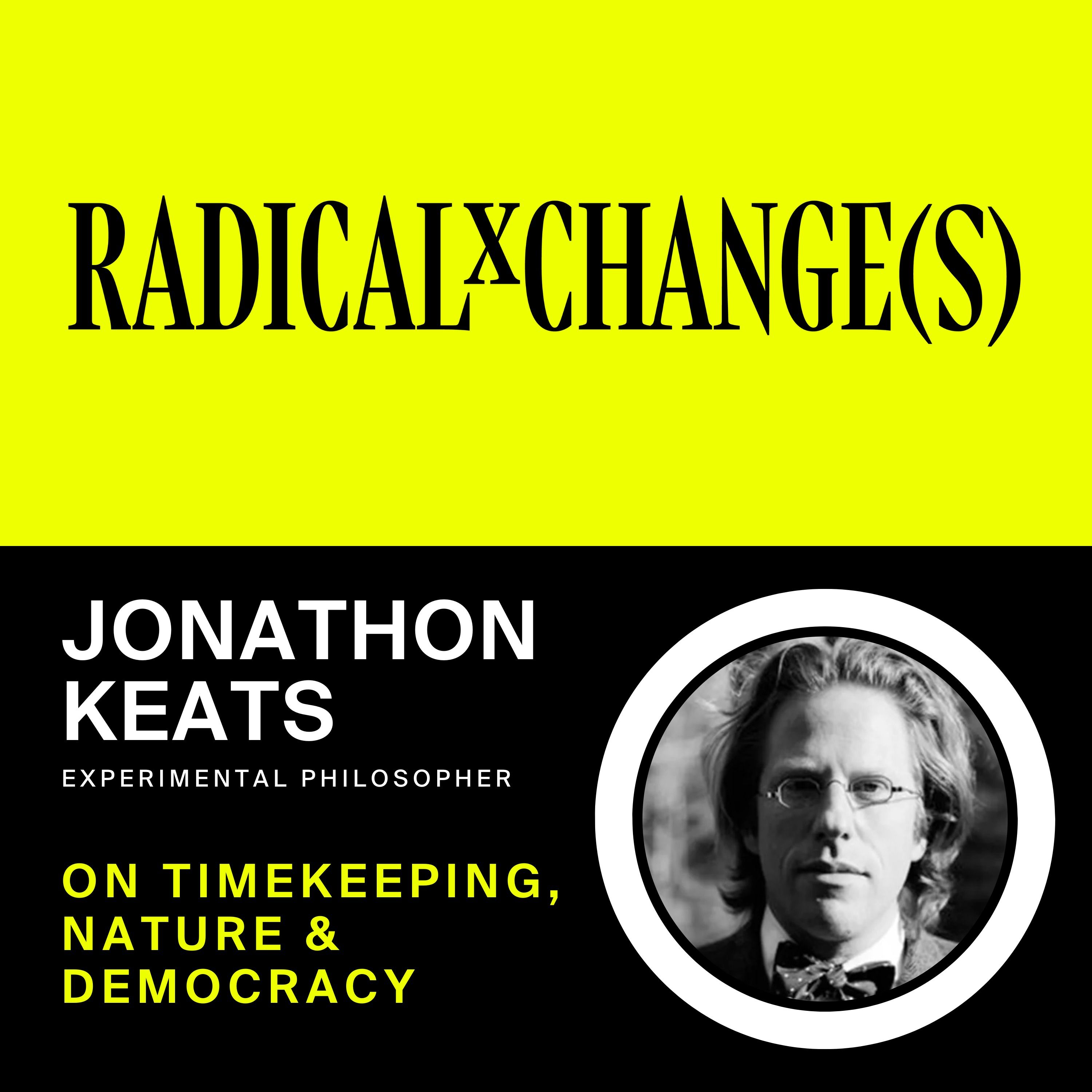
Jonathon Keats: Experimental Philosopher
RadicalxChange(s) | 2025-05-16 | 1:08:00
In this conversation Matt and Jonathon discuss the philosophy of timekeeping. They consider the connectedness and the alienation of being on universal atomic time, the promise of alternative systems such as the river clock, and how different notions of timekeeping influence our understanding of democracy and nature.
Top Keywords
- clock 0.019
- time 0.013
- river 0.010
- atomic 0.007
- metaphor 0.006
- system 0.006
- terms 0.006
- metaphors 0.006
- atomic clock 0.006
- ways 0.005
- pendulum 0.004
- timekeeping 0.004
Transcript
Speaker 0
0:00 – 1:42
Some people might call Jonathan Keats an artist, but he calls himself an experimental philosopher. His body of work going back twenty five years explores the way that human life intersects with political and economic systems. For example, his first major work in the year 2000 involves sitting in a chair thinking before hours and then selling his thoughts to patrons at prices calculated on the basis of their income. He once copyrighted his own mind as a sculpture. He created a ringtone based on John Cage's famous piece, four minutes and thirty three seconds, which is four minutes and thirty three seconds of complete silence. He built a pinhole camera that takes photographic exposures lasting a hundred years. In downtown Berkeley, California, he built a temple for the worship of science. He challenges us to look carefully at the assumptions built into our markets, our democracies, and our technologies, and constantly seems to do it in ways that seem abstract at the time but end up prefiguring political or cultural issues years or decades before they erupt. Recently, he has been involved in efforts to formalize rights of nature. He's a wonderful guide to this territory and to the big questions it involves. I love this conversation. I hope you will too. Alright. Jonathan Keats, thank you so much for for joining me today. Thank you. Delighted to be in conversation with you. So I wonder if we can start with you giving the listeners just a little bit of a, of a flavor of of what you do, the kind of projects you've done in the past. You, you your your job title is experimental philosopher. Maybe you could say a little bit of word about what that means and, give us a a bit of a of a tour of your your career. Certainly. I I've chosen experimental philosopher as a
Speaker 1
1:42 – 15:04
job title because it confounds me every time that I talk about it. I don't really know how to define what I do, and I have sought in every way possible to live my life in terms that defy definition by others and also by myself. I I studied philosophy and fled academia as quickly as I could, finding that philosophy seemed, at least to me, to be far too important for academics and for the constrained conditions of both the people involved and also in terms of the questions that could be asked. That is to say that philosophy had become, and I think continues to become to an even greater degree, highly technical and inaccessible to most at a time when philosophy as naively understood, as I understood it as a child and as I understood it even when I started to study it in college, seems to me to be the collective pursuit of knowledge, understanding, really as a matter of trying to cultivate and trying to accentuate qualities of curiosity about everything. This becomes a way in which I believe we can, as a society, come to understanding about who and what we are and what we want to become. And that needs to be a general discourse that needs to involve everybody. So having having left academia, I sought to do philosophy on my own terms, to do philosophy in public. And that came about mostly in terms of my life since then through the recognition that the thought experiment is a really powerful way in which to engage people in ideas and in collective speculation. So the thought experiment is within an academic context, a mode of argumentation, say, rhetorical device that is used to make a point or to make an argument using counterfactuals. To me, that seemed like a missed opportunity because making an argument or making a point seems to be effectively foreclosing rather than opening up exploration. And since my motivation for studying philosophy and my interest in philosophy was from the very beginning, the pursuit of curiosity and collective discourse as a form of discovery by all of us in relation to other people, other beings, and the planet as a whole, realized from the outset that the thought experiment as a as an argument was really not going to be a tool that would be very useful to me. Whereas if I were to take the term literally and to think about how I could run an experiment effectively posing a hypothesis in the form of a counterfactual or an alternative reality, asking what if and then instantiating it to a degree that could be experienced by other people where I could be also a part of that encounter. It might be a way in which to be able to think through the possibility space and simultaneously to recognize conditions and qualities and underlying assumptions in our everyday lives in the world in which we currently today. So that has been the approach I've taken for a couple decades now has been to, to create conditions that are sometimes absurd, other times are aspirational, and often where I don't know whether they are absurd or aspirational. Probably there are a combination of those. And in that ambiguity, I think there's a potential to make some real discoveries or to come to some some deeper insight deeper than I can do on my own, certainly. I think we all all of us who participate in the thought experiments that I set up, all come away at both both surprised and also redirected, directed in ways that might not have occurred to any of us had we not undertaken this sort of random walk that's not strictly random, but that takes us in directions that are far out of the ordinary. So this process of asking what if is pretty open in terms of my taking my everyday experiences as well as all that I'm reading and seeing and all the people who I'm talking to, all the discussions that I'm having. It's a matter of taking all of that. And for one reason or another, a question emerges. And I start to think that through to a degree that it becomes that is to say, there comes a moment where I see how I can make that question more than a question in the verbal sense, but a hypothesis in a sense that I can physically instantiate something in the world that becomes a locus for conversation, speculation, and potentially for reconfiguration of society. So as an example, I have been thinking about time for as long as I can remember, perhaps as I'm always late to everything and have never had a very comfortable relationship with time. I always felt that the clock was interrupting or was was coercing me in various ways that seemed antithetical to what I wanted to be doing, what I thought was important. And so I started to think about where time emerges in our reckoning in terms of how we tell time and how we measure time. And the more that I've thought about it, the more that I've come to recognize this as coercive, not only at an individual level for me, but I think at a planetary level. That is to say that as time has been measured mechanically, digitally, ultimately on the atomic clock, this has allowed for a sort of logistical override on planetary systems and all of the living systems and life forms that comprise the biosphere as a whole, where we are able to coordinate our actions without any sort of recognition of the impact that our actions have. So for instance, ordering on Amazon is a really good way to ensure that you get whatever products you want whenever you want it because everything is running on the clock and because a clock is insulated from planetary conditions. The the clock is precise and allows for shipping and for all the other factors ranging from manufacturing to the person who puts the package on your doorstep. All of this can happen in a way that doesn't really recognize the planetary impact, both at the level of the environment and at the level of people's lives and the labor that goes into making this system work. So to me, it seems that this is a mistake. This is a distortion, not of time in the sense of my making a claim that runs contrary to orthodox physics. I do not dispute the way in which physicists have characterized time and measure time. What I dispute or what I question is the degree to which this is meaningful or appropriate in terms of what we actually are seeking to measure. In other words, to me, it seems that really what we're after when we are trying to tell time, and this has been the case since time immemorial, is it's about relationality. It's about coordination in a sense that is about where where each of us is in the world at any given moment, what each of us is experiencing, and how to take all of that in terms of how we influence each other and to make it work as well as possible for all of these disparate needs that different humans and nonhuman beings have. So as a result, the idea that time keeping should be precise in order to be accurate, I think, is actually, it's false. It actually is very different as any scientist will tell you, very different at what we mean when we talk about accuracy, when we talk about precision. And the precision gets in the way of accuracy in the case of how we need to think about time in order to overcome the conditions of the Anthropocene, in order to be able to unwind many of the circumstances that have led us to act upon the planet in ways that are extractive and that are not considering as a matter of feedback, what impact we have through the decisions that we make. So the thought experiment is that's where I started this very long and meandering discourse. The thought experiment emerges from asking what if, and in this case, asking a simple question, what if the flow of time were calibrated by the flow of a river? So a river is a living system and the flow rate for that river is modulated as a result of myriad factors ranging from rainfall to farming practices, to the riparian system, all the different life forms that live on and in the river. So this living system is highly sensitive to all of our actions locally and to some extent also at a planetary level. And by imagining a clock that is calibrated by the river, where we take the average flow rate for that river, and then we set a ratio for the rate at which the clock is moving, the rate at which time is passing based on the ratio between that average and the current flow rate. It becomes a way in which to sensitize us to that river and all that the river and all of the life on that river is experiencing and to sensitize ourselves to ourselves for the fact that we influence all of that. There's everything from the sort of immersion in the in the moment, the stochastic nature of the river, to the seasonality, the cycle that is something that we insulate ourselves from in myriad ways ranging from our timekeeping to our air conditioning to the effect of climate change and the fact that a glacial river, for instance, will flow more quickly and then more slowly and finally taper off perhaps to nothing as a result of the melting of glaciers. So all of that becomes integrated into this process. And by building clocks, which I've done in Alaska, for instance, with the Anchorage Museum, a municipal clock that was projected onto the museum that remains also as a digital clock that could be accessed on a computer, that is one way in which I've been approaching this. But the other way in which I've been approaching it is to situate calendars within ecosystems where you have to go out to the river to to find out what time it is, but over a much longer term basis. So for instance, setting stones in rivers that erode over time where future dates are incised in the stone. Those that are farther in the future are incised more deeply and is based on the current erosion rate for that stone. That is to say that the calendar, like that clock, will get ahead of or behind the Gregorian calendar and the way that the clock will get ahead of or behind the atomic clock. And this becomes an alternative system by which to be able to see these sorts of changes creates a sort of a cognitive disconnect, a way in which we ideally are drawn out into the world and also more deeply into ourselves. And so this is an ongoing project, takes on many different forms. The calendars are currently in development for some rivers in Georgia, and I'm starting also to look at collaborations everywhere from Mexico City to Norway. And even in in the form of performance, a dance performance on the Chattahoochee River coming up in just a few weeks that looks to the river as a conductor. So you're not working on the metronome. You're working on on river time as a way in which you're able to experience it. And the reason for all of this is that it uses culture as a way in which to maybe bring about at least a possibility of change in political terms, in legal terms. It also gives us as much more visceral sense of these environmental conditions. And ideally, it undoes the ruinous condition of seeing ourselves as being apart from nature. It undermines or it counteracts that self alienation that seems to be ubiquitous
Speaker 0
15:04 – 16:45
or quite prevalent at least in the world today. Amazing. There's so much there. I've got a I've got a few questions, which I'd like to sort of flop your way. Yes. Absolutely. Perhaps naive questions. One of them, so if we if you think about, if you think about time as there's different ways we can measure it. Right? We can we can measure it using an atomic clock. There are also processes that have always been going on, which always seem to have been linked with the way that we measure time. For example, the rotation of the Earth or the circulation of the Earth around the sun. These things always seem to have been connected to the way that we measure time. And I wonder I wonder how you think about the interaction between all of these different anchors that we can find in order to keep track of time. So, for example, it seems to me like the sort of atomic clock way of measuring time has historically been kind of shoehorned into some of these other processes. Like, we've got a day. We've got a year. We, we know how long those are based on these sort of celestial events, and then we take this more mechanical system that we're using. We kind of fit it into that, and it doesn't fit exactly quite right. So we need to have leap years and things like this. Right? So there's this way in which all these different systems of time seem to be interacting with one another not quite right. So I wonder when I think about the kind of thing that you're talking about, like measuring time based on natural processes, based on a river, based on the growth of trees, how do we get them to talk to each other, basically? Do you have thoughts about sort of which one should be shoehorned into which other one or which one should you know? Or Yeah. Or does that make sense? I Yes. Definitely. I'm curious about the sort of plurality of
Speaker 1
16:46 – 25:46
No. I I I I love the way in which you're thinking about this. I I think about chronodiversity as a dimension of biodiversity, which begins maybe to get at some of how I try to imagine all of this, I I don't think that it's a matter of us saying that this aspect is more important than that or that this dimension should be subservient or should be contained within that other aspect of time in terms of time reckoning. Because with the exception of the atomic clock, which perhaps also has some sort of presence in our world. After all, there are plenty of atoms all around us, including the cesium atoms that have been amongst the favored atoms used for atomic clocks. But the other systems, that is to say, the spin of the planet, the rotation of the planet around the sun, the flow of rivers, the growth of trees, which as you alluded to is another way in which I've been approaching this where I've been working with bristlecone pine trees and their growth as a calibration for another clock and calendar. All of these are correlated. All of these are responsive to each other. And that's, to me, that's the essence of it. They are not integrated like clockwork, so to speak. They are all of them responsive to each other in ways that have certain latencies and have certain discrepancies. And those latencies and those discrepancies are important because those latencies and discrepancies are real in the sense that that is what is happening in the world. And so if we take the world as a planet that is in rotation around the sun and all that is on the planet in the ways in which all these different life forms are responding to that through the seasons, through day and night, through the cycles of the moon. These are all constantly in dialogue. I'm not claiming that the rotation of the Earth around the sun is in any meaningful way dependent on the time as indicated by the growth of a tree or that that the tree are controlling planetary spin. They are to some very minor extent, but not to any significant degree that I'm aware of. And I remain agnostic about everything in a passionate and active way, so I will happily happily take other belief systems other than those I'm familiar with and will consider what those might mean, any form of animacy or any form even of astrology. I will take those seriously and consider them. But for the sake of this conversation, would say that even if none of that is the case, nevertheless, the seasons are changing even as the rotation of the planet around the sun remains the same as it was in the past, changing slightly over very long span of time. So I think that we need to take all of these measures. And if we look historically, if we look for instance to ancient Greek sources on agriculture, we find that that is the advice that is given, is to look up and to look down, and that all of this, all these signs are relevant. And what I would add to that is that all of these are coming to some sort of a consensus in the form of a dynamic homeostasis until or unless one entity opts out. And one entity has opted out ever since the industrial revolution, certainly, and arguably to some extent before that with the agricultural revolution. But certainly, if we look to the nineteenth and twentieth century and up through the present, what we find is that there is no longer any recognition of, let alone any dependence on those other aspects of the living system that is planet Earth in terms of our actions. And the way in which we get away with it is fossil fuels, is all this stored energy that has a limit in terms of how much is stored and also has implications in terms of what happens when we use it. But for a certain period of time, we can we can opt out under the delusion that that is not going to have any limit in time and that it is not gonna have any impact, but it does. And so what I would argue is that we should get away from this well, get away from oil dependency as a shorthand way of saying to get away from this sort of artificial way of, of living as if we were completely autonomous and instead recognizing interdependencies. And the interdependencies of time are only some amongst many. Though, I would say that as is the case with time, where I see all these linkages, that all of these interdependencies are ultimately linked and that time weaves its way through all of them and vice versa. Where I think time is particularly valuable from the standpoint of a thought experiment is that it is immediately recognizable as a phenomenon. It's something that we are constantly struggling with, all of us every day, constantly thinking about, and that has these deep connections to everything else in the same way that the flow of time being calibrated by the flow of a river is taking up a cliche and taking it seriously. Time is money is another one of these cliches. So this brings us into the economic system where we can, as a dimension of this thought experiment, think about municipal bonds, for instance, where the interest paid on those bonds or when those bonds come due could be on river time rather than on atomic time or on the Gregorian calendar. So there are ways in which to expand upon this that bring it into all other aspects of of society. We could think also about the legislative calendar, legislative clock, the the clock rate at which congress passes new legislation or considers new legislation. This is on a clock. And the ways in which that clock works are but nevertheless, one can imagine that the rate of change in the world as a matter of environmental change, That is to say how stormy it is, how much conditions in physical terms are in flux. The more that they are in flux, the more frequently it would make sense to query the effect of that on all these systems that are in place and potentially to change those systems, to make adjustments to them. That sort of dynamic homeostasis is something that we find is completely natural to to any life form or living system, but not to our our body politic, not to our government as a system. Time becomes a way in which to start to to manipulate or to explore all those different attributes of, of the world at work, but it also is a heuristic. It's it's a way in which we can hold it all in the imagination, and we could think about all the all the things that emerge that are problematic, changing potentially a little bit crazy. It does not seem very easy to schedule, for instance, this this interview where we're on river time and where the river is unpredictable. So there certainly are problems with taking river time, for instance, at face value and simply saying that's how we're going to do things going forward. But the way in which it's problematic and the way in which it interacts with what we currently have, I think is revealing regardless of whether it is a practically speaking, whether it is a proposition that is viable or that is desirable. So the thought experiment is always investigating possibilities that are there for the taking in terms of that might be a better way in which to do things. That might be a pragmatically speaking a a solution to our problems, but it might well be a an alternative not to take, but to consider in order to be able to find some other alternative that would not have been evident to us had we not opened up the possibilities by virtue of having some counterfactual
Speaker 0
25:47 – 27:00
in our midst. And by having it out in the world in a way that lots of people are interacting with it and interacting with each other on the basis of this disruption to the status quo. Yeah. I mean, one interesting paradox that emerges to me is that, like, when we when if you think about the sort of imposition of clock time upon the world in the context of the enlightenment and the industrial revolution, etcetera, the usual way that we think about that is that there's sort of it's some sort of human imposition on the but then if you think, you know, what what you're pointing to that jumps out to me is that when we think about the time systems that we that, you know, we have imposed upon the upon the world, they're not actually very human. So for example, the you know, there's this kinda it's kind of implicit idea that, like, well, if you wanted to if you wanna respect the river or be in a better relationship with the river, then having some kind of time linked to the processes of the river would be a way to do that. But in imposing a human time, we haven't imposed a human time. We've there's nothing rate of atomic decay has nothing to do with, with human life, for example. So the Right. What what we have imposed actually sort of nothing to do with us. No. I think that that's a really
Speaker 1
27:01 – 33:10
important observation. I fully agree with you that what we have come up with is not only alienating all other life in terms of the conditions that preexisted the industrial revolution, the anthropocene, but also alienating us. And that that that has been a process that has been dehumanizing at the same time that it has more broadly been deep, I don't know, deplanetizing. That doesn't seem quite right. I think we we need a better term for this. The the way in which the biosphere is disrupted should not be seen as separate from the way in which we have been disrupted because we have to recognize ourselves as one of many species all living together on this planet. So I think that the work that we can do by recognizing, for instance, our circadian rhythms as being relevant to the ways in which systems operate in terms of our interactions and expectations imposed upon us, that that is part of the same project in the broadest sense of the word as the project of looking to the river. All of this, I think, also is about becoming more sensitized, becoming more sensitive, which is inherently both an internal and an external process. It's inherently a matter of being more aware of, more observant of all that is happening around us, but it's also a matter of being able to recognize the effect of these phenomena within ourselves. We are observatories, and we are observers of the observatories that are our bodies. And I think that this is true for humans and for all other life forms. And one of the ways in which I've been approaching this outside of timekeeping, though timekeeping is is maybe one dimension of it, has been to think about how we can all be observers together and how we can collaborate. So in an academic context, I think about the potential for nonhuman co PIs, co principal investigators, in terms of taking up questions that concern all of us. But I also look at this in terms of political systems. In other words, when I think about the body politic and I think about the fact that democratic decision making processes are as a matter of ethics, that these are processes that should express what the those who are affected by the system want the system to achieve. That is to say that all who are affected by the system should be enfranchised in terms of the decision making process. When I think about democracy and think about the fact that many other species that, in fact, all other species are affected by our actions, this leads to the thought and to another thought experiment that is that all life on earth should be a part of the process, the act of governing. That is to say that all species should be in a position to vote and to participate in government on equal terms. So the the way in which that relates to this question of sensitivity and of sensing is that it is on account of our sensitivity and our ability to sense conditions around us that we bring relevant data to the polls when we vote. In other words, the ways in which democracy works or the justifications for democracy are ethical, but they also are practical. They also are at the level of making computations at scale on the basis of correlating all of these experiences by all these beings who comprise the system. And that comes down to that sensitivity and that act of sensing individually and collectively. So to me, it's really important that we consider, in our own case, how to be more sensitive, how to sense the world through ourselves and also in terms of our observation of others that essentially this process that we might think of as being extended cognition is taken at the sensory level as well as at the at the level of processing what we sense. So all of that becomes a sort of a first approximation of what I see as the potential for an interspecies or multispecies or planetary democracy, where the ultimate limitations that we have as a matter of our umwelt, our our worldview, our own limitations as a matter of how our bodies work as humans, that other species have other capacities, that when we take all of this together in the same way that when we take many people together and maybe many people together are able to come to a response to fluctuating conditions that probably is going to be more appropriate and also going to be in closer to the common interest of all involved than if only a few are making those decisions. This seems to aggregate at all scales of interaction to include more beings interacting in more ways on the basis of more observatories observing themselves and observing each other. And this kind of global act of observation that is a matter of being aware of and being curious about the experiences of others and also being attentive to our own experiences. That seems to get us toward some kind of self regulation, self governance
Speaker 0
33:11 – 36:28
that is, I believe, where self governance began as a matter of a planet that is alive and where we need to go with it with our actions and with our systems. Yeah. I mean, the there's a when you think about a democratic system, there the different things that we try to do with that democratic system are trying to basically build in ways of respecting the being or the consciousness or the, you know, the interests of of different agents who are who are affected within within the system. I mean, one of the one of the things that your work has has made quite salient for me is that one of the ways of doing this has to do with essentially tuning into the different ways of measuring time. Right? Basically, getting on the schedule of of, you know, whatever the constituency is. And it seems to me that there's something something quite quite deep in that because as you're as you're surely, you know, aware for a long time, there have been these different, you know, there's been sort of an intellectual habit for at least the past several hundred years of kind of modeling the modeling the mind or the consciousness on you know, through technological metaphors, which for a long time was the clock. Right? For a long time, people sort of thought that the brain was like a complex clockwork. Right? And then, you know, now we've we've moved to more to, like, a computer metaphor. The brain is like a very complex computer. And, when I think about this clockwork metaphor thing, what, what I mean, there's just there's a lot in that that really provokes thought for me. One is that the metaphor of a clockwork is I mean, if you think about what a clockwork is doing, like, the clockwork is setting its schedule to something else. So there's this implicit idea that, you know, I mean, if you if you if we think about, like, a water clock or something. Well, okay. I mean, if the brain or the consciousness is a water clock, then it's like it's like we believe that we're that our consciousness is setting its schedule to the processes of water dropping through a water clock. And, if we use a different metaphor, you know, we might have quite a different model of, like, who we are and what and and what we're doing. The metaphor or not the metaphor, but the actual practice of measuring time based on our atomic clock. I'm curious to hear your thoughts on, like, what's going on with that. Like, why are we why are we all using the atomic clock, basically? Yeah. I can I'll show I'll put my cards on the table. I'll tell you why I think it is, but I'm curious what you think as well. It seems to me that by by measuring time based on this very, very, very small, very, very fundamental, very, very far from human process or, basically, like, a process with which almost nothing that we care about has any real relationship. You know, we're what what we're doing is we're creating a common language because the because the time schedule of the river and the time schedule of the tree and the time schedule of the mayfly and the time schedule of the human can all be represented in the language of, atomic decay time scale. So So it's like a common language. We've we've kind of gotten ourselves into that language. And, and then that connects to the more modern sort of mind metaphor, which is the metaphor of computer for me because that's also what computers do. Right? Computers are are, you know, translating everything into a into a into a common,
Speaker 1
36:29 – 43:16
language. LMs are translation machines. I'll stop there. I'm I'm really curious what you think about that. No. I I I think that's really an interesting way in which to think about this. Immediately, I would say that the atomic clock is highly appealing to the society in which we live, both from the standpoint of insulation and from the standpoint of granularity. And these are two of the factors that if you look at the history of virology of of clock making that you find consistently to be preoccupations of the clock makers and of those who use those instruments. So the first of these is the principle of precision, which is to say that you want the clock to be as fully insulated from what the clock is measuring as possible. And you want the clock to be as fully insulated, not only from what it's measuring, but also from any fluctuations whatsoever as possible in order to be able to have one second exactly the same length as as another. So this has resulted in truly ingenious devices that are compensating devices often in historical terms where, for instance, the Mercury pendulum uses mercury in the pendulum bob on the basis of the fact that the pendulum rod on a clock will expand as temperature rises, and that will change the period of the pendulum because it will change the center of gravity for the pendulum, which is the basis upon which a pendulum is is keeping time. So the Mercury pendulum ingeniously addresses this because the mercury will rise in the pendulum bob at a rate that is correlated with a rate at which the rod expands such that you end up always with the same center of gravity. So this is ingenious, and it goes together in the case of clocks of the eighteenth century, nineteenth century with a clock case that is increasingly developed in ways that prevent air currents from having an effect. So all of this is one of the preoccupations that is inherently addressed by the atomic clock. That is to say that you have the ultimate precision or the best precision by far that we've ever been able to achieve better than the precision of quartz, which is the basis for the digital clock, far better than the pendulum, let alone the the water clock, which was extraordinarily problematic in more ways than we have time to talk about today, but fascinating for all that. So the other is the interval that is measured. That is to say, clocks that are able to measure ever smaller intervals are useful in ways that are potentially ever more diverse. That is to say that when we have a clock that is able to measure milliseconds, it's a clock that because of our ability to aggregate that, to add it all up, we can look at and time the rotation of the galaxy. And at the same time, we can use it to be able to make measurements that are on the order of the the processes underlying photosynthesis that are extraordinarily short. So it gives us the ability to use a clock in myriad ways as a device. And what's positive about that is that it connects these different systems. But at the same time, it takes time. It extracts time from the systems being measured in a way that the authority seems to go with a clock rather than with what is measured by the clock. And this is the observer observatory relationship that I started to talk about earlier, where the problem with observation historically as a scientific act has been the problem of objectification of what is observed, in particular, where we're talking about observing other beings and living systems. So the autonomy of each and every one of us, regardless of what life form we are, to be able to observe and the recognition that all of us are simultaneously observatory and observer, and that we are acting in a community that is the space in which observation is taking place, I think is a crucial turn in terms of what science needs to address. And the timekeeping problem is a subset of that larger problem. So I think that that is compatible in some ways with what you were describing earlier in terms of how you're looking at the atom and the fact that this is something that is as abstract as can be from the standpoint of our lived reality and as standard as can be in terms of the fact that it is equally alien to each and every one of us and equally capable of measuring each and every one of our changes, the changes to us at any scale whatsoever. So that's, I guess, all that speaks to the scientific value of the atomic clock. But I think that what you're getting at that I really appreciate is the philosophical implications because the philosophical implications are deep, and they do get at that essential process of scientific measurement as a process of alienation and of technological progress as a sort of trajectory by a certain constituency, humankind or some part of humankind, acting in a way that is not progress in the broader sense, but is a it it's a distancing from everything that has sustained us, everyone who has sustained us. So the progress only exists on that scale, on on that measuring stick that the more distant we become, the more that we count that as progress. And yet, that distance becomes more and more precarious, and therefore, the progress that we think we're achieving becomes more and more self defeating. There's a very interesting parallel
Speaker 0
43:16 – 43:48
between what you were saying about the installation of the timekeeping mechanism and the sort of insulation or isolation of the sort of people listening to the timekeeping mechanism from other systems. Right? You know, like, in the same way that by creating a tightly insulated, not correlated to other processes' timekeeping mechanism, we also insulate and cut the correlations between ourselves and the river system, for example, because we're no longer looking at a interconnected
Speaker 1
43:48 – 50:27
time system. Yeah. There's no question that timekeeping partitions us, and that is political, inherently so. And it is related to all the other forms of partitioning that are happening politically ranging from the border walls and tariff war that we're seeing inflicted upon the world right now to the human hegemony and to the ways in which we claim to be separate from and superior to all that we seek to control. So I think that it is essential to figure out how we, how we counteract that, that partitioning and recognize that it is in fact a very recent human phenomenon that is not tried and true. In fact, it is most likely bound to failure. It it is from my standpoint, I just can't think of, aside from if we think about planet Earth as a whole in terms of of spaceship Earth, to use the term that Buckminster Fuller preferred, and we acknowledge that, in fact, life on Earth seems not to have any connection to any other life in the universe if there is other life in the universe. And I believe there most likely is. But most likely, we are in a self enclosed system. Anything at any scale other than at that planetary scale is so totally interdependent that any attempt whatsoever to partition is going to make the homeostatic qualities of the system less efficient, less responsive. And we are always going to be in a state of flux. Conditions are always going to fluctuate simply as a matter of a planet in a state of entropy and simply as a matter of random events like asteroid strikes. So everything that we do that makes us into Westphalian nation states, everything that we do that separates the time that we keep from the time that is inherent to other beings. All of this is creating conditions where information is not able to circulate through the system. And if information, in the broadest sense of the word is not able to circulate through the system, the system is not able to self adjust. So this is yet another dimension of that process of democratic decision making that is so important is that it is a process that is universal in the sense that all beings are engaged in it. All human beings, and, of course, this is not strictly the case given gerrymandering and various other things that we're seeing happening, causing great destruction here within The US. But the ideal, I think, is quite evident, quite obvious. And again, in terms of how I've been approaching this in my work, I've been approaching it as a thought experiment initially because it gives tangible form to these thoughts and to these possibilities where, for instance, I've set up a a polling agency for plants, initially set this up in Australia, in in Adelaide at the University of South Australia in their gallery space, a space that is called Maude, and then have have been working on it in a number of other places. I'll be bringing it shortly to Munich, for instance, at the Festival of the Future at the Deutsches Museum. But it's a it's a polling agency where we're looking at plants and their stress level and changes in stress level over time. So essentially, are are you better off now than you were four years ago? Instead of asking that question of fellow humans, asking that question of plants by observing changes in canopy cover, for instance, which is correlated with change in stress level. So getting people out into the city, making these observations, and then attempting to correlate them with changes in the political system and the political status quo becomes a way in which to start to integrate the political perspective of plants into our decision making processes. And this becomes then a model for what might be a more more advanced version of that of that proposition, which would be legal enfranchisement. But this could be a terrible idea. This probably is a terrible idea. This is a first approximation that I'm trying to bring into the world only for the sake of having some approximation that we can use in order to be able to come up with something more sophisticated, something that, that actually is doing the work that is underlying my inquiry. That is to say, I sincerely want to figure out how we all live together and support one another's well-being for all of us to flourish on planet Earth. A cliche, but one that I think is worth fighting for. I don't know how to do that. I do have intuitions about the fact that we should all be involved in it and that by involving all of us, we can, we will be motivated to and capable of getting there and obligated to find some sort of system that is not beneficial to the few, to the detriment of the many, but that is as close as possible to some sort of a, a system that, that supports well-being all around. So I want to achieve that. And by putting out there the question, the what if, what if plants could vote? And then by instantiating it in a way that we can experience it, and then by seeing what could possibly go wrong, it gives us some intuitions about how we could think about it more deeply. And also, potentially, it brings about a sort of a cultural shift, a deja preview, a way in which we are better able when something comes along that actually can do this work and do it well, that we are not put off by it as much because we've already seen some premonition of it. We've already previewed it. So it becomes a way in which to bring together all these different intelligences to ask these questions and also to change the culture, to be able to have the capacity to bring into being whatever turns out to be
Speaker 0
50:28 – 52:17
a way in which actually to to do this work well. Yeah. I mean, amen. I think that's that's this is the this is the thing to figure out. Yeah. When I, I I I would have put put a a hard question to you because I think that, I think we've sketched out the sketched out the outlines of one of the one of the very hardest questions, which is, when you think about these sort of ways of partitioning or ways of gathering information, ways of gathering information from different constituencies in a different constituents in a democratic system or different anchors for timekeeping or whatever. They can always be described in two ways. They can always be described from one side and and the other side. So for example, if we going back to the I mean, we could we could do this with with the democratic system or we could do it with with time system, but let's stick with the time system for a second. So if if we think about, keeping atomic time. By by keeping atomic time, we are abstracting away the connections between different parts of a natural system, between people and their relationship with a river, also creating the possibility of greater connection. Because now we can translate the time of a river in Siberia to into the language of an ant colony in Argentina. So so precisely by partitioning or compressing, we can also connect. And I find there's always this sort of ideological thing happening with with all these sorts of all these sorts of systems where are we are we telling the one story, or are we telling the other story? And if you wanna get it right, if you're trying to get it right, how do you know? How do you actually know? How do you tell the difference between a a system of abstraction that is cutting organic ties,
Speaker 1
52:18 – 59:01
and a system that is creating unflow in a in a positive way? It is a hard question, and it is a really important question. I really appreciate that as one of the deep questions of the project that is arguably the enlightenment and post enlightenment project, but I think actually goes much deeper than that. It is fundamentally the question of the degree to which abstraction is universalizing versus alienating. And I think that like taxonomies that are neither true nor false, but are useful in their place, like models that are neither true nor false, but are useful to the degree that they are relevant. Likewise, I think that this can be said of abstractions because, first of all, I don't think that abstraction is unique to us or unique to the Enlightenment project having just called it that a moment ago. I think that this is happening all the time by any system of any complexity whatsoever. There just are different levels of abstraction, and there are different methods of abstraction. And in the same way that having multiple taxonomies or multiple models is highly valuable because they can call each other into question and in aggregate, they can potentially represent reality such as it is, to a greater degree of verisimilitude. I think that, likewise, we can say of the choice between the atomic clock and the river clock that it's not either or, it's both. It's all of the above. And I don't I see, on the one hand, a cognitive disconnect that occurs. When when I first set up the the river clock in Alaska, we were projecting it onto the Anchors Museum, which is one of the most prominent buildings in Anchorage. And people were looking at it and saying that clock is broken. It isn't telling the right time. And it was this interesting process by which people came to recognize it as being different but not being wrong. And why that happened was, first of all, that it took time for people to figure, figure out what the clock was doing. But secondly, more significantly, it took time for people to take the cognitive disconnect not as a problem, but as adding insight or adding value in terms of what either one of these clocks is doing. So I think that bringing people to that tension and having people have to confront that crisis is an essential starting point for dealing with all of the crises, the famous poly crisis of our time. That so that's part of it is we need to we need to see how we have a need to decide either or and to ask whether in fact that's an appropriate way in which to partition the world or whether we can hold both possibilities or multiple possibilities in our minds at the same time. And then consider what each one of them has to say to all of the others and what all of them have to say in a pluralistic way to us about the world. And I fully agree with you that connection is the at the essence of what we're seeking in the sense that it is the interconnectedness that allows life to thrive on Earth. And that the connection is non obvious in terms of what it entails. That the connection seems to require that we are all physically in contact in one way or another in terms of how energy and matter flows through us. And also that there are wormholes such as language that are able to move through the system without there being a direct directly contiguous relationship between one and another. So I think that we we need to try to the best of our ability to embrace all of these with hesitation, with enough skepticism to ask what they're doing and why why they're doing it and and to what extent they are doing the work that they purport to do and that we are attributing to them and that we seek from them. And then I think we need to seek more. I mean, I think that we need to make it messier, not neater. I think that in the same way that a conversation inherently has a lot of ambiguity to it, that there's inherently a lot of noise with any signal, that the noise is extraordinarily valuable. The ambiguity is extremely important because that's the space in which alternative possibilities outside of those that were contained within each node in the network, that those alternative possibilities come into being. That is where life maybe is most generative is in all of those inefficiencies. The noise is the ultimate signal, but it is a signal that the moment that we try to signify with it, we lose the essence of it. It's actually, it's equivalent you brought up metaphors earlier. It's equivalent to, I think, the way in which metaphors work and poetry built upon metaphor. That is to say that metaphors work because they cannot be reduced to one or another specific meaning, but they they exist to use a metaphor in a superposition. And the collapse of a metaphor is a very sad event in my opinion. Ability of metaphors to to take us to places that we would otherwise not have been able to imagine. And for the places that they take us to, not to necessarily not necessarily to be accessible to any one of us individually, but to be some sort of collective space, that is really exciting because it's where our minds start to approximate the world, where our minds start to become what the world is in terms of all of these interactions that are happening simultaneously with various degrees of awareness and degrees of interaction that are coming in and out of awareness
Speaker 0
59:01 – 59:37
at every moment. Yeah. I mean, it's interesting. Like, I guess I have two thoughts. I mean, one is one is on the on the collapse of metaphors. Don't you think that metaphors can sometimes be, limiting so that when one collapses, it's like because we've recognized a a deeper complexity? You know, for example, the metaphor of the of the human mind as clockwork, for example. Right? That I think that was once very compelling. It's maybe it doesn't completely collapse. We don't need to entirely mourn it, but it's like it no longer has the power that it once did because we now sort of see more of the messiness
Speaker 1
59:37 – 64:10
than we once saw. Does that make sense? It makes perfect sense. But I I think that this is a limitation of our imagination, not a limitation of the metaphor. In other words, I think that any metaphor that works works a system of that works a system that is Mark Johnson Mark Johnson, Metaphors We Live By model for thinking about how metaphors work here. These are always, there's that initial impulse that we know what a clock is and we don't know what a mind is. So we use the clock as a way in which to talk about the mind. That runs for some period until we stop to really think about it as a matter of what it means, where we can then potentially start to think about it in terms of if it is in fact a clock, then what is what is the pendulum of the mind? And can we can use it as a probe to continue to think about ways in which the mind works. And because our understanding of the mind is always changing, there are new ways in which it might become meaningful. Also, I think that it can run-in reverse, which is to say that it can tell us something interesting about clocks, and it can potentially tell us something that might be generative in terms of what clocks can be, what clocks can become. So the metaphor can work in both ways. And while I agree with you that some metaphors become less useful out of the fact that they are no longer au courant, they also become more useful for that reason because of the fact that we now think of the mind as a computer to recollect that we thought of it as a clock is to recognize that that quaint notion that that's what the mind was to us in the past should alert us to the fact that our imagination is limited in terms of thinking of the mind as a computer. So I think that metaphors continue to have valence and value through time. I think that the the metaphors though that most interest me and some of the work that I've been doing for a while now and am trying to try to build into projects that allow for others to interact more more tangibly are the metaphors that are nature metaphors for culture. So the apple doesn't fall far from the tree as a proverb that operates on a metaphor, for instance. The these metaphors and the proverbs that that contain them are really interesting because of the fact that they increasingly, as a result of the fact that we are increasingly urbanized, increasingly alienated from our environment, the the aspect that was obscure becomes the one that is most accessible, the more accessible. Whereas the one that was more accessible becomes more obscure. So that we probably have more direct experience with family relationships now than we do with apple trees, most of us. So these metaphors, the proverbs, the poems, the literature containing them can flow in both directions. And I think ultimately what happens in the nature culture context is that they can open the portal wider between nature and culture by virtue of the fact that they that that they can take us in both directions. And by moving back and forth, they can continually situate our culture within nature and situate nature within culture where I see this as being a false dichotomy in the first place, but it is it's a false dichotomy that is very real in the sense that that is how we have structured the world. So it becomes a leverage point for being able to undo that work. The metaphor actually, by virtue of the separation they create, can undo the separateness of the domains.
Speaker 0
64:10 – 64:20
That's fascinating. It's sort of like the it's sort of like the trail of breadcrumbs that leads you back out in a way. Yeah. Yeah. I think it it takes us the the more time that I spend with any metaphor,
Speaker 1
64:21 – 66:05
the more that it takes me in in new directions. Constantly thinking about, for instance, the tree of knowledge as a way in which to look more carefully at trees and as a way in which to be able to think more deeply about the nature of knowledge. So the more that we look at trees, in the case of the tree as a metaphor for knowledge, we have the branches of knowledge, the roots of knowledge, relatively obvious by now, essentially, the cliches that are dimensions of that metaphor. But what is the flow of knowledge? What is the bark of knowledge? The more that we look at trees and then when we look at different kinds of trees, the more that we are flummoxed by what they tell us about knowledge. And of course, there's an arbitrariness to this because it was not intentional in the sense that the use of a tree as a metaphor for knowledge was not meant to say anything about bark or phloem. But that's also the arbitrariness is an opportunity for serendipity. And the the serendipitous potential of the metaphor, the ways in which it draws us as way the ways in which it draws us into the world and allows us to to think with plants, with animals, nonhuman as well as human, with the soil, with the air. This is really powerful, and it sensitizes us, once again, that that word sensitizes us, to both domains. It it makes us look more carefully at those trees as well and to try to understand the knowledge of the tree as much as the tree leading us to think about knowledge in ways that we otherwise might never have approached. Yeah. And that I mean, that serendipity is is a beautiful observation. It
Speaker 0
66:06 – 66:15
reminds me also of of evolution. Right? That's how life works or, you know, mutations, which are serendipitous. So that's actually how things change and and,
Speaker 1
66:16 – 67:44
and adapt. Yeah. I mean, we think about about exaptation. This is a great sorry. So I mean, thinking about exaptation as a as a as either a dimension of adaptation or or not, depending on where you you fall in terms of of, the science. But the exaptation as this serendipitous way in which the wings of of a bird that evolved to become the penguin become the flippers. I think that we really need to be thinking in terms of exaptation and what I would refer to as acceptability as a phenomenon that is something that can operate in metaphors, but also more generally in a world where everything is changing as radically as it is, as fast as it's changing, we need to have that capacity that is perhaps parallel to the capacity for resilience, talk about a cliche but the capacity for acceptation in the sense of that sensitivity to and that that excitement about the serendipitous opportunities, that the possibility space that comes about through serendipity. And so many of my thought experiments really begin through that serendipitous way in which some something observed in one domain and something heard elsewhere somehow seemed to amount to some question that when explored
Speaker 0
67:44 – 67:54
lead to insights that I could never have come up with on my own. That is a great place to close. This was, this was fantastic. Thank you so much for the conversation. I enjoyed this enormously.
Speaker 1
67:55 – 68:00
Likewise. Really appreciate your questions and your your ideas. So thank you.