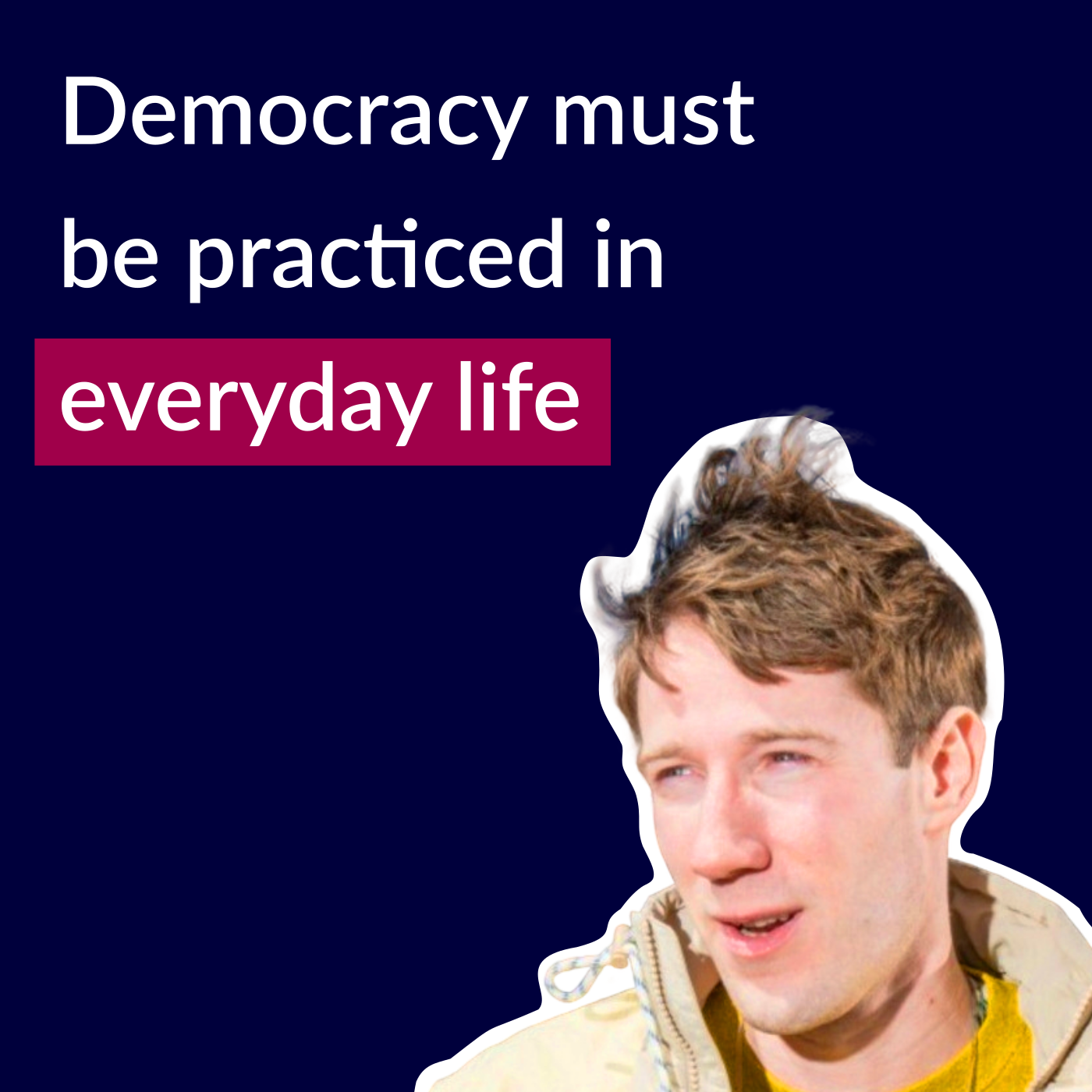
Samuel Vance-Law on how digital transformation gives space to governance innovation
Democracy Innovators | 2026-01-19 | 49:34
Samuel Vance-Law is Senior Researcher at the Decentralization Research Center and excited about governance and blockchain. He sees technology, especially blockchain, as an opportunity for governance innovation that can serve as a sandbox for progress also in our political democracies. In this episode we talked about:
🤖 Why governance is not sexy
🔢 Governance in DAOs and the blockchain space
📕 How to engage people in democracies
⚙️ Why efficiency is not everything
💰 Why we need to think bigger and weirder
💸 Support us with a donation: https://www.paypal.com/ncp/payment/7KCR9XBSCQVMG
Top Keywords
- governance 0.015
- blockchain 0.007
- time 0.005
- democracy 0.005
- daos 0.004
- better 0.004
- decentralization 0.004
- technology 0.004
- efficiency 0.004
- different 0.004
- unsexy 0.004
- incentivized 0.004
Transcript
Speaker 0
0:00 – 0:44
Welcome on another episode of Democracy Innovator podcast, and our guest of today is Samuel Vance Law. So welcome, Samuel, and thank you. Thank you very much, Alessandro. It's great to be here. And, as a first question, I know that you're very mean, I think you are very interested by decentralization. Absolutely. And, I saw on your website that, as, the first phrase, Yavo, what is governance and how does it affect the ways we interact with technology and one another? And, so I know that is, it's it's not an easy question, but, like, what is governance for you?
Speaker 1
0:46 – 3:07
Yeah. I love that this is the starting point for our conversation. Thanks again for having me on. And I think here's here's what I'm gonna start with with governance, which was the start of that question, the start of that whole paragraph, which is, my, my knowledge and interaction with governance as a concept is relatively new, like, the last, say, five or six years. And, when it was described to me first, right, like, how we organize stuff, it sounded incredibly boring. Like, to be honest, it sounded really, really dull. And it turns out that often the very boring sounding things are the most sexy things. I did not know, but now I know. And so when I think about governance, I think specifically, about who owns, runs, controls, specifically controls, for us at the DRC, any particular type of technology, but in general, how we organize society and the ways in which we organize society. And I think for a lot of us, we don't think too much about governance. Like, democracy is a turn up every few years and cast a ballot. Like, that's kind of the extent of the action part of it. And in terms of governance, we like, within even, like, the family unit, right, or at schools or within churches or, in terms of local government and one's engagement with it. Like, those concerns tend to be theoretical at best and completely ignored at worst. And one of the things that's happened because so many people ignore governance is that those who don't have seized a hell of a lot of power. And for us at the DRC, we're mainly focused on, emerging technologies. And that can include the Internet, which is hardly emerging now, but, like, they can include web two, but it's also web three, blockchain, obviously, the newer, wave of AI innovation. And, and the governance of that tends to be extraordinarily centralized and for the for the financial benefit of very few people. And so, that's where our interest in governance is, is who controls these technologies that affect us all, who benefits from them mainly financially. And if we're not happy about that, then I'm not. How do we create better systems for owning and governing, massive corporations for one, but also governing our everyday lives?
Speaker 0
3:08 – 3:16
And this question is even harder than the than the one I asked you. I mean, how do we
Speaker 1
3:17 – 4:15
do we Interesting. Right? I mean, the one thing I wanna say about governance for me at least is there is no answer. There's no right answer. Right? Governance is a constantly emerging interaction between peoples. So there is no, like, stasis that you reach where you go, thank god we governed. And then you just, like, all stop, and it works. Right? Like, governance is a constant set of compromises, negotiations. It fluctuates between jurisdictions, like groups of people, communities, types of organization, types of legal structure. It's an ongoing battle forever. So it's okay if you don't get it straight away. Right? Because you're not supposed to. That's not the point. It's all just about, maintaining an ongoing dialogue with who's in control and why. And so I think, like, that at least already takes a lot of the weight off and the heat off people who are like, but how do we fix it? You go, we don't. We work on it. We engage with it, but we're not looking for the final final fix to this whole thing.
Speaker 0
4:15 – 5:06
Yeah. And I'm thinking how as you said, also in your website, that governance is unsexy. Yeah. And I think how, like, when, you ask to people, like, what you would like to do here or there, they all have ideas. So in some way, they like, to, let's say, say their idea. So govern Yeah. About, I don't know, their neighborhood or, like, inside the the house where to put the television. I'm sure that every person in the family knows the right place where to put the television. Yeah. Yeah. Yeah. But then, yeah, how can it happen in a way that is not, let's say, just one person that decide,
Speaker 1
5:08 – 5:55
this is the But I wanna say having having an opinion is the first step in governance. Right? Like, it is all of its governance. All of it from from ideation to execution, all of that is, governance. Right? And one of the interesting things about that is, like, how does ideation happen? Where does ideation like, where does that opinion come from? And I think when it comes to the web, we and throughout human history, particularly now when we live in these, ecosystems, online ecosystems, the why we ask certain questions and why we don't ask certain questions is as important a part of governance as follow through, because there are a lot of questions that we are incentivized not to ask, and there are a lot of follow throughs that we're incentivized not to follow through on.
Speaker 0
5:57 – 6:50
And I can imagine that, also the question that we don't, ask because we are not incentivized to to ask or or they incentivize, like, incentivized in a negative way. Yeah. Yeah. I think that those could be also interesting contributions, but because, we give, yeah, maybe we not just, sorry. The what I want to say is that, the fact that some questions are not asked, then, it can cause a lot of, loss in the in what could be a sort of collective intelligence process.
Speaker 1
6:51 – 8:36
Absolutely. Absolutely. In a plurality process. Right? Like, the best well, not as there there are all sorts of ways of doing good governance, and it depends on situation. So I don't wanna claim one is the best for all situations. But, the ability to have differing opinions and have those opinions voiced is what makes democracy, at least, as a governance structure work. And if you have a whole bunch of, voices we're we're quite used to the idea of silencing voices. But at the moment, as well as that being a problem, we do have the problem of various opinions, not only not seeing the light, but not even being thought of because they're so far outside of, as you say, what we're incentivized for. We're deincentivized to think about various solutions as being practical or even of interest. One of the one of the histories that I have not got into, but you will know far more than me, which is very exciting, is, the kind of, federalist makeup of of Italy, like, a couple of few 100 years ago and the number of different governance systems that Italy's, like, city states had, and, and how different they could be one from the other, how proud the various city states were of their governance, structures. Like, governance was pretty sexy. The whole history, you will know better than I do, but, we don't have that anymore. We don't have kind of governance models that we stand behind or represent or feel excited about in constant friction with one another. That's that kind of sense of plurality and of interaction just some simply doesn't exist in our our modern world in the same way. And, and I think we're poorer for it because we simply don't have some perspectives and points of view that we should probably have in order to have a fully functioning society.
Speaker 0
8:38 – 9:12
Yeah. Something that, I think about, in the media in the medieval age. Yeah. Like, the, the the towns, they had an interesting thing, at least was interesting to me, like, that, they were basically, like, inviting someone external from the town. Yeah. Govern the town. And then after two months, they were, like, they had a sort of process to see if the town was governed in a correct way or
Speaker 1
9:13 – 9:14
Right. Right.
Speaker 0
9:14 – 9:44
And, yeah. And this, there is a famous, historian professor in Italy, and, he was, comparing those, way of governing, with the one that we have now. Now we look for, like, stability. So, like, we have, like, a government that has to last for five years. Well, back then, it was, like, very short and, with a sort of feedback loop also.
Speaker 1
9:44 – 10:52
Yeah. Well, this is something that, people like Audrey Tang talk about all the time. Your listeners probably know Audrey by now. But, one of the reasons why, we all love DAOs as a concept, if not an execution, is and Audrey says this all the time. You are you can iterate on voting mechanisms all the time. Like, the feedback you get from a four year cycle is every four years you get feedback on the feedback loop. It's not remotely useful for data collection. Whereas in a DAO, if you have votes happening all the time and if you have thousands of DAOs voting all the time, you can collate that data. You can get a way better idea of what works in terms of democratic governance, and in which systems, what works. Like, if you have a bicameral system, for instance, like, what works there across a whole bunch of different use cases. Yeah. The four year system gives you so little, data, with which to figure out if the system's working at all or not. But, yeah, that two month idea is kind of interesting. I don't know if I'd I'd have fun in it, but but you'd get way more feedback way way more quickly about what works, what doesn't, what makes a citizenry happy, what doesn't, etcetera. Yeah.
Speaker 0
10:53 – 11:38
And how do you measure? Like, the let's say, the future of governance, also considering DAOs, if DAOs can be adopted, I don't know, like, can institution also become DAOs? Right. Or, like yeah, I wonder if there if, how do you see it? Like, like, that institution the institution that we have now, decide to also appear on the Webtree. So as a source of parallel Yeah. Or it will be a source of parallel process. Yeah. There are normal institution, DAOs, and at certain point, institutions are become sold that the DAOs become the new institutions. I don't know. Right.
Speaker 1
11:39 – 14:28
Yeah. I mean, one of the one of the things I would like to kind of, go into a little bit, and I this is me personally speaking. I'm not I do not represent necessarily my organization when I say this, nor do I necessarily represent a a broader view. I'm not entirely sure. But I find really I find DAOs extraordinarily interesting because what they suggest is possible, not necessarily what is possible. And I just wanna clarify that a bit. DAO I think the types of experimentation that DAOs enable is something that is possible without, say, blockchain technology. I think it's the new exciting iteration of governance in practice that caught people's attention specifically because of the technology, but has helped revivify, various types of democratic practices, get people interested in various type of democratic practices. But they face, many of the problems that legacy organizations from state governments to co ops have. Right? And one is low voter turnout, for instance. Right? Like, Dow turnout is, I think, on average, around 7% on votes. It might be a little bit higher. I'm not entirely sure, but it's in it's, like, let's say, 10% as a friendly friendly, low. And, and so a lot of the problems that voting systems have had in the past or had now now. I wanna come back to your question, which is what does this look like when it integrates into legacy systems? And one of the things I don't want is for people to think that suddenly legacy systems work or work better or are more responsive. Because if you have low turnout, right, if the if the same problems that plague legacy systems plague, then the outcomes can't be different. And so I think there has to be a longer discussion about incentives as well. I mean, the other thing that, like, DAOs and web three is relatively famous for is, like, tokenizing incentives. And, and it's a system I don't particularly like personally. Once again, I do not speak for my organization here. I I find quantitative and I find metrics based assessment of reputation and trustworthiness, difficult, personally. And so I know this is a roundabout answer to your question, but I I don't think we've necessarily solved for the problems that we would have to solve to make we could a 100%, and it has been done, attach a DAO to a legacy governmental organization and have them operate in tandem. Can be done, has been done. I don't know if it's yet solved many of the problems that we faced in the democratic space outside of Web three or blockchain, for instance. Does that make sense? Was that too long? Was that too strange and long an answer? It it it makes sense.
Speaker 0
14:28 – 15:08
I mean, that, there are the same problems also in the legacy organization or in the Webtree organization. And so it's a sort of cultural problem. And, because many times, I ask to myself why people do not participate Yeah. In the political life. And then, it is the same also in, let's say, maybe inside DAOs. Right. And then I wonder, like, because, actually, people are participating in other things. Mhmm. So I know that, they're also musician.
Speaker 1
15:08 – 15:08
Right. And,
Speaker 0
15:11 – 16:08
and so I'm thinking, like, have you ever had any thoughts related to, like, maybe, I don't know, people like, politics and, maybe is unsexy. Governance is unsexy. Mhmm. But music in some ways is sexy. Like, people want to go to concert. They want to dance. They want to chat about life and, whatever. Yeah. Maybe they also chat about politics. Yeah. So I wonder so they are actually participating in something, this concert. And I wonder, like, if you have any thought about, how maybe because that is a place where people are participating. So I wonder how to bring participation to them instead of asking people to, you know, to use another, platform or, like, to Yeah. Yeah. Yeah.
Speaker 1
16:09 – 24:04
To install a wallet. You're speaking my language, Alessandro. So here's so I'm gonna give you a a if my last answer was roundabout, this one's gonna be even weirder. But I think it's gonna I think it's also gonna make sense. So I think it was, Alexander de Tocqueville who said, if you wanna practice democracy at large scales, you have to practice it at small scales. And I really appreciate that idea that democracy isn't just something that happens on the state level at, you know, millions of people. It has to be practiced in everyday life, and it has to be practiced relatively often. And what that looks like, can be discussed, but it can't be ignored, I don't think. And then I wanted to combine it with something that Nathan Schneider, said to me once. He he works in cooperatives a lot. He works on a lot of things, but he's a he's a co op guy. And, he says he says, looks look at board of directors on big corporations and look at how much they get paid. His point is governance is expensive. Like, if you want like, good governance costs a lot of money. And a lot of the time, we hope that people give up their time and energies for free, not even because like, not even like, oh, and you'll make your world a better place. Just turn up, get shouted down, lose, and please do that for free, by the way. And so I think there is a disconnect between, why we think people should turn up and why people do turn up. Back to dancing, music, clubs, let's go, art. So I've been thinking about this problem very specifically. Right? Like, how do we turn something that people really don't wanna do? It seems. Right? Like, the percentages are just so low, into something that they've practiced doing somewhere else, have become used to, understand, and engage with almost automatically. And, I thought art was a great place to start. Right? If you can get people engaged in democratic art making, then you can get them used to like, we're used to authoritarian systems. Teacher comes in, we sit down, they say stuff for an hour, we get up, we leave. We practice that our entire, like, childhoods and teenage years. We don't practice democracy like that. Right? If we practice that, like, multiple hours per day in every single class we went to, we'd be really freaking good at democracy by the time we left high school. But we leave high school, and then someone's like, oh, by the way, politics or something, vote for whoever your dad votes to for or whatever. And you're like, oh, okay. I get I guess that's it. I guess we've I guess we've learned how to do democracy. It doesn't work. It's one of the weirdest failures of a system that I can imagine, genuinely. So, people engage with art. People love art. People want art now. The extent to which they wanna make art is hard to say. But you can imagine all sorts of art that is, participatory, democratically created. It's hard to imagine, right, like a club dance floor without dancers on it. I mean, we've actually all walked into that club and then walked out because there was nobody there. Right? In some ways, that's already a form of participatory art. Right? We've got dancers, and that might be you. Right? You've already got, like, performers in there. You might even be dancing for someone. He's cute. She's cute. They're cute. Oh my goodness. Alright. Like, you're part of something. You're already part of some participatory artistic community. And what would it look like to formalize that? Right? Like, one of the reasons democracy, can function is because we formalize it. Right? We know when a vote is. We know what the vote's on. We know what happens once the vote has been passed. And you could do this not even necessarily through blockchain, but technologically to a certain extent. I imagine, and I'm just throwing this out as a really quick example. On a dance floor, when everybody puts their hands up, there's like a laser reader at a certain height that checks how many hands are in the air. And that does something with, I don't know, a smoke machine or, like, the lights or volume level on the thing. The DJ gets feedback at that point, and there's, like, a feedback loop. That is participatory art. Is it democracy yet? But it's, like, it's participatory. Another thing you can imagine this answer is gonna take a while, Alessandro. So sorry about that. Another thing you can imagine is, like, at the moment when I, create a piece of music, I think of something as the lone genius. Right? Right? Like, genius is always so low. It's never like a whole bunch of geniuses came up with something. It's always like someone alone in their attic, probably poor, and they come up with something real clever, show the world. But, like, changing that format, what if a a whole bunch of people came together, say twenty, fifty, a 100 people, and, instead of sitting down at a piano where I play, say, a c and someone else plays a g and you hear the notes g and c, I played a c, they played a g, and you heard the note e, right, which is the note between them. Now that note e doesn't exist when I play the g and it doesn't exist when they play the c, but when we both play, you end up with that note. Now you can imagine a whole bunch of people at digital keyboards playing a whole bunch of different notes, and then you have an average. And once again, that average would not exist without the community like, the entire community giving that input. And that can be up to, you know, an infinite number of people giving input. But, that would be a form of actual communal and democratic music making, for instance. You would always end up with a note in the middle. Like, the more people you've got, the more it would move toward the mean, so it would sound really dull. Right? But you could make it happen. And, anyway, I could go on about various different ways of making this happen for a while. It's something I've been thinking about a lot. It turns out very few people are interested because I've talked to quite a few people about this. I've applied for grants based on this, these types of concepts. I've, raised them with musicians. I've raised them with technologists. I've raised them with academics, and absolutely nobody is interested. And it's not that people so, Medigov, for instance. Medigov has a really interesting experiment going on right now in terms of, more collaborative slash democratically created art, and and I we'll see what happens, with that. I think the idea is that there are three people I think got chosen to be a team, and they build an architecture and idea around, collaborative piece of art that will be available for the public to work on. So that so when I say nobody's interested, there are a few people interested. Primavera de Felipe is also well known for making art that is interactive, and and, obviously, there are all sorts of NFT experiments where you can interact and create art. Almost none of them are democratic, though. Like, they're collaborative, but they're not democratic in the way that we think of governance, say, being a democratic decision making process. Right? Like, an outcome that is not the specific outcome that everybody wanted, but is the collective response to a problem or whatever, the decision making process was. It's really hard to gain traction. We live sadly in a time that is deeply uninterested in democracy in general, and it's very hard to gain traction on an idea that on the right has lost, impetus anyway because, authoritarianism is in. Right? And on the left has lost trust. And so I feel as if we live in a bad time for thinking about, truly democratic governance models. We live in a great time for talking about governance. But engagement is really hard to come by right now, I find. And and I would love it if your listeners right now are shouting at whatever they're listening on. I'd be like, no. That's not true. We're doing it. We're making it happen. Like, share it with the world, however you do that. Write me an email, whatever it is, because, my world is very, very, has very, very few examples of that type of work happening. Anyway, that's my long and winding answer to the question, how do you bring people in engagement? I've been finding it hard. But there are some ideas, and if anybody wants to run with them, feel free.
Speaker 0
24:06 – 24:18
I mean, I totally agree with you that it's hard and, also, that we are not used. I mean, formally, we have democracy, but then we are not used to exercise our power.
Speaker 1
24:18 – 24:19
Right.
Speaker 0
24:20 – 25:13
And I saw it, many times also. And this was something that when I was a teenager, I remember that also in high school, sometimes the I have heard from professor, like, this is not a democracy. Like, when they were talking about if to open the door or to the windows. Yeah. Yeah. Something like that. And, also about this, like, during my master, I remember that, I asked to the professor if we could have, if he could, do the the break Yeah. The at the middle of the lesson. And, there was a very short, rotation. Yeah. And then, that was in favor of the break. Yeah. And then, he said, but we are not in a democracy. And so
Speaker 1
25:14 – 25:18
They're like, then why vote? Yeah. And the It's a sham election, my friend.
Speaker 0
25:19 – 26:06
Yeah. And then, I I was like, we are not not democracy. I mean, I agree. I can agree, like, if we think about the ancient democracy representative. Right. It was more direct, and this is not direct. Yeah. This is representative. And so I I went to the mayor, and I interviewed the mayor, like, asking him, like, is it true? Like, can a professor decide if the windows has has to stay open or closed? And, he said that, actually, he cannot decide. But Right. Because there is no power, like, from the state. Like, if the state is the entity that does the monopoly of violence, it gives the power to professor to evaluate students
Speaker 1
26:06 – 27:29
not to decide if the window's access. Window is open or closed. Yeah. Yeah. Yeah. Absolutely. And I think that's also how, like, how like, coming back to one of your initial questions where you talked about what is governance. Right? Like, and why is it unsexy, but, like, why do we need it? It's knowing those differences. It's really important to know where power is being exercised and where you are self where you're in your own panopticon. Right? Like, self controlling ourself, but, like, based on fear of power, but where you're, fully within your rights to go open a window, and yet you don't know you are and don't think you are. Right? We need to know when the system is working in whatever way it's working. We need to know when it's not. Specifically, so that, number one, we can exercise our rights outside of that, hierarchy. And number two, so we know if the system is working or not. If I think that something is happening that is the fault of the man and it has not like, nothing to do with the man in a formal sense, that's a really good thing to know. And then if I think that something is happening that is bad and it turns out that's the one stream of power that we're dealing with and it is the terrible thing, that's really, really useful to know. Right? So, yeah, we need to know when we're practicing, and when we're not. We need to know what that what the boundaries of that control is, kind of at all times, at the best in the best and final analysis.
Speaker 0
27:32 – 27:53
And, maybe this could be a question also related to your background, personal, professional, academic, whatever. And also when, you realize that, maybe technology can help in, can be helpful for governance purposes and decentralization.
Speaker 1
27:54 – 29:26
Yeah. I mean, here's here's I'd see this the other way around a little bit. Right? And the way I see this the other way around is not that technology is, it can be helpful, but not that technology is helpful. It's that technology is the frontier in which, there is the most ability and excitement to experiment with other types of governance models. If you turn up at, like, I don't know, your German state government and say, hey. We're gonna be employing blockchain right now to run this place. They're gonna say, no. You're not. There's already a system set up, and they like it. Thank you very much. And there's probably really good reasons why they like it. I don't think we should tear down all systems, just to replace them with whatever we've come up most recently with. But because these, technology shifts and move so quickly and is in such a state of flux in development, that's where you have enough gaps to experiment, to create sandboxes, to try out different ideas, to build technological responses to current problems that may or may not work, but are different than the status quo. And so for me, the excitement's the other way around. It's not that, blockchain technology enables a certain type of governance practice, which it sure does. But, like, more that governance practices can find in blockchain, a new form of expression that might lead to a different way that we can organize at least our digital worlds. And since our digital worlds are interwoven with and inextricable from our physical worlds, our physical worlds. Yeah.
Speaker 0
29:29 – 29:57
I was thinking about a recent recent interview. He's an expert of, cryptography and security, and, he's a Bruce Schneier. I and he said, like, everything that can that is using blockchain can be done also without blockchain. Yes. And they're way better. And,
Speaker 1
29:58 – 31:18
Yeah. I mean, the I would the one thing that I okay. So I semi agree. One of the things that I I do think is that there are things that are more self evident with blockchain than are with other technologies. There are things that lend I don't think blockchain's a neutral technology by any stretch of the imagination, but it lends itself, to certain applications better than some other things do or more self evidently than other things do. As he says, there might be things that do it better, actually. Right? But there are always trade offs with what you mean by better. Right? Like, what are we what are we, optimizing for under that better? And so, yeah. But I I do think it's really important. One of the things I wanna stress is that blockchain is really can be really used, like or different parts of blockchain application could be really useful, case studies for governance. But it is not the be all and end all of governance. Like, it's not like and then blockchain ends and governance ends. All of the things we're talking about that, say, manifest in DAOs are things that can manifest in all sorts of other systems, including, like, hanging out in your reggae, like your, shared living space with seven people or whatever. Right? Like, those governance principles can be put in place and are often put in place better within, say, a seven person living, situation, than are in any digital space.
Speaker 0
31:21 – 32:01
And, I think because, also, maybe it changes a lot, when we say blockchain, maybe one person think a lot about the technical aspect. Mhmm. Maybe the other person see more the social, political aspect. And, like, personally, I see, I agree with what you said about, like, the technology create, like, a sort of the cyberspace is a is a a good space where to test new Yeah. Kind of, governance systems. And, I saw blockchain as something that could potentially, decentralized power.
Speaker 1
32:02 – 32:02
Mhmm.
Speaker 0
32:03 – 32:24
But still there is a sort of concentration of power, because maybe, related to the different kind of proof of system. Yeah. Proof of work, that, if you have a lot of, computational power, you can have more power in the network.
Speaker 1
32:24 – 33:16
Yeah. Proof of work, proof of stake, both of them have their concentrations of power problems. I mean, blockchain in general has its concentration of power problems. What I love is that it's, it's and and this isn't talking about crypto in general. Right? Especially not, DeFi. But the block the one thing I love about blockchain community in general, like, on the side that thinks about these things and cares about more than pump and dump schemes, is, they think about governance, and they notice these things, and they care. That's actually quite rare for people to actually notice and care about organizational problems, of those type. No. Absolutely. Like, recentralization, centralization problems all over the place. But how cool is it that we notice that? How cool is it that we're talking about it as opposed to just going, oh, no. It's the status quo, whatever. That's already a way better starting point than, apathy, for instance.
Speaker 0
33:19 – 34:26
And, I, so I saw that, maybe I'm wrong. I don't know. Usually, people that are interested in politics are people that came from, humanistic studies, probably philosophy, history, political science, also art, also science sometimes. Mhmm. And, while, with technology, what happened is that there was a sort of, like, blockchain is not neutral, as you said. There is some political, thoughts, behind blockchain Yeah. System and behind the centralization. So I saw that, sometimes technical people also maybe without having, like, the the culture related to governance and other things can see that the centralization can be bad, because you can see, I don't know, CloudFlare, is down and all the Internet is, is stuck.
Speaker 1
34:26 – 38:10
Yeah. I think one of the things that I find interesting about a lot of, a lot of the discussions and one of the things that I kind of like about the concept, like, Glenn Vile and Audrey Tang's plurality concept, which, like, you don't have to take in the specific, but I appreciate in the general, certainly, is it's not that centralization is, always bad. Right? And it's not that decentralization is always good. But it is that we live specifically and particularly in digital systems that are almost always, certainly when it comes to control and power, centralized. Right? We don't have that many alternatives. And it'd be wonderful if we wonderful if we had a multiplicity of alternatives that for each use case could offer various different, like, pros and cons. And, you know, I think I think one of the other things, and this I think about, specifically and particularly when it comes to, like, the AI race right now, We're often optimizing for efficiency, when we talk about optimizing. You were talking about better when you're when you're talking to Bruce Snyder, and he said it's always better. Right? Or it often is better. And you go, well, what is this better? Often, people will talk to me and they're they're thinking of, efficiency. Efficiency is often terrible. It's really, really bad. The the easiest example, which is a wonderful game, it's a museum piece game, as in you play it once and then you know it, you can't play it again. But it's like you know those railroad games in, like, in North America where you build a railroad and you have to you've laid down tracks and you own stations and stuff like that? It's one of those, but it's for Europe. And you get points for laying tracks the most efficiently between various different points. And after a while, if you're at all historically awake, you realize that you're building a rail network to take Jews, gays, priests, the disabled, and the politically averse, to Nazi ideology to concentration camps. You're building the concentration camp rail network. And you have been incentivized for efficiency. And the question is, of course, do you keep playing and win, or do you stop playing? And I think, it's a it's a it's obviously a stark example. It's obviously an example that doesn't in terms of the evils that can be, coming from, efficiency. It's obviously not gonna be comparable to a whole bunch of different use cases or or things that we might be talking about right now. But it for me, it's the perfect example to show you that efficiency is not always good. And, decentralized systems can often be less efficient. I think that can often be better. Right? Like, if it's if efficiency isn't always good, then we can start thinking about, well, when is inefficiency a really useful thing to have? Is it useful when it helps with security? Is it useful when it helps with more equal ownership and governance? At what point like, what are the what are the balances that we want? Where do we wanna place efficiency in our rank ordering of priorities? And, that takes a much longer conversation around what our priorities for various technologies and various uses of technologies are. But I think we have to be having those conversations a lot more often because when it comes to I think a lot of technologists that I know, and I know a lot of engaged political, interesting, smart technologists. But most of their training was around how do you solve a problem quickly and well. And that's not necessarily, when it comes to governance, what you want. It just isn't.
Speaker 0
38:14 – 38:43
There are no, quick ways. And I think he, like, I was reading some of your papers. Like, there was a paragraph about the danger of government centralized approach to identity. Oh, yeah. In some ways, related also to efficiency. Because we all want to not log in on all different platforms Yeah. At the same time.
Speaker 1
38:46 – 39:48
I mean, we want our lives to be as easy as possible. We're in we're we're also incentivized in a world that that measures time as money. We're also incentivized to move quickly, optimize, become more efficient. And, yeah, we don't wanna be doing all these things nor do states want to be dealing with the hassle, of, a decentralized system. The problem is that the dangers of centralized systems, specifically when it comes to, say, something like digital ID, are so well documented. Right? But we'll go with convenience instead of history, time and time again, it seems. And it's a it's a frustrating it comes back to kind of that education side, right, which is when my understanding of my interaction with technology is how convenient is it, and that's the one and only question I ask, then we we're missing all the important questions about using any, piece of technology.
Speaker 0
39:51 – 40:10
Absolutely. And, so would you say that you are optimistic or pessimistic in a short time, long time? Because, as you say, like, we choose the efficiency Yeah. Instead of history. Because, also, history is unsexy.
Speaker 1
40:11 – 44:57
We have to say this. Oh, yeah. It's sexier than governance, but it is it's also unsexy. It's and it's inconvenient. I think that's the thing. It's inconvenient. It's a it's a real I feel like this is a a baby another side rant thing. But, you know, the Oracle of Delphi didn't actually predict the future, and throwing bones didn't actually predict the future. And and now we're like, PolyMarkets gonna definitely predict the future. And you're like, team, we haven't done it yet. We're not gonna do it now. Right? Like, bringing a new technology to bear, getting a different animal's bones, slitting a different animal's stomach open is not gonna help us, like, figure out the future. And I think we're looking for technological solutions to unsolvable problems. Rather than looking at the historical dangers that have been proven and attempting to solve for them. And it's I find that deeply, deeply frustrating. We look at his we refuse to look at history to learn for the things that haven't worked and replicate that. But we also, while replicating that, refuse to look at the downsides that have also been proved through history. And, that's a personal frustration about bear of mind. But, yeah, one of the things I'm I'm in terms of my own personal opinion, I feel look. Here's what here's what we're gonna do as an organization, and here's what I'm gonna do as a person. I'm gonna work hard. I'm gonna put in the time. I'm gonna be full of optimism because to live otherwise is perhaps no great life from from my own perspective. I am not a nihilist nor am I interested in it. As a rational thinker who is engaged with these issues on a daily basis, I am deeply pessimistic about the chances for the success of many of the I if you look at, say, even just blockchain, and you look at the, like, the whole thing. Right? The amount of money that is generated, the amount of turnover that is generated from scams, North Korean hackers, pump and dump schemes, Trump meme coins, right, like, far outweighs the decentralized ethical folk. And that's, like, that's the promising side of technology. I I so I don't think it's, like it's not even pessimism, which is a, like, a suggestion that we're looking forward in assessing the future. We live in a reality right now in which, our side has been losing for a very long time. That's okay. That's fine. We gotta keep on doing the work. But this isn't like I often find I'll be at a conference and someone will say we're at a tipping point or we're at a turning point. Right? It's now or never. And I'm like, no. Now or never was, like, fifty years ago minimum. Post second World War, probably. The building of the Internet, probably. We lost to then. That's okay. Let's keep on trying. Let's see if we can build even spaces, digital spaces, if not the entire infrastructure of, community, decentralization, equitable ownership, and governance, and see what those experiments look like and live in them, perhaps, even if they're small, even if it's not the main system. Let's do all that. It's not even pessimism to say that, things are not looking good right now. Things just aren't looking good right now. But I don't think that matters in terms of what we do next. I think what we do next is I wanted it just briefly, and this is for listeners may be interesting. I don't know, but I used to be someone who is quite, idealistic. One of the reasons why I'm a musician is you can quite easily choose to do mainly good. Right? Like, if you make music and you are speaking to someone about something, you can really, give a hun like, your your ability to be idealistic in that situation can be at a 100%, and you can get it out there. Right? Songs do it all the time. You're the best. Simply the best. Better than all the rest. Right? Like, you're right. Like, you can put it out there. 100%. And when you get down to the work, especially of governance, but especially of governance right now, it is always incremental. It's always a fight, and most of the time, you lose. And a lot of the time, we think about, moving the needle. It's not about creating a whole brand new world right now. It's about making sure that a different world that is better is more and more available, more and more possible. And if we can move that needle a little bit kind of every day toward that future, then I think it's worth it.
Speaker 0
45:03 – 45:17
You mentioned, a couple of times your, organization that I haven't asked you questions. So I'll do it now about the the decentralized research center. So if you want to tell us something.
Speaker 1
45:18 – 47:25
Yeah. Absolutely. Well, I'll I'll be quick about it, only because, some of my some of the things that I say are really based on my research and based on this think tank, and so are very much aligned with the think tank. And then some things are like personal opinions that are not necessarily aligned. The DRC, the decentralization research center, is, the place that really got me turned on to governance, got me excited about governance, and where I've been working on governance in emerging technologies for the last few years. It is a nonprofit organization, that advocates for decent the decentralized, ownership and governance of emerging technologies and really focus on, blockchain mainly at the moment, and specifically around control. Right? So it's it's kind of difficult sometimes to say what is decentralization. You talked earlier about, like, proof of stake and decentralization there. You can have physical, decentralized, and architectural, governance, technical, etcetera. And, one of the things we've really wanted to do is is and it's really hard for policymakers in a policy context. Right? You turn up and say, we'd like decentralization. They say, well, what does the law look like that enables that? And you go, this is more something for something. It's really difficult. And so we've come up with, some control tests for decentralization so the policy makers and, regulators can see where where a system is more or less decentralized, create sandboxes for very similar organizations that are working towards decentralization and attempt to, change in ways both big and small, US regulatory and compliance, rules to allow more decentralized, blockchain based organizations to flourish as best possible. And that can be DAOs or whatever else. And so, that's the organization. We work outside of blockchain as well. We've worked on data co ops. We're doing work on decentralized AI. But we're trying to be a kind of full stack enterprise that goes all the way from research on one end to advocacy on the hill, particularly, in The US on the other side, to try to make decentralization more of a reality than it currently is.
Speaker 0
47:28 – 47:47
Thank you, Summer. And, usually, the last question is, like, a message for the people that are working on similar things. Like, but I think that in some way you already sent a message, but I don't know if you want to say something else. I love it.
Speaker 1
47:49 – 49:21
Oh, okay. Yeah. I'll say a couple of things because I think they're important. The first is that I love I think we need wilder thinking. I think we need bigger thinking. I think we need weirder thinking. I think we live in an incredibly restricted age when it comes to thought. And I think whatever we're working on, whatever you're working on, think one step bigger. You can always pull it back in the edit. Right? Like, you can always come back when you're getting the master's thesis ready and or, like, the project ready or the art proposal ready or whatever. You can always pull it back. But I think the risk is that we're thinking too small rather than that we're thinking too big. And I and I'm I tried to do that in my everyday life as well, and I fail most of the time, because it's actually quite a hard thing to do. But I do I if I were to bump into anybody working on stuff like this, what I would want is an idea that was a little too big and then to figure out what to do with that rather than another idea that's a little too small. Once again, it's fine if that's where it ends up. Right? Like, especially if you're working on regulation or legislation, by the time the bill is passed, it's gone through dozens of hands. It's gone through dozens of compromises. But that doesn't have to be your first step. Your first step doesn't have to be self censorship. Get big first. Other people will censor you later, or you'll, like, edit your work later. And I'm excited by anybody who does that. That's that's what personally excites me about this space and what I wanna see, going forward a lot more. I'm very excited about that.
Speaker 0
49:22 – 49:29
Thank you. And, I think that failing is also the key of success. So I'm glad I'm glad you agree with me. Yeah.
Speaker 1
49:30 – 49:33
So thank you very much for this. Thank you for your time. This is very fun.