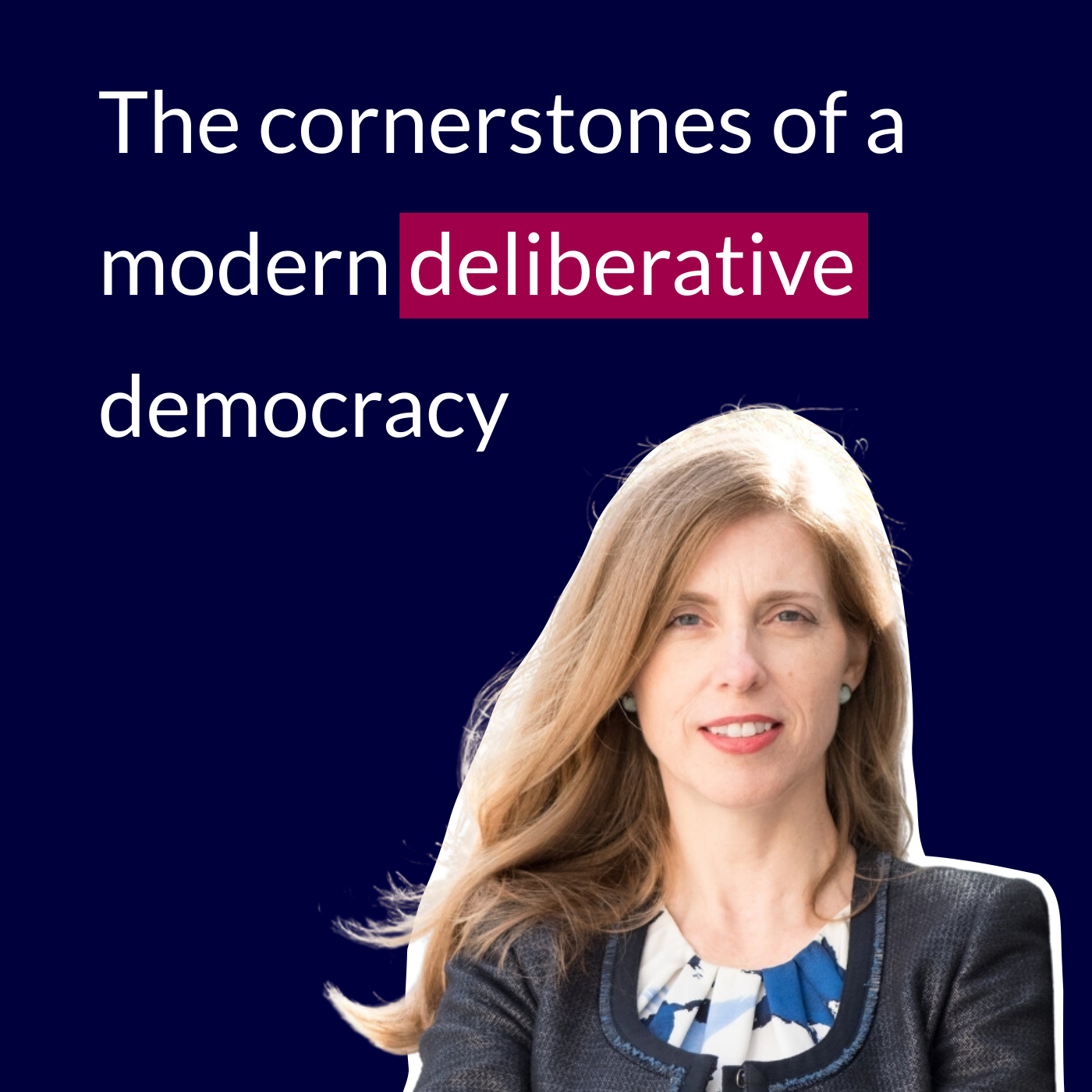
Hélène Landemore about deliberative democracy, citizens' assemblies and the future of democracy
Democracy Innovators | 2026-03-03 | 51:52
Political theorist Helene Landemore joins us to explore what democracy could look like in the age of AI. We discuss citizens’ assemblies, sortition, digital participation, global governance, and how democratic systems can transition toward more inclusive, deliberative, and future-ready institutions.
Top Keywords
- democracy 0.010
- assembly 0.009
- assemblies 0.009
- citizens 0.007
- mean 0.006
- selected 0.005
- elections 0.004
- well 0.004
- assisted dying 0.004
- governance 0.004
- even 0.004
- french 0.004
Transcript
Speaker 0
0:00 – 0:09
Welcome to another episode of the Democracy Innovator podcast, and our guest of today is Ellen Landemore. Thank you for your Hi, Alessandro.
Speaker 1
0:10 – 0:11
Nice to be here.
Speaker 0
0:12 – 0:24
And, I mean, you're working with, the intersection of, I don't know, politics and philosophy. How would you define it?
Speaker 1
0:24 – 0:52
And you Technically, I'm a political theorist. So I I work in, you know, a subfield of political science that looks at, the history of political philosophy, the concepts that are used in political science, like, you know, sovereignty, equality, freedom, things like that, legitimacy. And so I'm a I'm a bit of a social scientist as well, you could say, but I was trained mostly in political philosophy.
Speaker 0
0:55 – 0:59
And, also the intersection with technology, if I'm right.
Speaker 1
1:00 – 1:41
Yes. It's it's more recent. I have developed an interest in, artificial intelligence. Not as an expert, I would say, of the, you know, the technology itself, more as a as a user, as a person, you know, as a citizen concerned about its implications for democracy and for, generally, the the the the freedom of human beings, and but also, an optimist about the potential of this technology to augment our capacity capacities for for connection, mobilization of knowledge, and and generally, improvement of the epistemic properties of democracy, which was my initial field of research.
Speaker 0
1:42 – 2:06
And how do you think that it it can improve democracy? Like like, I also have a lot I don't know. A lot of trust, but maybe trust is not the right word to use, because I see how technology could help, people, could empower them. I wonder, like, in your own, vision, how it will do
Speaker 1
2:07 – 4:06
it. Well, I guess, I'm an optimist by nature. It's one thing. But the other thing is that my my early work was on, as I said, the the epistemic properties of democracy, which means simply the knowledge aggregating, knowledge producing properties of our, democratic institutions like deliberation and majority rule and other things we we think are, core to democratic practices and and even norms. And so it's kind of natural that I would think that a tool that is supposed to, build on human collective intelligence to, you know, all the data we generate, all the connections we've established, all the texts we've produced to to to generate an even higher form of intelligence, would be a good thing. I mean, I I just think that, artificial intelligence, it is artificial, but, fundamentally, it is human at the beginning, at at the root. So as long as we keep it under human governance, which, of course, is the difficult piece in in all of this, I think it can be a force for good and a and a way to connect us more more closely, solve problems for us, make possible a vision of democracy that I think would be, you know, difficult to implement without these kind of tools because you need to aggregate data at a very mass scale. You need to, you know, again, connect people at the mass scales if we want to have global governance institutions, things like that. I don't see how you do that sustainably without this kind of technology. So it's good news in a way. It comes at the right time. But I but I do worry that we we didn't put in place the dams, you know, the the institutional checks and balances and the governance structure. We need to to channel that sort of technological breakthrough for the greater good rather than the enrichment of a few people at the top.
Speaker 0
4:08 – 4:51
And, I mean, regarding democracy, what is, I mean, there are what could be several things that can be, let's say, fixed? So, like, for you, what is, like, something that is problematic? I mean, like, now we talk about democracy, but then it's representative democracy. So it works in a certain way, not, I mean, people can vote, but, then they're sort of inactive or passive for many years. I don't know. Is this something that, like, what is for you democracy and what is, what can be fixed and should be fixed about democracy?
Speaker 1
4:53 – 11:48
So so for me, democracy, it's, you know, people's power. So it's exercise of power by everyone, if not at once, at least in turn. And so that means that it cannot be just what we have right now, which is consent to power by others every few years, which is its own form of power, you might say. But it's very, very minimal, and I think it's too minimal for, you know, the for our given given our expectations about what democracy should be. So so I think the current system, the problem is it is that it's not sufficiently democratic. There's not enough democratic power in it. It's power exercised by elites that are selected by electrons. And I think the fact that these elites are demographically too different from the rest of the people makes them more likely to make mistakes, makes them more likely to have blind spots, make them more likely to lose sight of the common good and become a corporate class with its own interests. So that, you know, even with the people, the the the most well intentioned people at the top, you still do not get the kind of good governance that democracy is supposed to be the promise of. So my view is that we should reform our institutions to create spaces at the very least for ordinary people to exercise a real kind of power, which for me would be the legislative power. And at the very least, some kind of agenda setting power for the for the, you know, program that, politicians would then legislate on. So how you do that? Well, if we could start from scratch, I would not design institutions the way they are designed currently. I would just not start from elections. I would just not use elections at all. I would follow the opinion model, just, you know, scaled and adapted to modern circumstances and augmented with technologies. So I would have a large randomly selected legislature of maybe 600, 700, randomly selected people who deliberate for months and set up an agenda for the country. You know? And then, put this program to a referendum with maybe some key issues made more salient because they're more controversial and more likely to be perhaps rejected. And you would have, like, local, debates about this, etcetera. You would you would create a sort of, like, permanent feedback loop between the people at the top and the and the people in the larger public. And conversely, I think the agenda of that assembly, which because someone somebody needs to sit down and and spend hours poring over, you know, the complex problems we're facing and come up with proposals, that that's not something you do through a referendum. In a referendum, you you you there's a a question that's asked that you cannot shape. And so referenda are not the proper tools to to set an agenda and formulate proposals. But I would say even that assembly that has an agenda setting power should be informed and and base its work on the larger input of the larger public. Right? So through crowdsourcing techniques, through data sensing tools that could be deployed, through, a constant, you know, circular process of iteration that makes sure that you you get upstream of the deliberation of this agenda setting assembly as much information as possible. Midstream, you also get feedback, and downstream, you get feedback. And so at some point, you know, there's always this question of, okay, but do you really want this small group of even 600 people making the loss for us without any kind of accountability? But I think if the process is iterative enough and, you know, you have referenda attached to the key decisions and and consultation, you know, constantly, I don't think that you're at as much risk of losing sight of of the common interest that than we are in this sort of, much less, iterated system of, well, we elect people every few years, and then we completely lose control for for, you know, you know, for for years and and then only recuperate the control of kicking them out, but not really swaying necessarily the the direction of, of policymaking that much. So so that's that's a vision that I laid out in, in my book Open Democracy. It was, you know, very abstract and academic in a way, so I I although I did rely on examples from Iceland, which in 2010 had a really interesting constitutional process that was inclusive in that way, that was based on the recommendations of a forum of 950 randomly selected people that, you know, excluded politicians from from the council that wrote the the the new constitution, that used crowdsourcing techniques to bring in the wisdom of the larger public, that had a referendum downstream that approved, the the new constitution, etcetera. So it was very inspiring, and I put that in the book. But I also looked at the French citizens convention on climate that, president Macron convened in France in two thousand nineteen, twenty. Also very inspiring, a sort of quasi legislature, really, that was at the at the at the root of one of our most ambitious climate bill later, the one passed by parliament. But I still in that book, it was still a little, academic, I would say, because I was really focused on on rethinking the concept of representation, trying to detach it from elections and saying, look. Representation can be performed by different types of people. You know? It's just the act of speaking and acting on behalf of other people. So this can be done by elected officials, but it can also be done by randomly selected people or appointed people for that matter or, you know, self selected people. It's it's there's nothing mysterious about representation that means that only elected officials can do it. And I just argued that if these people who do it based on lot do it, it's likely to be actually better and and more accurate in tracking the preferences of the larger group just in virtue of the fact that they look and think like the rest of the public because they are demographically similar. So that was, like, the main argument. And and so in the recent book, Politics Without Politicians, that just came out, I tried to basically turn this into storytelling, rather than abstract arguments and and really root everything in the observation of the citizens conventions, in France, including one I co governed on on end of life issues. So that's I guess, that's a very long way of answering your question about, yeah, democracy.
Speaker 0
11:49 – 12:32
No. I I I had a lot of thoughts when, while you were speaking, like, changed the way of representation, how people represent other people. So I was thinking also about a possible change, in the party. So not just left or right. So the person that is elected is representing, I don't know, other leftist parties or a party from the right, but maybe could be topic related. I don't know. And then also, I have a sort of question. When you are talking about, let's say, permanent assembly of, I don't know, 600, 700 people, why not more? If there is a reason Yeah.
Speaker 1
12:32 – 14:10
Why not more? Because it's roughly the the average size of parliament around the world. So I think, historically, we've we seem to have, evolved a size that sort of works, logistically. Although the Italian parliament, I mean, I I I'm guessing you are Italian or, yes. Well so apparently, it's the largest one in in, in the world. It's it has over, I mean, a thousand people. So you could go there. I mean, I I imagine that if we if we created a global parliament at the, you know, scale of Earth, really, I would want a thousand people because, you know, that that that symbolically almost it's like the minimum number of people you think could legitimately speak on on in, on behalf of an of the entire planet. Although statistics is funny that way. You don't necessarily need that many more to have a sufficiently demographically representative group. So, I know, the broad the broad categories, you know, gender, geography, etcetera, language. You you you could do a lot with, even just a sample of a thousand, and I just assume that a thousand is already quite a size to to manage, to create connections amongst, to to have meaningful deliberation amongst, in plenaries. You know, this it gets really unwieldy past a certain threshold. There are sort of physical and cognitive limitations. But who knows? Maybe even larger would be feasible. I I just think maybe there are some constraints and and, con constants across human history that I I'm trying to stay close to, and 600 sounds like a good size to me.
Speaker 0
14:12 – 15:39
Yeah. Actually and I I was thinking that, you know, we also like, politicians are also very well paid compared to other countries. Yeah. And and and about the number, because I was thinking, like, with technology so technology now could also enable a sort of direct democracy. Well, as an example, the fact of, extracting extracting people and sort of building, basically, it will be like a, like, it is now with the parliament, but instead of people that are elected, people will be just, randomly selected. Based on different, not properties, based on different, like, I don't know if someone is poor, rich, so based on the class, on the gender, and so on. And so I wonder, like, before I was talking about maybe more people than 600, because, like, as I look say, politics without politicians or at the same time could do, like, a sort of, I don't know, cities without citizens. Like, I mean, citizens that are also participate in the political life. So it there will be this mix between politicians and and citizens.
Speaker 1
15:42 – 19:30
So I'm not sure I completely understood, but what I would say is that I really wanna insist that for me, I'm not talking about mass direct legislation, which is, kind of, like, somewhat feasible. I mean, you can do it. In Switzerland, they have that. They at the constitutional level, at the federation level, actually, they you can have a small group of people who get together and gather enough signatures to support a particular constitutional reform or amendment. And then if it's I don't exactly remember, but if if it's not, countered by parliament with a better version that's accepted, it goes straight to a referendum. And if it's accepted in the referendum, it is directly a law. It is it's it transforms the the the Swiss constitution. So you could say that's a form of direct legislation by the masses. But notice that still someone has to formulate the proposal as to write down the law, and this cannot be done in the millions. It's gotta be a subgroup, and this subgroup in this particular example will be self selected. And I think it's fine for some things, but I don't think self selection is always good. In fact, it's sometimes very bad. It it has the same sort of inegalitarian implications as, elections do because elections, you know, are also very unrepresentative in terms of who they who they send to power. So since I'm a little skeptical about both self selection and elections, I tend to prefer the the random selection process because at least you get a a purely egalitarian distribution of of the task of thinking through, deliberating, and writing the law proposal. And then you can have a moment of direct mass democracy where absolutely everybody is involved in thinking about the proposal or the the set of proposals or the bundle of proposals and then vote on it. So for me, what I'm offering is often confused as a form of direct democracy, but really really it's not. Unless by direct democracy, you mean rule by ordinary citizen. Okay. Fine. But that's not what people mean. It mean they usually mean rule by a subset, that is chosen a certain way. And I think I also want rule by a subset chosen a certain way. It just happens not to be the way of elections. It's random selection. So my model, I I don't know if I were to describe it. I would say it's more like semi direct democracy, but it's semi representative, except it's representative by lot, not by elections. So you have moments where only a subset really is at work. With with the consent, of course, of the larger group, I don't imagine the, you know, you know, institutionalizing something like that without a a moment of constitutional approval by the entire population, of course. But they delegate that task because not everybody can be involved in politics all the time. I think that's, like, a myth. Even the Greeks didn't do that. Not you cannot. Physically, very difficult. We have lives to live and and money to make and, you know, pursuits that are our own. And so, yeah, there needs to be a division of labor. But somehow, since the eighteenth century, we've convinced ourselves that this division of labor needs to be to the benefit of a small class of people who stay in power very long, who sometimes, you know, trans transmit the the the senator seat to their children, and just die on the job rather than let go. And I don't think that's very good. Maybe it's better than what came before. It's better than actual dynasties or actual, you know, absolute monarchies, all of that, but it's still not as close to to democracy as it should. So, I'm just trying to push us in a in a slightly, more democratic direction.
Speaker 0
19:31 – 20:22
And very interesting. And how do you think it can be tried, this model, like, in an unapplied way? So could be because a lot of times, I think about the five star movement in Italy, but also other kind of experiment where they're trying they tried, like, leaving the system as it was to bring something new. So in that case, it was, an external platform, that had but was not perfect also there. So I really like, to try this new model. Should, like, a country to switch all the system to this new model, or or there could be a way to test it without changing all the everything?
Speaker 1
20:24 – 25:59
Well, yes. Of course. I I wouldn't wanna switch over brutally to this new system. I don't think there's enough, you know I think it's never a good idea to to change an entire system for something that is still mostly theoretical. So, obviously, no. My job is to come up with series, but, of course, I think my job and other people's job is also to test those theories and try to to tweak them and and make them better until we can sort of safely engage in in in more radical reforms. That said, I I just wanna say that, look, when, the French and American revolutions happened, they they kind of jumped into the unknown. And maybe if we continue on this trajectory, we'll reach the point where our systems break down, and we'll have to try something. And when that time comes, if it comes, it's good to have at least some theories as to what to do. And and when the founders, you know, created the American Constitution, it's not like they had a a blueprint that they could rely on or or, you know, they they they borrowed from the Roman Republic example. They purposely did not borrow from Athenian democracy, actually, which I think was a mistake. But, you know, they they came up with a hybrid regime that they felt would be a republic with oligarchic, monarchic, and and and democratic principles countering each other. I mean, they were very creative, but they did it's not like they had much opportunity to test run it before. So okay. So let's say we wanna be a bit more safe because in the American context, it worked quite well. They still have their constitution. In the French context, it didn't do that well. It collapsed instantly. It was we've had, I don't know how many constitutions at this point, five I guess. And, and, I mean, five republics, sorry, and many more, you know, constitutions in between, including, you know, imperial ones. So so it's true. We need to test. Okay. So how can we do that? I think we can do it at the local level. So for example, in the speaking the German speaking region of Belgium, they've implemented, a permanent institutionalized agenda setting citizen jury of 27 people, I believe, or 24 maybe only. So it's very small. It's at the scale of a of a town of something like 75,000 people. It's very small. But it's working quite well. People seem to like it. The powers of this agenda setting assemblies are are limited but real, so it can put stuff on the agenda of the local parliament. It can also convene one of, citizens' assemblies on on single issues of interest. That's one tiny example we can start, you know, looking at. I also think that online platforms who need a governance structure might wanna experiment with that format. And maybe there are countries that transitioned from autocracies to something else who might say, look, electoral democracy hasn't worked out so well in many emerging countries or transitioning countries. In fact, it often leads to more violence around election time, oligarchies that sort of entrance themselves and use supposedly free elections to to to have a veneer of legitimacy when in fact it's, you know, super manufactured and and controlled and and and kleptocratic in in essence. So maybe there's a country who has, you know, less to lose at the transitioning moment like that who may who may wanna try that. So this a lot based assemblies as opposed to elected ones saves you the cost of elections. It saves you the the the agonistic nature of elections. It doesn't save you the conflicts, of course, but I I I do believe that, conflicts are also channeled and and, resolved in part through these assemblies. I say that, though, there's indeed one part of my model where I'm not so sure. It is the pure conflict resolution aspect because I I see it, take place within these assemblies, but maybe it's wiser to split the tasks in two, to to divide the labor of resolving conflict and the the labor of, coming up with a common solution and to to perform these things in different assemblies. So it could be that we still need elected assemblies to adjudicate pure conflicts of interests. And once that's done, then the task of actually writing the law based on the outcome of that adjudication could be passed on to a citizen's assembly. I I'm open to, you know, many, variations of the model. It's just that, it's really hard to think of hybrid systems, dual systems, and it's very hard to for me to envisage how the the relationship between elected assemblies and citizens' assemblies would work because, except in the Irish case, which I could talk about, it's usually been, a little bit conflictual. Like, there's a competing there's a sort of competition between between them in France, for example, that to me means that, at least for now, inevitably, the the citizens assembly will be minoritized and, marginalized because the elected officials just don't like the competition.
Speaker 0
26:00 – 28:10
Okay. This is a very interesting point. Also, I'm very, I am very excited by online citizen assemblies and data spaces and also by, let's say, citizen assembly can that can be self organized by citizens, because of the reason that, you said. And and, also, this is something that, there was a Tiago Presotto Mhmm. On the podcast, and he was explaining how budget that is spent in a participatory way, it's, well spent and the people are happier and so on. But then sometimes, so, you you know, people that are elected, they want to the power to decide where to spend the money. And so I was, thinking a lot about this tension from the from what, is possible now and, at the same time about, yeah, things I mean, we are still humans. And so there are a lot of things that, we follow. And there's also power can also be one of that. And then I also have a a question that is, maybe not very related to this. So if people, participate in online citizen assemblies, and so it's it's the governance is not tied to the territory anymore, then, can we talk about decentralized states? Or if there is not disconnection between governance and land, that also, that also create the territory because, I mean, land without, governance is not the territory.
Speaker 1
28:12 – 32:31
Okay. So there are a lot of questions there. So the the I I think for the last part, you you have in mind a global governance of sorts, I guess, where we would bring, people from all over the world into this, global assembly, maybe of a thousand people, and it would not be connected to nationality. Well, it's been done already, actually. There there was, a a pilot called the global assembly. I think it was 2021. They brought a 100 people only online because they didn't have much of a budget. And they brought together people from all over the world, identified through, geographic coordinates, and work with local associations to to pick a person in that, you know, adjacent to that geographic coordinate. And, who did they represent? Not not their countries, I guess. Not the you know, one was from Afghanistan, was from one one from from China, one from Brazil. They came, you know, shaped by their nationalities for sure, but they they came up mostly as, representatives of Earth and human beings and humanity in general. And the the one of the outcomes of our deliberation was to recommend, entrenching the crime of ecocide at the global level. So it was it was, an assembly convened to deliberate about climate issues. And they said, what we need to recognize international law at the global level is the crime of ecocide so that when Exxon goes and pollutes the Gulf Of Mexico or whatever, they're liable not just in front of US courts, but really in front of, you know, the international community, and they have to pay a price. And everyone, every other company has to pay a price. What I find really interesting is that this is also an outcome that, this is also a recommendation that came out of the French citizens convention on climate that took place in two thousand nineteen, twenty. They they said, we would like French companies to be tried for ecocides when they when they massacre the environment and kill species and and, you know, pollute water and things like that. But president Macron at the time vetoed that proposal, so he didn't even want to consider it because he said, if we create that ecocide, you know, and concept and recognize it only at the French level, it will basically sync French companies who will be liable, whereas the competitors won't be, and and that's not acceptable, which kind of is is is is understandable in some ways, even though it's a pity that we didn't set in motion, you know, a trend of recognizing ecosystems all over, the EU, for example, and beyond, hopefully. So someone has to start, really. But the reality is that there's a collective action problem and that some of these proposals can really only work if everybody's, recognizes these proposals. And so so that means we need governance structures at at the global level, which we don't really have. Or the ones we have are like, the UN are not very efficient or let alone, you know, representative and in a demographic way and and and, legitimate in a democratic way. So so it's not really happening right now, but I do think it would be a decoupling of governance and and nation states for sure. That's an example. You could also imagine people creating their own communities and maybe governing them like that through through a model like Open Democracy. On online platforms, this would be very virtual, of course, because, like, you you don't have a physical entity that you can relate on. You don't have natural resources. You don't have, you know, armies. You don't have so so it's it's a it's a virtual state of sort, but I don't know if it's if it is a state lacking, you know, monopoly on the use of violence, stuff like that. Yeah. So that these are my thoughts on the on the last part of your question.
Speaker 0
32:33 – 32:40
Yeah. I I mean, it's an open question. And and that is, because, I I did my thesis about this, sort
Speaker 1
32:43 – 32:44
Well, I can't tell you.
Speaker 0
32:46 – 34:37
Okay. I clicked the, on the microphone. Yeah. I was thinking about, because I did my thesis about this sort of decoupling between, land and governance and, also the the fact about the monopoly of violence where it where it goes. Who has the monopoly of violence? That was, an open question that I had. So, that's why I was curious to know your point of view. And, also, I was thinking about the poor conflict solution that you were mentioning before. And, many times I thought about the sort of possible workflow because at the end, if we think about, governance structure, they follow sort of, flow, sort of so but we don't have, like, instruction. If there is a conflict a conflict now, it is stuck somewhere. We don't discover it. And so if it is a sort of, like, okay. There is a conflict to what we do. There is a conflict resolution workflow. I don't know how to call it. Yeah. And and I see it also very connected with last interview that, that we did that, where the topic of modular politics was also central, about how, was with Net and Schneider, about how maybe different and composable way of governance can be created. So I don't know if you were also thinking this direction, when
Speaker 1
34:39 – 39:55
so so the conflict resolution piece, I I have no certainty. I just thought that what happens in in in citizens assemblies is that you don't come in with the presumption that conflicts are, unbridgeable and, that you're here just to defend the interest of, say, property owners or, you know, homeowners versus renters, right, which sometimes feels like that in politics where, you know, the right and the left distribute among themselves the the defense of certain interests. And then they don't really budge, and then it's only if there's progress, it's only through negotiations and extractions of compromise and stuff like that. In citizen assemblies, they approach things more like a like a like a collective problem and and try to shift things around until there's a framing that maybe works for everyone. And and when it doesn't work for everyone, at least the losers get to really shape the outcome or get a chance to shape the outcome. And, I think get a recognition that is different from the purely procedural recognition you get in in electoral politics. So I'll give you an example, of a somewhat zero sum game, which was the question of end of life. So you have people in the assembly about 80% I mean, ultimately, 76% of people in the assembly who basically thought that the law needed to be liberalized to accommodate forms of assisted dying and even some forms of euthanasia. So allowing people to inject themselves with lethal medicine that that would just, you know, end their suffering. And in some cases, allow doctors to inject the medicine to people who are completely sedated or incapacitated or, to to also end their suffering. If they, of course, consent to it and they are all like this, you know, constraints and processes and family reunions and and and medical advice. And but there are some people about, you know, twenty percent to maybe sixteen per fourteen fourteen percent who actually reject I'm sorry. Twenty four percent. Oh my god. I can't calculate. So reject the very idea of of allowing any form of assisted dying or euthanasia. So it's not a case where, you know, you can turn a negative a zero sum game into positive sum game. Right? But you can find a way to reconcile all the no. It's it's just not gonna work out. This is our ideological vision that are radically opposed. But somehow, because the process was long enough, because there was, you know, efforts to really take into account the point of view of the of the minority, they were able to shape the constraints on the permission to, you know, allow euthanasia and and and and, assisted dying. And they were able to say, look. We want half of the report to be about palliative care. So palliative care is when you create special units in hospitals to take care of the dying so that you, assuage their their their pain and their fears as much as possible to the point that, in fact, many who thought they needed the pill or the injection decide not to get it. And they they die of natural causes, and and it's peaceful. And and I think that was really, really nice to see how, minority and majority respected each other, didn't agree, but at least worked really hard to forge a a a final document, a package of proposals that, of course, in the detail didn't work for everyone, but as a package worked for everyone so that 95% of the group of a 184 participants approved the final package. And even better than this, almost, like, I remember being very touched because in the final session, we had, the minority leader, if you want, the informal minority representative who a woman who I think was deeply Catholic and opposed to any form of assisted dying. She stood up and she said, I want to thank the 76% for giving us, the minority, 50% of, the final reports and 50% of the speaking time. So they felt that in the context of citizens assembly selected by law, you know, that that had eight weekends to talk this very difficult topic through, listening to expels, listening to doctors, listening to families, they had been given a lot of time, more time than their size, sort of, like, you know, technically required, you might say. So they they were really integrated in the process. They felt seen. They felt heard, and they felt at peace with the outcome. You know? So that's the way to to me of of reconciling even seemingly, you know, zero sum game conflicts.
Speaker 0
39:57 – 41:35
K. It's it's very interesting because, I was thinking about time and space, and the fact that, citizen assemblies often they're not connected in time and space. And I think that, I mean, data spaces could connect them. So as it is an assembly that is done in, The UK, it can also connect to one that is done in Italy. So in that case, it was a process over several weekends. So it was connected in time. And, okay. I didn't know. And, also, I was curious, like, maybe it's a source of not important question. But in what case, there was, like, a source of person that was, with a certain point of view, but that was already, how do you say, ready to talk about it? How it was the composition of the group? Like, because you said that there was a minority and a majority. So I can imagine majority was pro, how do you say? Assisted dying? Yeah. Assisted dying, while the minority, it wasn't. And, yeah, if you, I mean, I have many questions about, about this experiment or could be about, some other examples that you, could think about.
Speaker 1
41:36 – 44:41
I mean, what is the question? How were they selected? Yeah. Yeah. This was the first Yeah. Yeah. Citizens assemblies are always selected by random selection. Right? So in theory, it should be one lottery ticket, one person. So, you know, everybody would be given a number, and then you, you know, pull out an a number from an urn or or from a ball from a from a, you know, rotating sort of contraction comp contraction. In in the case of citizen assemblies, because typically they're quite small. I mean, ours was not that small. It was a 184, but still it's it's not a thousand. So you need to to do what's called stratified, sampling, random sampling, where you identify basically quotas, like categories of people you wanna make sure are represented so that you end up with an assembly that tracks the broad categories that matter for a given topic. So in our case, we we stuck to the very traditional categories of gender, socioeconomic, you know, bracket, education level, geographic origin so that we pulled people from the different regions of France, but also our overseas territories. We had a big conversation on the governance committee of this assembly, which is composed of experts like me and and who decide about this kind of questions. We had to decide, do we include religion, as a category? So do we wanna make sure we have a certain number of, say, you know, Jews, Muslims, Catholics, Protestants, etcetera, Buddhists, or atheists? And we decided against it because we thought, oh my goodness. This is gonna I mean, you know, it's tricky because then you have to ask people when you call them. And then and then if if if if they are not accepted in the assembly in the end, they might think that it's because they said they were, you know, x or y. So we thought, you know what? Let's not touch this. And in the end, it felt to us at least that there was a great diversity of profiles in the assembly. We I don't think anybody really documented them, but, the, you know, done well these things. I mean, we we had a statistics, institute who did that for us. It's supposed to track the the the categories of the larger population. So so we ended up having pretty much the same divide in the assembly as exists in the larger French population. So it's typically eighty twenty, roughly. 80 in favor, 20 against. In our assembly, as I said, it was more like 76, 24. So pretty close. I think it it suggests even that there might have been either a movement away from liberalization of the law after the liberation or or maybe an overrepresentation of the people against or or or the fact that they had more influence in the assembly. I'm not exactly sure. But, clearly, we were not we were not ignoring the minority, and we were not underrepresenting it.
Speaker 0
44:44 – 44:55
Yeah. Thank you for the clarification. And, now we don't have a lot of time. I wanted to ask you something about, maybe your background, also personal background, academics. Mhmm.
Speaker 1
44:56 – 46:54
So my personal background, I'm French by birth, although I'm American now as well. I grew up in Normandy. I studied in Paris for seven years. After that, I moved to The US, to do my PhD at Harvard University. And after that, I, you know, did a few postdocs and then went on to, my job at Yale University where I've been ever since, pretty much since 2009. And I started as a, I would say, a pure philosopher, pure historian of ideas even. I I wrote a book on David Hume and the notion of probability in his decision making, theory in his decision theory. And that led me to social sciences. So I studied some economics, and I became very interested in rational choice theory. And from then on, I don't know, I I just developed an interest in in the connection between democracy and the law of large numbers and collective argument collective intelligence arguments for democracy. I discovered Habermas, rules, etcetera. And I wrote, my first book with my my dissertation, democratic reason, Politics, Collective Intelligence, and the Rule of the Many. And, at the end of that book, somebody asked, okay. But what doesn't Landau Morien democracy look like if you believe that we'd be better off, maximizing the cognitive diversity of decision makers? So I wrote Open Democracy, which was an attempt to flesh out a vision of democracy that is not based on elections. And, and just now, I I, had my my book out, Politics Without Politicians, which is an attempt to make that, vision very concrete by telling the stories of the citizens I've observed in in citizens assemblies. Even as, as you pointed out correctly, it's not quite the the reality of the full system. It's just a a pilot of sorts.
Speaker 0
46:55 – 47:09
But I totally agree about the fact that we should have some theory ready for one. The system collapsing? Yeah. It happened in the past, so it will happen also in the future. And,
Speaker 1
47:11 – 47:29
and, yeah, also Yeah. Because the the alternative is is, the alternative is is known, regime forms, but they're not appealing, like, you know, authoritarian regimes, fascist regimes. I don't I don't think that we know doesn't work very well for people, so we have to have something else that's ready and and more appealing.
Speaker 0
47:31 – 47:46
Yeah. Absolutely. Yeah. The other kind of regimes are not very, as you said, appealing. And, yeah, I mean, if you have a, a message for the people that are working on similar things.
Speaker 1
47:47 – 51:33
Well, so maybe two things. One is that I also now have an interest in, shareholder democracy and work workplace democracy more broadly, but right now, it's it's more restricted. I I work with economists, Luigi Zingales and Oliver Hart, who became interested in in this idea of city citizens assemblies and think that it can be used in the shareholder democracy context to give more voice to shareholders. And Oliver Hart, in particular, really argues that, shareholders don't want just maximization of financial return. They're actually, people with ethical preferences and values that are not taken into account. So for example, on the treatment of animals in in meat farms and and in the the use of antibiotics in, you know, you know, again, poultry, you know, processing, etcetera, or, you know, the environmental concerns or other kinds of ethical concerns. So they think that we could use, a version of citizen's assemblies in the in the corporate context to represent more ethical interests and and constrain management decisions, which tend to be purely sort of, you know, mercenary and profit oriented at the cost of ethical considerations. So that's what I'm working on, which I think is interesting. It's not as, you know, radical as, say, workplace democracy, which would actually give a voice to workers. That for that, I have my my my friend and colleague, Isabelle Faras, who's a full steam on that on that track, and I support her fully, and and as well as the group we we call ourselves democratized work or democratizing work. And so there's there's a number of very talented people in that in that group that that push that agenda. And then finally, there's another thing that I work on that might be of interest to your listeners. I I'm designing, a citizens assembly in Connecticut on the topic of, local public services. And we have great partners. We have, the Connecticut Conference of Municipalities. We have the controller's, office, Shanes Cannon, who is behind us and has promised us a legislative hearing in October. And so we've raised enough money to launch it this summer. We plan to bring a large sample of a 150 randomly selected Connecticut residents to try to figure out how to better deliver and fund local public services. And, I'm really excited about that prospect because it's, I think it's, you know, exciting to bring about the first state level citizens assembly in The US. There have been local experiments, but none at the state level. And also the design, is bolder than what I've seen before in the sense that we really want to make sure the citizens are on top and the experts are on top. And that even when it comes to the governing structure, it's the citizens making the decisions and not people like me. Because in prior experiments, and I've been on one of those assemblies, it's people like me who who decide the duration, the criteria, the process, the experts we invite, etcetera. And the citizens are a bit, you know, I mean, it's natural because it how do you do this before they even convene you? You need someone to kick start the prospect the the project. Right? But once it starts, I really want all the experts to surrender their voting rights and step back and stay at the disposal of citizens, to help them make their own decisions. And they may decide that they follow our recommendations, but it's their choice. So how do we do that? We're gonna have to figure it out because it's never been done, so it's gonna be very exciting.
Speaker 0
51:34 – 51:42
This is Sandel as a very exciting experiment. I'm very encouraged to know what how it will go.
Speaker 1
51:42 – 51:47
Yes. Me too. I'll come back to let you know.
Speaker 0
51:47 – 51:51
Absolutely. It will be awesome. So thank you a lot again. Thank you very much, Alessandro.