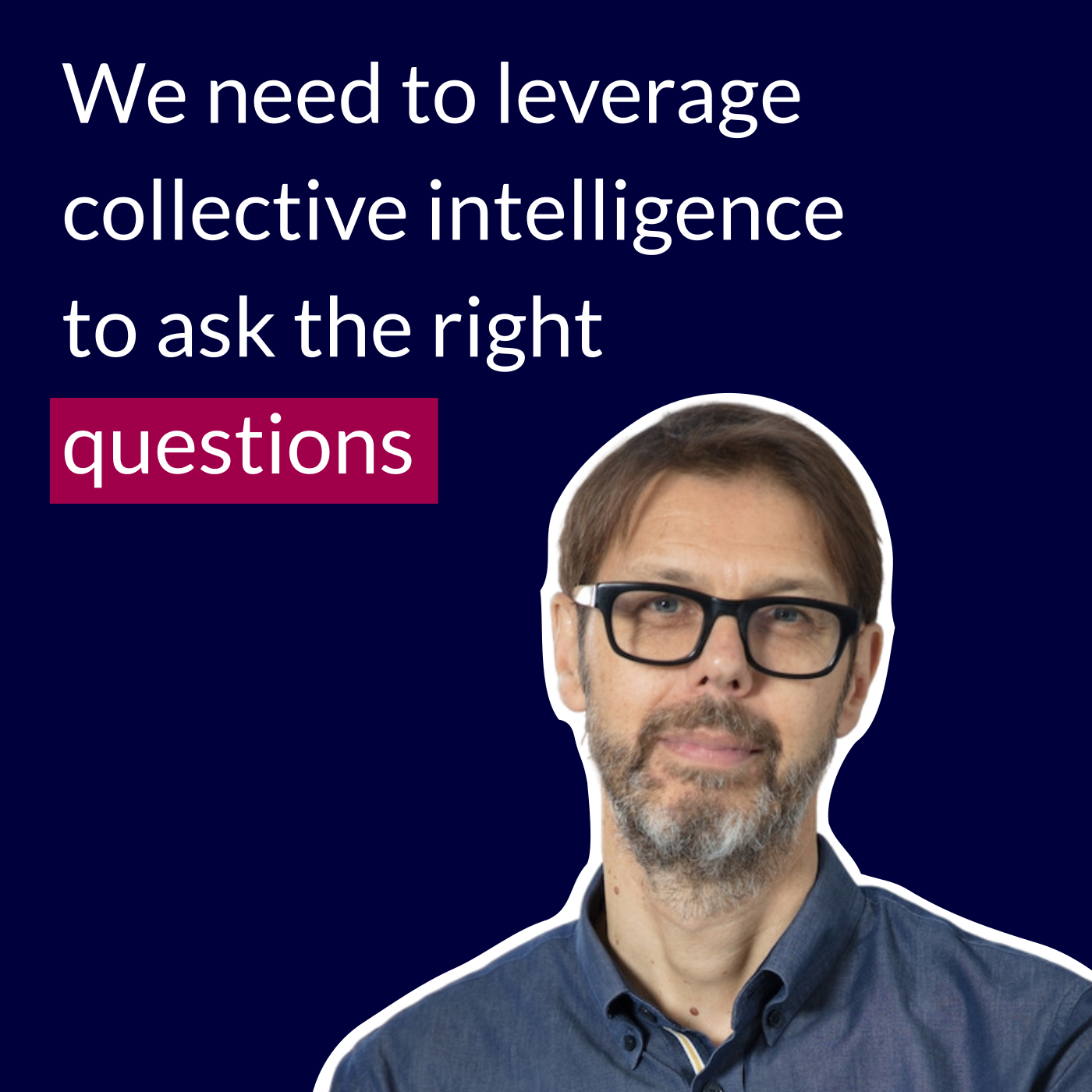
Stefaan Verhulst about governance, decision-making and how to ask good questions
Democracy Innovators | 2026-03-17 | 45:44
.Stefaan Verhulst is Co-Founder of the Governance Laboratory (The GovLab), a research center that is focused on transforming decision making by using advances in science and technology. Stefaan shares a clear view on the most important aspects of governance.
If you enjoy our podcast, please consider making a donation. It really helps us to sustain the podcast.
Top Keywords
- anyway 0.021
- alessandro 0.012
- collective intelligence 0.009
- data 0.009
- well 0.009
- make 0.008
- women health 0.007
- quite often 0.007
- society 0.007
- intelligence 0.007
- course 0.007
- collective 0.006
Transcript
Speaker 0
0:00 – 0:08
Welcome to another episode of the Democracy Innovator podcast, and our guest of today is Stefan Verholst. So thank you for your time.
Speaker 1
0:09 – 0:10
Thanks for having me, Alessandro.
Speaker 0
0:11 – 0:25
And, yeah, as I said, I don't have a very specific question now to start with because you have a lot of experience, so I didn't really know where to start. And, so the first question is how everything started?
Speaker 1
0:26 – 6:34
How Yeah. Well, so the genesis, question, Alessandro, which is a big question. But I would say, the thing, especially as it relates to kind of GovLab, which is, of course, the organization I cofounded, For me, it started, when I was working, as head of research in a foundation in New York, which really was focused on, how do we leverage information technology to address critical public needs. And the key realization from doing that work was that to a large extent as a society, we actually are very, arcane, and archaic when it comes to decision making. A lot of the public problems that we have, cannot be solved without also changing and transforming the way we go about making decisions, and especially changing the way we make, decisions in both a legitimate and effective manner. Because that turns out one of the key challenges is that there's a lot of effort, or in the past at least, there was a lot of effort to, make decisions, in the public interest more effective. But then quite often, they were not legitimate or not as legitimate as one would, want to have them. And then there were a lot of efforts to make decisions more legitimate, but then it turns out they were not effective. Right? Quite often, you can be as inclusive as you want, but never make a decision. And so the real challenge from my perspective was then, how do we actually advance decision making, which, anyway, we can also call governance, in society? How do we advance decision making in ways that are both legitimate and effective at the same time? And how do we do this by actually leveraging new methods and new assets that, we quite often ignore are there? Because as I said, a lot of the current decision making cycle is still kind of based in nineteenth century, sometimes, you know, twentieth century kind of, practices. And then the question was, of course, okay. So what are the new assets, and what are the new methods that we can start leveraging? And here, we came to the realization, and, again, this has evolved somewhat, but that there are kind of two important assets that if you leverage those in new ways, you can actually change the way you go about making decisions, making them more legitimate and more effective. And those two are on the one hand, people. Right? And so here, the question is not only how do you engage with people, but also how do you know who knows what in society, and how do you bring this kind of expertise and wisdom to the table when you make decisions, which is kind of fundamentally, underdeveloped from my perspective in society. Typically, when decision makers, seek to make decisions, they either consult the usual suspects or they assume that they need to hire a consultancy firm, but they never really take the stock in what are what is the level of expertise that already resides, whether it's in my city or in my organization or in my, region, for instance. And so if we can find ways to tap into what we call this collective intelligence in new ways, then the assumption is that you also would change, I e transform, I e improve the weather the the way you make decisions. So that's kind of the first area that, we started to explore. And in the second area, surprise, surprise, and that's where I've spent more and more time. But, of course, the first area is very closely aligned with the second area, which is, of course, data, because while society has become more complex, society has also become vastly more datafied. Right? So we have this datafication happening at the same time, which basically is a result of digitalization, meaning that every time you have a digital interaction, the one that we have right now, or, you, anyway, pay with a credit card or you, you know, which is a digital transaction or you, you know, make a phone call, which is a digital transaction these days, Each time when there's a digital transaction, there's a data trail. Right? And, and so the question then is, of course, a, how do we make sure that we don't, anyway, have a data verification that leads to surveillance, which is one, you know, key questions. But then the other question is, which is, you know, the one that I have focused on, is how do we actually start leveraging this data to improve society? Right? And how do we actually start leveraging this data in ways that can make decisions more legitimate and effective at the same time? And so those are kind of, coming back to your question, Alessandro. So the the realization was that unless we change the way we make decisions, we're not gonna make much progress in terms of, solving public problems, but we're also not gonna, make progress in maintaining and sustaining democracy as we knew it. So that was kind of the first realization. And then the question was, okay. So how do we make progress? Because it's not just enough to, diagnose the problem. It's also about how do we actually then start leveraging new ways of doing things, and this is then focused on kind of people and data. And, of course, that leads then to AI, leads to, you know, a blockchain, which is basically a data, disclosure, methodology, and so on and so on. Right?
Speaker 0
6:36 – 7:53
Okay. And I see that all those things are connected because you mentioned, like, critical public needs. And then how do you how do you know who how do you know, who know what? Yeah. Sure. Yeah. Because if you want to fix something that is not working, you need the that skill competence. And then also data governance because data, as you said, can be used for surveillance or also as something for collective intelligence. And so, like, in a sort of more practical way, do you how do you think, like, this collective intelligence can be used, let's say, also inside institutions, without maybe because I see or we change the institution now. And we say, okay. From tomorrow, there will be AI and we will use collective intelligence. Or maybe there should be a sort of transition time period. I don't know. And I think One one area that, yeah, one area that I focused on, Alessandro,
Speaker 1
7:55 – 16:30
that might be relevant to your question and also relevant to how do you start leveraging collective intelligence and even how do you start leveraging collective intelligence that can inform then the use of AI as well. It's really around this issue of, agenda setting and prioritization. What are the needs that you seek to address or what are what we have done, what are the questions that you should seek to answer in order to make progress vis a vis a problem. Right? And, and, quite often, my view is that quite often, decisions are poorly developed or, evidence is poorly, gathered or, projects are poorly implemented, mainly because, the question that you seek to answer, has been poorly defined. And, and it turns out that one of the, key challenges and at the same time key capabilities in society, is directly related with how do we formulate the questions that we should prioritize, and how do we then start structuring the quest in order to answer that question. Right? And, and that turns out to be kind of, underexplored. It's part of, of course, how do you set the agenda, how do you prioritize. Because to a large extent, whatever question you define that gets prioritized will also define, what will be funded. It will define what data is being collected and used, and it will define what is the kind of decisions that you eventually will, make as well. And so in that space, what I've been trying to do is to actually, leverage collective intelligence to improve the questions we seek to seek to answer in society or the questions that, if answered, can inform decisions in much better way. And so that's, an initiative that I launched, which, by the way, talking about institutionalization, every organization can do. And every, from my perspective, every government department should engage. And so the initiative that I launched was something called the 100 questions initiative, which is, like, what are the 100 questions that matter? That, anyway, if answered, we would make progress on particular kind of public needs or public problems. And we probably can answer it, because there's a a lot of data, but we just have not, made the data accessible because we never have prioritized the day the question in the first place. Right? And so by doing this work of the 100 questions, we developed a methodology that is kind of a collective intelligence methodology where we, a, first, around a particular problem, like we just did one, Alessandro, on women's health. Right? Good. Which is very interesting because women's health is what remains that, clearly, suffers from questions inequities, by which I mean is that, women's health is the least developed medical, field mainly because the questions women had were never taken seriously. Right? Because you can actually have questions inequity, questions that never get taken seriously. Now what we did, in the field of women's health, which we did together with SEPS and the Gates Foundation, was to, first of all, define what is women's health. Right? And I think that's kind of what I call is developing a gestalt of a particular kind of problem or a particular kind of domain. Because women's health is more than just, for instance, one particular aspect of women's health as it relates to a medical condition. It's also, anyway, linked to, research. It's linked to, gender, discrimination and so on. Right? And so we need to have a broader perspective, what I call a gestalt of a particular kind of domain. Now this gestalt can already be developed through collective intelligence. Right? So you can actually bring kind of, you can do kind of a a public mapping of all the issues, including, capturing lived experiences that makes it real as well. The second thing which we did then was to, basically bring, and and create a cohort of what we call bilinguals. And so, and here, this is very much informed by, what Phil Tetlock is doing in collective intelligence. And I know Alessandro would know Phil Tetlock, but what he has been doing is trying to, develop cohorts of what he calls superforecasters. Right? People that have a a kind of innate capacity, to forecast on particular kind of topics. And he typically brings those superforecasters together and then, anyway, develops kind of forecasts that, turn out to be much better than any other kind of method as well. So what I'm interested in in the questions, effort that we are having is, who are super questioners. Right? And so that goes back, Alessandro, to kind of the collective intelligence question is how how do we know who knows what. Right? And and here, it's about how do we know who has particular kind of, capacities that can inform, the question process. And so here, we develop this cohorts of bilinguals, which are people that have a domain expertise, in this case, women's health or an aspect of women's health, but also, quite often, a certain, other expertise, whether it's data or AI, but also, anyway, kind of a characteristic to be open to formulate questions. Right? Because it's also kind of an innate characteristic, to be a super questionnaire. And, and we bring them together. So, typically, we have around 100 that we, have curated. Right? And, and then we source, the questions, and then, ultimately, we come up with, like, anyway, 200 types of questions. We prioritize them. They prioritize those questions, and then we have a public, conversation and a public voting on those questions, as well, which then allows us to really prioritize a few areas that, from my perspective, will enable a more legitimate, right, because it has gone through a process that is not just, you know, someone who happens to be close with the research from there, that, decide this is the question that matters. So it has gone through kind of a legitimate process, to identify what the questions are, and it's also far more effective because now we know, right, which one should we, focus on first, in order to make progress on a particular kind of issues? And so that's kind of a collective intelligence example, Alessandro, that, that allows us to, do agenda setting in a new way. Right? And, by the way, combine that with AI, now we also can then, you know, already start using AI to kind of rapidly prototype answers to some of those questions. Right? And see, what what does Claude say about that question? And so you could actually have a kind of a hybrid way of going about, scoping out, the quest, of, answering a particular kind of questions as well. And it can also inform better prompts, and by the way, it can also allows you to understand what data you need, and you can start, you know, developing data comments around particular kind of questions that, provides you access to high quality data so that you then also can produce, you know, high quality kind of answers to some of those, questions as well with or without AI, involved. Right?
Speaker 0
16:32 – 16:39
This this is very interesting. So a sort of, I don't know, citizen assembly maybe with people that are very able to forecast,
Speaker 1
16:40 – 19:27
a practice. So you can do, yeah, we can do this in a variety of formats. Right? So, like, anyway, we're we're gonna do another one here during open data week in New York, which is in March. And so we basically gonna bring in folks from Brooklyn, from a particular part of Brooklyn and say, well, what are the because like like, the open data, right, the open data community, anyway, is focused on the supply of data. Right? So let's let's get data, open. The question that we try to answer is that, okay. But what are the questions for which you need data? Right? And and who should define those questions? Right? And so in a city, you could have, like, for instance, in Brooklyn, you could have kinda exactly kind of a a citizen's assembly, right, which, you know, invites people from a particular kind of part of the city. Could be community assemblies. Could could be community meetings for that matter. It doesn't have to be that complicated. But you could actually start, understanding what are some of the questions that will make a difference. Right? And then you know what is your open data program, what what should be your open data program, and how does it currently score vis a vis the questions that actually people have. Right? And so that's kind of one way to do it, but you could also do it anyway in, in in, in in universities. Right? I I mean, it's kind of remarkable, Alessandro, to be is that, universities anyway, and, again, this is all kind of they assume that everyone, right, will, anyway, figure out their own question. Right? And, typically, they don't share the question because, you know, if they share the question, Others might run with the question, then they don't get any funding. So it's kind of you know, everyone's kind of focusing on their little domain. But if a university would say, okay. Well, what are the questions that as a university we should prioritize and then align ourselves to make progress vis a vis those questions, you would have much better, well, I mean, my my assumption would be is that you would have much more effective, alignment of kind of the collective wisdom that resides within university to answer some of those questions as opposed to assuming that everyone will come up with a question that will make a difference in the society that they are working in. Right? And so it happens at multiple it can happen at multiple levels. And, and and it's surprisingly to me, Alessandro, that we have not, as a society, have not come up with a better way to do this kind of agenda setting. Right? And, and and especially in a in a more legitimate way. Right? That is not just, by a few, that happen to be there when the questions are formulated.
Speaker 0
19:29 – 19:44
Yeah. I was thinking before when you were talking about the the questions about the hitchhiking guide. I don't know if you were referring to it because also there, hitchhiking guide. I don't know how to pronounce it pronounce it.
Speaker 1
19:45 – 20:33
The same Hitchhiker Guide. Yeah. Yeah. 42. Yeah. Exactly. Yeah. No. Exactly. I give presentations that start with 42. Right? So basically, it's that anyway, okay. So this is kind of the situation we are in with AI these days. Right? Is that, anyway, we get an answer, and everyone's thinking, okay. What was the question? Right? And, and that's kind of we are through we are obsessed with the answers. And I always say we are answer rich, and especially in today's age where we can get any answer we want, right, to any prompt that we are formulating, whether it's a correct answer or a hallucinated one, doesn't anyway, we get an answer. But then the questions of, well, is this the question that matters? Right? And and and is this, is this a question that actually will make a difference if answered? Right?
Speaker 0
20:34 – 20:56
And, I I was thinking many times I asked, to to the guest of the podcast, like, why, people do not participate. But then, I thought maybe it's it's not the right question, and still, I don't know if this is the right question or not. And, I wanted also to ask you which open questions do you have in mind now?
Speaker 1
20:58 – 23:23
Yeah. Well, alright. So you throw the ball back to me with, with questions. Well, there are many, and, again, first of all, I mean, and it was on what topic. Right? So that's the question. But on the topic of questions, right, so, I think there are a lot of meta questions that, that, that we can, that we need to start answering. Right? And so one meta question is, of course, what is a good question? So that's already kind of a a a fully again, there is no, real sense of, criteria, right, by the way, on, what that might, might look like. And this will be different for different context and for different people and different cultures for that matter as well. But then it's also about, you know, who are good questioners. Right? And, are there some kind of characteristics, that define whether, you, you are you are more, you know, more you're more of a questioner than a taker to a large extent. Right? And it would be interesting, like, even there, Alessandro, my hunch is that you could actually kind of kind of, anyway, develop a map of the world in terms of, you know, societies where questions are permissive, right, and actually, promoted, and other societies where questioning is, is seen as a threat. Right? And then the question is, how does that translate into actually advances in how you in in societal advances? Right? And how does it, have and then the other question that I'm interested in, Alexandra, is that what are the questions that we should not ask? Right? Because, questions gets, very political quite quite often. Right? And some questions are harmful to society, as well. Right? So not all questions should be asked, right, or answered for that matter. And so these are kind of the meta questions that I'm trying to, try to, to develop. But I think it's ultimately getting a more scientific approach to questioning and, and then also translate that into new methods that, are, are more legitimate. Right? And also, again, leverage, collective intelligence, and AI can also be leveraged more and more towards that end.
Speaker 0
23:28 – 23:36
Like, which which question do you think, can be dangerous and this should not be discussed?
Speaker 1
23:37 – 24:17
There are many questions that, go to the heart of identity, and, and I think some of those questions, should not be answered or should not be posed. Right? Because they they are divisive. They are also offensive quite often. And, and I think, these are kind of you know? Yeah. You could say, well, anyway, you could ask all the questions, but I think some of those questions, basically don't contribute to, a a healthy society. There are actually more questions that would be divisive. And then also, again, what are you gonna do with the answers? Right? So it's like, it doesn't doesn't make you a better society. Right?
Speaker 0
24:19 – 24:53
Yeah. As as you were saying before, like, that, I I mean, we should think, what to ask. And that is the important thing. I I think that a lot of times we, maybe we ask things, and, we would like to maybe ask a different things. I don't know. Also, at this moment, maybe I would have liked to ask a precise thing, but then I'm asking something else. And,
Speaker 1
24:54 – 27:22
Yeah. No. It's and, again, look, it's of course, there are different situations. Right? But the but I think, yeah, I think we we anyway, we we as we have taken it as a given, right, that all questions are kind of good questions. And we've also taken it as a given that everyone can ask questions. Right? Because, you know, we grew up. And, again, there's all kinds of studies. Right? When we grew up, when we were younger, we were asking questions all the time because that was then a device. Anyway, questioning was a device for learning. Right? But then, of course, we forgot about questions. And so now, anyway, as a society, we are actually pretty unsophisticated when it comes to questioning, and we are pretty unsophisticated when it comes to prioritization. Right? Because, anyway, you can have an argue while all questions should be, anyway, should be answered. Well, some questions are more important than others, and so how do we start prioritizing a few of them? And how do we then structure what I call the, the the inquiry, how do we structure the inquiry? Right? So how do we structure the quest? Because, the interesting thing about questions, Alessandro, is the first part, right, with quest. Right? And so so one question leads to another question. And so what's anyway, you started off with the genesis question. Well, what's the genesis question of certain kinds of, certain kinds of, topics? Right? And and and in some cases, we will know that certain questions cannot be answered unless we answer another question first. Right? And so this is where this taxonomy of questions comes in, where we have descriptive, diagnostic, predictive, prescriptive, and so on. But I think having even, questions fluency to understand that there are different types of questions and that, actually, you need to structure a quest, when you are, trying to for instance, for evidence based policymaking, it's not gonna be one question. It's kinda how do you structure the quest. That turns out to be fully understood, Alessandro. And, and again, because the assumption is that everyone can formulate questions, which is true, but it doesn't mean that everyone has a fluency in questioning. Right? And I think that's kind of what I feel, especially at the time of AI. Right? When any question we can answer, what that we need to start prioritizing. And this is also where I think, collective intelligence can help. Right?
Speaker 0
27:25 – 27:41
And, another question is Yeah. I know. Sorry for going on this questions trajectory. You just kinda got distracted. No. I mean, but actually interviewing is sort of like asking questions. So Well, they're they well, there are we there are, of course, there are,
Speaker 1
27:41 – 28:31
of course, professions that, require certain questions fluency. Right? So journalism, of course, is one. Right? Podcast is another one. But, but lawyers are trained to ask questions. Right? And so so there are clear professions that depend on questioning as a as a as a skill. Right? But, but then, anyway, why is this not, anyway, part of other kind of professions? Right? Like, for instance, in the in the policy community, why is questioning not kind of a skill that is actually more focused upon? Right? And I think, yeah, I think that's kind of what we need to learn from, from other professions, right, on how do you go about questioning, for instance. Right?
Speaker 0
28:34 – 28:46
And, maybe it's also very related to what we do, what we study. And, yeah. So it's it's a sort of social issue.
Speaker 1
28:47 – 29:51
The Yeah. Yeah. Yeah. No. It's it's definitely well, again, it's that that's why anyway, I think it would be interesting to understand, and we have not really we have not much research in that space, right, on who are who formulates what question, what's the what are the the variables and determinants of answering the question that once asks. Right? And I think that would already be interesting. Like, anyway, you anyway, you study history, right, which is kind of all about kind of big questions as well. But in some anyway, like, in, anyway, history, you have topics like the Polish question, right, which was basically kind of, anyway, an area that anyway, this was kind of an area of study, right, or even an area of, you know, history that, that is still unresolved, by the way, but that at least is kind of a way to address a particular kind of development in society. Right? And I think, again and then even understanding questions as different devices in different disciplines and in different areas would be interesting.
Speaker 0
29:52 – 30:23
Yeah. And also, I mean, I had other question here, but, because we are talking about meta questions, it seems like that we as humans are not really able to deal with with question that do not have an answers. So often we create something, that could be believing in a religion, in God, in another God, in another in, an an ideology. Yeah.
Speaker 1
30:25 – 32:35
Yeah. No. No. And, again, we are moving into the the the big questions. Right? What's the meaning of life and so on? But the, and and how was, the world, created? But exactly, right, is that, it makes us very uncomfortable. But I think being able to, to engage with the question, I think, requires a certain kind of, sophistication, or a certain kind of, openness, right, that, that that, that is quite often not there. And, again, meaning, of course, multiple answers have been developed. And, again, who are we to evaluate those as long as they are not harmful to kind of society at large? But I think, exactly, there is a lot of uncomfort being uncomfortable about questions that are not answered, which is also, by the way, from my my my my assumption, by the way, Alessandro, is that it's so easy in the current world of dis and misinformation, right, to be misinformed or or to be misled by conspiracies because we like answers. Right? And, and I think, if we would be more critical and say, okay. But what was the question to what is being presented to me? Right? You probably would have, less impact of the current misinformation ecosystem that we are in. Right? Because we are kind of, you know, bombarded with answers, bombarded with statements, without even reflecting about, well, what is this anyway, what's the question here? And, and is this the question that matters to the problem that we seek to solve or the state of the world that we are in? Right? We just get bombarded with information and in most cases now, misinformation. And that's why I think the misinformation pandemic or epidemic that we are having is kind of also the result of our, lack of, question, fluency from my perspective.
Speaker 0
32:39 – 33:33
How how do you imagine society in five, ten, or twenty years if, let's say we are able to give a good answer to the question that we have now. Yeah. If you because I I see technology that I mean, it's evolving very fast at, at a level that we have never seen it in history. And so, also, like, an expert in the field can be, like, a sort of every every new week. There is a new AI model, the new AI platform, and so on. So I don't know. How do you see like, are are you optimistic, pessimistic? Like, pessimistic in the short term and optimistic in the long term. So
Speaker 1
33:34 – 37:00
Yeah. Well, it's always like, you know, we underestimate the impact, in the long term and overestimate the impact in the short term, I guess, somewhat. But the, it remains to be seen. Right? And I think, obviously, I think there is a lot of, well, so so a lot of the work that we've been doing is kind of democratizing access to knowledge. Right? And that has been kind of one of the work that I've worked on for a long time. And, and, of course, that was also, by the way, the excitement, when, you know, the Internet arrived. Right? They would say you would have, you know, access to knowledge as never before, which is, of course, true. Unfortunately, what has happened is, of course, as I said, knowledge has become weaponized. And, and I think, and I think I'm not, anyway, that worried about kind of the models. I'm just worried about what happens if the models get either monetized or weaponized. Right? And that's what happened with the Internet, Right? Is that the Internet got monetized. I it was all about advertising. Right? The advertising advertising business model is the only one that, has been promoted, at, en masse, right, and with massive investment, right, which is why we're having the current Internet that we have today, which is basically an ad based kind of Internet, and, which then leads to all kinds of behaviors. And and, of course, it also has become weaponized, in ways that, we didn't anticipate because we forgot to govern it in ways that, that, that that we didn't anticipate. Right? And, and I think, so my worry, Alessandro, is less about the models itself. It's more about, anyway, because there's there's massive investment at the moment in AI. Right? Eventually, they don't have to show our, return on investment. And and my worry is that the only return on investment is gonna be, again, an ad based model. Right? And so and and that's gonna skew, the whole ecosystem, Because at the moment, I would say we are everyone is worried, but I think we probably are in a, the honeymoon moment of AI at the moment where many of those models are freely accessible. They're actually anyway, they're they're not that bad, and they are definitely not yet weaponized, right, in ways that skew certain answers, because of certain forces behind it. My worry is that that this honeymoon period might end, at a certain point in time, and it might, again, become monetized and, weaponized, very rapidly. Right? And I think, that's what I'm worried about, and, and I think, that's where governance comes in. But, unfortunately, most of the governance has basically ignored that kind of aspect. It's all about kind of output evaluation, but it's not about, you know, the broader funding and business model and governance, system that is out there. Right? And so so that's kind of what I'm worried about.
Speaker 0
37:02 – 38:22
And, I mean, I see always this tension between, let's say, policy policies and code, because, I see how Internet was, used to, let's say, to make money and also to influence, control, and so on. So I wonder, like, if we want to, let's say, build something and protect what we build, if we should use law or code. Because sometimes I see, let's say, lawyers, that that one too. They want a law about everything, but at the same time, I see this, the technology, the code that is also sort of it's there is a parallel between, code and law. What I mean is that, sometimes, if you write in the code that something cannot be done, then it cannot be done. But if you if in the code, it can be done, but by law, it cannot be done, then you you can decide if to do it or not to do it.
Speaker 1
38:24 – 42:07
Yeah. No. That's it. Of course, anyway, Larry Lessie, many years ago, of course, code is law. But then, anyway, things that I worked on was exactly, I was under to to show that law is code as well. Right? And so it's not, it's it's not like anyway, and we've seen this in many places, right, like financial, services, health services where clearly law determines what the code is. And I think we need to start, developing that, more and more. But, again, I think what it is also about, it's about, you know, alternatives. Right? And, and and so what would again, there are a lot of people that are working on kind of a public interest AI, ecosystem. Right? And so it would be interesting to see. So what is an alternative to prevent this kind of weaponization to prevent this kind of monetization. Right? So at the moment, like, for instance, why is social media so, harmful to a large extent in the current environment? It's because there's no other alternative than the ones that we have that is actually anyway, that is scale scalable. And that anyway, we can say, well, you know, because now it's the only thing we can do is ban so it's all social media, as opposed to say, anyway, let's anyway, let's have social media as we anticipated, which was all about connecting people, sharing updates in a way that is not, anyway, polarizing in a way that, does not discriminate or leads to hate speech, for instance. But we don't have a public, we don't have a social media that provides an alternative. Of course, there are some efforts there, but they are not, they are not at the level of investment nor at the level of, use. Right? And so what I'm interested is that okay. So are we gonna make the same mistake with AI where we're gonna have, anyway, a few bad, options and no, anyway, options that provides more of a public interest, kind of, option. Right? And we see anyway, there's efforts around that. But, anyway, they cannot compete with the scale of investments that are going on. And I think so if there is be one area of, it's not just in code, it's also about investment. Right? Who who who oversees the investment? Right? And who basically determines what is done with the investment? So if you would basically have, conditions with the investment, then you would have, far more powerful leverage. Right? It's like, okay. We're gonna invest, but you can only use it for this purposes. And, anyway and if we see that it's done for other purposes, we pull back, for instance. Right? Or you have to pay back. I mean, these are stronger leverages from my perspective, Alessandro, than any law, will be able to do, make it conditional in terms of investments. Right? And this, of course, anyway, was anyway, this we started working on that a little bit in the ESG kind of context, right, where we made anyway, if you invest, you have to show an environmental footprint. Now this has become too woke, so no one talks about it anymore. But we could have anyway, what are the ESG criteria for investments in AI? I think that's something that would be worthwhile exploring to ensure that exactly decisions with regard to code and decisions with regard to the business model, behind, models that that gets steered in a way that, is, societally, beneficial. Right?
Speaker 0
42:09 – 42:40
And, I think we have time just for the last question. Yeah. Now I've been going on and on. Yeah. Yeah. Yeah. Now if you have more time, we can also say. No. Unfortunately, I have to. Sorry about it. It's, I mean, just a message for the people in the space that are working on whatever it could be on your software, new ways of, use the collective intelligence and, also message maybe about question and what prioritize. I don't know.
Speaker 1
42:42 – 45:34
For me, any questions? Yeah. No. Well, I think we need, a lot more innovation in the question space, where that's kind of you know, I have been I've and I made a point here. Right? Let's let's take questions seriously. Let's develop a science behind it, and also make this more participatory. Right? So we can actually do a lot more effort to not only improve the questions, but also making it more participatory and democratizing that. The other one, which we didn't talk about, Alessandro, is that, we see massive, asymmetries, in today's world. And quite often, this is a result of both data and information asymmetries. Right? And so, and I think if we really wanna make, AI, more inclusive and, and if we wanna actually have AI that works for, the majority of the world, we're also gonna have to start unlocking data in ways that is, less extractive and in ways that is more inclusive. And I think, that's kind of another big topic that I work on, which is kind of this whole notion of how do you set up data commons, which deals with this notion of extraction, but also deals with the notion that we actually do need to have access to data. Otherwise, we you know, if we are moving to kind of AI, it becomes our way to learn about society. Right? Well, large part of society are not in AI. So we will kind of have invisibles, and we will have, kind of massive asymmetries between those that have access to tools and those that don't have access to tools or those that have access to tools that speak their language and those that have access that don't have access to tools that speak their language. Right? And I think that's kind of a a big asymmetry that is emerging as well. And I think that would be kind of one message is to not just focus on kind of AI governance in terms of risk profiles, but also turn focus on the asymmetries that currently exist that will, that the where the risk would be not having access to the tools, which is kind of an equally important risk than the risk of, you know, the tool will be, you know, will hallucinate or will be misused. Actually, having no access to the tools is, for many, a much bigger risk. And you see this also playing out in as we speak of because we have the AI summit in India. And then the global majority, I mean, they want access to AI. Right? And, and I think the the biggest risk risk that they see is that they're gonna be left behind like in many other kind of context, and I think that's kind of an area that we need to address more.
Speaker 0
45:35 – 45:36
Thank you a lot, Stefan.
Speaker 1
45:37 – 45:43
Hope this was somewhat of, interest, Alessandro, to your efforts. Yeah. So, keep me in the loop. Yeah. Absolutely.