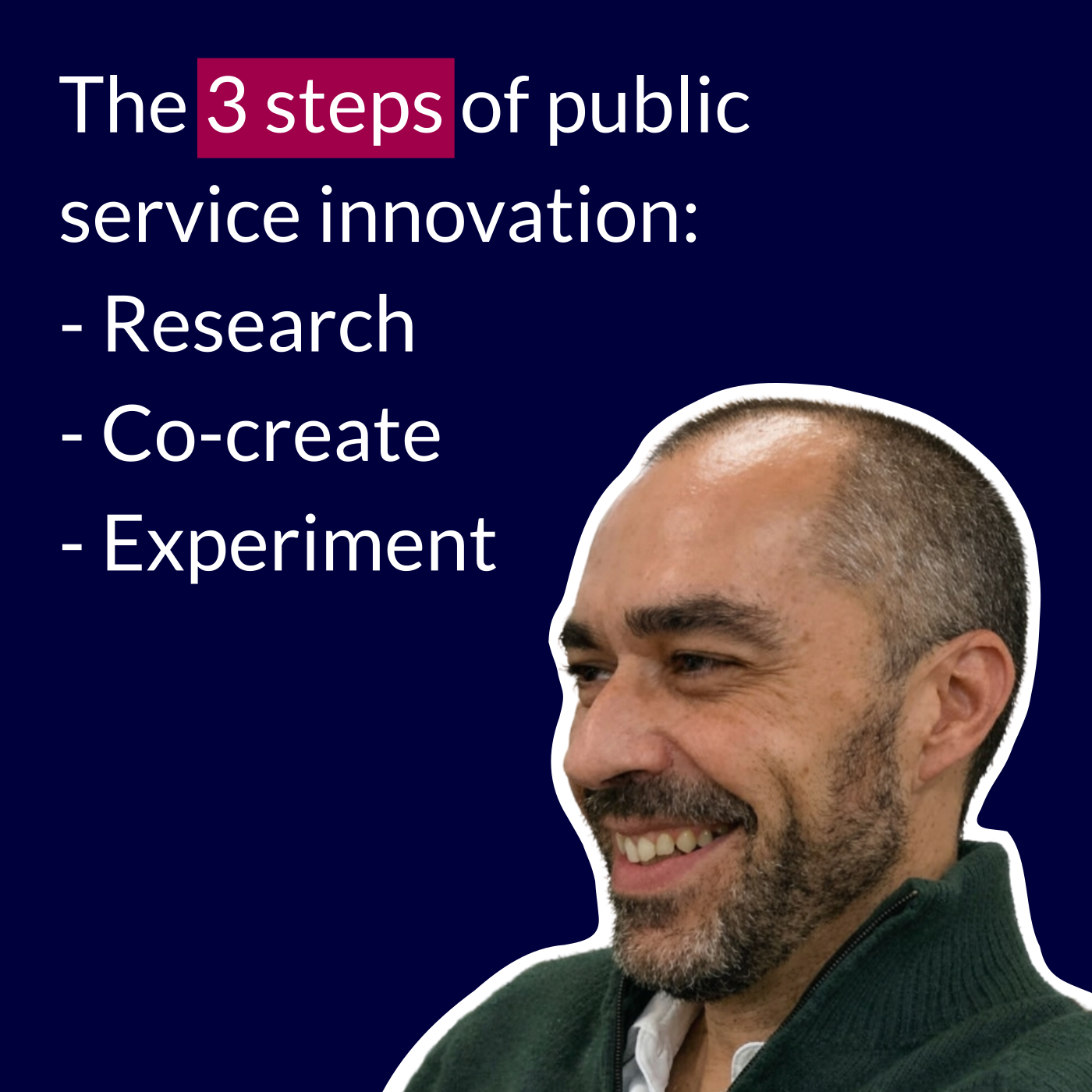
Jorge Lagarto about LabX and human centric design in the public sector
Democracy Innovators | 2026-04-10 | 45:36
Jorge Lagarto is director at LabX, a center for public sector innovation. With many years of experience in the field, Jorge provides clear guidance on making services more citizen-friendly by integrating their needs and expectations. We talked about:
- Public sector innovation and examples with the LabX
- The 3 steps of public service innovation
- Workflow re-design vs. technology
- AI in public service and the agentic state
- Risks of digitalization
Top Keywords
- public 0.015
- services 0.015
- service 0.010
- public sector 0.008
- portugal 0.007
- digitalization 0.007
- sector 0.007
- different 0.006
- government 0.006
- citizens 0.006
- nowadays 0.006
- innovation 0.006
Transcript
Speaker 0
0:00 – 0:18
Welcome to another episode of the Democracy Innovator podcast, and our guest of today is George Lagarto. Thank you for your time. Thank you for invitation. And, you're working at LabX. Right?
Speaker 1
0:19 – 0:20
Yes. And
Speaker 0
0:22 – 0:34
You're also directing it. And, yeah, would you like to tell us something more about, what is doing what is happening at LabX?
Speaker 1
0:35 – 4:49
Yeah. Sure. So LabX is the innovation division for the agency for technological state reform in Portugal. So we have this agency that is responsible for digital transformation of public administration. LabX, it's it's innovation division. So we we were created about ten years ago. It's it's in 02/2016. So LabX was created just as innovation lab, just a small team to address specific problems, on the context of public services. Like, it's we have a strong focus on service design. Like, in that, it we bring this, human centric view on public service delivery to public administration in Portugal about ten years ago. Since then, we have been evolving. So we have, more projects, more different projects, not only on the scope of service design, but we have worked on, culture transformation about innovate, inventory and, anticipatory innovation. We work on behavioral insights. We worked on strategic planning. So we have expanded our our our work, and then emerging technologies about use of AI and, all these emerging technologies, we are worried about how can humans use it to its own profit, not not only to, create the mechanisms. We are worried about how to use them. How how can they be applied to bring value to to society? So, yeah, we worked a lot also on participation processes. So because, when you are on public administration, you cannot improve public service delivery or public policies if you don't have a clear vision of what are the needs and expectations of of society, of different profiles of citizens. So we have strengthened this this, area of civic participation. We work along with different profiles of citizens because we have this mainstream of people informed and and that are acknowledged of the political, ecosystem. But we have a a part of the citizens that is very a part of this reality. So we have the the youngsters that are not worried about, are very influenced about the new perspectives of you have these far right, activities. And with lots of intervention on social media, with the lots of fake news and stuff like that. So we are very concerned about how can we develop, civic consciousness on our youth and make them to involve themselves in in participation about public discussions, about public policy. So, yeah, this two has been a long journey since a small team of five people that are trying to create this wave about human centric design and public sector. Nowadays, we have about 30 people on our teams. We have three different teams. So we have grown a lot since the 2016 when we were created as a small intervention team. And now we have a full army of designers to to reshape,
Speaker 0
4:50 – 4:55
public sector in Portugal. You were saying 30 people that are working on different
Speaker 1
4:56 – 9:55
projects. I I was curious about, the different projects they they're working on. Yeah. We have three different teams. So one team is for, studies and innovation networks. So they make they are always scoping on the future, are prospecting new new initiatives, new trends on society, new trends of technology. They do these studies for how to make this diagnosis about some particular problem or try to understand better new technologies or new trends. So, we can be on on on this front line of innovation to bring this for public sector. So this is one of the team, and this anchor, three networks that we manage. We have this network of innovators that is public sector, civil servants and managers from public sector that, recognize the importance of innovation in public sector that and we have these meetings and we have these newsletters and all this kind of communication that we bring that to them, have these capacitation programs that we deliver training to them. And we have this created the network of innovation teams. We can give training and create these innovation teams inside other public agencies, like tax authority, social security in the municipalities. Nowadays, we have a network of 15 other labs of the innovation labs. We have the teams from the navies, from, GCI police. So it's a very broad scope. We have an hospital also, a team from a hospital trying to focus on the public hospital trying to focus on how can they design better the services, the flow of people in the ER or something like that. So we have this network, and we are also the the representatives in Portugal of the, Open Government Partnership. This initiative that was promoted by former president Barack Obama that created this worldwide collocation, based on these four pillars about fighting corruption, promoting transparency in public sector, promoting civic participation, and the use of techno technologies in the civil society. So we are the coordinators of this network in Portugal and the representatives on the international forum. So this is all in the team of studies and innovation. We have a team for projects. They do service design projects, so they do this digital transformation. So we have clients such of Portuguese Court of Auditors, tax authority. We are redesigning, for instance, the creating a model for self-service kiosks on public service, like, yeah, all sort of projects. And then we have a third team that we it's a team about innovation services that in which we everything that the other two teams have developed, and we can offer public sector as a service. So this team is responsible for, collecting all the the insights from the other teams and the results of their projects and to create products and services that can be offered to other public entities. So this we have these workflows or streaming. First of all, the team of studies started and discover new things, then the project teams apply it. And then a third team about innovation services that create products and services based on this, streamlined workflow. So this is how we are settled and how we work on in in Portugal. We also have lots of connections with other teams across the world from, Brazil and all, like, Latin America. We have lots of connections with OECD, so we have are working directly with them in a couple of projects. And yeah. So that's a a a glimpse of what we we do and how we are established.
Speaker 0
9:58 – 9:59
A lot of things.
Speaker 1
9:59 – 10:19
And, Yeah. And I I'm not I just have told you the the highlights in in terms of projects and other initiatives. We have nowadays more than 30 initiatives, working on the field. So, yeah, lots of stuff.
Speaker 0
10:21 – 10:28
And I was curious about, how to design a service that is human centered.
Speaker 1
10:32 – 13:44
Working with people. The I'm for instance, I'm an environmental engineer. I don't I don't know everything. Okay. I have experience in public services. I work in this area for almost fifteen years. But I give you an example. We are developing accessible services for deaf people. Okay? So, yeah, we have to bring deaf people to us and ask them how they want to use this service. We have to understand what are their limitations, what can help them. The only way to this to design human centric services is to bring the real users of the service, right next to us in in order to for us to understand what are the needs, what are the expectations, then cocreate with them the solutions and test. We have this workflow based on three very simple steps, that we have developed based on service design methodologies and design thinking methodologies. So the first step is to research, to identify the right problems, and the right needs, what the people really want. So then cocreate with everyone, with the users and public officials and service managers and political sponsors, and meet with them and agree what is the better solution for a service. And then test that solution because when we imagine a service, it's all on our head. We just have to put it to the reality test to see that, in fact, this service will respond to users' needs. So it's not rocket science. It's how to bring the right users to to us or to go meet them, and understand what their what's their problems and try to solve them. But we we need to have these this disposition, this availability to go and meet the users. So if you are designing services for migrants, for instance, then we go we have to go to the communities and talk to people and understand them. So, yeah, that's this is how this very straightforward process to research, co create, and experiment. And in all steps of the process, bring people, around us to under to understand them, to to know their ideas because they have ideas, because they face these problems every every day. And they they they have lots of time to think, in the ways that the service would be better delivered to them. And then bring them to experiment what we are imagining that will solve that problem, to see if effectively it will solve. So it's not big secret, very easy. Just talk to the people. Yeah.
Speaker 0
13:45 – 13:50
Yeah. Sometimes we have to test differences between theory and practice. So
Speaker 1
13:51 – 16:37
Yeah. Yeah. And just to pass that gap. Yeah. We have to yeah. Because we have these these, I say it's bad culture to when we design public services, we close ourselves in our in our knowledge, and we think that we know everything about citizens and how they interact with each other and how they interact with the services. So the public sector don't have this culture of participation, of listening to people. So because we are somehow arrogant to to demand to think that we know everything. That's not true. This is endless. We need to be humble and and to to recognize that we don't know everything. So we have to ask people and to see them and observe them as as they use services. That's what I many one of most, critical activities when we are redesigning face to face services is to our researchers go to the field, on the the shops that they deliver the services, and just observe what are the dynamics, what the people say, how they interact with the the the public servants. So and we stay there for hours taking notes, understanding how can we improve this, can we give more information, can we even avoid that people use the service? We if we can predict what they need, we can be proactive and deliver them the services even before they they realize that they they need it. We have the example on driver's license, for instance. When, when the driver's license is reaching his limit, his val of, expiry date, So we send an an a text message to people or within the app, the government app, we have this application. So we send them a a notification and tell, okay. Your your driver's license is going to expire. Do you want to renew it? And people just have to say yes, and we send them, a bank code so they can pay because it's a a paid service, and then the driver's license is going to by mail to their home. Okay? So and this is how the government, if we know that that document will expire, we can be proactive on the on the on these services. So, yeah, this is how we do it.
Speaker 0
16:40 – 17:19
Very interesting. And, I I was thinking in relation to the digitalization of the public sector, how does it happen? Like, like, things that do not work in a digitalized way are then digitalized? Or it could be that there is also new kind of approach? I don't know if the question is clear. Like, if, you take, like, a process that is an analogic and you just try to implement it digitally so it is, let's say, faster,
Speaker 1
17:21 – 22:08
or also try to simplify the process so that it works. Of course. Of course. Because yeah. We have always to we want we try always to simplify first before digitalization. Because most of these workflows are from fifty years ago. The the laws that that define the workflow or the services, they are from late sixties and seventies. This is the the the legal framework comes from that period of time. So the context today is very different. So, we have this example in which we didn't do it because because, yeah, the the government the the the minister doesn't give us the opportunity. They just said, okay, we have this service. You have to digitalize it. So but at this moment, we we lost opportunities because the law says that people must submit a PDF document with their photo. And we have to re reproduce this this mechanism on the digital service. But it's stupid because when I do my authentication with my digital ID, I always I I I already give my photo to the system. So my my my information is already on the system. We we shouldn't ask people to take a picture and then transform it on the PDF and submit it. It's crazy. Another example for we have these storms in Portugal in the last couple of weeks. So now we are going to the field and and trying to understand who needs the state support so they can fund the the, the the damage so they can they can rebuild their homes. Okay? So but they need to to to to make proof that that's, his house. So if I'm asking for the government to help me to rebuild my house, I have to prove that that's my house. Okay? So but nowadays, I can go to to public registrations And understand that this citizen has this house is registered in his name. So he's not the one who has to make proof because I, as a government, I already has this information. So that's why it's very important when we start digitalizing these these services that already exist, so we can apply a simplification process before. Because, there are lots of services that demand citizens to go to a different public entity to get the document and then to submit it on another public service. So we said that it's the effect of, like a pigeon. Yeah. We have these these couriers pigeons. So I I, the citizen, I have to go there to pay for a document so that I can submit it again to do another public entity. So this is against the principle of the only once or once only principle in which when we gave our information to the government, one time is enough. The government then has to make all the efforts to spread this information across all the different public entities that need this information. For instance, you have to tell the government what is your home address. Okay? But you should have to say just to one entity. Okay? To the the entity that is responsible for this registration. And then this entity will will tell everyone else that your address is there. You don't have to to to communicate your address to all public entities, okay, to stay with your data updated. It's not how it should work. In this era of technology, it's, enough that you update your information with the government just one time, and then the government share this information with everyone that needs it inside the government, of course. So, yeah, that's it's very important to apply the simplification workflow before digitalization. So we are just missing opportunities.
Speaker 0
22:10 – 22:22
I'm very glad that this is happening because, yeah, it's it's frustrating when, you have to take one document from one entity and then give it to the other one and also maybe pay and also book and some.
Speaker 1
22:22 – 22:30
So Cannot happen. Cannot happen. Yeah. Nowadays In nowadays Yeah. It cannot happen. Yeah. And how
Speaker 0
22:32 – 22:48
do you think how, in terms of, I don't know, road map, in how many years it will require to have, all these, simplification of the public administration and
Speaker 1
22:49 – 28:20
It's difficult to to to to have, a road map that you can say, okay, I will transform every public services on this vision. We have we established the vision. We have this definition of what is a, a public a new generation public service. We have defined we have this cocreation session with major service providers from the government, and we have a definition. Okay? And this is a a service that is omnichannel that is supported by digital platforms, and that it's, comprehends any interaction between citizens and civil society and public entities and gives data to our data open data platforms and uses interoperability. And as all these, uses digital ID, uses the the public, notification system that is available on the app. So we have this this, definition. But then we have more than, yeah, 5,000 public services just on central administration. Not talking about municipalities. Okay? From these 300, three three thousand three, almost 4,000, services, we have about 200 that fulfill every every, checkpoints about this new generation services. So we have to redesign and reimplement others 3,000 and and a lot. So and then, you you start doing this process. And okay. We have started a couple of years ago, a lots of years ago. But at some points, all these technological, new technologies that appear, and the technological evolution is being so fast that the services that we see of state of the art a couple of years ago that can now be improved in better way using, for instance, AI. So we establishing a road map, I guess, it's important, but we have to be agile enough to to understand that it's not never going to be a closed road map because we are intervening some services now. But I I understand that next year, we'll have different, government priorities. Okay? So we are always trying to, redefining this vision, refining the vision. And and yeah. And it's not always very easy to to go to strong entities, strong agencies like the tax authority. They have lots of money. They they run the state budget. So, yeah, they are the main responsibles for the funding of the state. So they they always have different priorities to different than to deliver better services to citizens. They are worried about other things. So it's very difficult to make them all aligned with this initiative because it's it's easier when a country started the digitalization process later. Because when they started, they they could align everyone. And you got this example from Estonia. Estonia is one of the more developed countries on this, but they are less than 1,000,000 people. They are they started, late the digitalization process, and they have started everything right. Okay? In Portugal, we have this boom of each entity created the their systems, their technological systems, to create their brands, their platforms, their service model delivery, and and we have allowed them to create monsters, individual monsters. And now, it's very difficult to create a baseline and oblige everyone to follow these guidelines. But we have these guidelines, and we have, we are working walking the road. We have these road maps for the different entities to align their services with this vision. But there are lots of services, lots of entities. And as I said, on the middle of the of this process, the next big thing will occur, and we'll have to focus on that and then adapt every existing services to that new biggest thing. Yeah. So, yeah, a never ending story.
Speaker 0
28:22 – 29:41
Yeah. I I was thinking there about the digitalization of services, also in relation to, I think you maybe have seen the the agentic state, the paper, like, that was released, some months ago. And, yeah. So I was curious because one of the sort of thesis maybe, was that citizens are used to, like, services from from the private sector that are very quick. And so because, as you said, the the public sector is not is very complex and, a lot of monster happens are are are born. We're born in the past. So that the also the the state should find a new way to organize itself and also in relationship to citizens. And so I was, when I asked for the road map, I was gonna slide more like a shifting in, let's say, ten years, everything will be digitalized now. And also simplify because I see this occasion of digitalizing also,
Speaker 1
29:42 – 34:40
as you say that But you touch it's such a very good point because in this, vision for an agentic state, everything that we have done about the new generation of public services can be different. So we are already trying to train some agents and try to to, mostly around licensing processes that are very complex and, deal with diff very different entities, public entities. But I guess there is still a long road to to to evolve because people are very, focused on on the the outcomes, what they want. They want to simplify. They want to be faster. And but they are not worried about how can we how can we do it in a in a in a safe way, in a way that we can guarantee that the rights of these people and the data and personal information is used on the right way. Designing the processes, it is it's what you have said before. Even for AI, it's not a simplification, but we have to prepare it for for we have to prepare the services to be, done by an an agent. So and and the agent has to be on the top of an infrastructure based on digital IDs, based on interoperability, based on public datasets. Okay? So, yeah, we have to to create and see if that infrastructure is fit to the goals that we have. And then, yeah, we can start to developing all these kinds of agents. But we have to make sure that we are doing the right thing. Okay? We have already some experiences going on about licensing. We are looking and we are having conversations. We are colleagues from Ukraine that already has the chatbot that can make transactional services. And we are trying to make our first experiences in that field, but it's very important that, we have a very complex, licensing process. Not only us because it's European regulations. So how can you guarantee that an agent will not hallucinate with all the different requirements and the different locations because each location has has different rules because of their territory characteristics. So, and they have the municipalities that they are the owners of the territory. They have their own rules. So are we sure that we can make an agent that can navigate all these complex and and, different realities 100% sure? Because we cannot live with a, success rate of 70%. We have to make sure that the the add the right licensings, the right processes, and we have to give verified information to the citizens and the companies because, yeah, it's their lives, their businesses, their their their subsidy that that is in cost. So we have to make sure that all these AI services that we are going to develop, are safe and are coming to simplify and to solve problems. Okay? So, yeah, we are we are starting we have already have a great talk with Simone and the, the colleagues from the Jetix State, so we can, understand a little bit better what are their work and what are the vision. And, yeah, we are starting the our our our work. But, yeah, it's very difficult to foresee about in five years, I don't know what's going to happen next year if that crazy Trump has any crazy idea and blow the world. Yeah. We live in a very inconstant society. It's very difficult to predict what's going to be the the next big thing. When it going to occur, it's going to be next year, it's going to be next month, when yeah. And all of this going to influence influence and conditionate our work. So, yeah, one day at a time.
Speaker 0
34:42 – 35:18
Yeah. I mean, we we are living in some interesting times. And, yeah, it is true what you say. And, and about possible risk of digitization, because also you mentioned, like, data, has to be, treated in a in a safe way, so that privacy respected and so on. So So I wonder, like, for you, what could be, like, risk of digitalization if it is not done in a correct way?
Speaker 1
35:19 – 37:28
No. It's it's, we have we have these the examples ongoing. Digitalization can bring a very easy of access to information about everything and about yourself and myself. And and it's very easy to have a database with all our information, because all you you have this digital footprint that you live in the world. We can keep track of, of what is your browser history. What are your trends? What are your likes? What are your political sympathy? Yeah? And then if this information is shared, I don't know. You've seen these examples on The United States nowadays when the the central government is pressing, some states to give their their, information about their voters and about the yeah. This is crazy. So every system where is gathered information about citizens has to be protected. It cannot be, available for everything and everyone. There are lots of concerns about this, because, yeah, we live in a strange world nowadays. And you know that it's the you can imagine. We see movies. We know that what can be done if there is someone that doesn't like you, discover your home address. Yeah. Yeah. We don't want to subject our citizens to this kind of situation. So we have to be very, very ethic about this kind of work.
Speaker 0
37:32 – 37:35
I had a question, but I forget it.
Speaker 1
37:37 – 37:40
No problem. It's Friday. My my brain is not, you know.
Speaker 0
37:41 – 37:48
No. Yeah. I mean, something about, your background, if you'd like to share it, per also personal background.
Speaker 1
37:49 – 39:58
Yeah. So I met, I'm environmental engineer. So, yeah, I've I've started because I was a kid, and I wanted to change the world or save the world about the climate change. But this is worth thirty years ago, and the world have done nothing about climate change. So, yeah, this at some point of my role, I have I'm going to change. So if I want to be, effective on bringing a good impact to the world, it's not on the environmental part. So I joined public sector and started to, yeah, to work on services. And this is about 2010. And and and yeah. It's it's, it's quite a rise. So we have I I've start this is all a lot because, at the beginning of my career, I started my own business. And I've seen all the bureaucratic issues that are very difficult to create our own business and to to navigate the complexity of of brok prokractic procedures and everything. So at one point yeah. This cannot be this difficult. We have to try to simplify this this process. And, yeah, this is my my motivation is a lot to to make life easier to people because, yeah, nowadays, we have very difficult lives, most of us. We have to struggle to to reach the end of the month with money to feed our kids and stuff like that. So at least the interactions with the government has to be easy. So this is what I think. Yeah. So this is the the motivation. Yeah.
Speaker 0
40:01 – 40:21
And, and in relation to the, the work you are doing, something that, I don't know, you are struggling at, something that is difficult to do, and, you don't, you know, that maybe you're working on it now, and you're always thinking about it. I don't know.
Speaker 1
40:21 – 43:08
And this is always a struggle. So making guys from government to stop, with their ideas because they think they know everything, and to make sure that they can understand the people's needs and, understand it's it's, an ongoing struggle. It's every day for okay. The minister has decided to open or create this initiative. And we say, okay. This is not the best way to to go to achieve your goal. If you the if you can do it on other way, it will be better. And, yeah, that's the everyday struggle, trying to make people understand that it's important to have these human centric approach, not only designing services, but also designing policies. Because at the end of the day, the government is to, rule not rule, but to manage help to manage people's lives. So so has to be easy and has to respond to their needs. So, yeah, it's not easy at at times because this culture of public sector knowing stuff, the government knows it all. Yeah. This is cultural, and it's not going to end by a snap of a finger. It's going it's a generational change, and it's made by citizens more informed, more willing to participate, and take part of the of the civic life. And it's difficult nowadays because our kids are must a part of these of these things. They are very exposed for all kinds of stuff using TikToks and Instagrams and and not to the most through, things that it's there are lots of misinformation and fake news. And and, yeah, that's that's very important to address as, public sector representative as I am. And I have kids also. I have I have, twins with six 16 years old. So I'm very aware about what's happening in those heads. So, yeah, we have to help them somehow.
Speaker 0
43:10 – 43:23
And do you have any message for the people that are working on, on similar things or, like, that are working on civic tech, gov tech, on digitalization of other countries?
Speaker 1
43:26 – 45:17
Yeah. Keep on going because you are doing it right. So it's very guys from Civic Tech, we have, this process. This is last last year. We have reunite the community of more than 100 people around the cocreation process and how how emerging technologies can help us to promote civic participation. So and it's what's very, very impressive to see the momentum that was created by this initiative and the willing of everyone that works in this area to make a good impact in the world. So, it's very important to understand that they are not alone in the world. There are networks that they can give you support. There are lots of people working on these, on many different countries. So and it was much easier from for everyone if we can establish strong connections and strong networks, because most of the problems are common, about the disinformation, about how can we make our youth to be more participate more active on civic participation. This is a problem that not only in Portugal, but we can see it in Italy for sure or in Spain or in France or in the The Netherlands. So, yeah, there are common challenges, and we have to learn with each other better, to address them appropriately in each of our context. So that that's it. Messages. You are not alone.
Speaker 0
45:20 – 45:24
So thank you a lot, Giorgio. If you would like to add anything else
Speaker 1
45:25 – 45:34
No. No. It's perfect. So thank you for for this conversation. It's always nice to to talk about these issues with guys that are interested on it. Yeah. So