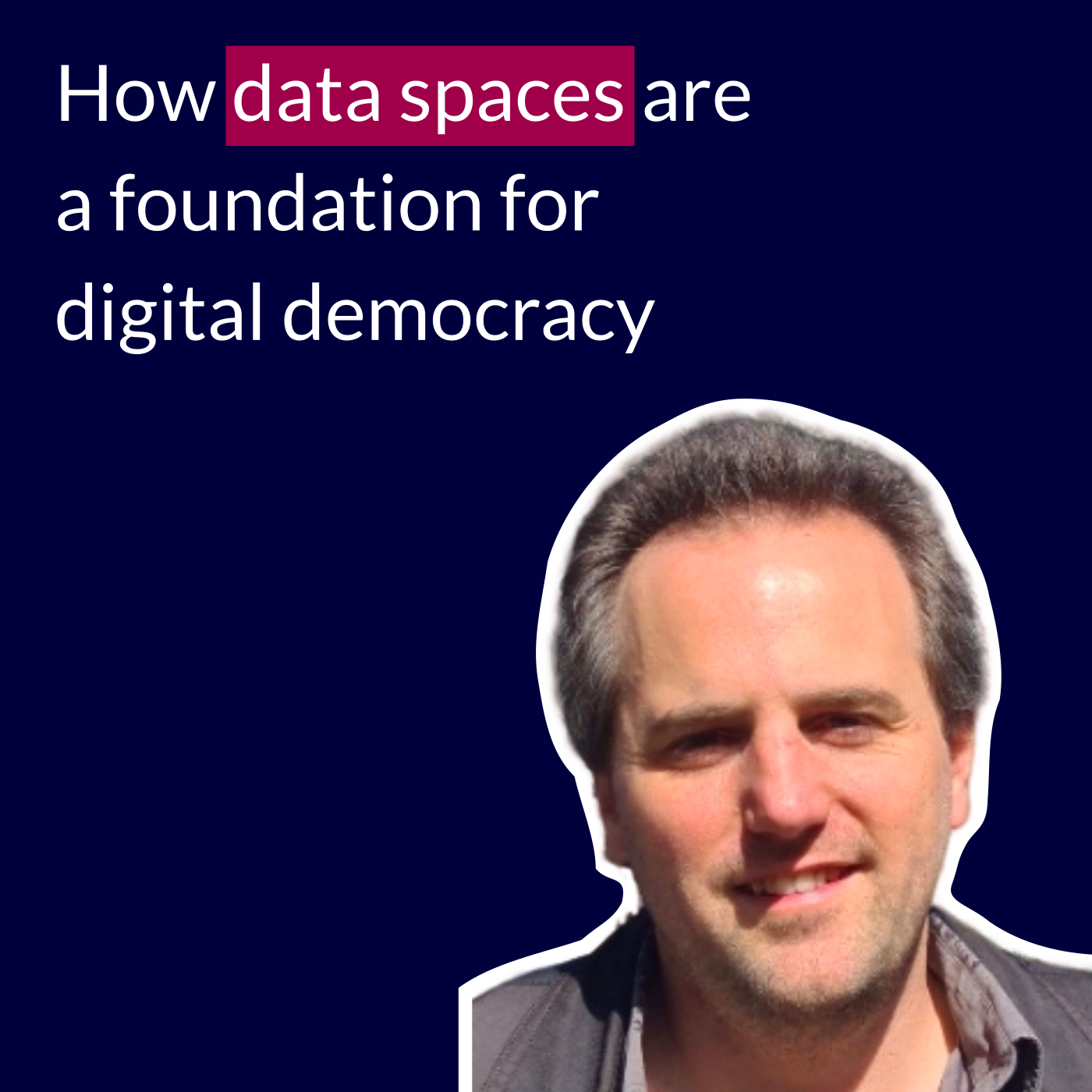
Sylvain Le Bon from Startin'blox about Data Spaces, Democracy and Interoperability
Democracy Innovators | 2026-04-14 | 49:43
Sylvain Le Bon is co-founder of Startin’blox, a company that helps building data spaces. Drawing on his extensive entrepreneurial experience, Sylvain provides an overview of data spaces and their role in establishing the foundation for digital democracy.
Top Keywords
- data space 0.035
- data 0.034
- space 0.014
- data spaces 0.012
- democracy 0.011
- mean 0.009
- access 0.007
- email 0.006
- media 0.006
- guess 0.006
- tools 0.006
- spaces 0.005
Transcript
Speaker 0
0:00 – 0:22
Welcome to another episode of, democracy of the democracy innovator podcast. My name is Alessandropp, and our guest of today is, Sylvain Lebourna. So welcome, Sylvain, and thank you for your time. And, Thanks. And, you're working at starting block. Right? Absolutely. Something that you cofounded?
Speaker 1
0:23 – 0:44
Absolutely. Yes. We we are a technical solution for data spaces. So, I guess we're gonna we're gonna get deeper into that, soon. But, we we we deploy technical solutions for people who try to build or join data spaces.
Speaker 0
0:47 – 0:51
And, I mean, basic question, what are Dataspaces? Because
Speaker 1
0:52 – 3:30
So a Dataspace is a, an ecosystem of organization who want to share data with each other, without relying on a third party platform. So, basically, today, when we interact, with like, digitally with people or with organizations like we do right now, we all depend on platforms. Meaning, we have to use the same app, store the data in that app. And, if you want to leave the app because you found another app that's better, then you basically lose all your contacts. And so, that means you're dependent on platform. That means the platform has a strong control over all the interactions of people, digital and that, in in that ecosystem, in the digital ecosystem. And so the the idea of a data space, is to get rid of the platform the same way we do with emails. Like, when you send me an email, you don't have to ask me what app I use or what I do with my data or, what's a company. You know, there's no mandatory, intermediary in email. And so the idea of data spaces is to do is to do the same thing with all kind of, digital interactions with all kind of data. So that means, you can have your app. You can store the data wherever you want. I can have my own app and install my data wherever I want and choose my algorithms and choose whatever, is being going to be done with my data. But through my app, I will be able to interact with you using your own app because the apps becomes interoperable, which means that they can plug on the same data space. So the data space is just like the Internet if you want, like the Internet of data. Data becomes available securely, under under the control of users, in a decentralized way. So today, it's mostly applied to industries. It's, because the idea is that, for a company being dependent on a on a third party platform is critical, because if if another company, especially an American or Chinese or, like, a huge company, decides who you can interact with, under which condition, at which price, then it becomes really critical for your business. So, a lot of companies are actually getting together to start this kind of commons where people can share data with each other and in a decentralized way.
Speaker 0
3:32 – 3:55
And, from a technical point of view, how it can work? Like, I can imagine it's a quite new things. Data spaces is a quite new thing, or is it, let's say, a proven concept? Like, from the a technical point of view, how this, is, can be done? Like,
Speaker 1
3:56 – 6:16
So, basically, what it means technically is that the software you're using needs to be adapted to support a certain protocol. Same thing with emails, then something like with email. The email software you're using respects the email protocol. So, in in this case, in a database case, there's a set of protocols that define how an app can access data remotely. And so if your app becomes compatible with this protocol, basically, you join the, the data space. There are to to simplify, there are three layers of interoperability in the data space. The first one, the top the topmost one is the identity layer that help define in a standardized way the identity of people, of organizations, and, also the characteristics of organizations. But for example, if I say, I'm Sylvain. I'm a CEO in starting blocks, and starting blocks is a French company, registered in a in in the by the French authorities, then I can have certificate digital certificates that prove all that so that when I, as a user, try to access data in your, in your data source, then I'm recognized as a French entity. And so if you want to share data only with European entities, for example, then I can be granted access because I can prove that. So that's the identity layer. Then you have the access control layer where we can have very dedicated, contracts with policies with access policies. So for example, I can say, yeah, this thing. I I want only data to be accessed by European entities or I want only people who pay for my data or I want, this data to be only accessible, under, a certain contract that we need to have. And this layer has a standardized way to verify that so that you can prove that you have the right to access data. And then you have the, interoperability at the data level where, basically, it it states how an app can actually connect to the data itself and access it.
Speaker 0
6:19 – 6:47
Okay. And, I I was thinking so on a practical level, let's say that, I don't know, municipality in Italy decide to implement this system and the same happens. I don't know. You know, municipality in, in France. Then, the data will be passed, I mean, completely or, like, every time there is when it's needed?
Speaker 1
6:48 – 8:14
The the the idea is to stay decentralized, and, that means the data should stay where it should be. Like, your data should stay under your control, and I might have a technical copy if I need for technical reasons. But the the official version of the data is still, in your data store. So, my app needs to access your data every time it needs to have an up to date version. So that today, basically, your name, your email address, your you know, all your information is scattered all around the Internet because everyone has copies of your data. So, for example, if you had 10 different email addresses, during your life, then there's lots of copies. And when I access your profile on a certain platform, I don't know if this this is still your email address or if it's if if it has changed. The idea here is to have all the data at one place. And when I want to access a certain information like your email address, then I will always access it in the official place, and so I know I have the latest version. And so that enables you to control who accesses it. And when you don't want me to access your email address anymore, you can, you know, stop the access control the policy, towards me, and then I I will not be able to access the data anymore.
Speaker 0
8:16 – 8:20
And at the moment, you're also working on some data spaces. Right?
Speaker 1
8:21 – 11:12
Absolutely. Yes. So we work in different industries. We're working on a big project that's the that's called Temps. It's the European media data space. It gathers, dozens of, companies from the media industry in Europe, including, television broadcasters, press agencies, and and people, in the podcast industries or in the in the book industry as well. And, there's a lot of different use cases around that. It's a it's a project funded by the cofounded by the European Commission. And, the the idea is to enable easier collaboration in the data space industry. So for example, you have fact checking, so from the price agencies and the news companies who are doing this fact checking, which is very highly relevant and highly value valuable, information because it's been verified by journalists. And, one of the use cases is to make this data available to AI companies, so that these AI companies can make better generate text generation because it's based on real verified information and at the same time, value the the and monetize the this work of fact checking by news comp corporations. There's also work on the audience data, because for media, audience is key, you know, basically. And so audience data is kinda hard to get because, you know, when you make a movie, it goes on TV, it goes on in the cinema, it goes on platforms in many different countries. So you have audience data scattered all of it all over the place, and being able to access all the audience data in a unified way is very important, for the media industry. We also work with, in the agriculture space, where there's a lot of challenges, for example, in terms of traceability. You have products, made with lots of different methods like organic or regenerative agriculture. And, the ability to trace, how some products have been made and to make them easily available to the consumers, is a key issue that can be solved for the data space. And and, yeah, and we have other, other use cases as well. We work in the mobility industry. We work in the energy space as well. And so we also have this, democracy data space that, we've been working on.
Speaker 0
11:14 – 11:33
Yeah. And exactly this was the question about, data space for democracy. And, yeah, how do you think it can be done or, like, oh, yeah, at which level of, I mean, you're working on that, and so how it is working?
Speaker 1
11:34 – 15:50
Yes. So the idea behind that is to see that there's a lot of, online democracy today. Well, online democracy what I call online democracy is a very broad thing. I include basically all social media because I think that today that's where democracy happens. That's where people debate, argue, and make ideas. So I think we need to include social media in what we call social online democracy. But, there's a lot of very interesting, democracy tools online today, where people can argue, when people can build ideas, when they can do petitions, where institutions can do consultations. But all these tools are completely scattered. They're isolated from one another. And, basically, we have these tools where almost no one interacts. And then we have all these media, the social media where, people, you know, all everybody wants to be heard, but no one listens to anyone. And, the the idea of the democracy data space is to create links between all of that so that, people can more easily have a dialogue at a high higher level. So, basically, we've, we've started the the the project last year, with several partners. The main ones were, the Metropolis of Bordeaux, the city in France, and open source politics, a company that works with Desiden, the the the consultation software. And, the first prototype we made was, a an ability for the platform, the consultations platform of the different cities inside the metropolis of Bordeaux. You know, there's probably 20 something, 28 maybe, cities in the metropolis of Bordeaux. And they they all have their own consultations platform. And so, the metropolis didn't want to to add up another platform on top of that where the citizen would have to choose if the question they want to answer is for the city or the metropolis. And, so what they wanted is to be able to share consultations between, cities so that as a citizen, I can see a consultation. I don't really care who asked it first. I just see the questions that are interesting to me. And then with on top of that, we built another tool that's, a prototype at the moment, but, where, people can see all the consultations in inside the data space that are relevant to them depending on the subjects they're interested and depending on the the location they are. So, if, you know, if we extend that and we add to that different levels of institutions, but also civil society actors, maybe some lobbyists as well, then it enables a a a new system where you can have a tool where you can see everything that's being said on a certain subject at a at a given time. And and you can imagine having AI tools. We experimented that as well on our prototype where, an AI tool that will give you the consensus that exists already on the on the debate or the distances, you know, the ideas that make people agree or disagree, but also, give you synthesis of, you know, what, debates are going on. And that all can also be used by institutions. So you can imagine having civil society actors talking to their members to create debate and create ideas, create those synthesis, and make these ideas directly available to institutions like policy, officer of the European Commission. So, the idea is to make all these discussion more fluid and connected so that, anyone can see what debates are going on and and, yeah, create, a decision good decision based on that.
Speaker 0
15:52 – 16:03
I I was wondering, what are the differences at the technical level, between another space, let's say, for media or for democracy? Like, are there differences or not?
Speaker 1
16:04 – 18:36
Yeah. That's a very good question. It I would say the general overview architecture is basically the same. It's still the idea that every actors keep their, their data. We make sure that, when you claim to be someone, well, you are that person, and, and we make sure that only people who can access data access this data, and we keep this everything central decentralized. But then there are specificities on every database that make it different from others. Obviously, when we talk about democracy, there's a lot of, personal data and a lot of, individual involved. Actors in the democracy space are very concerned by GDPR for a reason we can understand. So that means that access control should be linked to that. So for example, some institutions have have said, I I I agree that the consultations that I'm making could be used by someone else, but only I want to be sure that these people that will access the data have the same GDPR processes as we have on personal data. And so we can imagine having a kind of auditing system where you can be certified a certain level of GDPR, processes, and you can share your data only with people who have this, GDPR certification or something like that. And then another difference is that as opposed to many databases, most data is public in a democracy database when it's debate, when it's consultations. But at the same time, there are cases where it's important to have private data as well because, for example, you could have a private conversation inside a civil society actor before a synthesis is pushed to the institutions, and it's important that this private data stays private. You also have some institutional, conditions under which sometimes a consultation stays, undisclosed until a given date where everything becomes public. So, so the the type of data and the conditions under which things stay, private are not the same or are kind of specific in the democracy data space.
Speaker 0
18:38 – 19:41
And, I I was thinking about this, GDPR issue and also related to identity. So, I mean, because, data spaces, it could mean that, different municipalities share their data, but at the same time could be also, let's say, an organization, that that is, also have, his own, its own data space. But then it has to follow the same regulations. And so I'm thinking that the it will not be easy, like, for someone, let's say, a small organization maybe, to to be able to respect the same, so so I'm wondering if this, because the question that I had is, if data spaces should be something, at the, let's say, institutional level or, like, more bottom up.
Speaker 1
19:47 – 22:10
I guess the ideal that it would be that it it should be both. I think we need to have the bottom up approach. You know, if we don't have civil society organizations or citizens, taking you know, using anything that's democratic, data space or something else, then I guess there is no democracy. No. Democracy is first the citizens, I think. So, obviously, we need to have both organizations and applications, you know, things that make that democracy database accessible to people. But, eventually, we also need institutional support. So the the obvious reason in the first stage is that, we need investment. You know, we need to invest in in this infrastructure because, it's not made of of air. And so, well, the question is who should invest in democracy? I guess I guess it's a it's a it's a it can be subject for another debate we can have for a very long time. But, yeah, my feeling is that public institutions should be investing in democracy, and so they should be supporting this. But, of course, there's also then the question of once this democracy space exists and is made of lots of contributions, then how do we integrate that with the work of institutions? So, I think, eventually, the European Commission should be using this, data space. It it would save a lot of time, I think, for the policy officers who today do a lot of effort connecting to, stakeholders, who today are mostly what we call, you know, the Brussels bubble, which means the European Association of Nana and the European Federation of Nana. But, these federations actually have a lot of people on the ground, and these people is far from Brussels. So this data space could enable create this link between institutions and the the real people. And so I think the institutions would have to a lot to gain from, such data space. And so, yeah, I guess I guess we need both, eventually.
Speaker 0
22:11 – 22:36
Yep. Absolutely. And, do you have an idea about, let let's say that in the next future, institution will use data spaces and also citizens, like, I don't know, different kind of data spaces, but, maybe all related to democracy. How do you imagine the future? How, like, the society could work?
Speaker 1
22:38 – 25:05
I I I think it's kind of easy to do, this exercise because, I mean, there's a lot of amazing digital tools today. We do a lot of amazing things. You have tools that enable, yeah, to to analyze lots of data to tell you these are the best ideas that everyone supports. These are all the ideas that not everyone supports. And and so you can very easily, build, create policies out of data. You have con collaborative tools where people can build together a new, regulation text or something. You know, the the the diversity of what exists as tools is amazing. The problem is that these tools are not connecting to are not connected to the the real data to to so they're they're basically very small tools that no one uses or few people uses depending on the tools. And and and it's kind of disconnected from the actual, legislative work. And so, you know, what I could imagine is a world where we just connect the two. We connect the dots. And, that, creates a world where you can have on a certain subject, you you know, what I what I feel when I look at the state of our current democracies is is that whatever the very complex subject you take, if you dig deep enough, people have the answers. I mean, there are there are experts who worked on the thing, and they have solution. The solutions are in the table. The problem is not that we don't have the solution. The problem is how to make those solutions, become a decision, a collective decision. And and I think that's, you know, something we can create with the data space because we can create the link between the discussions you have on the social media and the reports and the complex, you know, solutions that are out there and the the political decision. We need to, you know, connect all of this, and I think the tools exist. What we need is to connect these tools to the data, to the discussions, to the debate, to the reports, to the institution, and so on.
Speaker 0
25:06 – 25:48
I'm also very excited about data spaces. And, I was thinking, like, because data spaces, we said the three layers, you mentioned also interoperability and the seed very, I mean, connected with standards and, finding, like, let's say, a common language between, as you say, the identity access control layer or interoperability. And, Yeah. I I was thinking also, like, about the Fediverse that, I mean, it's different. It's not a data space. But at the same time, I think it shares some similarities.
Speaker 1
25:48 – 26:39
Mhmm. No. Well, I I mean, probably some people can, get pissed if I say that, but to me, the Fediverse is a data space. You know, I I consider the Fediverse a data space because I have a very broad definition of what a data space is. Same thing. You you will hear lots of definitions of a data space. But to me, if you have to me, email is a data space. You know? We send email. The emails are shared. There's a common protocol. I call that a data space. So, the favor is a data space. It's a very interesting way to create social media in a data space way and to actually see what it means when it's not one big multinational corporation that controls all the interactions between everybody on a social media. So I guess the data space is just applying the same logic to all digital interactions in on the web.
Speaker 0
26:43 – 27:31
And, I I mean, I I was thinking also about the access control layer. So let's say that, we consider email as a data space. So, basically, with email, I'm able to send you an email or to receive an email. I'm not able, let's say, to see your activity. I don't know, like, if you sent email about data spaces today or you sent email about, I don't know, something else. So this access control layer could be also this, like, being able to share some data. Also, I'm thinking that with AI, it will be possible maybe, to share something about the context without sharing everything.
Speaker 1
27:32 – 28:38
Absolutely. Yeah. Yeah. So email actually is not a good example in this case because in emails, you only push data. You you you never pull the data, where in the real world, a lot of apps, you know, access the data where it is. Anyway, but, yeah, the there's a the idea of access control is really to be able to say in a very precise way, the conditions under which you accept that your data can be accessed. So there's a lot of variety in how this should be done. I can say this data is only for ASR, and you have to prove that you are ASR. And if you do, then you access the data. I can always also say, like I said, it's only for European companies or it's only if you can prove or you can if you can certify that we you will destroy all copy of the data after twenty four hours. You know, there's a lot of different conditions that you can define, and these conditions can be under certain condition, enforced so that you are you you can trust that they will be respected.
Speaker 0
28:40 – 29:52
Okay. And, regarding identity, because I'm thinking let's if we think about, also email addresses, I mean, I don't have to actually share my identity. I mean, sometimes there is, with the phone number or something else, you're approving your identity or connecting it with your, phone identity. And, but also the 30 verse, at this moment, doesn't have, an I I mean, you have an identity because you create an identity on a certain server, but you can also have, let's say, thousand of different identities. And so I wonder, like, because it's a very sensible topic, the things. And so I I was thinking also, let's say, because from a institutional point of view, like, data spaces. I mean, it's easy to, connect the identity with citizens. But in a sort of, let's say, bottom up data space, how this can be
Speaker 1
29:53 – 31:21
done? Sure. I mean, there's no data spaces don't you know, there's just a framework under which you can do a lot of different things. And both are possible. If an institution wants to say, you can participate in my, in my consultation, but you have to state your identity because we don't want people to just come ran randomly, which which, you know, is legitimate, then it's possible to require to have proven identity before, participating in a participation in a consultation. But at the same time, if, you want to have an open consultation where people can be anonymous or with pseudonym, it's also possible and, you know, it's it's I guess it's the the the the sovereignty of people who organize the debate to decide what are the rules in that debate. And all of that can be connected. Like, you can have a civil society organization organizing a anonymous debate for reasons we can totally understand, you know, where people don't want to, you know, want to be able to to speak freely without fearing, consequences. And then this civil society can make a synthesis of it and then participate in a public debate with, you know, a certification of who they are. So, you know, both are compatible, I guess, and complimentary.
Speaker 0
31:24 – 31:28
I just realized, is this starting blocks? What does it mean blocks?
Speaker 1
31:33 – 32:54
Okay. That's a total different subject. But, basically, at starting blocks, we, what we do in the database ecosystem is to work on the, what I call the last mile interaction. We really focus not on the infrastructure of the data space, but really on how you as a user will be able to to join the data space. You know? So we we work on apps, we work on AI, we work on how to make this data space. I mean, you don't even need to know what a data space is as a user. We you should not know what a data space is as a user. You should have an app on your phone with buttons and you you want to click on the button and whatever you want to happen happens. So that's what we focus on. And we do that with modularity, because one consequence of data spaces is that we can have lots of different apps. You know, your app can be different from mine. And so we have interest in reusing, in an open source way. You know, what I if I build an app and you want an app that's slightly different, you can reuse my app. And so the modular approach makes sense because you can remove a module from, from my app and add another module that fits your needs better. And, so we have a technology that enables to build interfaces this way, and that's, you know, those modules are what we call blocks.
Speaker 0
32:55 – 33:00
Okay. Because, I I thought to block, and I thought about blockchains.
Speaker 1
33:01 – 33:04
No. No. No. No. No. No. No. No. No. No. No. No. No. No. No. No. No. No. No. No. No. No. No. No. No. No. No. No. No. No. No. No. No. No. No. No. No. No. No. No. No. No. No. No. No. No. No. No. No. No. No.
Speaker 0
33:07 – 33:28
I remember there are some projects related to, let's say, health where data is shared, I don't know, in a blockchain. And then, I don't know, you give access to, let's say to a certain doctor. So the doctor has all the documentation about yourself, but the documentation is encrypted and so on.
Speaker 1
33:29 – 34:54
Yeah. I mean, you know, the the whole idea of blockchain is to have a public ledger of data. So I'm always, you know, I always find weird to use blockchain for sensitive data. In in another in a like, in a very similar use case, you had, Interrupt. I don't know if you heard of Solid. Solid was a w three c initiative led by, Tim Berners Lee, the inventor of the web, and he started this company with Tom with John Bruce, named Interrupt. And one of the project that they've been working on that was very interesting was this, Manchester project where basically they deployed what they called, pods. I think now they call it data wallets for citizens where you have basically all your health data under your control. And instead of having your health data scattered, all over the place, you have your health data and you share your health data with whatever practitioner you you you work with with where you work with. And, that doesn't require a very complex and energy intensive infrastructure just such as blockchain. It's a basic web server somewhere, but I guess it covers the same needs. And and that's very and I call that a data space as well. You know?
Speaker 0
34:57 – 35:42
And I was thinking, let's say that, yeah, a democratic data space a data space about democracy, will be created and the interoperability will, work. That I think that is something absolutely possible and useful. And then I forgot the question. So it happens. But by the way, I'll ask you something about your background, and then the question will come back. Yeah. If you'd like to share something about, your background.
Speaker 1
35:43 – 35:53
Oh, my background. Yeah. Sorry. So me personally, Sylvain, you mean, to who I am? That's what you wanna know?
Speaker 0
35:53 – 35:59
No. Like, where you I mean, what you study, what you work at dawn before data spaces. Sure.
Speaker 1
35:59 – 38:10
So I grew up in in France. I'm I'm French. That hasn't been said. And, starting boxes in Paris, actually. Yeah. I'm I have been an an entrepreneur for, fifteen years now, and I started, quite a few different businesses. We, with Alex, who he's also the cofounder of Starting Blocks, we've, funded Happy Dev, which, has been the the biggest, I think, network of freelancers in, in, in Europe, I think, as far as I know, at the time. I've always worked on how digitalization can bring collective intelligence. You know, that's really what, you know, I want to work with. So that has taken a lot of, different, aspects, over time. But, yeah, I mean, gathering freelancers in a new kind of organization was one of them. I've also worked on cooperativism. I've also worked on horizontal management or open source business models. You know, there's there's a lot of different things, but the idea is always the same. You know, how the web, actually transforms our organizations. And when we were at Happy Dev, we grew the network and at some point, you know, the digital tools we we reached something like 700 people at some point. And and at that stage, the digital tools were obviously key in the interactions in the network. And so we had we were facing a point where we we were becoming a Uber of freelancers, if you want, which which is not what we wanted. So we decided to decentralize the thing, and so we needed decentralized tools at the same time. And so, that's why we started to work on these technologies and, you know, that's what led to the creation of starting blocks afterwards.
Speaker 0
38:12 – 38:23
Okay. I have my question back. So Cool. Data space is is something that is needed. And then what else is needed? Let's say
Speaker 1
38:23 – 39:55
Mhmm. Yeah. The the technology is not is never magic. You know? Just putting a technology is never enough. I think that the absent the absence of technology can be a blocker, and I think the absence of interoperability in digital tools today is a blocker for a digital democracy. So that's why I'm working on this. But, obviously, if we have the technology, then we need people to use it. And I I think it requires I'm gonna say new kinds of organizations, which I mean, you know, it's what we can call civil society organizations, I guess, but, more digitalized. I I guess, you know, there's already a lot of networks online that organize, but their organization online is often disconnected from the rest of online democracy. So we need to have this kind of organizations that actually, take over this data space and use it and use it to with, you know, with a certain with a clear political goal. The the the the data space should be neutral politically, but organizations using this data space, well, should not. I mean, they're they have they they they should be defending whatever they want to defend. And I think, I guess, democracy is about having the discussions between, you know, people who disagree. And, you know, I guess that's what democracy is about.
Speaker 0
39:56 – 39:58
Yeah. Sometimes we are not used to disagree.
Speaker 1
39:59 – 42:09
And, I I guess we kinda lost this with social media. And I guess, you know, I I really feel like we you think that, people who don't think like us are assholes or dumb people. You know, how can I how can they not understand that I'm right, you know, basically? But I think, if we want, if we care about democracy, you know, I I guess it's a a very deep question we have at the moment at the geopolitical level. Do we think, democracy is important? Do we think it's an efficient system? And because if it's not, it's gonna disappear. You know, that's basically what it is about today. And and if we think it's efficient and if we think it's good and we should take care of it, then then we should learn to listen to people, who disagree with us and apprehend the fact that, you know, from their point of view, there's some, you know, rightfulness in what they say and, and the the true, the the good decision is not what you think. You know? The good decision is a compromise between what you think and what I think. And, and I think it's very very hard today. You know, we have social media where we we like to yell. We we feel so much, you know, touched by, you know, when we see someone who who claims something, that's, you know, a lot of situations are very hard. So we feel a lot of emotion for the people for those people. So we we hang on to an ID very strongly, not necessarily seeing that there's another face to the problem, and we need to see all the faces together. It's complex. We need to talk. We need to listen, and we need to build solutions little by little. And I think that we have institutions that used to do that quite well and kind of, like, I think online democracy kind of endangers that, threatens that behavior at the moment. And that's why we need to find a way to recreate that in the digital world as well so that we can, you know, become a digital democracy, for good.
Speaker 0
42:10 – 43:20
Yeah. Absolutely. And, but I I was also thinking, like, on one side, the, I mean, many times I'll I ask this question to to guess, like, why do you think that people do not participate, in, in the political life? Because I see technology as something very useful. And I yeah. I'm very excited about data space and the interoperability and everything that can, came also because I think it can be useful also to, let's say, you know, avoid the geopolitical issues. And, but, yeah, on some way, we could have had like an I mean, also without technology, I mean, people could participate, and and so on that. It will be, way more complex than, with technology. I mean, the question is, why do you think that some people are interested in the political life and some people are not? And also why some people are sensible to horizontality and, like,
Speaker 1
43:22 – 45:04
while other people do not care? Like, I have some friend that say, oh, if I have a person that decide for me, I'm happy. And I'm like, okay. Yeah. Well, I guess these people will have won't won't be happy when that person decides something they disagree with. You know? You're happy when someone decides as long as they decide what you want. And I I I think it's not true that people are not involved politically. I think if you go on TikTok and Instagram, you will see that people are very much involved. You know, people there's a lot of people saying things on social media. What they, you know, what they're not engaged in in is the institutions. And I I think, yeah, I think that sums up the the problem. We need to create the link between my social media way. I I want to be heard, you know. I want to express I my life is hard. I want to say it, and I want people to listen to it. And on the other side, you have an institution that feels completely disconnected from this problem with, you know, all these political actions where, you know, these political, mechanisms where people have strategies and so they build their strategies on how to get power in the next elections, which is completely disconnected from my problems, my daily problems. And so we I guess, we need to somehow disconnect the political decision and decision making from elections and connect it more with social media or wherever the people can express themselves. I think that's, yeah, one of the ways to improve that. And, yeah, once again, I think that's why we need a data space.
Speaker 0
45:05 – 45:28
And I really like, I mean, the idea of considering also big tech, social networks as, something where debate happen. Then, okay, debate happen where but with some logics that are not maybe healthy to the debate. Yeah. But that's also because of the nature of them. I mean, you know, you can have I mean, the the
Speaker 1
45:28 – 46:01
a social media is one thing. An algorithm designed by a company for their profit is something else, and having a social media doesn't mean having these algorithms. So there's also a question of regulating those algorithms, decentralizing the social network, you know, that's a you can see it part of the of the democracy data space if you want. I guess it's another work. We we've we're not working on this right now. But, yeah, I mean, I don't think you can talk about democracy if you don't care about social media. That doesn't make sense to me.
Speaker 0
46:01 – 46:28
Absolutely. And, I have some sort of specific question. Do you think that will be possible also to connect, let's say, mainstream such a network also to a data space because people are on, Facebook, X, and so on? And so I totally agree about the fact that, about going where the people are because the civic tech software, otherwise, are mostly empty.
Speaker 1
46:29 – 48:08
I I I think, there's two aspects, like, we can connect. It's kind of easy to connect in a one way direction, like, because they have APIs, you know, they they know they they they allow you to post things. So we can create a sudden link, but, of course, that doesn't change their algorithms and their control over the social network. And I think there's another problem, which is the same problem, that as Dataspace are trying to solve, and that's what you said about the Fediverse. Another problem, which is the the total control of a few companies over all the social interactions online between people. So I think the only answer to that is regulation. The European Union has started to put on some regulation, going towards this. My personal feeling is that, if people cannot choose the algorithms, of this the media they're seeing, then the media should be considered as editor and not hosting providers, and they should be responsible of all the content. You know? If you don't want to be responsible of the content that's published on your platform, then you should, open your algorithms and let people decide on the algorithms. Because otherwise, you're making a decision of who sees what, and I think that makes you responsible of the content. Well, that's a personal opinion, and I guess, you know, we but maybe if we had a, more fluid democracy, this kind of ideas could be discussed better and maybe, you know, it's been,
Speaker 0
48:09 – 48:20
implemented. Yeah. Let's hope. And, as a last question, like, if you have a message for the people that are working in the civic tech space, political tech, whatever, like,
Speaker 1
48:21 – 49:03
Yeah. Well, I guess, thank you because, I mean, it's amazing all the diversity of tools and the the richness of, you you know, everything that exists, in the civic tech world. And it's so frustrating to see that, we spend so much time on Instagram and so little on those tools. And I understand why we do that. But, so yeah. Your tools have a lot of value. You know, start competing for audience between between each other. Come together, join a data space, put your tools in common, so that we can build something bigger together.
Speaker 0
49:06 – 49:07
Thank you a lot, Sylvain.
Speaker 1
49:08 – 49:08
Thank you.
Speaker 0
49:09 – 49:11
If you have anything else to add,
Speaker 1
49:13 – 49:38
No. I mean, you have I mean, if people are interested, they can reach out. We're trying to build things, build different use cases. We're looking for, organizations who want to experiment. We're looking to for, funding to to move on with these experiments. So, yeah, please reach out if you if you're interested, you you want to to buy to experiment as well.
Speaker 0
49:39 – 49:41
Thank you again. And
Speaker 1
49:42 – 49:43
Thank you.