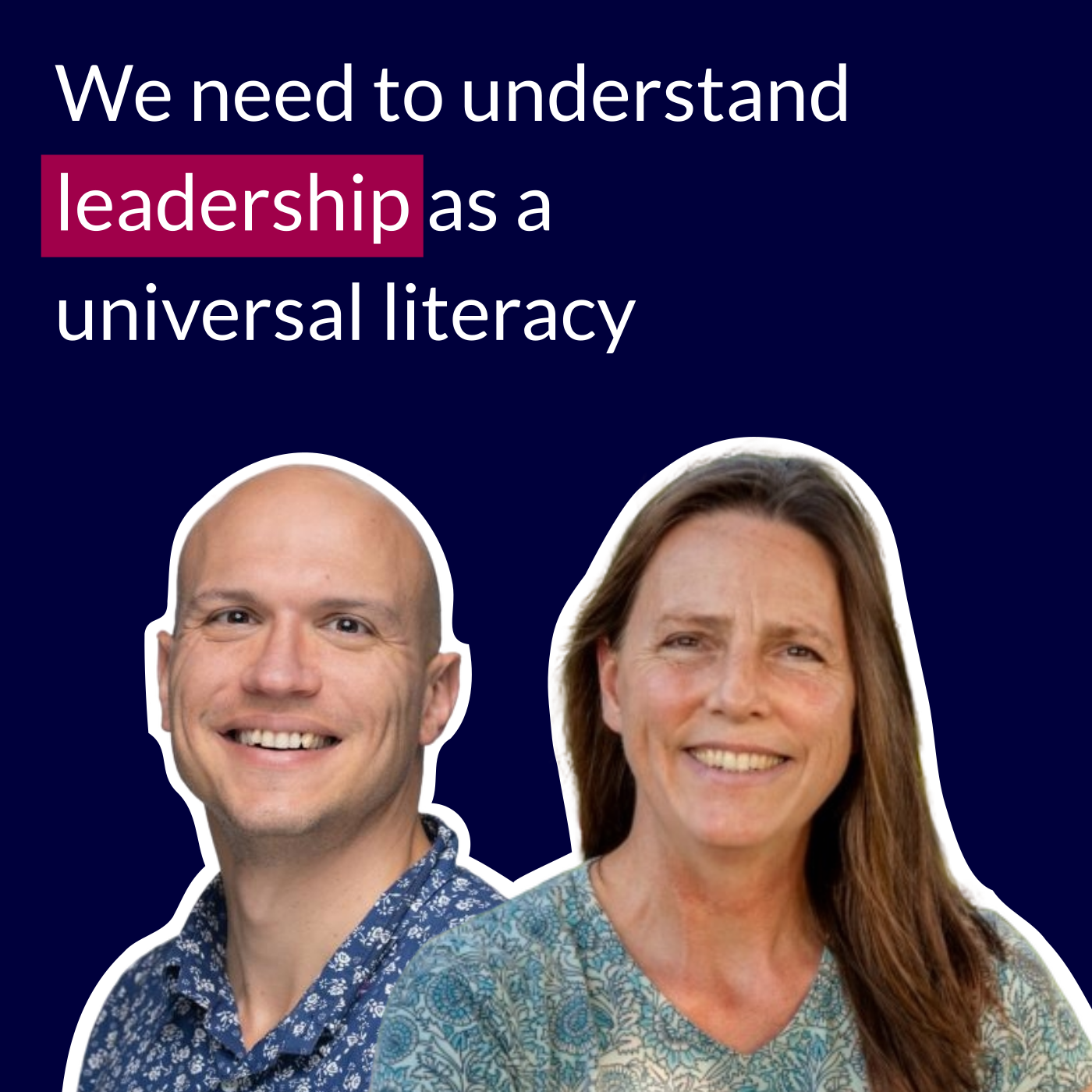
Cecile Green & Seth Frey on the Commoning Standard and the role of self-governance for democracy
Democracy Innovators | 2026-04-21 | 50:24
Cecile Green is a social entrepreneur and Seth Frey is a computational social scientist. They share a mission to enable healthy self-organization and improve relationships in society, which naturally impacts democracy. Together, they work on the Commoning Standard, which unites stakeholders from research and practice to develop standards for effective self-governance.
Top Keywords
- power 0.017
- share power 0.009
- share 0.006
- cecile 0.005
- skills 0.005
- everybody 0.005
- work 0.005
- commoning standard 0.005
- training 0.005
- together 0.004
- well 0.004
- collective 0.004
Transcript
Speaker 0
0:00 – 0:22
Welcome to another episode of the Democracy Innovator podcast, and our guests of today are Cecile Green and Seth Frey. So thank you both for your time. And and, yeah, you're working on the common standard. Right? So would you like to tell us something about it?
Speaker 1
0:26 – 0:27
Go ahead, Cecile.
Speaker 2
0:28 – 1:30
Yeah. Yeah. Thank you. It's a delight to be here. And, I guess a a short summary of the commoning standard might be that we are, attempting to bring together researchers, practitioners, and anyone who has a deep interest in this question of what it takes to self govern well, to weave together a synthesis of our best knowledge, and and wisdom around what that takes including the theory, the practice, the skills, and the traits that go into enabling us to self govern effectively over time. And, that work we're intending to make, available publicly and also potentially put it into some kind of a platform or integrate a number of different, tools in an interoperable way to enable that, digitally as well. But starting with, the the basis of bringing together a community of knowledge around this this topic, which we hope to sustain long into the future, to continue to improve, what we know about self governance. What would you add, Seth?
Speaker 1
1:32 – 3:11
We're doing that under a specific, theory that what's really needed, is a social substrate in which everybody knows leadership. We're we're really approaching assuming, the entire, cache of of of leadership skills, from, you know, note taking, building an organization, getting people together, and, you know, cooking to bring them together, resolving conflict and so on, as, as a a universal literacy. And we've really set the bar that nothing short of that, nothing short of universal training in common stewardship, as the most general, articulation of self governance skills in any domain, is our goal. Maybe it's worth introductions. I'm, I'm Seth Frey. I'm, an expert in, governance, at University of California in Davis with a background in, computational cognitive science, computational social science. And I've found, this very non computational, work, through twenty years, as a practitioner of cooperation, mostly through intentional community, as a as a cofounder, leader, and, little volunteer developer. So you mentioned,
Speaker 0
3:11 – 3:30
bringing together people, and and, you said to mention such a creating a such a substrate where everyone knows leadership. And so I was thinking because both are related to power. So, also, for you, what is
Speaker 2
3:32 – 6:50
power? Such a great question, Alessandro. And I'll I'll, I'll take a crack at that and also introduce myself a little. I'm, have a background as a social entrepreneur and, in that process of of launching many different and running many different types of mission driven organizations, I ran into this, issue that people don't really know how to share power well over time. That that often, even very well intentioned people with incredible visions run a ground on our inability to reliably and consistently over time share power well. And so that inspired me to do a deep dive into this question of what is power, and how do we how do we mechanize? How do we enable us to share it well over time? And and so, did did, research and published, some papers on it and and also an ecology of practices which have in practice over the last ten years or so shown themselves capable of of people using these in wide range of different environments to reliably be able to share power better. So, yeah, back to your question, what is power? And I think that this ultimately for me feels like the most important thing is us for for us to be asking that question, and continually answering it for ourselves. For me, I found that that answering it in the biggest possible way was helpful. So the force of enactment, something that is present in all of creation, as it so it it helps to also define, say, things at the quantum level as well as at the social level, but my particular interest was at the social level. And so within that very broad definition of power as the force of enactment, I then sought to understand what is most critical when we are working together, what forms of power are operationally relevant. And I I, chose to define four at the time, I'm there's many more, I'm not claiming these are comprehensive, but these are four that I believe if we don't have a really good handle on, we won't really be able to self govern. And so the the power matrix describes four forms of power, the vertical matrix is, at the top is autonomous power, at the bottom is collective power, and on the left there's implicit power, and on the right there's explicit power. And these four forms of power are all active at any point when we are trying to coordinate, we're trying to make decisions, we're deliberating anything that involves coordinating together. These four forms of power are active, whether we're aware of them or not. And the invitation then is to understand what kinds of power are active in any you know, like, primarily active. Are there imbalances? Are there congest is there congestion? Like, is somebody using too much autonomous power when we really need more collective power? Or the opposite, are we using too much collective power when we really need to give power to to individuals in the situation? So it becomes a tool for analysis and then taking action concretely in our groups, to to be able to share power, and and develop healthy power, for ourselves.
Speaker 0
6:51 – 6:55
You said to have any answer.
Speaker 1
6:57 – 10:08
I think I come to, the same place from, from the same experiences, you know, really independent. I've observed, in my experiences as you know, for first, I I, I absolutely hold, that daily practice of democracy, is essential for, an educated citizenry, and this is a citizenry that can successfully steward democracy. I've always, cared abstractly about democracy, but experiencing economic and political empowerment by in a in a community where I was doing every day was very transformative for me. But, also, I observed, that I think every community I've I've been in really actually, in some ways, fell short of its potential to transform people because as intentional as we were, we weren't intentional about developing everybody's, leadership, potential, everybody's capacity for, for being a really kinda mature and proficient. Everybody's latent capacity for being qualified to run the place, you know, whether they're good at it or not. Just reaching some basic level of literacy, you know, can accomplish for a community a certain amount of, herd immunity against, what de Tocqueville calls, municipal discord, when your political education, as a community is complete. So seeing communities so often fall short is what's made me, become a student of Cecile's, because she has, such an integrated sense of what it means, through all the work she's done getting her head around power. All the work you have to do, on yourself and all the different dimensions, you have to develop yourself and your skills and your knowledge, in order for community to, replace the crutch of hierarchy. Hierarchy, you know, say what you want. It's pretty easy. You can really kinda plug it in anywhere. It scales really well. It works on every type of person. It doesn't work on a specific type of person. And to to to kick that habit, to to, you know, to take off the training wheels, of social organization that hierarchy constitutes, and and really, like, go under your own power, you have to give every person, a huge amount of talent. You have to, you know, do it the hard way. And if you're not fixing things the hard way, you're not really fixing things. So that's a a conviction that, Cecile and I both share. And, and, yeah, I think for both of us, it comes out of our analysis of power.
Speaker 0
10:11 – 11:32
Yeah. I see it associated with, the concept of meritocracy that, a lot of times, you know, someone has merit. So he's like or she is the best, but I think that we should find the way to give merit to everyone so that we find the special talent superpowers that we have. And, and then, I was thinking about these things. Is it possible, like, to share power or, like, to, or you as you were saying, like, giving, the possibility to everyone to find their power? So let's say, the three of us, how can because as you said, Cecile, sharing power is not something that happen often, also in relation to hierarchy hierarchies. So I wonder these things about sharing power and at the same time, giving, the possibility to people to express their own power so that they can take the power, without the other person having to share it. So I
Speaker 2
11:33 – 11:52
Good. Yeah. If I, if I understand your question, Alessandro, it's how do we, encourage people to step up into power as well as and not just have it given to them. Is that accurate? Is that your question? Like,
Speaker 0
11:52 – 12:33
let's say that, now I decide to speak for the podcast all the time. Like, and I'm only one that speak. So I will take all the power in that way. At the same time, you can also interrupt me. And so you would use your power to speak. So I think that it would be good that everyone, like, respect the other people so that, we share the power of speaking. At the same time, like, all the people should take their power of speaking.
Speaker 2
12:35 – 15:14
Yes. That's wonderful question. I I if I'm following your logic, there's, something I would call personal development needed for people to be willing and able to step in and say interrupt if they need to. And there's also the responsibility of the the collective to provide space or structure so that stepping in is okay. It's actually accepted. And, I think both are really true. Both are needed. And so this approach, the commoning standard is really taking on both a collective and an individual approach to this question of what is power and how do we share it. We're not saying it's just the collective's responsibility to create space, but the individual also really needs to grow. And every individual is different, like, not everybody has trouble speaking up and and jumping in and taking up space. Right? Some of us do and and and for for those of us who do, and I would just mention that there's historical precedents here, right, which influence how much people are comfortable with stepping in and speaking up. And I believe it's the collective's responsibility to, account for that historical damage that's been caused and create, training wheels, training grounds for people to learn and to step in in in ways that are safe. Because I'll just speak for myself. I've been in situations where I did take the risk of speaking up and I was I was punished for that, right, in those contexts. And so many many human context actually punish people who dare to overstep the power boundaries and step up, and and speak or interrupt somebody who say is in a high position of high status. And so that's can be very costly for people who who say don't have as much status in a group. And this is where the collective comes in to redistribute those assumptions about status and power and says, no. Actually, we really wanna hear from you. We're gonna make space. We're gonna ask the facilitator is gonna deliberately ask that person who's been speaking too long to stop. And and and then make space and invite that other person in. And then as these imbalances are redressed, once they're more naturally encoded in a group's cultural code, then then it's much more easy to sort of flow and to share power more readily. But there is a training ground that's absolutely needed to move out of our toxic relationship to power into one that's generative. And I don't think it's fair to ask the individuals only to take up that burden, of stepping in when it's not actually safe for them to do so. So both are needed.
Speaker 1
15:16 – 19:32
And to, to build out one part of what, Cecile is saying, power is very much a a two way street. Maybe, maybe you've been in the in the situation where you built something intending for it to be a flat organization, but people, put you, in power. You know, maybe because you have a founder, maybe because you have the clear decision. People, give you power. And if you're not used to wielding it, you don't exactly know realize what's happening. Maybe when you do realize what's happening, you, you know, you try to pass the ball, but there's no one there to hold it. No no one has the stake, the investment, and it's probably, their fault, but it's probably your fault that you haven't, cultivated those people to to have that level of investment and that sense of capability and all the things they need to take the ball. I've been in very few really kinda successfully, successfully, flat participatory, equal organizations, organizations that succeed at maintaining this kinda sense of equality, the sense that we're all peers, the sense that we're all responsible. In every case, the the ones that manage that are the ones in which every member has tried and failed to create one of those before and has become that leader, who wants to pass the ball, but there's no one there to catch it. I think we all have to be through the crucible of, experiencing, both sides of power, in order to, steward it responsibly, wield it responsibly, hold it responsibly, pass it responsibly. There's just a lot of basic lessons. I think a lot of people don't realize, what corruption feels like, what it feels like to be corrupted, what it feels like to use power, inappropriately. You know? It's a simple yeah. In the same way, we don't always understand, our effect on on children. You know, children will make, really make anything their fault, because they're used to this idea of control. And and so it's not enough to just live your life and be responsible and make good choices. You also have to interpret what you're doing, for for a child to make sure that they kinda, see, that they're not responsible for everything that happens in in in in their lives. And I think we're all children when it comes to power. We can get ourselves into into tricky situations and only with, again, this kinda herd immunity where it's not just you have an awareness that this is happening, but everybody you're responsible for, and everyone who's responsible for you is aware of the failure modes. I see it my favorite example, has really become conflict resolution, nonviolent communication. Turns out there are some pretty violent uses of nonviolent communication, especially if you identify, as as someone in that tradition as a nonviolent communicator. You become blind to your potential for violence. And it's only with a general training, general training, universal training in something like nonviolent communication that we can be robust to those those failure modes. And that's worthwhile because, you know, maybe you've seen the conflict being resolved because, there was a skilled, trained, mediator between two individuals in the middle of something. Maybe you're impressed by how that turned out, but it's nothing compared to watching a conflict being resolved between two people with no moderator who are highly trained in nonviolent communication. It's seeing them go at it that makes you wanna get into more conflicts. It's seeing someone highly trained in meetings that makes you wanna have more meetings. And that's really inspiring, and it really illustrates the the potential. When we stop treating, you know, democratic literacies, connoisseurship literacies, leadership literacies as something that's only for people who have been put at the top of an org. That's something that's only for people who already have all the other steps of Maslow's hierarchy in place, and it's really for everybody.
Speaker 0
19:34 – 21:07
Yeah. Well, I was thinking about, many different things. Like, yeah, it would be cool, if in school, there could be, like, some classes about the conflict resolution, about how to communicate and so on. Because I see, I mean, a lot of polarization are happening, and we are not used to communicate. I was saying also, like, when someone is very interested in, trying to do his or her own best to communicate, it's, quite hard, and we see it also in personal relationship. And, and then, yeah, I wanted to ask you, like, as you said, Seth, if I understood correctly, like, that, let's say someone that could be a good leader often has failed in other communities. And so I wonder, like, which kind of experiences you had because I agree about this and, in the different communities. And, also when you realized that horizontally is something, I would say, better than hierarchies. Yeah. If you remember, like, some personal moment, like, you know?
Speaker 1
21:10 – 21:11
Only if you'll share yours.
Speaker 2
21:14 – 22:36
Yeah. It would be great to hear all of ours because I think I think we've all probably had these experiences. I'll just briefly mention for myself that one of the things that was so exciting for me about learning some of these tools and practices for sharing power that afforded, clarity not just for me, but for the people around me was that I realized I had been making myself small. I had been holding back because I was afraid of using my power. I did not want to be that dominating hierarchical leader. I just did not want it from coming out of me. I didn't wanna experience it from anyone else and I thought that, oh, well, I better start with myself. Right? But the way I went about it was to just hold back my power as opposed to stepping fully into my authenticity and my capacity, which is what's really needed. And so having the structures that enabled me to see for myself where's the boundaries for me, where are the boundaries for them, where do those boundaries change, how do we change them collectively, changed my experience as a leader. And I was able to really start stepping in fully to expressing myself and bringing all of my gifts forward instead of making myself small. And that's just one example of the transformation and and where I realized that the the assumptions behind flat organizing that I had were not helping and they weren't helping me or anyone else. Yeah.
Speaker 1
22:38 – 25:28
Yeah. So this emphasis of Cecile that we get so many of our ideas for what leadership looks like, for what power looks like from, kinda from ideology, from ideas, from sort of theoretical constructs that we sort of picked up that sound right rather than from experience, which is a a much finer tool, that's capable of the same ideals, but it's just a lot more nuanced and complicated. I got my sense of all that. I think the most dramatic lesson I learned was being part of a consensus organization, that was an intentional community that was renting. I was the only person who'd experienced community that owned, and, my diagnosis was what the community needed to be sustainable, to really have a culture of of sense of ownership, to to last forever, to serve everybody the best that community would have to own. And I had a hard time convincing everybody of that, so I was constantly checking in with myself. Do I really think this is important? Do I really think this is is the right thing? And I kept coming to the answer yes. Even as I became more political, even as I started, asking, forgiveness and set permission, to to build a project, to lead a project, even as I started managing information, calling in favors, cashing in five years of social capital to get something done, I, found myself, you know, really kinda pulling this org in a certain direction and constantly navigating my own, my energy, my sense of what was right and and and the community and kinda where it was at and when it was needed. And it gave me this realization that democracy is not a set of rules that you follow. It's the tension. It's the process of navigating the tension between what you think is right, no matter how popular or unpopular it is, and, your trust, the trust that you're given by everybody. And you can trade, more what you, think is right, for that trust. So you can pause on what you think is right to build that trust. So you can, work to minimize the difference between what you think is right and what everyone else thinks is right. And but that's fundamentally an in interpersonal process. So democracy is really, like, less about the set of rules or procedures that we've set up around ourselves, and it's really entirely about the relationships we're managing as we try to do something coherent together. So that was my lesson. I really, really experienced it. How about you, Jose?
Speaker 0
25:28 – 28:03
Yeah. I was also thinking about my experiences. I I would say some, political, assemblies in a university that, you know, that, where all people are sitting down, in a in a circle, but sometimes the circle is very calm. Sometimes it's not very calm. People scream and so on. And, you know, it's part of the game. But at the same time, it made me think a lot. I will say after the experience, I had a lot of thinking about it. And, also, I will say also family situation. I saw that, let's say some places of the house were not, like, let's say I was going in the kitchen. There was my mother. That's what the it was not easy to, let's say, to share the power in the kitchen. And then, was interesting because, when I also told to a psychologist, he was saying, like, that we are animals and sometimes we, like, defend the, the place where we live in some animal way. And I said, yes. It is true. Like, has, like, a dog would bark if there is another dog. Also, we sometimes we feel the same and, yeah. But we should know this because otherwise, we think that is the fault of the other person. So yeah. Probably also other reasons, but these are the ones that came to my mind now. And, and yeah. Again, about the commoning standard, how you will say that, because it's about this. How to we say how to share power, how to maybe empower people. And, yeah, if you like to tell us more about, all the research and also if you are what are you working on at the moment, if you're stuck in some way, conceptual way. I don't know.
Speaker 2
28:04 – 30:26
There's a lot of lot of potential places to go with that question. I think what's inspiring me inspiring me right now is to to talk a little bit practically about, well, what might we do in the three situations that we just sort of laid out. And, you know, what the commoning standard offers is a set of practices, and understandings that help us build certain skills, push them mature into traits and, our our, you know, sort of practice evolves from there. But the, you know, in in in, say, my instance, the example I gave, the the relatively simple fix was to begin and initiate the set of what our meeting practices as a place to learn and practice together collectively and to set some, set set some some of the clarity that that's necessary to collectively say decide that, oh, yes. To take SAS example, we are going to, even if it's not a fully popular decision, we are collectively going to decide to own this thing. We're gonna move forward together in that way, and we're gonna work out the bugs along the way. But having a concrete place and a effective decision making process that allows us to get to that without devolving into yelling and or barking at each other, because those things create trauma in our systems. Right? And and shut down our frontal lobes and we're not able to actually make good decisions or to share power while once we sort of devolve in that way, into barking at each other. So having a container where we can practice, you know, staying calm and making contentious decisions together, really enables a whole lot to shift, and not just once. Right? So So the the idea is this this is a dojo where we're entering into this space where we're gonna practice something new together. We're gonna apply that outside of the the the space that we're practicing, but then we're gonna come back to that practice space just like you would if you were practicing any martial art or anything. You would just keep coming back, keep coming back. It's the only way we're gonna develop these is through practice repeated over time. And that's the essence of what the commoning standard offers is a place to identify what are these essential practices and and to get groups launched in that direction because from there, the learning of the the natural learning of the group will unfold,
Speaker 1
30:27 – 31:03
and we'll each get the learning opportunities we need, depending upon where we're coming from. Actually, one thing that might help to motivate, I happen to have a couple slides from something I'm working on that illustrate a sort of, hidden, congruence, that has really sparked our imagination. It's really motivated a lot of our work on the common standard. If I may, let's see if I can find Feel free to share them here. K. Great. Let's see let's see let's see if I can get away with this. Here we are. Is this let me know if this pops up.
Speaker 0
31:04 – 31:08
Just, remember that, it's,
Speaker 1
31:08 – 31:15
for some people, it will be just audio. So Oh, I see. I see. Okay. I'll I'll I'll keep that in mind. Is this showing up?
Speaker 0
31:16 – 31:16
Yes.
Speaker 1
31:16 – 36:29
Okay. Great. Great. Great. So, I'm gonna share four examples of, groups that have, approached, like us, the the problem of developing, people, developing, leaders, developing self managers, developing communities as an educational project. And I'm gonna give a sense of what their systems are. So I'm starting off with one called the Internet Development Goals. The inner development goals, they have a big list of stuff that everyone has to learn, and, those, those include, the the traits of trust and empathy and compassion, the skills of critical thinking and goal setting, the, the values of, let's see. Let's see the properties or capabilities of emotional regulation of, of self esteem and decision making, and and, basic collaboration skills like, you know, doing teamwork and having assertive communication. These are these are broken up into kinda five bigger bodies, that more or less map on to this idea that you have to be a certain way, you have to know certain stuff, and you need to have certain skills. And, here's a completely different framework. There's, there's one. The Council of Europe has defined something called the Competences for Democratic Culture. And this, again, is a is a rubric. It's actually, I think, intended to be taught to instill in every European. There's this recognition that every European needs certain values, certain skills, certain knowledge, and certain what they call attitudes. Again, empathy is here. Right? And this value of cultural diversity and the sense of civic mindedness, this ability to hold respect, this knowledge of oneself, this knowledge that other cultures exist. You know? These are, things that are taught, that are broken down into skills, that can be assessed in individuals because of this recognition that, to be, competent in a democratic culture, you need certain stuff. So that's a so here's a third completely different group. The, Center for Engaged Democracy in The United States did research on what they understand as the core competencies for civic engagement. But if you look and and they reviewed scientific literature, they reviewed national reports, and they reviewed, the syllabi and kind of materials of academic programs. And once again, they have a breakdown into, the things you know, the ways you are, and the the skills and practices you put into place. So, so we've had three orgs, and I'm gonna give you a fourth, a real wild card. The The US, the United States army has a conception of, leadership that embraces subsidiarity, this idea that people should take initiative even if it means breaking orders under certain conditions. And the and the the military recognizes that, you can't that's that's not just a structural property, that you need a certain type of person, for that kind of system to work. And they take what you can, really unprecedented, view that every person in the military at any level is a leader and has capability for leadership. So they have a be, do, no breakdown, and very narrow, specific, and well defined rubrics. In this 100 page document, ADP six dash two two, for how to teach this and instill, these three areas of of talent in, in any human. And so what I wanna call your attention to is these are really different from each other, but they all have really fundamental things in common. So they're all doing the same thing. So all these people have independently converged on one recipe, for, and one, and one premise that you just have to train everybody. You have to do it for everybody for us to have the social substrate of, of, you know, a democratic culture. And the project of the commoning standard is to make sure that those don't talk past each other, to make sure that they're all complete, that something identified by this one isn't missed by another, and to create the sort of, web that makes it possible, that in your context, with your history, in your community, if you have to do this as well, if you come to these conclusions as well, then you have a nice head start for adapting some of these to to your context, to your problem. When we have a common language across all of these standards, across all of these approaches, that recognizes they're all the same thing, they're all about producing people who are, skillful in common stewardship. We get the first step towards, this world, that's prepared, that acknowledges that everybody needs these skills. So these are basic literacy.
Speaker 0
36:32 – 38:24
And, I was thinking, what are, like I mean, may maybe in some way you also explain it with the with the document, but what are for you, like, the some specific, things that every person should do, and experience, if, the per the person want to be able to share power and at the same time also to to know the power that that person has. Because I'm thinking that everyone of us experience, also different position that could be, let's say, in a hierarchy. So not always the person and at the top of the hierarchy is, conscious of, sometime also of the violent power over people. So if if you think about if you have, anything to advise about, yeah, which kind of experience a person should do and also maybe in relationship with technology. So I I see the question is quite broad, because I I'm thinking that with civic tech, tools, it it is possible maybe to have, some sort of conversation that can lead to a deliberation that we were saying that can lead also to, coordination. And so I was thinking how to use technology to, yeah, to on one on one side, empower people and on the on the other side, make people to,
Speaker 2
38:25 – 38:30
to share their power. I'm gonna take a crack at that first, Seth, or shall I? Oh, that's generous.
Speaker 1
38:31 – 39:10
I'm I'm happy to do it mainly because I was gonna share a framework Cecil's that's been influential on me. It's recognizing that to break this habit, to take off the training wheels, the hierarchy, and really, run a a community in a way that everybody is proficient, in power, you have to do a lot of work. There's seven conversations you have to constantly be having and cycling through. You have to constantly be double checking your your your shared purpose, together. You have to, constantly, be discussing your strategy of the second. Right?
Speaker 2
39:11 – 39:12
Business model.
Speaker 1
39:12 – 41:26
Oh, your model. Right. Right. How you're gonna, what you're essentially, what your constraints are in the world, that could keep you from doing that together forever, your strategy for how you're going to get to where you need to be, where you've decided as a group you you need to be, from where you are. There's always operational conversations about what actual work everybody should be doing week to week in order to accomplish that strategy toward that shared purpose. There's, there's the governance work. There's a governance conversation. There's an interpersonal conversation. There's a personal development conversation. This acknowledges sometimes the thing holding an org back is me. And and everybody has to approach, the organization with that preparedness, to be wrong, and or that eagerness to to learn and to see themselves as a student in their org. So only by cycling through these seven conversations, can we, as a group, be doing the work that lets us be as effective as a hierarchy, without it. And that might sound like a lot of work, but it also sounds really worthy. Doesn't it? Right? If we're really committed to this idea that, yeah, some people aren't born to be leaders, but that doesn't mean we shouldn't train them up to be leaders. Because some people aren't born to be readers, and we have, a a this, like, commitment as a society to teach everybody to read regardless. Like, that's not a relevant piece of information in our decision to teach everybody to read, that not everyone's born to do it. That's not the point. The point is creating a social substrate of, readers, of literacy. Right? Because, someone who who literally can't read, who's, who's, you know, could due to whatever circumstances, in their life or biology will benefit from a society that can read in the same way that a a child too young to receive vaccinations is safer against, infection when there's herd immunity, when everyone else is vaccinated. So there's these synergistic immersion benefits of this kinda universal training, that you can only get with universal training.
Speaker 2
41:28 – 43:12
I wanna double click on what Seth is pointing to there, which is, the importance of the individual working with a collective. So So in your question, Alessandra, you asked, well, what can individual do? What training can we do? How could we interface with tools that might help us? And what I wanna emphasize here is that individuals can obviously have agency and take and learn stuff, but what they need to do is to learn that within a group, within a collective context, and not just with a tool, unless that tool, that platform is literally connecting them with a small group that they can practice with. And especially, you know, if we're getting, you know, as we're getting, as we're beginning our learning journey, it's essential to find a group that's friendly to practice within. But we can't learn this work in a vacuum. We cannot learn this individually. I cannot learn it just by reading a book. I must engage a collective, to do the to have those conversations that Sath was just just pointing to and to do so within a structured manner that enables us to reliably share power. Because just having those unstructured conversations, we will be repeating the power patterns of our past. And so in order to achieve this literacy, we need a period, for ourselves as a as a species to do this in training together in a new way of being so that we can ditch the crutches, Seth was pointing to and move into this other way as a collective. But it's not an individual journey. And and that's can be really challenging for people to actually find a collective within which they can learn and practice, but that is that's the first move, to make.
Speaker 0
43:14 – 44:05
Yeah. I I just, I was thinking of that, a couple of years ago, here in in the university, I made a small poll, and, not a lot of people replied, but around 50. And they saw that half of them, they actually wanted to find a community where to practice, like, sorts of political activity, but they were not able to find a community that was, matching their, so I'm thinking that, there is a lot of people and, that that, that would like to to find a community and maybe experience also this. And, also, I I haven't read your book, but I think that it talks about it, about all the topics that we
Speaker 2
44:08 – 44:16
Yes. Yes. For sure. And and there's more work coming out. So it's, yes. Never never too late to to learn to learn about all this stuff.
Speaker 0
44:19 – 44:23
And would you like to share something about what is coming up? Or
Speaker 2
44:25 – 45:41
Yes. Well, I can, I can say, that that, some of the work currently that we're doing within the standard is to is to work with folks in the field of deliberation? So citizens assemblies and various deliberative platforms are obviously on the cutting edge in one in one regard of of developing our skills for self governance. And, and deliberation in and of itself is not self governance. It it it can start us there, it can give us a place to to learn some things but but it, ultimately, there's coordination tools that deliberation doesn't doesn't, give us but but there's some very important, understandings that can be woven across the field of deliberators to what is what are the basic practices of deliberation that will that that essentially work. And so we're we're beginning a process of of working with some of the the players in that field to to weave together an understanding of of the the basics of deliberation, and that feels that feels really exciting. And that will also bear on tool use, so deliberative platforms as you were mentioning earlier, Alessandro. How do we integrate those platforms in ways that really provide us with the best outcomes possible, reliably?
Speaker 0
45:43 – 45:45
And you, Seth? Are you working on something?
Speaker 1
45:46 – 47:58
Yeah. Yeah. Yeah. I'd say, we're we're all interested in technology. You know, I'm I'm a technologist by trade. As much as I might sound like a Luddite sometimes, as much as I believe more and more, in, in this idea that that what we need is education more than a new tool. And where I'm coming from a little bit is there is a place for technology, but it's not where we think. If you're seeing, these literacies as fundamentally an educational project, not, not about new mechanisms, new procedures or processes, a new box, then, then you start to see things really differently. You start to see, for example, the potential of AI really differently. You start to get this feeling that when we build, new tools, that when we build new procedures or processes with certain, you know, formal properties, we are, we're taking an artifact that was built by, that's left over from a from a past world that we've found. The people are extinct, but they've left behind this structure. And, and we think, wow, what an interesting structure. This this works for them. Let's build it. Let's build it. Let's say our incantation, you know, we we hold these truths to be self evident, and then we think the people will come. But that's the that's cargo cult democracy. That it's it was the people that we had to build, and the artifact is just left over by really skillful people. And so the place of AI, the place of platforms, the place of all this is to make education motivated, to make it well structured, and, to make it consistent across people, to make it a tool, that people are using to come together. I'm developing the argument and developing. And and but so it's serving the standard we're working towards, the the technology that that, that I think can work, this, developmental, approach to these skills.
Speaker 0
48:01 – 48:12
And, do you have any message for the people that are working in the civic tech field or other different, or similar field?
Speaker 1
48:15 – 48:17
How are your numbers in the space compact?
Speaker 2
48:18 – 49:17
Yeah. Yeah. Just just underscoring the fact that that what we have to get right first is the what and the how, not the the mechanisms of the tools. And that that we can get really distracted by focusing on the on the tech first. Then what's needed is something that can operate outside of tech that can be used completely offline. And, like, if if it passes that test that it can be used offline, then we can embed it, and it will do good work for us. But approaching it from the other angle, I believe we get into these these places where we're we're kind of building ourselves into a boxes that don't and that enable us to do what we actually really need and wanna do. So that's what I'd be I'd be very careful about approaching this from a single topic angle and and that the need is to go big, go meta, go comprehensive, understand that first, weave that first, and then go specific. I think we might have lost you, Alessandro. Oh, you're back.
Speaker 0
49:18 – 49:22
I'm back. I'm back. So You're back. If you said if you have a message.
Speaker 1
49:23 – 49:29
Oh, I think we've had enough messages. Me and Cecil are pretty aligned, so I'm happy piggybacking on the hangars.
Speaker 0
49:30 – 49:38
So thank you a lot. And, I mean, if you'd like to to add something else, to the conversation.
Speaker 2
49:41 – 50:16
Well, I'd I'd add thank you for having this podcast. And, you know, I feel it's really important to being able to get get these ideas out there and to to be just talking about this this territory. I do believe that it is it is the the nexus that we need to be putting our attention on in order to solve any of the larger metacrisis, poly crisis issues is to get this get the we need to we need to figure out how to share power. So so, thank you to any of you out there who are working on this. It's deeply, deeply needed. And, yeah, happy to be in partnership, around around these topics.
Speaker 1
50:18 – 50:20
Thank you for having us, Alfondra.
Speaker 0
50:21 – 50:23
Thank you both, Seth and Cecile.