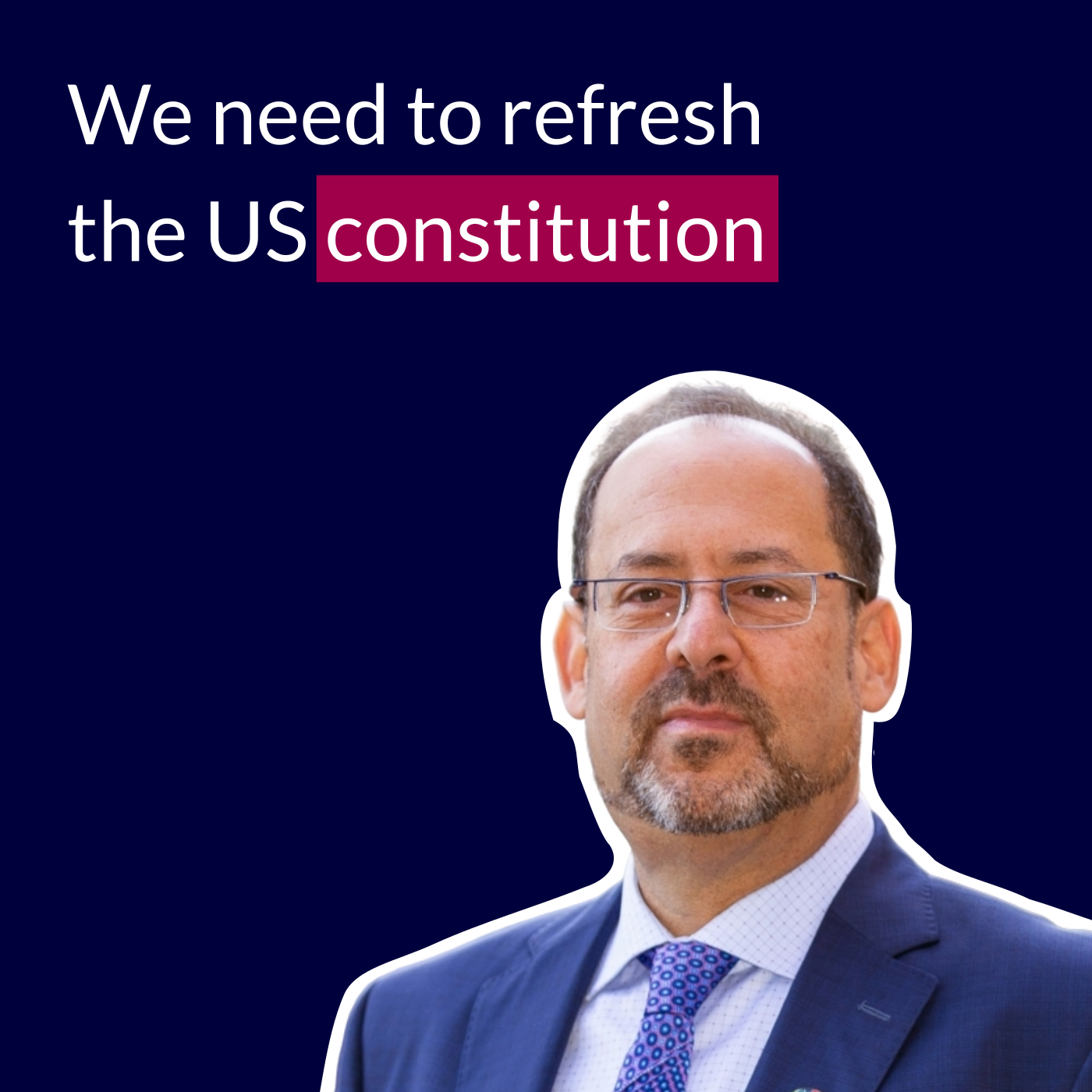
Paul Zeitz about permanent citizens' assemblies in the US and using technology to scale it
Democracy Innovators | 2026-05-05 | 45:26
Paul Zeitz is an author and advocate for global justice and human rights, among other things. With over 35 years of experience and several publications he is addressing systemic challenges. Especially in his book “Hit Refresh on the U.S. Constitution”, he calls for more deliberation in our democracies.
Top Keywords
- democracy 0.015
- citizens 0.010
- united states 0.009
- states 0.009
- united 0.009
- assembly 0.009
- citizens assemblies 0.009
- system 0.008
- assemblies 0.008
- political 0.007
- movement 0.007
- deliberative 0.007
Transcript
Speaker 0
0:00 – 0:08
Welcome to another episode of the Democracy Innovator podcast, and our guest of today is Paul Seitz. Thank you for your time.
Speaker 1
0:09 – 0:10
Glad to be here with you, Alessandra.
Speaker 0
0:11 – 0:21
And, as I said before, you are doing many things, related to democracy and society. And, I wonder how everything started.
Speaker 1
0:24 – 7:28
Yes. I am, thanks, Alessandra. Really great to be here. I feel like I love the title of your show, Democracy Innovators Podcast, so I was excited to be on. Yeah. I am a physician by training, actually, and I became, an, expert in preventive medicine and public health. And then I ended up shifting my career, very early on into advocacy campaigning and movement building. And, I worked globally, internationally, mainly in Sub Saharan Africa and a little bit in Latin America and Asia on global health mainly. And when I became an advocate, I realized that, I wanted to do advocacy on other topics beyond global health. So I worked on the climate emergency. I worked on the sustainable development goals, which is a broad framework, for social economic and racial justice. And, I think when, Trump got elected in 2016, I knew that we were at the beginning of something that was gonna be dangerous, and I think, I didn't really, realize how severe it was going to be until 01/06/2021 when, he invoked and sparked an insurrection on the Capitol that, was a direct attack on our democracy. So in 2023, a couple years later, I kinda dropped my other projects and my other advocacy efforts, and I became a full throttle democracy activist. And, I had to I've done this before where I shape shift. I go from working on this topic and I shape shift, and I start, you know, going onto this topic. And so I really dug in deeply into the democracy ecosystem and I tried to understand who all the actors were, what their agendas were, what was the cutting edge of transformation within The US democracy movement. And I guess I always started I I started off with the premise that I learned from my global aids advocacy, my global health advocacy is that whatever exists is necessary, but clearly, it was insufficient because what was going on was crazy. Right? We had an insurrection, and there was no accountability. So maybe the democracy, quote, unquote democracy that existed was necessary, but it and all the advocacy that was underway and all the innovation that was underway was necessary, but there was clearly something missing. Clearly, it was insufficient. So I I spent, like, the first year working on, figuring this out for myself and with colleagues, as we as we endeavor to sort out a way forward. And what we came up with was deliberative democracy, citizens' assemblies, And the idea of linking that by bringing participatory democracy to change, the the other side of the coin was bringing that to update and and transform our democracy, the structure, and the systems of our democracy through citizens assemblies to refresh the US constitution. I have been studying the US constitution for at least thirty years and, felt like it was very clear to me that it was a framework that was antiquated. It's 250 years old. It was set up as a system of oppression, and it works really well. It's it's a the the rules that were created have continued to protect the elites and the wealthy while oppressing, the the people of color and lower economic level people, don't have a fair shot. Even if the rhetoric about it says that they do, they actually don't. And we also know that the, democratic system in The United States was set up to, support and promote capitalism, and now we see the impact of unbridled global capitalism both in The United States and globally, and how that extraction of that extraction, philosophy of extractive capitalism is, destroying, our opportunities for a livable future. So, I mean, all these things were linked to the problem with The US democracy. So that was the big idea, which is to link deliberative democracy and citizens' assemblies to refreshing our US constitution. So in the beginning, once I clarified that that was the agenda, I brought that into the ecosystem and people were like, oh, you're crazy. You're you're being laughed. No way. That's not possible. You know? So I, like, started educating, people around me about the fact that in Europe, for example, Ireland and France have used citizens assemblies at with great success at the national level and local level, and Iceland and, other countries as well, Germany and Belgium. I'm not sure about what's going on in Italy, but I have, seen other examples of success in in Europe, in Canada, North America, and now it's spreading all over the world. So, in The United States, we've had very few, citizens assemblies, maybe a dozen, and they've all been really at the local level. Last year no. In 2024, there was a breakthrough where there was the first ever statewide citizens assembly in the state of New Hampshire. So that was, like, a big development, and now, a year later, there's about six or 10 states that are now thinking about doing citizens assemblies. So we're seeing a movement in The United States to really bring deliberative participatory democracy to much larger scale. Then the other thing that's going on is that we have a backsliding of democracy. We have, in my view, an authoritarian leader and an authoritarian leaning government running the entire government right now. And so they are trying to, consolidate power very, very quickly. And so the democrat the pro democracy movement is in, is in a race for our lifetime to see what will unfold here in The United States. We're really at a very exciting and dangerous time.
Speaker 0
7:29 – 7:59
Yeah. I was thinking, what is, democracy for you? And also how do you imagine, let's say, democracy if it is an assembly or it's, are widely used, in all countries. So how this can, change, let's say, the political system because, as you say, there is a system that is quite old. It works. It has some problems, but it can also be in some way updated.
Speaker 1
8:01 – 12:45
Yes. So, I mean, the true dream would be that we would be able to amend the US constitution. The goal that we have is to amend the US constitution with a fourth branch of government, a permanent citizens assembly. And this has happened in the city of Paris right now. They have a permanent citizens assembly. And in Eastern Belgium, they have a permanent, citizens assembly. So you have, chambers or branches of government, we say, that are elected, like a congress or a legislature, and then you have a citizens assembly, which is a group of people that are rotating, if you will. They're selected randomly by sortition or by lottery, and they participate as policymakers for a period of time, around whatever topic, the of the assembly is, focused on. The citizens assembly, is a way of involving, the public to get peoples, to harness the wisdom of the population about what challenges they're actually facing. Because the role of government is to serve the the collective well-being or the collective flourishing of the people. So who's better to do that? The, the people are. The people have intelligence. They have lived experience. They have ideas. And, the politicians, they go into politics and they make a career of it, and then they end up wanting to stay in power for a long time or forever. And, they get attached to the power of it, and they are usually very wealthy, elite people anyway. So they're not necessarily in touch with the real experience of the majority of people. So Citizens Assembly helps reshuffle that. The other thing, and I wanna make sure that we touch this, I'm I'm extremely excited about the opportunity that we have to harness the digital and AI revolutions that are happening at the same time and harness those capabilities to bring participatory, deliberative democracy to scale to for the whole system, for the whole population. As you know, there are methodologies like deliberative polling that was pioneered by, experts James Fishkin and Alice Hsu at, Stanford University. There's other platforms like Frankly, which is an online deliberation platform, that was pioneered out of Harvard University and professor Lawrence Lessig. So, there those are two of many. There's, there's Polis. There's there's there's a massive number. There's an explosion right now of technology platforms that are being developed to, transform our democracy. There's, there's mobile voting, which we don't have in The United States, but that technology exists. There's, digital democracy platforms, being established to, involve, the public in overseeing and holding elected politicians accountable. So the innovations that are going on are massive and hard to track, but I do understand the general ecosystem, not all the details, but, you know, people now are seeing that we need, like, what they call a tech stack. There's like a stack of technologies that, you know, you need to bring together when you're doing a citizen's assembly or when you're doing deliberative democracy. You have to compliment it with, these online participatory platforms. That's the deliberation aspect of technology. Then there's the other aspect of technology was the AI enhanced deliberative technology. That is changing everything right now because, there's ways in which AI can be listening and part capturing, conversations and comp capturing dialogue and then synthesizing that, that can be, brought together in information that we can digest and then interpret. And that is just, like, opening up a whole world of possibility.
Speaker 0
12:48 – 13:59
And, I mean, now we have the technology, but in some way maybe there is not, maybe the culture, the knowledge about this kind of tools. I mean, I'm thinking about politicians. Sometimes they they don't know maybe policy. They don't know the CDM. They don't know the other kind of the different softwares. And, so I wonder how to bring this change because in some way you we can, let's say, educate politicians about this kind of tools. And at the same time probably there will be also, I mean, young people that maybe know the tools will become politicians. And so maybe they will propose to use this kind of tools. Or also, there there were some kind of experiment where some people, decide to open a party or, like, to to run, I don't know, as a mayor in a town and also using some tools for to extend their participation. So I wonder, like, in your vision, how do you see it on a practical level?
Speaker 1
14:00 – 19:41
Yeah. That's a great question. At a practical level, right now, there is a national, movement of, folks working on citizens assembly, and a lot of the work is going on at the local level, at the city level or at the, small, county level, the the lowest level, if you will, of government. And, what is happening is that, a city council or is deciding that they have a difficult challenging issue, and they want to they're stuck. The politicians are stuck, and they can't really sort it out. So, there have been great examples, in Colorado, in California, in Oregon where citizens' assemblies have been brought together, and, citizens are selected randomly, They go through a learning process, then they deliberate, and then they make recommendations. They come to a consensus on recommendations. And then the the key thing is for those recommendations to be applied and to be followed up on. And so, that is happening now in in in cities across The United States, not not everywhere. It's still very new. It's still not commonplace. But what my main response to your question is that we have to create pathways for people to actually experience deliberative democracy and to see that it can work and to feel it and to live it. That's the only way, I think, that we can get this to be taken up. Now we have an example where, in, in the court system, in the judicial system of The United States, we have jury duty where people are randomly selected from the public, and it's a civic responsibility to sit on a jury. So that is something that people have experienced and they understand that. And so what we're saying is, it's like jury duty for policy making and for law making and for, refining our constitution. So the other thing that I think is really critical right now is that we're creating, online opportunities so that people can experience deliberation through, technology. So right now, one of my, favorite things going on right now is that there's a national campaign, that's just got launched, last month called the People's Bill of Rights two fifty, and they are using, frankly, the online technology platform, and they're launching 10 national deliberations on macro issues about the constitution. So they're looking at they're calling it a people's bill of rights, so they wanna create, momentum and a movement for people to advocate for constitutional amendments. And so that is what, is happening now in The United States. We're starting to see real innovation to bring this widely to the public. And we need to figure out how to get the media and the politicians educated and to start covering this as a strong and viable pathway to, heal and transform our democracy, which clearly is not working. For the and I believe we have to build a, political movement, a we call it a cross partisan. We have to bring together Democrats, Republicans, and Independents, to, embrace, citizens assemblies and deliver to democracy. And I think we can do it. I I know that we can do it. I think it's happening, actually. Now it's I don't know how fast it will happen, but, the crisis of our democracy right now is accelerating very, fast the uptake of a solution like this because people are looking for something, and this is the best thing out there. Quickly, I wanna respond to your earlier question. You said, what how do I define democracy? And I really, go back to Abraham Lincoln who, very succinctly described democracy as a government of, by, and for the people. That's it. And, you know, that is a simple definition of what we're aspiring towards, a government of, by, and for the people. Right now, we have a democratic republic that is driven by the election system only, and it is a, system that is controlled by the dark money, the money in, from wealthy billionaires and wealthy corporations that are driving and controlling the political system. We wanna disrupt that, interrupt that, and bring, a participatory, deliberative, egalitarian democracy. And ultimately, it's gonna be, I believe, we need to really, reconstruct our constitution and, refresh it, I say, or, rewrite it, however you wanna say it, amend it, significantly in order to, achieve the goal that I just described.
Speaker 0
19:43 – 20:58
Yeah. I mean, I totally agree about the fact that, it doesn't matter what our our political opinion about facts. I mean, we should all sit down at the table because, the change is so big. The change that can be done using technology So big that I think that changes all the political paradigmas that we are used to. Doesn't you can be left, right, whatever. We should all, sit down at the table and discuss how to create something better. And, but I was thinking also about something that I see it as a sort of problem because I'm also very excited by citizen assemblies. And, but in this precise moment, sometimes there is, there is not late commitment. So let's say, maybe a citizen assembly is organized by institutions, but, not always the output of the citizen assembly is, something that the politician decide to follow. And I think that this is related to the attachment of power you were referring before.
Speaker 1
21:00 – 24:27
Yeah. No. I think you're right. That is the key. I do agree with you. The you know, if we go through all the time and effort and spend all the money to establish a citizen's assembly, then what you said is the key, which is, like, how do you get the recommendations of a citizen's assembly to be taken up and to hold the politicians accountable for it? And that is the central, imperative, central priority of making sure that happens. It happens in two main ways. One is depending on who is, funding and setting up the assembly, making sure that the participants demand and set up the rules of the game so that their recommendations are taken up officially, by the government that may be sponsoring, such as an assembly. There are also ways in which right now, we're also looking at another track, which is, like, accountability. So that if, citizens themselves assert the right to assemble and they, are successful in being able to convene, citizens assemblies and generate recommendations or proposals, for example, for constitutional amendments, we don't have a way to make the government take them up except through a political movement. And and so that is what I think is what I'm focused on right now, which is building a cross partisan, a super majority political movement that agrees that our the system of our democracy is broken and that it needs to be updated and modernized, for the future. And, that that movement can be, come come to exist, hopefully quickly, relatively quickly because we don't have a lot of time, right here in The United States. What we're seeing is that we have an authoritarian, government right now and an authoritarian and anti democratic. They're literally they don't believe in democracy. And they are, they're in the midst of trying to take over capturing the election, meaning that it will it'll it'll be like an elected elected authoritarian approach where they'll have, like, an election, but no one will have faith or trust in the outcome of it, and they'll get their people, you know, in control. And then they could rewrite the rules and entrenched their authoritarian rule for decades. So, you know, it's been hard here in The United States because no one ever thought it would be possible here. Everyone was living in this, like, bubble of, or this dream, the American dream, like, how could this happen here? But now it's actually happening. And, it's taken a bit of time for people to get their heads around the fact that this crisis is actually happening here, right here, and right now. It's been going on for a decade, and now it's coming to a head over the next year or two. And, it'll be exciting and interesting times for sure.
Speaker 0
24:29 – 24:33
Yeah. Usually, interesting times are not the ones, are not the best times.
Speaker 1
24:34 – 24:41
Yeah. It's not the best time. I mean, it's, you know, it's a tough time. Yeah. Yeah. I wonder, why do you think,
Speaker 0
24:41 – 24:59
you know, in democratic society where there are, liberal democracy systems, every now and then, people decide to democratically elect someone, that is not pro democracy. It's a sort of contradiction we see often. And,
Speaker 1
25:01 – 28:20
Yeah. I mean, I think it's a flaw of the concept of what you said, you called it electoral democracy. It's the idea that, that is actually representing the true views of the public. In The United States, for example, we many of our elections, you only have maybe forty, fifty. If it's a really great election, you only get to, like, 60% of eligible voters who are actually even participating. So you have a large vast number of people, 40%, 50% of people who should be voting or could be voting, and they don't even participate. They're checked out. So then what happens is you get a mag then the of the people that are voting, they're split as partisans, you know. So you have a small group of partisans, that are driving the political system. You have a a small swing voter, group in the middle that can swing it left or right. And I think what I'm hope what I believe is that right now in The United States, there's only two choices. There's the Republican Party and the Democratic Party. And I know myself, I'm an independent. I have I'm a registered independent. I always have been, and I always will be independent. And now the data is showing that the majority of eligible voters in The United States are independent. They're fed up with the two parties, and they're not participating. And, that's an opportunity, I see, because, then if the parties lose their control of the political system, then we can come forward with a cross partisan. We wanna work with them. We wanna bring independence forward. We wanna work with Democrats, and we wanna work with principled Republicans, pro democracy Republicans. And there are a lot of them. There are a lot of traditional Republicans that believe in the rule of law and believe in the system of government that allows the people's voice to be heard. The other thing we have to do is get money out of politics because the money, the billionaire class, and the way the Supreme Court has operated has allowed the money, con to control the whole political system. Obviously, that is not working. And the good news is is that about 90% of Americans agree that money in politics has ruined the system and the system is broken. So we have a consensus on that. Now the question is, how do we build a political movement that's cross partisan that can actually, you know, advance, this agenda that we're talking about, renewing American democracy, fixing the system, transforming the election system, transforming the structure of government to make sure that the people's voice is never marginalized. It's central to how we operate our government, and I think that's possible.
Speaker 0
28:22 – 28:27
Yeah. The question how to build the the political movement, it's it's a good question.
Speaker 1
28:30 – 32:38
Well, you'll see on March 28, you know, a very the largest political movement protest in US history. You'll see over 3,000 events happening, in The United States, and I know there'll be, events globally on that day as well, in solidarity with a, with this that The United States cannot become a fascist authoritarian, ruler, country, or we can't continue to let that happen. And, the movement here is getting very strong. I've never seen anything like it. And my I'm 63, so I'm older. And but there in my lifetime, you know, I guess the civil rights movement was something like this, but that was really driven by a certain subpopulation. This movement is, cross partisan. It's across the political spectrum. It's across the racial spectrum, and it's starting to become across the economic spectrum because even business owners and business leaders are recognizing that this government and this, the threat of an authoritarian dictatorship in The United States is real, and it's not what the majority of people want. So you'll also see activists and action happening going into May Day, May 1, which is a work the global workers workers' day. And I think that we're gonna see really powerful resistance, and noncooperation emerging. We saw we we saw that in, Minneapolis, Minnesota just last month where the local population, pushed back against the ICE, the, the police force that was kidnapping people off the street and killing citizens, you know, at gunpoint. We people are not gonna put up with that, I hope. So, we saw the we saw that the local people in Minneapolis organized the international the the national movement came in to support the local, leaders that were leading that, and it it had an effect of pushing back, the authoritarian project. It wasn't perfect, but it was really powerful, you know? And I got really scared because, I've been talking to experts, and they've been saying that, our country could end up becoming there could be a civil conflict. We could go from political violence, which has been really dramatically increasing. There were a 150, political violent attacks in 2025 in the first half of twenty twenty five, and that was more than double of the year before. I I don't have the full data for all of 2025 yet, but, we're seeing a big uptick in political violence, and some experts see that it could be a tipping point. And in Minnesota, what we witnessed was the state military forces, like the state national guard, the state police forces were pitted against the federal forces, the ICE agents, and the border control people that were there from the federal government. And you could even feel the possibility of military on military conflict internally within The United States. That is, like, shocking and unexpected by by most people. No one thought that could happen here, but it can, and we have to prevent it from expanding. The authoritarian people, they want that. They wanna they wanna expand, uncertainty, unpredictability. They wanna raise fear, and that is how they gain control of the minds of the population.
Speaker 0
32:39 – 32:43
Yeah. Fear fear is something that historically has always worked.
Speaker 1
32:44 – 33:24
So Yeah. Yeah. I don't you know, I you're right. And they're really good at, deploying it and using and manipulating the mind. Of course, social media and the media ecosystem, which you were, you know, we're talking about technology, we we call it information chaos. And, no one believes the truth anymore, or no one knows what the truth is anymore. The AI enhanced, social media, has created confusion and lack of trust. So these are some of the downsides of technology that have to be addressed.
Speaker 0
33:26 – 33:57
Yeah. And then, also historically, like, information was always something that, I mean, also in some way related to power. So I I think that also before, let's say, AI, it was, you know, also, we were saying money and politics and, also information sometimes is at the service of money or politics.
Speaker 1
33:57 – 34:49
So Yeah. Exactly. Yeah. I mean, very very true. Yeah. Well, the money is used to control the media and the communication systems. So that's that's right. I mean and, you know, the authoritarians have been very aggressive this year, this past year, since Trump came back into office to really disrupt the media and take control of it, through corporate takeovers and through bullying tactics and pressure tactics. So the idea of the free press and the right of free speech that is connected to the freedom of the press is definitely being attacked and challenged Yeah. By this government. So in a way that's never happened before.
Speaker 0
34:50 – 36:33
I mean, also, we were talking about, power. I mean, it can be, institutional power. Then, we were talking about economic power, then also informational power. And, when all this kind of power are I mean, when a person has all those powers together, then, of course, it's a concentration of power that, can lead to something not good. Still, I I see, like, this is something that, I cannot really understand how but in some ways, similar to the question that I made before. Like, why, people every now and then want a person, you know, the strong man, that get take care of everything. And this has happened in the past. And, usually, that person was, using fear, because it works. And so, yeah, I I was thinking about, again, how to build a political movement that is maybe aiming for not being partisan. So going over, like, the differences that, sometimes, as you said, the it doesn't matter in which party you are. It can be that you are pro, dialogue. So yeah. I mean Yeah. I mean, I think Those are still open questions.
Speaker 1
36:33 – 36:38
Yeah. What's your sorry. Go ahead. What's the question you have? No. No. No. It was just,
Speaker 0
36:39 – 36:54
those are some open questions to me, that I still haven't been, able to to give an answer. Mhmm. Just, also, I mean no. No. Please.
Speaker 1
36:56 – 36:58
No. I wanna hear what you have to say. Go ahead.
Speaker 0
36:59 – 37:10
No. I I was asking your question regarding the podcast, because maybe some of with some of your guest, you had some discussion related to this, and, I don't know.
Speaker 1
37:10 – 41:23
Yeah. Yeah. Yeah. Yeah. So, I again, you're right. I agree with you that they use fear and, very successfully. So when people are feeling economic uncertainty or they're feeling unpredictability, they're looking for a solution. And so a fear based powerful leader looks like they're gonna come in and solve the problem. The pro the challenge as I described is that the political system allows for a minority of people. It's almost, what I call minoritarian rule. The way that our political system in The United States is working right now, a minority of people could, you know, kinda jigger the system and then can get elected through it. That's what happened with Donald Trump. So both times. You know, the first time, he didn't even have the majority of votes. The second time, he did get the majority of votes, but the way that the political system is structured, the large states where the the bulk of the population lives did not have a fair impact on determining the outcome of the election. So the system is broken in that it's set up by design from the original founders two hundred and fifty years ago for there to be a minoritarian rule, and that's what we think needs to be healed. We need to shift the way the system works to allow for the majority positions to lead the, policy making and law making and the way the constitution operates on the one hand. On the other hand, we have to make sure that minority perspectives are not ignored, that they are also considered, and that they're also addressed by the majority. And that's what, the Citizens' Assemblies and Deliberative Democracy does. And I don't know if you've heard of, Helene Landemore, who is a French political scientist. She just published this book called, Politics Without Politicians, The Case for Citizen Rule. And, she talks about how through citizens assemblies, you can actually reestablish trust, and you can it's based on love, actually, between people. And for me, it's about revealing the truth of our interdependence. Like, we are actually not independent of each other, you and me even, or me and any other person. We're all interdependent. And then, we experience interdependence as love and trust. And, the power of citizens' assemblies is that it can restore love and trust collectively at scale for the population. And so that is why I'm so committed to bringing forward deliberative democracy. I think it's the only way for us to heal these broken systems that are, as you said, designed based on fear. So the political movement that you'll that we're that is building now, I'm just one person. It's a vast movement of movements, of organizations and networks that are aligning and converging right now, and it's coming forward as no kings on March 28, and, May Day will be a noncooperation effort, and other things are happening. So the people are rising in The United States. People that believe in government being a government of, by, and for the people, a government of that wants to recognize our interdependence and wants to be a force for peace in the world rather than what we're seeing now, a force of violence and it's this is not the American people are not behind this. We're just trapped in a broken system.
Speaker 0
41:25 – 41:49
Yeah. Enough here. We we I actually interview her. We probably should have interview a couple of weeks ago. And, and as, I mean, the last question is if you have a message for the people that are working on, civic tech or or like a deliberative democracy that are searching for new solutions?
Speaker 1
41:50 – 45:14
Yeah. I mean, I think that the work is critical. I think that Europe, for the most part, is leading the way right now, in bringing forward this kind of deliberative democracy. I mean, for example, the EU, has a EU wide referendum, a mechanism that exists within the EU charter. In The United States, we don't have a national referendum. There's no way for the people to implement a referendum at the national level here, and only 22 states have some mechanism for that, for statewide referendum. So, Europe has led the way in that. Europe, countries and cities are leading the way in, bringing citizens assemblies to scale in many countries around the European continent. I think The United States, I think, the technology, assisted component of it is really happening, and, we we're about to start seeing it applied here domestically in new and large scale ways. So I think that my message is really, like, let's do it. It's time. We gotta bring it forward now. Let's find a way to work together, find a way to converge your efforts, find a way of, like, bringing people together, not only individual people, but institutions and organizations. They have to con converge and work together to go to scale, and to bring it to all 50 states, and then to bring it to the nation. That's what we see is happening now, and we wanna accelerate that. And so it's, like, it's a shift because people are used to setting up their own I don't know about in Italy, but in The United States, there's, like, this rugged individualism culture. So everyone goes up and sets up their own little thing. And then you end up having, like, a a lot of parallel siloed small scale efforts that are all beautiful and all really interesting and innovative. However, they're not having the impact because they're it's like a thousand flowers are blooming, and it's a beautiful thing, honestly. There's beauty in that diversity. And all we're saying is, like, let's, tie a ribbon around it and grab a bouquet so that all that effort can be, you know, brought forward in a beautiful way to have an impact, to change policy, change laws, and change our constitution, with, the voice and the collective wisdom of the people of The United States. And I I I think we're on the I believe that we're on the cusp of a breakthrough, so it's like having hope and belief that we can actually do that. That's the problem. The fear that we talked about leaves people in despair and hopelessness and, feeling like there's nothing we can do about it. They throw up their hands, and they're just trying to survive. And I understand that. That's real. That's legitimate. And, we're trying to, convince people that while we're surviving, we can also build a better system and a better future.
Speaker 0
45:17 – 45:20
So thank you, Paul. Thank you again.
Speaker 1
45:22 – 45:25
Thank you for, your questions. Appreciate you.