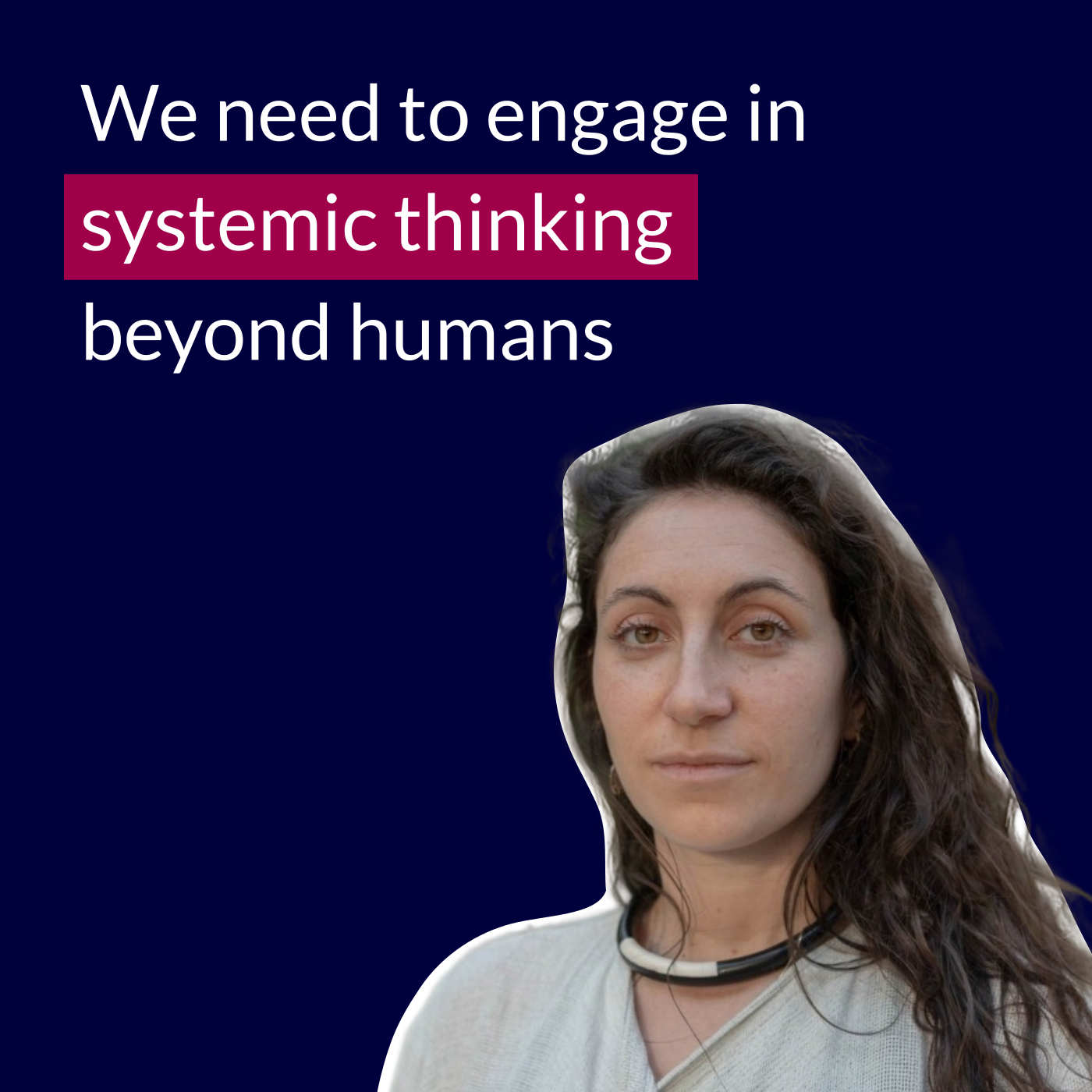
Alice Casiraghi on designing regenerative systems, public services, and democratic participation
Democracy Innovators | 2026-06-30 | 52:12
Alice Casiraghi is a systemic designer working on sustainability, circular economy, regenerative systems, and public services. She is a European Climate Pact Ambassador, teaches at Politecnico di Milano and created Climate Cards to educate on environmental impacts. Through her systemic approach, she gives new perspectives on participation of citizens and beyond. In the interview we talked about:
Top Keywords
- need 0.010
- citizens 0.009
- municipality 0.008
- milan 0.007
- assembly 0.005
- climate 0.005
- digital 0.005
- system 0.005
- experts 0.004
- climate assembly 0.004
- decision 0.004
- relation 0.004
Transcript
Speaker 0
0:00 – 0:17
Welcome to another episode of the Democracy Innovator podcast, and our guest of today is, Alicia Kaziraghi. Welcome, Alicia. And, as the first, question, I would like to ask you, something about, you, about your background, and, so thank you for your time.
Speaker 1
0:18 – 2:55
Thank you, Alessandro. Thank you for inviting me. So, yes, to introduce myself, I am a designer. I work in sustainability, work mainly in circular economy and, regenerative, systems. And, well, I started as a originally, I started as a UX designer, as a digital UX designer in China, where I graduated, and I lived my first, three, four professional years. Moved to stayed in Shanghai for a few years, then, started working internationally in Asia, Hong Kong, Singapore. And then I came back to Italy for, an an opportunity at the digital digital transformation team of the Italian government. Worked in Rome for a few months, then I was about to move back to Asia and, the pandemic happened. So then I was already here, and, it was difficult to, organize the visa, organize my, life back in Shanghai. So I stayed here, and still I am in Milan, based in Milan right now. And this shift from digital UX design to, sustainability, circular economy, regenerative ecosystems is something that happened already before I went to the digital transformation team in Rome. I started in 2018 trying to apply my knowledge as a designer to regeneration. Because many times when you read about the circular economy, it says that you need to design things so that they're not made to be thrown away. You need to design systems so that they are regenerative, but they need to be regenerative by design. Because if you try to introduce regeneration in a system that is designed in a linear model, so in a throwaway culture, then it doesn't work. And so I since then, I started working with the food policy of the city of Milan for four, five years, with the European food systems and, also Mediterranean, Middle East, and North African, food systems. How trying to shape policies towards circularity or interventions towards circularity. And later on, I've been also supporting the efforts of coordinating the youth and climate assembly of Milan, the first youth and climate assembly of Milan, which has been a very interesting way to apply design knowledge and facilitation skills to public services. So I've been transitioning more and more towards sustainability, but also towards public services and governing structures.
Speaker 0
3:01 – 3:23
Very interesting. I am thinking about, circular economy and regenerative systems, and you say that, a system has to be, designed to be regenerative and not so if you would you like to tell us something more about, how can a regenerative system be designed?
Speaker 1
3:25 – 6:01
Mhmm. Sure. So in every in every system, in every political ecosystem, in every, like, state, country, city, region, you would have, regulations that, drive your choices towards one drive your, yeah, choices towards one steer your choices towards one direction or another. And, generally, laws, are made to preserve what is what somebody fought for protecting. If you decide that certain things need to be protected, if you put enough voice into this, then this will result into political decision and eventually loss. So laws tend to be conservative because they are designed after a reality has been built. And think about, for example, the dangers of AI or the throwaway culture. Like, you need to reintroduce models of regeneration or, like, prevent packaging or control AI in a certain way. But you need to introduce laws for this because you these laws are reactionary. They they happen after innovation happens. They happen after, groups of people, lobbying groups of people for good or for bad, decide to advocate for one thing or another. So in order to introduce a circularity and regeneration, you need to rethink also the systems of regulations, incentives, and, and also fines to to steer, to nudge certain behaviors. It's called behavioral nudging. You drive people's behaviors towards one direction or another. When I was living in Shanghai, there was a moment in which, the regulation changed for waste sorting and recycling, and then, you know, everybody was fine a little bit. Maybe just €23, the appeal went to €23 if they didn't sort their waste. And this small change made everybody slowly comply because it's not one big fine that could happen if the police would catch you, but it's a repetitive fine that you're sure will happen. So it's a repetition that steers you towards a certain direction. Or, for example, preventing people from binge eating and making money out of it on YouTube. This is another thing. You know? It's another regulation that steers people towards a different value, different set of values. First, you want you wanted to boast that you could afford to binge eat and also make a show out of it and being paid for it, and then it becomes something to be ashamed of. So, this is how you you you nudge behaviors, it's still behaviors towards, more or less sustainable choices.
Speaker 0
6:05 – 6:22
And, I'm thinking about, policies versus culture. Mhmm. So that culture can be influenced by policies and vice versa. How this is, considered when designing a system?
Speaker 1
6:26 – 7:35
Think my knowledge of the topic is more anecdotal than, coming from, like, research studies. But from yeah. Well, from field research, I can tell you if you change the size of a waste bin or if you introduce two waste bins instead of one, you need to test this kind of solutions because then if you introduce two waste bins, people will throw away twice as much. If you change the size of the waste bin, then people might throw it away somewhere else. So the you always need to, when you when you introduce a policy a policy, you try to be mindful of the context, so of the traditions of people if something is considered acceptable, or not locally, because of religion, because of cultural beliefs. But also you need to test how people will respond. So it's yeah. It's as you said, it's a two way conversation. On one hand, you you're trying to be mindful of the local culture, and on the other hand, you are trying to see how people respond to the way you are introducing, the policy. So I guess it's a continuous, you know, test and test and learn.
Speaker 0
7:36 – 8:07
And, and also in relation to the digital transformation, because when we talk about transformation and also it it means that we are taking what it was working in a certain way, and we are transforming it in a digital way. How the design process, can be done? How does it happen? How it was your experience in relation to this?
Speaker 1
8:09 – 11:09
Okay. That's that's super interesting. So on one hand, so when when I joined the digital transformation team, one thing that I had to realize, of course, it came from my inexperience, was that I don't only have to talk to the citizens and try to you know, when you develop an app, you you, of course, need to test it with the citizens, understand if it's, the experience is good enough for them, if it's immediate, if it's if it's preferable compared to the offline experience because it might be more immediate, but people might have, safety concerns or privacy concerns. But on the other hand, you need to test the experience of the service providers, which is the municipalities, which is, when you say municipality or when you say a hospital, when you say it's actually people that work in very traditional systems, administration systems. So people who have been used to print papers and make you sign the paper, scan your ID card. And so they need to be able to do this digitally. And the decision makers in this administration, in these hospitals, they also need to be able to allow for their employees to, public servants, to approve these processes. So there there are many actors that come together in this. Right? You need to have the the legal representative that is, for example, the mayor or the dean or the, director of the hospital that needs to sign for you to be able to provide them with a template for digital services, then they need to have some technical person person that adapts the digital service to them. If it's an open source system like the Italian, digital public services system. And then you need to have, the administrate the administrative part or the policy officers, they need to operate this account and this online service. And they need to do it, you know, when they they need to relearn completely. So it's not just about the citizen. Because the citizen, when they start using public digital services for everything, from paying a fine to getting a document to renewing a document, it gets easy for them because they are used to do it for multiple different services with the same template. But the people who work for that hospital, that municipality, that administration, they have to start from scratch just for their own administration and then keep repeating this process on and on. So I guess it's, it's also a big learning curve for them. And you need to be mindful that whenever there's a problem, there's, like the legal party needs to be aware, but they do you don't have to bother them too much because, otherwise, it's, too much, involvement from the nonoperative part. So there are many, profiles that interact, many stakeholders, behind the digitalization of a service.
Speaker 0
11:12 – 12:01
Yeah. Sure. I can, I can imagine this? And, and also, I I was thinking something interesting is that, many people or episodes in the, of the podcast were about platforms that most of the times they were, imagined by the the person that, create the platform, and then proposed to, an let's say, an sort of imaginary audience. So I have an idea about the silic tac software. I do it. I create the software, and then I hope that someone else will use it. Yes. Of course. While in this case, it's working on something that is, already there. You know the users, basically.
Speaker 1
12:03 – 12:10
Yeah. It's a service that people need already. We know that they need it for sure. Yeah. Exactly. And,
Speaker 0
12:14 – 12:46
yeah, I was thinking about this difference. And, yeah, and what have you learned during this process? And, also, maybe in relations also to the other things that you mentioned before that could be, yeah, designing a system, but also a system that is, working. Well, I don't know if the the question is clear or if you have something to say about
Speaker 1
12:48 – 16:30
Yes. It it's kind of clear, but, so what I've learned in in working with public services, first, I've learned that designers are needed in public services more than we actually thought because, there's a lot of technical profiles in public service. There's, domain experts. There's, yeah, developers and developers. For example, architects, they work much more with public services than designers do. Designers, they think they have to design, you know, objects or experiences. But in the end, we are also very useful into designing public services. And there's also, a very sought after profile in the public administration services that is the facilitator, the one that talks with the citizens, organizes focus groups, peer learning sessions, stakeholder alignments, stakeholder is different public and private companies that work with the municipality to achieve a specific goal. So all of these is also a skill set that pertains to designers, especially service designers or user experience designers like, myself. So on one hand, I learned that this is very necessary to relieve the user experience the the burden of the user experience from, you know, the the user having to fail many times before you achieve a good result. And you and in any case, whenever you add more research and human focused research at the beginning, it just makes sense. It's an investment that will pay back in the long term, especially exactly in public service that are already necessary and they are super scalable. The other thing that I learned, now that I talk about, the user and the human centric focus is that it's not just about the human, the the customer, but it's also about the impact that a thing you design, a service design will have on the broader infrastructure, the society, and even the planet. So, recently, I've been supporting these efforts to facilitate a youth and climate assembly in Milan. So developing proposals for the cities for the city on climate. And even there, you need to always think of frameworks to convey this message to the people involved that you're finding a solution that supports them for the planet or that supports them in better communication with the government and the local organizations and the planet. And you need to create this mind map. You have to create this, framework in which citizens understand, that they have duties. They have, rights. They can ask for something. They can also they need to also comply with other things. They can vote for the municipality, interact with the municipality, work with the municipality, but they also have to, you know, provide feedback from the company. The municipality regulates the company, and then Visa will have an impact on the way resources are used, and it will have an impact on the planet. And so it's always an ecosystem of moving parts. And I learned to expand my perspective and trying to map this this expanded perspective, a systemic perspective, so to make it easy for customers or, people that, with which I facilitate, that they are not making individual decisions. They're making decisions, you know, inside of an ecosystem, inside of a system, instead of an administration. So to put things in relation with one another.
Speaker 0
16:33 – 17:37
And, in relation to, the climate assembly, the tech and imaging was a sort of citizen assembly. Mhmm. What, do you think could be improved in those systems? And, also, because it will be interesting also if more people do it, because I think that participation is on one side, helpful so that, we collect, what the people would like to see in their cities. At the same time, it is also important that a person express what they feel because otherwise, people I mean, I talk also for myself. I get frustrated if I don't have a a possibility to express myself in relation to something. And, yeah, if you have any idea about, what to improve in, during this kind of process.
Speaker 1
17:39 – 24:26
So there's a lot of things that we don't know very well of the of how municipalities work or how do they talk to their citizens because sometimes the communication doesn't get to us. First of all, in cities, especially, there's generally newsletters that you can follow. You like, first duty is on us to, not just follow tech newsletter or or circular economy sustainability newsletter, but also follow the municipality ones. To know more about our surroundings. Then the second thing is, in terms of the assemblies, for example, Milan also has a permanent citizens assembly, so it's not for use. It's a permanent assembly. And the way it's structured is, I think, quite, standard in a way that, thousands of citizens get, receive this invitation yearly to be part of this climate assembly, and then a few of them will respond. And then, a cohort of, I think around 40 to 50 citizens is added to an older cohort of 40 to 50 citizens so that half of the assembly remains from the previous year and half of the assembly goes out, transitions out, and and new people come in so that you, on one hand ensure continuity, but also new ideas. And, it depends. Certain things are managed with groups of interest, people that are already active in within the municipality, people that have, key, activities in the city, or sometimes it's just the whole citizenship being engaged. It it depends on what is the topic, what is the administration. I'm talking broadly, not just about Milan. One thing that I learned is that you need to allow for people to express their voice, but you also need to mediate this message. You have to contextualize. You have to show, what are they asking, what what are to whom are they asking? Are they bringing their proposals? What is the context so that proposals are better drafted? And also so that you understand that a proposal is feasible. Because if you, for example, want to propose, a service on waste management in a place where waste management is privatized and is not public, then it's gonna be hard to, to achieve that goal. If the private company is not in the conversation, for example, you can ask it to the municipality, but then it will be up to them to talk to the private sector, and then maybe they don't align. So you always need to be very aware of the context. You need to really engage with complexity and systemic thinking. And then what did I learn? Yeah. I think these are the main takeaways. I learned that we I mean, the more you get involved, the more you will learn the intricacies of how does it work and the more you will be, also, kind of understanding, whenever there's a a failure, there's a roadblock, you understand, you know, for what are the reasons. The other thing actually, that I wanted to say, and now it comes back to my mind, is, I've been visiting some friends in Switzerland, and I've seen how referendum works there. And you received a leaflet, with the reasons to vote yes and the reasons to vote no. And they've all been peer reviewed, and you can go through all the motivations, and they will try to explain the topic as clearly as they possibly could, especially if it's a topic that you don't know much about. Sometimes it's a bit too daunting. Sometimes the the the, the topics are very difficult to understand, but I like that they don't shy away from showing you the complexity and giving you perspective. So I think something that needs to be improved is this, is to showcase the complexity of things, and, and and getting citizens, to really think more critically about what they can decide for. And sometimes even know that they are ignorant on a topic, and maybe it's better if it's not, for them to choose. Sometimes we tend to oversimplify issues, and then everybody has an opinion, and they can go to the bar and get they can talk about their opinion. But for example, in Milan, we have these, taller weeds growing now in the parks because there was a decision was made, to introduce biodiverse weeds so that they would invite more biodiversity in insects, birds, and so on and so forth, and it's working. And then people are like, oh, but it looks like, the municipality doesn't want to spend the money to cut the grass. It looks like more careless than it used to be before. It looks less polished. And then the citizens were convinced because there was an analysis from, I think, Bicocca University showing that these tall grasses, not only they reintroduced biodiversity, which citizens didn't really care about, but also it helped retain more of the pollution from the car's exhaust because it's at that same height in the street. So for that, people are like, okay. Maybe we can keep the grasses, you know, because it's protecting our children. For me, I I consider them to be beautiful, to see more more taller grasses or flowers. And, I live close to a park where there's an artificial pond, and now there's a heron a heron bird, one of those big birds that you will see in the right studies. It comes to that, artificial pond, every now and then. And I keep track of her, him, And I love to see this bird close to me even if it's an very anthropo anthropized environment. I don't know. I just think that it's beautiful. And if I need to thank the tall grasses and the and, the flowers, I'm very happy to have them. An older generation will be more used to, English gardens, clean-cut grass. Then for them, it will be harder to accept. Especially in Asian societies, bringing change is always hard. But, I guess we yeah. Again, we all need to the municipality needs to be better at showing the many aspects of a decision, the complexity, finding the lever for you to accept it. So if it's not for biodiversity, maybe it's for your lungs. And the other thing is that people need to be more patient and understand they don't always have an opinion about everything because we cannot be expert of everything.
Speaker 0
24:28 – 25:41
Yeah. And, I was thinking about the the output of something that is, can be a collective discussion or decision. So in this, so it can be a policy, or can be just an advice to the municipality about what citizens want. And being that we are going toward, like, a sort of digital society, I can imagine. How do you imagine, like, the cocreation of policies from citizens. Can these be, scaled in term of design to because now, as you mentioned, there is a, a permanent, assembly, but then maybe this can be also scaled up. So with more people participating because, I mean, in Milan, there are millions of people. And, I wonder also in relation to other topics, because it'll be very interesting to see, like, the city participating, in relation to what has to be decided in this.
Speaker 1
25:46 – 28:41
So yeah. I this is a complex question to answer because on one hand, you know, when you ask everybody to participate directly into the the public decision making. It's for me, it's a great idea. It sounds like a great idea. At the same time, how do you assess their readiness to, understand certain topics? You should educate, enable people to, to participate into the conversation. So you should first inform the citizens. Then you should allow them to have a voice into, what's the into public discussion. And the third thing, you should protect them from the threats of a digital democracy. So digital democracy where, I don't know, votes are anonymized, tokenized. You need to trust the system a lot. I think I would welcome a system that, facilitates us from the facilitates, the the development of proposals from the citizens. Because in Italy, we suffer of this a little bit. We vote once every few years. It should be every five years, I think. But then it happens more often than not. The government's fall and then we have to vote again. But our only moment of decision is voting, and it happens in a very concerted time in which there is a lot of propaganda because all the different parties are doing political campaign. So, it's not a very calm, and reflective, environment to to make political decisions. It's always the rush of of the political campaign, before the elections. So, yeah, I would welcome such a system, and I guess you I mean, the technology is there, and the technology is just an enabler. Right? We we always need to understand how to use technology for the benefit of societies. But we've seen we're like, we are now seeing how technology is useful to control, people or to decide for, you know, making work decisions that people don't wanna make, or, yeah, informing strategies that should be informed by some human beings so that somebody can be held accountable. So right now, we're using technologies to achieve governing to to get to governing decisions that people would rather not make, not the ones that people would want to make. I don't know. It's, I don't know if you have a different perspective than mine. I mean, I wish we we would use technology much more for good decision making instead of, you know, using it as a dumpster for decision. Decisions we don't want to be responsible for so that they nobody can sue us after.
Speaker 0
28:43 – 29:59
Yeah. I I I mean, I can imagine technology more as a source of enabler mediator, between, different citizens or also between the citizens and the municipality. But then something that they should be avoided is the black box Because then you do not understand, though, yeah, what is happening. And, yes, as you said, now we have the technology to also make it happen, then there could be a lot of risks related to this. And, and also in relation to, what you said about informing the citizens about the the topic, also that, of course, is something very important. But, also, I think that many times, citizens are informed about specific topics just because they live in the place. So they live in a place. They see the place every day. So, of course, maybe they don't have a theoretical background about, how the grass can be, good for pollution and so on. So they just see maybe the aesthetic part.
Speaker 1
30:02 – 30:50
Yeah. I I agree. So if it's an informative process instead of deliberative process, which means if I am a citizen and I want to inform the municipality, there's a hole in the ground, there's, like, some minor floating, there is some sick tree. That's that's 100% how I would use technology because, it allows well, you always have to think of how people would use it in a bad way because there will be somebody that wants to use it to to make harm. There is somebody who wants to sabotage your efforts. There could be somebody. So yeah. But I I would I would, use it the same way you would inform, like, a bike sharing service that the bike is broken. It's like a feedback system. Technology is very useful for that.
Speaker 0
30:54 – 31:22
Absolutely. And, in relation to, the YAF climate assembly, of Milan, Try to refer from the question. Otherwise, it's similar to the crystal. No. I'm thinking, like, about the outputs of the of the climate assembly of Milano.
Speaker 1
31:23 – 31:24
Mhmm.
Speaker 0
31:25 – 31:49
Which kind of difference would you say that, like, in relation to an output of, let's say, of a municipality or a group of expert, did you see any significant difference that was like, is is the co creation really changing the output?
Speaker 1
31:51 – 32:30
Okay. Two things that I also two takeaways that I also want to take from my work in universities to teach systemic thinking, circular economy, regenerative design. On one hand, you really need the human part, when you do decision making. So the cocreation with people that have less of a voice because they're not expert on a certain topic, but they can give you another perspective. And, like, talking to more people, it's always, useful, I would say, talking to groups of people, especially in if you're talking in in person with these people.
Speaker 0
32:31 – 32:32
I realized
Speaker 1
32:32 – 36:46
even with my students, you know, when you ask them to solve a problem, a design problem for nature, for humans and nature, even when you ask them this and they're working in front of a computer and they are, you know, they're like the experts in the field, they will now use AI and get to the get to the solution with AI, with more information faster than ever before. So they finish the the task within two hours, but they don't have fun with that. They don't have they don't talk. They don't share. They don't stimulate each other. I think this creative social part of generating ideas, it's very important. It's really useful. So, like, even with my students, I I challenge them and saying, okay. Yeah. This this is a good answer for a generic intelligence artificial intelligence. But if you want to give me your personal answer, what would you expect? What would you do? What would you want? So I think experts advise on strategies, but then instead, citizens, they bring their experience and they add diversity. And we know that with AI and with, the traditional workplace as we know it, we have a bias for, a specific target group. We are always talking to, generally, the older white male in charge in power. So it's yes. We have more diversity in the workplace right now than we used to have fifty years ago. But at the same time, we don't have as much diversity. So I guess it helps to, I think it's important to to have conversations with citizens. And, again, it's a two Way Street. Like, you inform the citizens, and at the same time, you ask for their opinion. And then if you need to validate certain matters, you talk to experts. When you organize citizens assemblies, you always have a mix of expertises. You have the citizens. You have, the facilitators. You have the experts. Experts. You have the stakeholders. The experts might be scientists that work with the municipality. The stakeholders are companies that have an interest in that specific field or that are working with the municipality on that field, whether it's private or public. Yeah. You have a a directorate from a municipality that is in charge of, of, collecting the opinions and making reports. So it's I don't think these either or, experts or citizens, it's both. Like, you're just enlarging to also the citizens, not just the experts. When I was living in China, I used to do research for brands. My very first job was to do research for brands. And for me, everything was new because I was doing research for brands from The US or Europe that wanted to come to China. And when I interviewed experts, what they used to tell me was always, not always, like, 80% of the time, it's full of prejudice. Because it was an opinion coming generally from the Western business leader or the person that didn't take enough time to fall in love with the local society, ecosystem to then give you answers that are out of passion for, you know, that context. So you would have the guy that, came from the same industry, but working in Europe, coming to work in China, being the expert of their own craft, but never taking the time to understand what was the actual experience of local people. And so this is when design came in handy because you could interpret these signals and say, hey. By the way, let let me challenge this. You know? Why are you saying that? Why are you saying that this is gross and this is okay? Why are you saying that this is preferable and this is not? Have you talked to the people? So, yeah, I would say it's just a more complex way of doing things, to organize assemblies, but also more fulfilling. And I guess because the reality in which we live today, it's not the best possible world or it's not going towards the best possible world, we need to enrich our perspective to find alternative solutions.
Speaker 0
36:49 – 37:21
Yeah. We are living, I mean, a democratic system. And as you say, there is not the the best possible world, not because it is a democratic system, of course. But I wonder, like, if, we talk about digitalization, we are also talking about, yeah, designing a new system. So maybe it could be a new kind of democracy. And, also, I wonder, like, for you, what it could be done to make this the best possible world.
Speaker 1
37:24 – 39:52
Okay. Listen. If we like, the point is not democracy or not for me. The point is redistributing, and it's, redistributing among peoples and with nature. Like, from my perspective of a person working in sustainability or regeneration, I can tell you that, one of the biggest issues is how much resources we're taking from the rest of the planet and thinking that they are there for us to make use of them. Also for AI, also for digital, like, we're using anything from the water in the rivers to cool down the servers, to the space, to fuel, to power this giant machine, sometimes for very, very useless tasks. So, very, yeah, superficial tasks. And so the best, in in my perspective, the the best possible world will be a world where we even get more stakeholders in decision making that is goes beyond human beings. And if you could talk to the tree or to the fox or to the bumblebee or to a rock and say, hey. Look. Like, help us make decision. I guess they will give us very different answers from the ones we give. So enlarging, you know, from the single decision maker, the leader to the experts, to the citizens, to anything beyond human, and achieving, you know, those sustainability goals that we have collectively decided that we should strive for for from the UN, the the agenda 2030, the Paris agreement. These are goals that experts domain experts pro bono most of the time, have been working, towards. And I think we should all be more educated to them. And everything that we do in public services, in in digital, startups, in every business ecosystem, we should be mindful that we are working inside of a larger system that we need to protect. So introduce the nonhuman stakeholders into the conversation, to the time better solutions. Because if we really need to comply with the Paris Agreement to survive as species, we might as well introduce the limits of the Paris Agreement in business decisions so that we all work towards that, for the for the collective. We're not really going in that direction at the moment.
Speaker 0
39:56 – 40:10
Yeah. Yeah. I really like the idea about, having animals as new political actors that can, maybe decide also about the how much the grass has to be, how much,
Speaker 1
40:10 – 40:31
yeah, how much nature But they need to be they need to be non interest, non interested, animals. Because if it's your pets, like cats and dogs, then that doesn't make sense because they depend on the food you give them. So it needs to be in the Yeah. From the opposition, from opposing perspective, you get more richness because you find contrast, and in contrast, you find new
Speaker 0
40:32 – 40:59
solutions. I wonder how in term of design this can be done. I mean, because we can imagine probably the needs of an animal that could be a bird, could be a cow. But, yeah, it's actually an interesting point. Maybe new democracy, new political system will also involve, animals as actors, and this will be Exactly. Very interesting.
Speaker 1
41:02 – 41:32
Maybe we need to you know, there are these, futuristic dystopian, films or TV series that, where we decipher the language of animals, and then we're able to talk to them. And some use it in better ways. Some use it and, like, exploit it for, again, their own individual wealth. But this is something that we could do in learning to interpret, those voices and, involve them into a more collective decision making.
Speaker 0
41:35 – 42:15
I actually saw on some social media, like, dogs. I mean, that they were pushing some buttons, like, to say, go out. I need to do this or that. And, yeah. And I was like, okay. They can speak, so they can also vote. I mean, of course, I'm exaggerating, but, they they they have some sort of, way of expressing themselves. I mean, I've had a dog, and he was very, very able to express himself Yes. Of community. I never know
Speaker 1
42:15 – 43:21
I never know how do those videos work. Like, it's it's very weird for me to under like, the an animal is giving you messages like that. Because it it it means they are not only passively interpreting human voice for receiving orders, but they're also giving something back. So I don't know. There there are scientists that study these kind of things. I'm I don't have enough experience to talk about it. But, yeah, there's also more we have, like, this tunnel perspective in the West that is, human to human and, like, kind of ignoring everything else, ignoring, again, the complexity of the interdependence. And I don't want to sound exotic, but there are different, traditions, different cultures, indigenous cultures that instead have a way to, relate to other species or, you know, consider the environment as, a part of a one living thing together with humans. So maybe we need to also listen to diversity among humans to learn ways of working with other nature.
Speaker 0
43:23 – 44:45
Yeah. Absolutely. And in terms of relations, human to human, I think that, I mean, going back to the, let's say, to technology in some way. I mean, this, human to human often is passing, throat technology, also now. And and we're in the ring about, the future of I mean, also in term of, let's say, user interface, because we have seen, graphical interfaces in the last, I mean, always. I mean, after the terminal, then we start to use a graphical interface. And then, now we are going back to a chatbot. I don't know if going back or going forward. And I wonder, like, in the future if, we are all going to use a chatbot. So I will say, okay. Send an email to Alicia and say this, and the mail will be sent. Or if we still need the graphical interface because, it, resemble more reality.
Speaker 1
44:48 – 46:49
Are you asking me if we need the graphical interfaces or not for the future? I guess we're very dependent on screens at the moment because that was the easiest solution for us to develop a screen to contain our reality, and this shaped our experience. It shapes how how we relate to the digital world. Screens are taking different shapes more and more. So I guess it's up for experimentation. Like, if there are no technical limits, if there are no resource constraints, and spoiler, there are, I guess, we can shift from, yeah, maybe voice or, like, already, you can use the glasses now to to see information, to talk, to register, to to to record information. So, I guess, wearables, glasses are already, a new direction. Again, our digital economy is very real in terms of the resource consumption. So I guess it depends also on what is available in this new geopolitical, yeah, in this new geopolitical landscape. So it depends on the resources. It depends on what kind of technologies develop faster with AI. You know, sometimes you have many possibilities and then one takes over just because, you know, we thought all we all wanted buttons on a telephone, and then the iPhone came out with just a screen with no buttons, and we all switched to no buttons. And then maybe something else will happen. So, it will, finally, we will find a pair of glasses very convincing, and we all switch to glasses. I I really don't know. But I guess Yeah. It comes from marketing. It comes from resources in many, many ways.
Speaker 0
46:52 – 47:22
Yeah. There are there are no ways to discover it. Yeah. I was thinking about this question in relation to the agentic state. That is a quite, interesting concept about the digitization of the state. And, and I know that they were suggesting, I mean, now they're experimenting with some chatbots. And so I was, that's why I was thinking about this. And,
Speaker 1
47:23 – 49:55
You know what? The the best thing that I could think of, like, if if I have to think about how I would imagine part of the agentic state is me going around with, I don't know, glasses or something wearable, and I see some issue with the streets, and I can just take a picture. And, like, this picture goes exactly to who needs to see it, to fix a road, to depave a way, to show that there's, like, too many cars in too much traffic in one street and not enough trees, to show that there needs to be more shade for people in summer. It goes directly to the people that needs to know. And if it's aligned with global sustainability goals with the Paris agreement, some decision making will happen automatically, and some robots will come and fix it and, like, plant a tree or put set up a shade or fix the road or without involving so much bureaucracy and decision making, that thing will be super useful. If we agree, if we all vote that there's, like, some direction to look forward to and it's, for example, climate goals, and then if that suggestion of mine aligns with those, there's nobody that needs to make a decision and just go straight there. There's no there's no cycling lane. Okay. Let's put a cycling lane with trees. Okay. Good. Let's go. Because we will eventually get there, but sorry. I I was thinking. We will eventually get there, but it will take lawsuits. It would take you know, now there's a lot of climate litigations because the more climate targets become stringent and then the UN, decides that you can sue your country for, climate target or if there's a precedent like this, Clemency, and in Switzerland that have sued their government because they're not feeling safe in their retirement because they're they think about climate change. Once a lawsuit goes through, then you will have more losses. Losses. So, eventually, this will happen. Now they're talking about, citing, religious concerns against using AI at at work because of the encyclical of, the new pope. Again, it will take, you know, push and pull from different perspectives to restear the this technocratic reality towards more human and redistributed possibilities. But, yeah, I I guess, I guess it could happen faster if we all decided that technology would just go and do it without too much bureaucracy involved.
Speaker 0
49:58 – 50:47
Yeah. I think this will be awesome, if we are able to avoid the black box that, I was mentioning before. And, and I think it's doable, and I think, it can be done. So, as, I mean, the last question is, if you have any message for people, let's say, in the field, people that are thinking about, designing new kind of system that can work with democracy. So it could be platform, it could be, doing research about, how to shape our cities in a way that they are more sustainable or, like, people that are putting their energies toward this.
Speaker 1
50:48 – 51:42
Yeah. I think my message stays the same. We really need to enlarge the perspective beyond humans and find ways to engage with the, the complexity of the world around us and the resources that we depend on, but also the species that we take the land from and everything and, and reengage with the with this complexity and find solutions that satisfy everybody. Because right now, we are really walking towards, you know, some of the worst case scenarios in terms of, habitable Earth for the future. So, I think the only way forward is to, engage in systemic thinking beyond humans. So that's my final message. Find ways to engage beyond humans into the democratic conversation, even in in the participatory conversation.
Speaker 0
51:46 – 51:53
Thank you, Alicia. And, would you like to add anything else if you have something that, maybe we didn't touch?
Speaker 1
51:55 – 52:02
No. I think it's good. Thank you. It's, a scattered conversation, but I hope some messages came out clear.
Speaker 0
52:04 – 52:06
Yeah. Absolutely. Thank you again.
Speaker 1
52:07 – 52:07
Thank you.