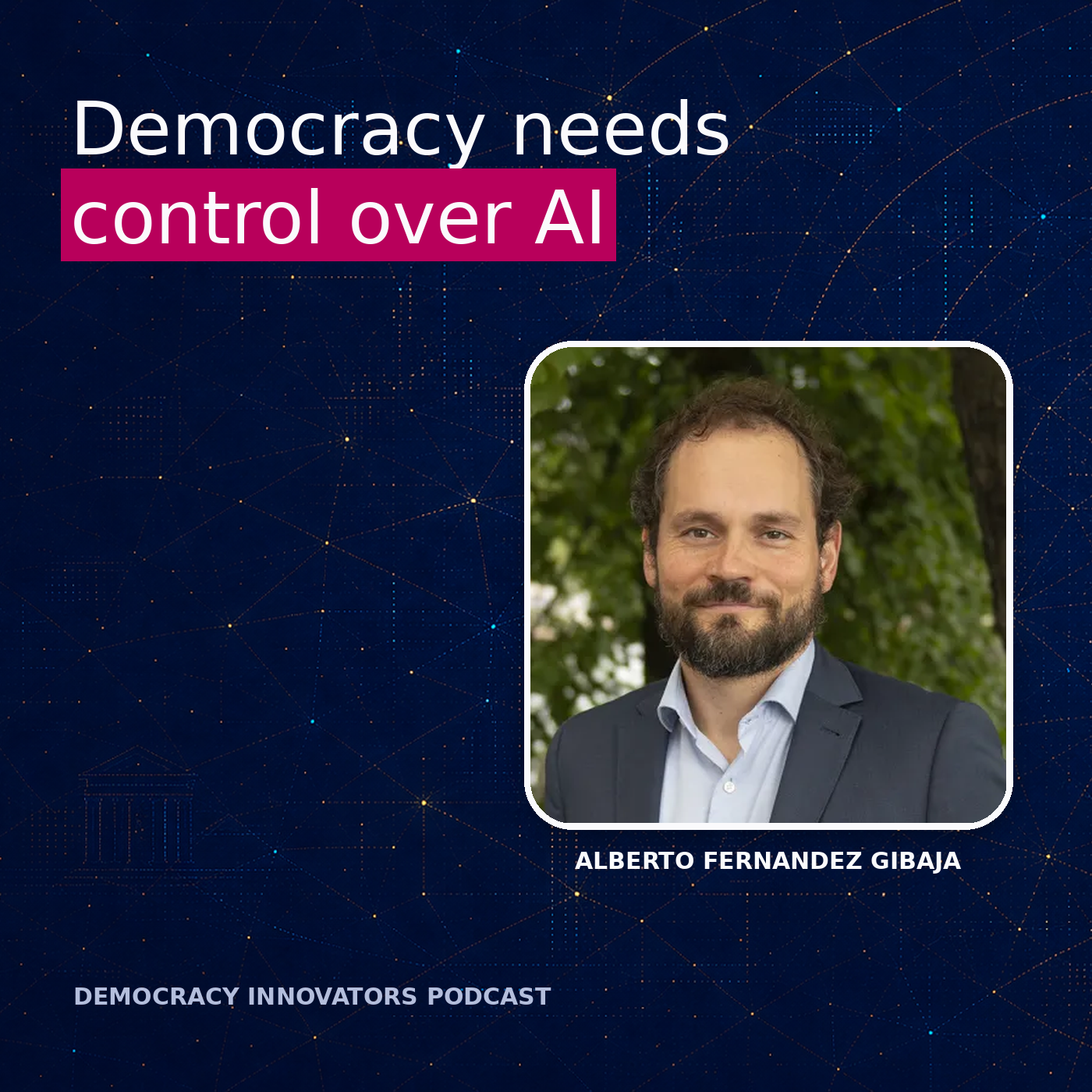
Alberto Fernandez Gibaja from International IDEA on Technology and Democracy
Democracy Innovators | 2026-07-29 | 1:00:18
Alberto Fernandez Gibaja leads International IDEA’s global work at the intersection of technology and democracy. In this conversation, he discusses how the early optimism around digital technology changed after Brexit, Trump, and the rise of disinformation, why tech companies can be as powerful as medium-sized countries, and why democratic societies need more control over data, infrastructure, foundation models, and AI applications. We also discuss digital sovereignty, data rights, the limits of direct democracy, political parties, expertise, and why the difficult part of democratic innovation is often political will rather than technology.
Top Keywords
- countries 0.008
- technology 0.008
- democracy 0.008
- data 0.007
- democratic 0.006
- political 0.005
- control 0.005
- mean 0.005
- society 0.005
- models 0.005
- stack 0.005
- democratic societies 0.004
Transcript
Speaker 0
0:00 – 0:19
Alberto Fernandez Hibaha. And, so welcome to the podcast, and thank you for your time. Thank you, Alessandro. And, as, I mean, the first question is, if you'd like to tell us something about you, something about your background or personal life and,
Speaker 1
0:20 – 0:53
Sure. So, yeah, my name is Alberto Fernandez Rivaja. I'm currently leading international idea, global work on, on everything at the intersection of technology and democracy. For those of you unfamiliar with international idea, we are an intergovernmental organization, with 35 member states, and global presence and member states from from all over the world, all of them democracies with just one mandate, which is to support democracy worldwide.
Speaker 0
0:57 – 1:08
Thank you. And, and, how did you came to this? When you realized that the technology could be interesting for democracy?
Speaker 1
1:10 – 4:13
That's an interesting question. I am of I'm old enough to be of those that generation that we started working on technology as from from a positive point of view. We thought and we joined the wave of, enthusiasm that, at the beginning of the of the 2010, A lot of the people in the in in in in the area of democratic governance, participation, and so on thought that technology was going to be a great asset for better democracies, better, more powerful civil society, more, fair, political debates, the the the the Arab Spring the fact that the Arab Spring basically started online through, Facebook, was kind of like, an eye opener for many people. And I also want to, I also want to think that that's still to to a certain extent, the case. There are certain countries, especially, hybrid democracies, democracies that are struggling or authoritarian countries that are, like, open open enough, but still authoritarian where actually technology has made it that possible and and and had made possible for certain groups to challenge the government. There is this, idea of the of the digital dilemma of dictators. You can't curtail completely technology because principally North Korea, where where you you lose out, in comparison to to anybody else. But if you open too much technology, that means people have a mean to express, a vehicle to express, to share, to contact others outside, and that that reduce your capacity to control, to control your population. So, that idea still stays there. But then well, then it was 2016, then it was Brexit. It was the first Trump electoral victory, the the issue of disinformation, the manipulation of information environment. And I think that from there, we have been on a on a downhill of, of technology becoming not only a fundamental part of our democratic societies, but also one of the main challenges, on how to deal with, with technology and with its impact on on democracy at large. And and specifically on on how we take democratic decisions either through elections, but also through, political debate.
Speaker 0
4:16 – 4:25
And, I mean, ideas, ideas, which kind of project are you working on with, your organization?
Speaker 1
4:26 – 6:31
So we, as an organization, we, we do mostly four things. We provide we generate knowledge. We we write reports, policy papers, policy briefs, sometimes manuals, on on key issues that, our stakeholders are demanding. It is it's usually very, very niche things, very highly specialized reports on very particular things, like, how to organize outside of country voting or or what are the, federal federal possibilities for South Sudan. So the very, very highly specialized content. We do a lot of, advising and capacity building for governments. So we work hand in hand with governments, democratic governments all over the world, supporting them in different things, improving their parliamentary processes, drafting new legislation, creating new new system, new electoral processes and and so on. We convey dialogues. We create spaces for stakeholders to to have dialogue, and towards exchange ideas and learn from each other. And then we do advocacy. As an intergovernmental organization, we don't our advocacy is a bit different than what you will expect from organizations like Amnesty International or things like that. So it's more at the at the, multilateral, multilateral level. We do a lot of, work with, with the UN within the UN system, with other regional organizations like the Organization of American States or or the Council of Europe or, the African Union, and and and other spaces where where key discussions on on democratic, aspects are being taken.
Speaker 0
6:34 – 6:51
I was wondering, like, if you notice any difference in relation of the I mean, in the different regions. So the different government from the different countries, if there is a different kind of, behavior attitude. I don't know.
Speaker 1
6:52 – 6:55
Towards, technology or towards democracy in general?
Speaker 0
6:57 – 6:59
Yeah. I mean, I can imagine for both.
Speaker 1
7:01 – 10:22
Yeah. There is indeed, there is indeed a a very, very big, difference. And it's I mean, for both. When it comes to democracy when it comes to democracy, it's a bit this is a this is a little bit we don't have time for in a podcast to analyze this, but, there are different tradition and historic trajectories that push regions one way or another. So for instance, Latin America, it's it's very aware and and very, I would say it's still traumatized to a certain point of of the the story of of the, of the last century. And and for those countries, as imperfect as their democracies might be sometimes, there is no other game in town. Democracy is the only possibility. So countries like Mexico, like Brazil, like Argentina, like Chile, like Peru, Colombia, they might have many problems, but there is no alternative to to they don't want anything else than a democracy. The discussion is more about how to make it better and work for the citizens and so on. I think it's it's it's it's it used to be the case in Europe, that that is sadly, that that is starting to change slightly. It is the case in most African countries, but, that's also starting to change. And we've seen how many Sahil countries have embraced, military dictators. There is, like, a coup d'etat type of, like, domino effect in in the region. And and for Asia, it's a bit, it's a bit more complex. Also because Asia, it's it's not a nonogeneous region. We just consider everybody together, but it's it's a very diverse region. So India, it's clearly, it's the biggest democracy in the world. And there's no questions about, the the the democratic system in India. All the regions have not had many, experiences of proper democracy or they keep, like, going in and out of democracy, countries like Thailand, Malaysia where, they have kind of, like, they have tried to create hybrid control models of democracy that are always in the in in the line between our it it's it's popular control over decision making and equality in exercising that control possible or not possible. It's always in in that blurry line. And that is reflected also in the way technologies, address. So many most countries realize that, a key factor to the survival or the strengthening of the or the democracies is how they manage techno technologies. How they manage the impact of technology, how they adapt to it. But then there are different ways to relate to it. So European countries tend to go more into legislation. They they they they want to impose rules because it's it's a rules based order. In regarding, like, to the,
Speaker 0
10:23 – 10:44
let's say, digitalization that could be a mix of, how, because the previous question was, the relation between different countries in relation to Mhmm. Could be technology or democracy. And so I wonder to digitalization, have you seen, like, a different, kind of,
Speaker 1
10:45 – 14:39
there is, as I said before, there are some difference between, how regions approach this. And, in general, Europe tends to be more on the regulatory side of things. They tend to try to tame or control, what technology companies and the technology space, does through through regulation. It is also like a big enough market, so all companies will comply. So now we all have on our iPhones, USB c and that's because the European Union, forced Apple to do that. And and they all complain, but then they they they they comply with it because they're not going to lose the European market just for for the the charger. And and because and and like this, this is very obvious, very visual because we can see it, but there are many things that, that go in the in the satellite. So it it generally works. It just sometimes is not enough. Other countries are, because their legislation is weaker or their their enforcement is weaker, their markets are smaller. So they know that, let's say, Meta can threaten Colombia to leave, because Meta can survive without Colombia. It's it's fine. But but any government that does something that eventually pulls Meta out of the country will face a huge backlash from from the population because people want to keep, scrolling on on Instagram. So they are less powerful. They don't have, infrastructure, governmental infrastructure like the European Union that can impose rules. So they they are more, they they're forced to be more on on on a negotiation mode, and they try to find agreements and and working modalities where civil society, private companies, and governments, get together. Some exceptions like Brazil, for instance, Brazil doesn't have a problem with imposing this. Again, because it's a big market, so nobody wants to lose out in in Brazil, India and so on. And and I think this is a clear, this is a clear signal. Private companies private tech companies today are as powerful as medium sized countries, and they can they can impose their will on on these countries. They can't impose their will on the European Union, on Brazil, on India, or or or The United States, obviously. Well, United States, it's it's a complex thing. Indonesia, Australia, some some certain countries are capable of of of imposing things to the to tech companies, but most countries are not. So, they need to ideally, they should create alliances with other countries and impose legislation with other countries together. So it's fine to lose out, on a particular African country, but nobody wants to lose out on the whole African continent. So that should be, ideally one of the ways to go, but that sadly doesn't happen very often. Reaching agreements on on tech policy are extremely extremely difficult. Tech companies spend millions of euros in lobbying, which it's effective. But also there is no clarity on what this legislation should have. So it's not that there is an agreement between countries like we want this particular thing, please do it. And there is a lot of different opinions on on how to go about it. So, that also, makes it very difficult, to have this type of, like, regional, pieces of legislation.
Speaker 0
14:41 – 15:24
Of course. And, I I was thinking, how do you imagine, like, the future? Let's say that, I mean, digitalization is happening also right now and also in the past years. And, I'm thinking, like, if in the future, like, the I mean, democracy and technology are, like, tightened ever more than now, because it could be, like, something that, I don't know, an absolute like a very strong centralization of power or, like, could be decentralized, it could be so how
Speaker 1
15:24 – 26:38
what are I think there are, for me, there are two fundamental questions that will define the way technology, works in society in general and in in our political and and systems to organize our politics. The first one is, choke points. Who controls the tech stack, and who has capacity to influence the tech stack. There are not that many choke points, but there are some of them. And and and we are all very unprotected, for those. One of them is, semiconductors production. It is enhanced in the hands of one country, two countries, Taiwan and South Korea mostly. The the the production, the physical production of semiconductors. There is one country that controls, that has well, there's one company that can produce the ultraviolet lithography machines that can produce modern semiconductors. China is trying to catch up. But, as they advance, the other like, the technology also advance. So right now, you can stop every I mean, it it is there is a possibility that it's not zero that we run we we don't have the capacity to produce semiconductors. So that will that that's, something happens in Taiwan, Taiwan decided to stop producing, or or I don't know. There are many many possibilities for that to happen. And that will imply we can produce cars, we can produce TVs, we can produce, many things. But semiconductors is not the only one. We also have, choke points in, in other parts of the of of of, of the global tech stack. The second question, and this is related to the first one, seems to be also who is going to control the AI stack. And and it's related because the AI stack is part of the global tech stack. So who's the hardware who's going to control For me, there are, like, four parts of that tech stack. The hardware part, that's the same semiconductor's computing capacity where, the data centers, who will own them, who will build them, who is going to own the capacity to run the systems, the AI systems that by what we know now, they're extremely inefficient in terms of energy and and computing needs and so on. Or I don't know if they're inefficient. I don't know if there is a technical way to do them more efficient. That was what DeepSeq apparently was capable of doing, but, it doesn't seem to be able to do in that direction. But But there is a question on on how much how much computing capacity can we create, and who is going to control that computing capacity? Data. They are the second layer of the AI stack is about data. And and we have a problem with data because, AI is going to be this is a personal opinion, obviously, but AI is going to be useful. And so far, the data we feed to the sys to the systems are is useful data. So, and I'm not speaking about large language models that we all use for doing a shopping list or correcting a paragraph. It's more about specialized AI applications. So the medical data of the, public, survey, public health system in Italy is incredibly valuable because that can train an AI system. But that's all it's also incredibly sensitive because it's not that difficult to I mean, it's it's not anonymized probably. It can be anonymized, so you have to be able to link the person to the the report written by the doctor. So it's it's it's incredibly valuable because with that data, you can probably do thousands of improvements in in medical science. It is also incredibly sensitive. And and how do we manage data? How do we control data? It's also part of how we are going to, relate with the technology in the future. People will be I think people will be very against artificial intelligence in they if they find out that a lot of their private information is there. I I I have I sometimes have, feels a bit weird when I realize that Claude knows personal things about me. And it's and it's because I I I told him. Right? But suddenly it's like, oh, because you live in this part of the city. It's like, shit. Why do you know that? You shouldn't be knowing that. So that I think that is going to multiply in the near future. The third part is the foundation models. The the and this is I don't know how the technology is going to evolve, but my my fear is that there is going to be a handful of foundation models, that are that because of economy of scale, they will keep evolving faster than any model. It would be impossible to catch up. And who con like, who controls that models controls, like, a fundamental layer of the AI of the AI stack. So if you control a model, you're suddenly everybody's your I mean, you can't also stop supplying, the model to to anybody. So let's say you are Airbus, European company, and your AI system that helps in hundreds of ways of building planes relies on an American company. And then that American company decides to stop, supplying that or decides to steal your designs and fit those designs to Boeing. There there are a lot of implications of of that. And then the last part, which is the one we usually are more concerned about, and I think is the one, easier to solve is the application layer. Most of our individual experience with AI, it's it's, large language models. But I think the real change of AI is going to be on on very specialized applications. So if if you are a doctor, it will be the the an application that helps you as a doctor. That's gonna that's gonna be the the real gate changer. So this AI stack and how it's controlled by by whom it's going to be fundamental at the geopolitical level, at the society level, and at the democratic level. At the geopolitical level because it will create a half and half notes, type of wall. And and I I don't see I don't see an agreement, the type of agreements that we got at the beginning of the 1920 or or the beginning of the twentieth century to, like, share this the the share the, serve a system so we can send telegrams between different countries and that type of I don't see that happening. So the geopolitical level at the political level, because, the implications, the second second effects of, of AI are gonna have a, like, fundamental reshape the way democracies and and political system work and at the society level as well. I this is not my own sentence. It's somebody I I work with say that, artificial intelligence is not a communications technology, it's a cognitive technology. And that changed the the impact of a the impact of a cognitive technology is way bigger than of a communications technology. Even the printing press was a communications technology. It allow us to communicate ideas in a different way. And that that simple printing press is you can trace almost all the evolution of society since, the invention of the printing press to the invention of the printing press. I don't I don't believe in the hype, but there is there is a scenario where we can do the same in three hundred years. We can do the same of linking all the evolution of the less the the next three hundred years to artificial intelligence and the way the the cognitive, change that that it implies. And I know this is this sounds a little a lot like Silicon Valley type of, of hype, just just so they can sell, startups and and get, stupid high valuations. But there is indeed a possibility of of the technology slowly in in a long very long term changing fundamentally some of these of these questions. And we are not we're not having those those those, those debates. We're not considering, those type of things. What happens with, education? How do we when we have a brain that thinks for us, how do we use our brain for? I I I I study, social science, in university, in humanities. And and and to a certain extent, it gives me a little bit of pleasure to know that a lot of people now is saying, well, it's gonna be all about humanities because that they we will solve the technical part. The medicine, we don't need we don't we're not I'm exaggerating. Right? But we don't need researchers on medicine that can be done with AI. We need people, with humanities training to know what we should be doing with this, cognitive potential we usually didn't that we used not to have. That sounds very, AI, optimistic, but I'm I'm not.
Speaker 0
26:40 – 27:14
Yeah. I'm, like, I'm also quite, impressed when I use AI because, it is impressive what, it can do. It does. And, but yeah, I'm also I also ask to myself, this kind of question like, also regarding education. And, because now it's wonderful, like, to write like a let's say a boring email, Maybe we can use Judge GPT or whatever, but we are used to write. And, and so also for new generation is, something
Speaker 1
27:15 – 29:34
Exactly. I I two two things. I I love one, comic Stripe that is, I don't remember where it was published, where it's, somebody sitting in front of a computer speaking with a colleague and say, see, I use AI to, I gave AI one sentence, and it grow this long email. And then on the other side, there is somebody who say, look. I got this long email, and it summarize, AI, helped me summarize it in one sentence. And that process, which I mean, it seems like a joke, but that process, it's it's our it's it's fundamental. Like, the thinking process of writing an email and actually discerning the meaning and understanding the what it says, if we don't do it, if we lose the capacity to be able to do that, and and again, writing reports and and and thinking and and and discussing ideas, that's risky. And and we need to understand what's going to happen, when when institutions that are civic pillars of society, like the media, like the universities, where new ideas come up, when those are hollow out by by artificial intelligence. What's going to happen when we don't have, like, universities? What's going to happen when all of our society works through a handful of foundation models that can be used can be used. I don't believe I don't believe they're going to be, salary sent in and and then capable of, like, running us and this will become the matrix. But but there will be people that will control them. And what happened? Like, we will be able to to to take the Bastille. Can can we do a new French revolution and and cut the head of the not not of a of a person, but of the machine? Will will we be able to do that? That's I think that's the question we're not putting in front of us. We're more worried about, oh, there's a deep fake. But that's Yeah. That's a that's a certain problem.
Speaker 0
29:36 – 30:45
Yeah. It could be also an occasion maybe to put in discussion a lot of things that we are used to do in society. Maybe I'm thinking also regarding education. Yep. And, but, yeah, I also saw that comic, the the stripe regarding the one that tried the mail, the other one that read it and it was, quite, It summarized it very well. Yeah. Yeah. Yeah. Yeah. Exactly. And, I mean, regarding, like, the I mean, who control the AI stack, who control, also, as you said, the semiconductor or foundation models. Like, what could be, yeah, I don't know, solution because I am there are also some, it's also in relation to sovereignty of data, maybe. And, yeah, what could be, yeah, a possible solution, to this? Because I think or it comes from the people that we just start to use, I don't know, Mastodon instead of Facebook. But it's hard.
Speaker 1
30:46 – 31:42
Yeah. No. That's that's that's a difficult one. Part of it, it will come from the people. And I I really hope there is going to be a backlash against AI. A positive backlash. Not just people, like, not type of like, Ludic's not wanted to use it, but like a positive backlash that people will the same way that apparently, young generations like, kids, in their like, 16, 17, 18 years old kids are starting to have a certain backlash against mobile phones. And they they, so they organize, like, gatherings where everybody drops their phone, at the entrance and then they so they kind of, like, inter interact offline. So that's kind of they're they're realizing the dangers and they don't want to be sitting in a room with their friends
Speaker 0
31:44 – 31:46
looking at the phone. So they they realize how to, work,
Speaker 1
31:47 – 39:02
against the the the machinery that force them. There is no one solution. There is no one magic bullet, silver bullet that will solve things. But there are things that we can do. We the EU is right in moving the debate towards sovereignty. We need to be careful about digital sovereignty because, at the inter not at the multilateral level, the the at the multilateral level, digital sovereignty is a term that has traditionally been used by China to justify, their they not respecting the the normal functioning of the Internet, basically. So, imposing, firewalls, basically, this idea that the Internet shouldn't be a number of connecting nodes, but rather isolated islands, controlled by each of the governments. So but still, the idea that countries need to have certain control upon their digital infrastructure is is correct. But democratic countries cannot rely on them like, it's not about controlling their own stack and then hoping the rest will will do the same with their own stack. I think there is a need to have some some level of agreement among countries. For data, for instance, we need a bill of rights for data. We need more clarity. I I will even constitutionalize data rights. Although constitutions are very difficult to to to get, an agreement. So constitutionalizing day, data rights is it's pretty difficult. But I I will move towards constitutionalizing data rights. I think we need mechanisms. I'm not a a technical person, but I we need mechanisms to use sensitive data in a way that is respecting of privacy and and and human rights. And and there are ways to do that. Estonia has been using sensitive data for many years without problems, and and and they there are ways to, host data in different parts and all the, I mean, it's it's and and only provide the part of the data that it's necessary. So data minimization. Data minimization shouldn't be just a slogan. It should actually work. And there are ways to do that. And I think with AI, we need to be much more creative in ways to do to do that. I also think, especially the European Union, but but also other countries, should join efforts to promote semi open AI system semi open source AI foundational models. You can have a fully I'm I'm very afraid of fully open source foundation and models because because we know that human beings are gonna find the worst way to use that. And be it developing a biological weapon or or doing, nonconsensual porn images. But we will human beings will find the worst way to use that. We need to have safeguards. We can release completely open weight models into the wild, because that's right now, that's very dangerous. It's it's it's it's too dangerous to do that. It's like if we were, like, if we were to release all chemicals that we produce in the world, just you could buy and, buy them in a shop. That that would be too dangerous because people would do bad things with them. But we also need to allow for certain level of open source, in in in foundational models. So I think democracy should push for semi open source, foundational models in which certain aspects are controlled. There are safeguards. There are limits, and there are institutions. We have created a type of institutions like ECan, for the Internet or, UN can create that. I don't know. There are ways to create those institutions that control that or, private public partnership. But those models that you can create an a biological weapon, but will help you, develop a system to control the traffic jams in a city. That is where, we that's how we can control it. That's how we can be sovereign with the technology because we won't depend on a single source. We won't depend on Anthropic or OpenAI or Google, model that they can always they they will they will do two things. They can always stop it. Not that they will necessarily do it, but the possibility is always there. And and and when it's some added of, developing, I don't know, traffic jam management system, there's no interest. But, when when these systems are used for warfare, then then it gets, way more tricky. And then the second thing is that we know the companies tend to not always improve the product, but and shitify the product. We they tend to eventually just try to get as much profit as possible rather than make the product good. And we have seen that with social media. They have kicked out people of social media. Now social media will, this is my my wild guess, but so the the time of social media has ended. We we don't we live in a post social media world already. And that's because the product became shit. Like, nobody wants to use it anymore as it was. So now it's a different it's a post social media wall. So they will also do that. And and and and for social media, it's not it's not the end of the world because, okay, fine. We use other ways to communicate. But for a cognitive technology, we can allow Anthropic or Google or OpenAI to take those decisions. So, or or Chinese providers. So I think that's, that's also fundamental, fundamental part of the picture.
Speaker 0
39:04 – 39:34
Yeah. And, I was thinking about, this project. I don't know if you're aware of the agenticstate, .org. And, yeah, what are if you have read it, what are your thoughts? If you think that that is a viable way, for a different states.
Speaker 1
39:35 – 40:36
I'm I'm I'm not sufficiently familiar with I know the paper. I know some of the authors. I'm not familiar enough with, with their proposal. I know there is a lot of conversation on how the state can, harness artificial intelligence. And and and I will go back to what I was saying before. It's all about data and the trust on using data, and and and how how you manage to use data in a way that people trust. So, you know that by surrendering your data to a certain extent to the state, there is no no second second degree consequences, negative consequences of of that.
Speaker 0
40:39 – 41:52
Yeah. I mean, isn't this something like the like, as you say, the if an AI system in The US is used in Europe for the, let's say, something not very important, then everything is okay. Then if there is a potential or whatever conflict or situation, then of course, you are dependent and you cannot really do anything. I I wonder if also the situation for data is like, because most of the times, is, like this that also if you give data to the state, nothing happens. But historically, there are situation where the state, I mean, the the state is an entity then depends who is in charge, who has power. So in a, let's say, democratic society, nothing will happen. But if then there is a change, in the in the way the the state is, leaded, then, there could be troubles maybe. I don't know.
Speaker 1
41:53 – 44:26
That's and and and you say that's the fundamental part in in a democratic society. And that's why we have democratic societies because, I often say it's, democratic societies are about predictability. You know that that certain things can happen. And you know that, you know that you can get rid of a government if if need be. It's not that it's not that democracy select better governments, is that they can get rid of bad governments. And and there is a level of predictability, which is basically what it's it's, predictability is what rule of law means. There are rules. So, they're not going to be randomly exactly. Things like your data is on the, the the government's suddenly tracing, or cross crossing data to realize who is, I don't know, opposing the government online or that type of things, Or or who are the I mean, you can think worse things like, who are the more likely people to use the, health system, the most in the next ten years and then decide that they are not going to get access to it because it's too expensive. That is doable. You know that a democracy will not allow that to happen, because there there's a rule of law. There's nothing impeding a dictatorship to do that. So you say there it's it's about having democratic societies. It's it's not about I always say it's not about democratizing AI. That that it's very beautiful for conferences, and and to write papers and and to speak in international fora. But democratizing AI doesn't make sense. We don't need to democratize AI. We need democratic societies to manage AI. And that's a different thing. Because that's what matters, that there is productivity, that there are rules, and that we can impose those rules. And we won't be able to impose those rules if we don't have certain sovereignty. And and I think that's where, as I said before, the the concern of the European Union makes sense, to go that. Because if you want to impose your rules, you suddenly need certain sovereignty.
Speaker 0
44:29 – 45:29
Makes sense. And, and, yeah. Also, like, before I ask you, how do you imagine, like, society after digitalization? But, maybe the the the question could be reframed more, like, if you imagine a change, let's say, in the political life, in in the way also in democratic society, because now there is, I mean, most of the country when when we talk about democracy is representative democracy. And, I wonder if I mean, because technology could also allow, let's say, a sort a kind maybe something like we could call it direct democracy, but could be also something else, some more like, hybrid sort of democracy between direct and the representative? And,
Speaker 1
45:30 – 53:22
I personally don't believe in those models for practical reasons, not for ideological or or or ethical reasons. It's for practical reasons. Ethically, it sounds good. It's just not practical. And and it's not practical at the individual level, but it's not practical at the administrative and and governing level. So we can't demand people to spend a huge amount of time, of their free time in managing the state. There should be spaces for consultation. I am all into public consultations and and and and reinforcing this idea of, this, connecting belt between power and people, shouldn't only be political parties. There should be the state and the administration should listen to the citizens, respond to the citizens, media should respond to the citizens and not create, manipulate, the information environment to think to make citizens think what the problem is. So, yes, all into into that. But decision making, it's more complex than an individual idea. And there is democratic societies need to delegate into a group of people. You can't you can't articulate clear ideas on asking everybody. And and that's because the idea of, direct democracy or, like, deliberative democracy assumes that the that government can be a win win situation for all the society. And that's not true. Every single policy has losers and winners. And and politics is about who loses and who wins with every every, policy. Clear example, making education free. There are losers if you make education free. There's people who is losing money because they invest in private education. There is people who because of their politic, economic situation, they have an advantage. But, if you make, education free, then they lose part of that advantage because they don't they had an advantage because they could access levels of education that now everybody can access. So they lose that advantage, and now they have to compete with more people. The people trying religious organizations lose because they were able to control and make and and have an income out of education and now maybe they can. So there are losers with every single policy, and there are winners. If you make education free, it's quite evident who wins. And politics is about who wins and who loses. So if we try to find always deliberate everything, we will always try to find, we will first of all, it's very difficult to deliberate. There is, people people with I mean, deliberation is not an equal exercise. People have more capacity to convince others, are more charismatic, and so on, and they they know better to convince. And so there are many things that shape that. But you would not always find the right policy. And there is a value also in negotiations between political actors. I people hate this, but I think part of the work of a parliament is precisely that, that you sit down and speak with all the political groups and and find agreements and say, like, okay. I'm gonna I'm gonna vote on favor of this law, and then I will get your support for this other file. And and we exchange cars and and if if this is done ethically, obviously, and without without going against the principles of your party, that's fine. That's part of the democratic game, and that is needed. That is that is important. We we we have demonized that type of behavior, but that is actually part of the democratic, arrangement. That's how democratic societies work. The agreement is at that level and not at the society level. At the society level, it's it's, it's impossible to find those those agreements. And then the last thing is about expertise. I shouldn't be asked about I shouldn't I I I shouldn't be consulted on waste management of the city where I live. Because I have no idea. I have absolutely no idea how it works. So there's people who have dedicated their whole life to research that and to to study different models and how do you waste manage in the best way. I have no idea how it works. I my opinion shouldn't be that important because I don't know anything about it. What I might have is some political and ideological general ideas. Like, well, whatever you do with waste management, I hope it's not against the environment or it supports the environment. That's why there is a representative in parliament that will bring that idea from me. But it's but I but I'm not engaged into how to organize the waste management of the city where I live because I I have no idea about this. And and my opinion is we like to say everybody's opinions count. No. The expert opinion counts, not my opinion because I have no idea about this topic. So shouldn't be deciding about this this particular thing. And direct democracy assumes that everybody has the capacity to decide on everything. So what will happen if we were to have a direct democracy system? That we will become a heuristic society. We will just vote by by by heuristics. We think, okay, this is the way to vote. And we will eventually create what was the old system. We will eventually create political parties. We will aggregate ideas and then follow leads on what we vote. That's the same what we have that's what political parties are for. They aggregate ideas and they say, I'm gonna go to parliament and I'm gonna represent your big ideas, your cost conceptualization of the world into each of the different legislations. Be it waste management or should we, ban, plastic packs or or should we build a new airport? I don't know. Like, all these small decisions where I don't have the capacity to to to take, decision. So if we were to do it well, if technology because we do have the technology. If we were to do it well, we will end up having the same system. Just much more complicated.
Speaker 0
53:25 – 55:07
Yeah. I'm thinking, I was thinking about, what you were saying and, that, as as an example, you took free education, the advantage and the disadvantage for the could be for a group of people or for the others can also be seen in short terms and long terms because, and, this could be interesting. And, also, I'm thinking because expertise is fundamental because, I mean, also, I don't know anything about, I don't know, bridges. But, as a citizen, I could say, yeah. The cities, the the bridge there is not, maybe it could be bad for environment, because maybe my expertise is environment or something else. And And then I was thinking for political parties because, yeah, I'm very interested by, also in Italy. I always say this, that in Italy, there was the five five star movement that was using their platform. And, I was thinking that, as you as you said, political parties aggregate, not ideas, but interest. Interest. Exactly. So it could be maybe more, a specific interest instead of because a political party often aggregate many, different ideas and goals. Yeah. Just
Speaker 1
55:10 – 55:25
yes. If this is it gets very tricky because, you the example of Italy is very good. You can have, white, broad 10 parties like
Speaker 0
55:27 – 55:28
like, the traditional,
Speaker 1
55:30 – 58:16
central right and central left, Democratia Christiana in Italy or the PD. They they try to to cover a very big part of society because that's the way to win an election. But then because they cover too many, they can represent them well. But if we go to the extremes, then we go to, like, single issue parties, where you just work on one particular thing. And and a single issue party might be good at some point if if that's a key issue. But then if your only ideology is one thing, then when you are in government or when you are in parliament, you have so many other things to decide. So what is your moral compass in the rest of the things? So I I I would think parties should use technology wisely to understand their voters or their constituencies, but also understand the rest of society. And and and know where people I mean, one of the main issues why people don't don't engage in politics is because they don't feel represented. And and and sometimes it's because, how can it be that one of the main if if if you ask people one of their main problems in, for instance, in Italy or in Spain where I'm from, or in many countries is housing. And housing is not at the center of the debate in most countries. So people understandably get angry because they feel their main concern in their day to day life is housing and then politicians speak about something else. They don't feel reflected. Like, why are they not speaking about housing? This is what matters. So I think political parties should be using technology wisely to to understand these things better, and to talk to citizens on what really concerns them. And what they do, they're actually very successful. It just, our information and this is for another podcast, but our information environment is broken right now. And and they have to, if you try to speak about what actually matters to people, you are not facing you're facing a, a wall of of penetrating an information environment is broken and and it's not it's it's not sweet not right now to, for those messages.
Speaker 0
58:19 – 58:38
And, talking about messages, if you have, a message for the people that are working in the field of, could be democracy, democracy innovations, or the democratic innovations. And, yeah, if you have a message for them.
Speaker 1
58:42 – 60:04
My message will be, and I have always say this, the easiest part the easy part is the technology. You can always find the technological solution. The difficult part is the political will. It's the politics of it. I I don't know. I I I can't. But I know it's very easy to create a super fancy tool that aggregates people opinion through AI and that's that's easy. That's doable. It's not it's not I mean, it's rocket science for me because I'm not a programmer, but but it's for a programmer, it's not rocket science. It's relatively easy. You can probably buy the code now, something that more or less works. It's the politics. So I don't focus on I I have seen this so many times, just very well intentioned people focusing on the technology and showing how cool the technology is, but then they have zero political, understanding and political will. So it never it never goes anywhere. There are hundreds and hundreds of tools that are super cool. They are lying around nobody using them, because they didn't invest enough on the political side of things.
Speaker 0
60:06 – 60:07
Thank you, Alberto.
Speaker 1
60:08 – 60:10
And, It's my pleasure.
Speaker 0
60:10 – 60:15
If you want to add something else, maybe I forgot. So thank you again.