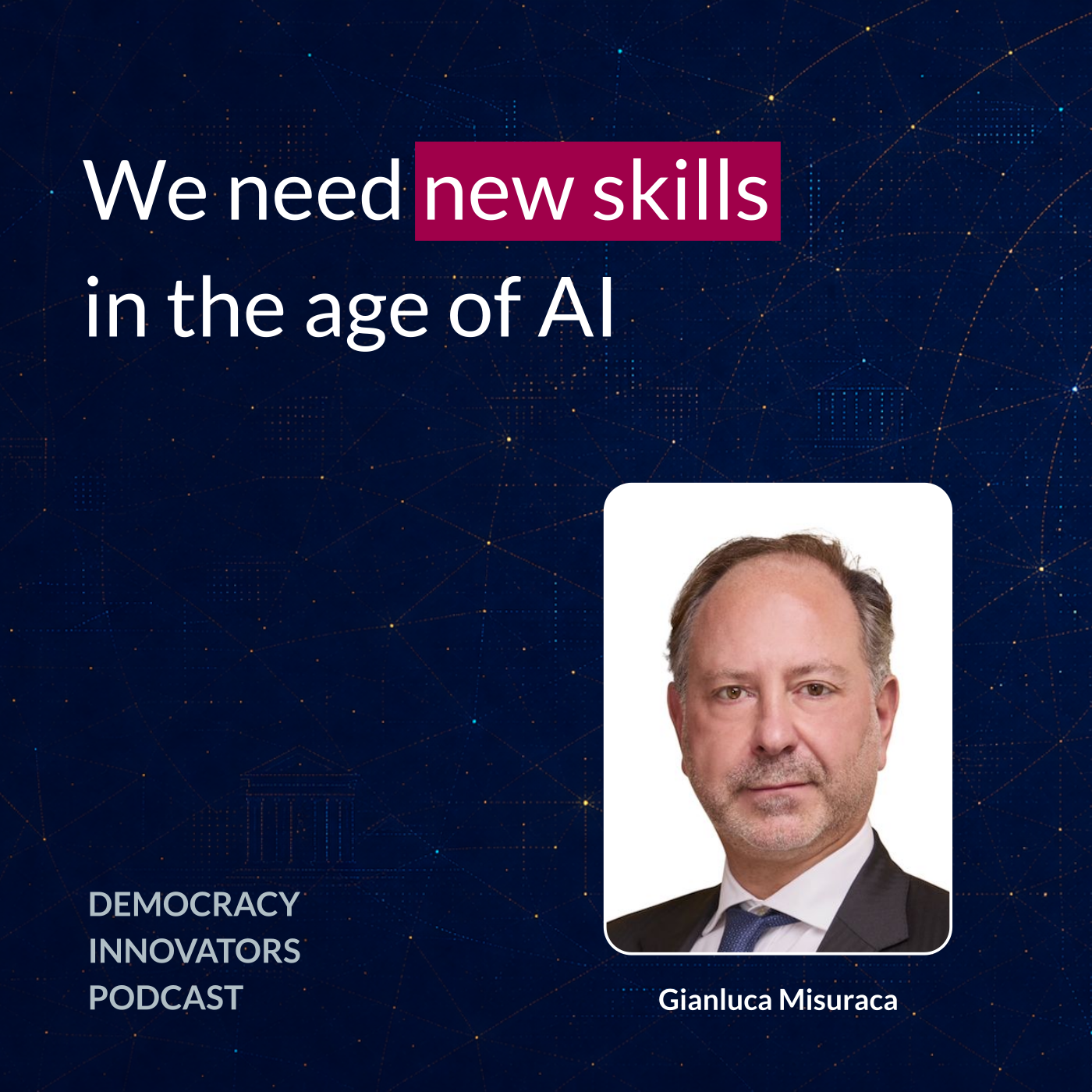
Gianluca Misuraca from Inspiring Futures on AI in the public sector
Democracy Innovators | 2026-08-12 | 49:14
Gianluca Misuraca of Inspiring Futures Europe, coordinator of the European Union AI Skills Academy, discusses how foresight can help societies shape technological change. He explains why democratic control of AI depends on digital sovereignty, public-sector skills, interoperability, better procurement, and meaningful citizen participation.
Top Keywords
- mean 0.017
- course 0.009
- european 0.009
- technologies 0.007
- digital 0.007
- future 0.007
- technology 0.007
- make 0.006
- scenario 0.005
- commission 0.005
- artificial intelligence 0.005
- certain 0.005
Transcript
Speaker 0
0:00 – 0:07
Welcome to another episode of the Democracy Innovator podcast, and our guest of today is Gianluca Mizuraka. So thank you for your time, Gianluca.
Speaker 1
0:08 – 0:11
Thank you for the invitation, Alessandro. Hello, everyone.
Speaker 0
0:12 – 0:16
And, I mean, you're working on many projects. And before we were
Speaker 2
0:17 – 0:19
talking about, inspiring future,
Speaker 0
0:21 – 0:23
would you like to tell us something?
Speaker 1
0:24 – 3:12
Yes. Maybe well, first of all, thanks again for invitation, and, it's a pleasure. And, I mean, maybe I give you a bit of my background and, how I got impact to to, let's say, to be to get obsessed about the future or futures in a plural, term terms. So first of all, I I mean, I've been working, mainly in several institutions, United Nations, European commissions, and working always at the intersection about, you know, policy, governance, technology. So democracy is clearly very much related to this. And in particular, you know, always looking, with a future perspective. I mean, I work at the Institute for Prospective Technological Studies of the European Commission, joined to the center in Seville for, well, for more than twelve years. And, and, we have been always looking at, you know, how technology can impact society, and what could be the future of the digital Europe. So we were talking about artificial intelligence many years ago before now became, you know, the the the new normal, and, everybody's talking about it. And we can probably discuss about this, later and what are the implication indeed for democracy. I mean, before that, also, they call Politecnique Federado Lozani is where I started looking at the, you know, at the at scenarios for the future, how to, you know, to road map and and to try to understand, anticipate, you know, the especially deposit the possible negative consequences of certain, choices and certain decisions. So how to equip policy makers also with, you know, the capacity not to to, let's say, to to to to see the future. Of course, this is impossible, but rather to, better understand, what should be avoided, for example, or what should be done, what strategies and policy would be better to put in place. That's why when I decided, in the middle of COVID in 2020 to leave the the the European Commission, I actually set up with colleagues, these new ventures, Inspiring Futures. Actually, we are based in Switzerland, but we also have, the Inspiring Futures Europe, actually, that is based in, in, Madrid, but we work globally. I mean, I'm just back from The US. I'm going to Argentina next week. So we are working on different projects. And in particular, and maybe this is something we can elaborate bit more, is exactly what kind of skills, in relation to artificial intelligence, we should report and strengthen, at different levels in our society.
Speaker 0
3:13 – 3:26
You you were saying, future or also possible futures, so, in the plural way. And, I was thinking, how do you imagine, like, the a possible future or also the possible plural futures?
Speaker 1
3:27 – 7:45
Well, I mean, we we, I mean, we always say I mean, that's the the rule number one for, futurist is, you know, the future does we don't know the which which will be the future. No? The or or someone say even the the future doesn't really exist. It's how we shape it, how we we construct the future. And there are as possible alternative futures, and that's why it's always important to look at the what could be the the, you know, the different directions, the church certain choices of today, with the, you know, with the with the shape a different future. So, I mean, when I I started, many years ago already to to to make scenario, especially about the the possible impact of technology on society, I mean, we were already, as many others. Of course, we are not the only one. We were not the only one seeing, clearly the the positive, and the opportunities that technologies different ways of technologies, have and can have in our society. I mean, this is, it cannot be denied. You know? Technology, especially digital technologies in the last thirty, forty years has completely changed our society. And I would say, in general, times for the better because, I mean, we we can do things that, we in the past were not possible because of the technology and the the the kind of that we have, especially in certain part of the world and not in all, of course. But then we have also the the the risks, the the the the possible, negative, consequences of the, let's say, the bad use and misuse of technologies or the fact that society has become, really, somehow now used so much to certain technologies, and we our behaviors are shaped by those technologies because, of course, we could not or we didn't know how to also regulate those technologies, or we didn't want to regulate. We couldn't. So if we look at social media, I mean, yesterday, you you this is very timely. Yesterday, the commission launched president von der Leyen, you know, a proposal to to to, to make, compulsory for, for, children for minors. So so to to to to show their ages on for social for assessing social media so that, basically, they cannot, do so. And this is in fact a major problem for for the current generation. But, definitely, this is something that was already anticipated, I would say already twenty years ago, that how social media could be a weapon also for democracy, and we see that every day. I mean, I was in Washington last week, and if we see what's happening nowadays and the the the attempt to, you know, I mean, not the attempt. Actually, the disinformation that is growing, because of these technologies, it's not say I mean, we cannot just say, oh, we we didn't know. We we have not seen this coming. Actually, it was there. And when there are a lot of studies that were anticipating this, but probably well, actually, the policymakers were not able or didn't want to really listen to that. Of course, evidence is not so white and black and white. Of course, there are many nuances, but clearly, there are, the there are some risks and some very dangerous big big dangers that some technologies are bringing. AI, artificial intelligence, is clearly the the probably the most prominent and and, also, I mean, powerful, set of technologies that we have today that could, make, of course, a very good, positive contribution to society, but also could create a lot of challenges. So that's why we have to to to look at the future, I wouldn't say in a pessimistic way, but with, you know, careful attention to the fact that if we lose the control and this seems we are somehow or sometime losing it, we could, have a bad, let's say, ill consequences.
Speaker 0
7:47 – 7:59
And and so, I mean, we can shape the future. And, I wonder, like, for you, like, to shape a future that also you would like to see,
Speaker 2
8:00 – 8:08
and also regarding, like, not losing the control also in relation to technology. What do you think should be important to do?
Speaker 1
8:09 – 14:21
Look. One one actually, one of my last, work when I was still in the European Commission was exactly in in the period 2018, 2020. So we published this scenario for building and shaping a digital euro 2040. And these were very timely our work was to provide some evidence, some input, some contribution to the to the the policy decision taken in Brussels and in the in the European, capitals because this is a joint work, of course, of the commission and the European Council and the and the parliament. Clearly, the final for the first time in 2020 was launched a dedicated program on digital from the digital euro program, and a lot of emphasis was given to digital, technologies with the digital policy, digital decade policy program. So the the the claim or the the the vision and the ambition of the European Union to become, a leader or at least to to start, racing with the other regions in the world in different areas, including on artificial intelligence, was was, let's say, something also very timely and and and interesting, and and concrete because we were not just, you know, starting the future, let's say, but actually providing very concrete input to what could be done, already at that time and should be done in order that by 2040, our horizon was, 2040. So in twenty years, we could actually really make sure that, we don't go into those negative scenarios that we have also depicted just to to to show what could be the the the the danger of not intervening, for example. And on the other side, trying to hope and develop an ideal scenario where we can hope, of course, that, for instance, the maker and the shapers of technology come together in an open and trusted innovation ecosystem. Right? Something where we have open governance, you know, democratic systems are not threatened by technology, and there is a more social cohesion. So, of course, to do that, we have to address, those main, what we call it in in foresight terms, dimensions of impact. So what could actually make this positive scenario happen or actually not, not become reality, and bring us in a in a in a negative, or a bad scenario, a dark scenario, let's say. And clearly, we look already at the time at the, at the landscape of digital transformation. So it's something that it's, not only the regulation, of course, but clearly building on the regulatory framework that it's, indeed, and what, for instance, the European Union is, been has been building for for now for decades. Not only the AI act, everybody is known knows about AI act more or less, but there is a a a digital governance framework that has been built since, many years, that has a combination of, rules and also, incentives because, of course, it also required the the the need to ensure that we have an ecosystem that that allows then those, rules to be enforced and make sure that we have a a a a plain level field for all European players, and, avoid that, you know, some players that are clearly not European are actually taking advantage of our economy, our market. And the other element, that is very much linked to that is the data sovereignty issue. Basically, we have been discussing about, you know, making, ourself, everybody own owner of their own data. The GDPR is all about that. Basically, it's making sure that we can control our, our data. And, this is not necessarily the case. Actually, the current scenario, if you want the status quo, normally, you have also scenario that is, okay, what if nothing change? Right? Where are we standing now? Basically, it's a it's a scenario that, we call it, of a a party can close the innovation. Basically, first of all, all this the systems that we, have now, most of I mean, all of them, despite their claim to be open, in reality, they are very much closed. I mean, the Apple, the Googles, I mean, they are not necessarily interoperable. I mean, there has been some advances exactly because of the request by, governments and in particular, the European Commission. But in reality, they they tend to, let's say, create their own walling, water garden. On the other side, there is also the fact fact that we as users, are not capable. We're not equipped with the the the the the tools and the instruments to actually question, this this status quo. And what we do, in fact, at the end of the day, we tick the boxes of the GDPR. We hope that nothing too bad will happen. So this is exactly where, we we we talk about digital sovereignty. We have to make sure that everybody in principle, in an easy way then, can regain the the the the ownership and the sovereignty of those data. So, digital governance and data governance become actually the two key issues that need to be addressed. And if we make it right, we are trying to do, but, of course, there have been many things happening since we we we we designed this scenario in 2020 until now, then we could have maybe that ideal positive scenario, for the future of of our, future for the future generations.
Speaker 2
14:23 – 14:37
And, actually, this is also related to what you were saying about, which kind of skill should we develop in society also in relation to technology. I mean, AI is the, the main technology.
Speaker 1
14:37 – 23:22
Yes. Is the is the the buzzword or the keyword. I mean, I would say, yes. And indeed, this brings me to, to to to to the projects that I'm actually leading now. And, I mean, one once I left the commission, in fact, one of my first, proposal was to have a a a dedicated master on, AI for government, AI, artificial intelligence support public services that we designed with colleagues, in collaboration between the Universidad Polytechnic in Madrid and Polytechnic di Milano. I I work with both of them. And we had also other partners from from Germany, Estonia. And, and this master, that started in 2021 and now is entering his sixth edition, is, I mean, is a combination by design of, you know, data scientist, AI expert, and specialist with design thinkers. So for example, Polidecchio Milano, I'm associated with the department of, design. And the idea there is that, we actually when we want to use, adopt AI, in public services, we really need to think carefully, the design of the service, the policy, the processes, and, even ask ourselves a basic questions. Do we really need to use the latest technology AI? Maybe is there something else that, we need to do before maybe investing on certain technology just because it is cool. You know? And, clearly, generative AI that was then, you know, exploded, in 2022 a bit unexpectedly, although it has been there for a while, it will even change the the the the the game and even including, in let's say, and, further emphasize the importance of this approach. So in in a design, in design terms, we we talk about reframing. We need to reframe the public sector innovation systems because they need to actually embrace the complexity that a a digital transformation and especially AI enabled, services are bringing to the, I mean, to the government, the public sector, but in general, to society at large. So the the the master was very successful. I mean, we have been, awarded the digital skills award, European digital skills award in 2023, have been also mentioned as a best practice in several, UN, OECD, and other international organizations, let's say, reports. But apart from that, it was because at the end of the day, we we train, let's say, in average, 40 people per year, 40 person per year. That is good. We are very good participants. We don't call it call them students because they are all very, experienced professionals, and they then end up maybe many of them ended up working, I don't know, in the in the AI office or the European Commission or the OECD AI policy observatory, just to mention UNESCO, or, of course, in national governments, from, really I mean, of course, from many European countries, but also from, I don't know, from Bhutan, Philippines, up to Chile, Argentina, Brazil. So we really cover the and Africa as well. So we cover most of the, I mean, many countries in the world. I think, about almost 60 different countries in the last five editions. And we have now almost about 200, a network of over 200, let's say, alumni that has been established. And so this was also the the the inspiration for me, for launching a new project. We made a proposal under the digital euro program, and, I mean, I call it AI for Gov X, AI for Gov Accelerate. And this is a much larger project. We have, over 40 partners and, equally 40 associate partners from all over the world. Also, not only Europe, but we cover all Europe, but we also have Australia, Korea, many other countries. So what what we are doing here, we are launching, right now, a new master in a different format. I mean, I forgot has been crafted in a way that you have to be there, virtually. I mean, it's online, but you have to participate real time. So we have classes twice per week. And then there are a couple of, in person event in Madrid and in Milan, where people also network because this is very important. And what we have there is a lot of project based learning, experiential learning. So you'd actually work with tools, with, with data, and, you make your own, projects, and with tutor shape of by by some, experts. There is also a final thesis that is very much linked to your specific work. This is a invaluable experience we have seen that, give, is a unique, added value of this program. Now, of course, as I say, this, is limited to a number of participants that can actually dedicate the time and the resources for that. But now, we have launched I mean, if you want to scale it up, we are making this, on a larger scale with the idea to train 3,000 people in the next three years, both through a new master, a master I call it, magics, master in AI, governance innovation, and digital transformation. And here, we have several specialization, and you can actually make your master, almost a la carte. In the sense, you can choose a certain, modules, certain courses. Many of them are asynchronous, so not real time or not in person, but there are also opportunities to do summer school, specific courses, any different languages, not all in English. English remained the pred the prominent, of course, but in many cases, we have also offers in Italian, in German, in French, Spanish, and so forth. And this is growing as we have, the masters, and then we have a catalog of, the moment, we are already getting to about 100 courses, different formats, different, universities, different also non necessarily academic institutions, but also more practical oriented, for instance, boot camps, and you can choose those. And the good news is that out of the budget of the project, we have quite a large amount of resources for scholarships. So people can actually apply to a program, that are already very accessible. And in addition to that, they can get, 50% basically of of reimbursement, through this process of, of selection. So something I will invite everybody to join because, it's, it's really, again, the the approach is that is not just listening to someone or or studying, but is really doing things, learning by doing. And you can immediately apply to your own work, because that's what we have seen with the participants. We had entire teams coming from certain organizations, and then they were going back to to to to work with, some skills that they applied directly. And on addition in addition to that, I mean, this is not yet, let's say, public in the sense that, we'll we will start the May 1, but I have also been appointed the coordinator of the European Union AI Skills Academy. We just won we won this, and this I will be coordinating. This was also a call from the European Union, from the European Commission under the digital euro program. And, we'll be working directly, through with the with the AI office also because they have a lot of interest. As you know, there is an important element, of AI literacy also in the AI act, for example, that need to be addressed. And this I will do, directly as a coordinator with my own company, Inspiring Futures Europe. So it's an additional, let's say, honor, but also, responsibility.
Speaker 0
23:25 – 23:31
Yeah. A lot of things. I was, thinking about the transition to
Speaker 2
23:32 – 23:39
digital. I mean, the digital transition also regarding the public administration and also relation to governance.
Speaker 0
23:40 – 24:03
And, I mean, I know that this is already happening, sometimes in a informal way, sometimes in more structured way. And I wonder, like, if you have a sort of possible timeline that, I I know that is not, that cannot be very precise. But,
Speaker 1
24:04 – 31:03
Well, I mean no. Let me because this brings me to another I mean, prop definitely, my last scenario that last year, I presented, we made a foresight exercise for the for the for the commission on GovTech. And, and, of course, they they wanted to have something, you know, this is happening. Right? It's you know, you see a transition, as you mentioned, is something, you know, you have a state, and then you have another state. Right? So you move from one state and transitioning to another state. Now when it comes to to to to digital transformation, digital government, this is not actually so. At least, it's not, so easy. I mean, I've been looking at this phenomenon since even before it was called the e government in the nineties, informatization in the public sector, in public administration. And, of course, as, again, as as I said before, a lot has been done, especially in some countries. I mean, if we look at Europe, I mean, we have a lot of digital services. We cannot say that nothing happened. But this true that, we, at the time, twenty years ago, we were hoping for this to be quite more radical and and and quick. So there's still a lot to be done. And, and, and, also, because there's been some, let's say, I don't know, mistake or some something that does not really been done is the the the change that we wanted to to I mean, that that should be done with these technologies. So sometimes it's, makes also a bit of fear. No? There is some fear of change. You know? There is a resistance to change. There is the path dependency of the organizations that I mean, that it's very difficult to change their cultural mindset, the rules, the skills, in fact, and then, of course, the the incentives for people to really, make this transformation. Now in the in the last, this work we've done, on the GovTech, so, I choose to to look at the horizon 2050 because, I think, we have to go a bit farther in the of course, then we we went we came back. We do did what we call the backcasting. Right? Backcasting means we look at the long term scenario, then we come back to to, what we have to do today to in order that this scenario will actually be possibly, achieved. Although, of course, we all know that the future will be a combination of different scenarios. But in this case, apart from the various, the name we gave to the various scenarios of the known the the known, positive ones, you know, like, a camelian, GovTech or or, you know, the fact that we could be, also ending up in a Pokemon GovTech. That's what, there was the the the collaborative work we have done. We co designed these scenarios with experts and and practitioners and different stakeholders. And, of course, I ensured that, also younger people participated and contributed because sometimes, you know, we have the experts, then we are all, you know, getting to certain age. And one of these younger, expert, I mean, participants told me, but why twenty fifty? So maybe and and and the road map that we had then, called code codee codeeveloped, say, maybe there are things that, you know, we could already do before and why. So I we there was a bit an interesting discussion. But then at the end of the day, if we look at certain, prerequisite, I would even say, for this transition, this transformation to happen, we are not yet necessarily there. For example, one of the one of the key dimension of impact in this case, we choose, interoperability. And it's okay. Interoperability is very easy. Right? But in reality, if we look at, at the case of Europe, we don't have yet such interoperability, so so well done in the public sector. Well, maybe not even in the private sector, but so, basically, we had to make a regulation, a proposal of regulation in Europe that enter into force, I mean, last year. And now we take some time hopefully to get to full speed. So we have to to take this, but we have to make sure that, I mean, we have been talking about interoperability for forty years maybe, and now is really time to make this happen. And this is not a technical issue. Technically, it's pretty simple. It's more, you know, a political one. A political decision is a legal, and and also semantic, let's say, aspect that need to be addressed. So we basically have to make sure that we speak the same language. And when when I send when there are some exchanges of information, we recognize immediately the system recognize immediately, and they can be put then, at disposal of different organization, etcetera. And the other element where we are, still, despite we have been talking about this for many years, lacking behind is the, public procurement. I mean, innovation in public procurement, has been there, and there are mechanisms for doing it, but it's not much, used. I mean, we still buy technology like we are buying, I don't know, bread in the in the grocery or or by kilograms, or we we buy technologies like they are, chairs and tables. But, actually, the the all digital technology, but especially artificial intelligence are, you know, are are dynamic. So we really need to make sure that when we procure something, first of all, we understand what we need, and that's why it's important so important to have the skills and the capacity, the competencies to understand this. And on the other side, we have to also ensure that there is a continuing process of maintenance and accompanying this. So it's institutions and, and technologies are actually, co co evolving. And so we had to make sure that, we have the correct governance systems to to to make this happen. I
Speaker 0
31:06 – 31:09
was wondering what could be, like, the role of a citizen,
Speaker 2
31:11 – 31:12
that maybe
Speaker 1
31:12 – 34:55
Well, I mean, this has been, for for some time a bit, maybe exaggerated in the sense. Okay. We need to have the citizen participation, you know, the first movement of e democracy participation because everybody wants to participate. But maybe it's not so so so needed, because, at the end of the day, who wants to participate, it's probably a limited part of society, or, I mean, participate actively, of course, because then you always have some way of participating. But most importantly, citizens, want the users in general. They want to be served in a way that they don't even notice or they don't need I mean, they can do anything. So, I mean, they I think the service come to you is even better. And the technologies today is that would allow that. I mean, AI can personalize, customize the the the the solutions for each of us. Of course, these are also some risks that we have to to to to to manage and mitigate. But, in general, we could, actually listen from the citizens without actually asking them what they really want or need. And, but on the other side, the current systems of stakeholders consultations or or or participation are very are very, let's say, limited. So we definitely can do more. And, again, technologies can allow for this, for this, let's say, increase the participation, strengthening the the the democratic, participation. So we have the project, Orbis called Orbis that was exactly trying to with the Milano leading it that was, trying to build a experiment with different party platforms exactly that it could increase the deliberation process of of the democratic systems. There's been quite interesting results. One of them in particular is using, POLICE, for example. POLICE is a is a platform open source, by the way, that is, is, been used in several countries. It was started, I think, in Taiwan, and to to really ensure the citizen's participation, user, discussion. And this is now being adapted for different format, in, in the experiment. So there are some, opportunities there, but still, probably we need more and, and there are also other, initiatives. I'm, for example, involved in one at European level, humans, for example. They are launching some citizens initiatives, that could allow for participation of of citizens in a different format using what is already available because, there are forms of participation like referendum or citizen initiative can be done. And technology can help that in that case, or could help actually increase the the, you know, the the possibility, for instance, to to to gain support or to to, you know, to sign a petition, for example. So this is something where, I guess, we should do much more, and, and probably that that would be something that parliaments in particular, could do.
Speaker 2
34:56 – 35:41
We had a small, technical issue because part of the recording was lost, and that's why we are dressed in a different way. And, also in relation to this, technical problem, I I was thinking, when, our society will rely more even more on, technology, in relation to, I don't know, the public administration or or our political system, What could be, the problem when, I mean, the technology doesn't work? Because most of the time, it works. And, also, what could be some, maybe good practices to avoid, this kind of problem?
Speaker 1
35:43 – 40:08
Well, thanks, Alessandro, for the question. I for yeah. Indeed, we due to this, technical issue, we I mean, basically, the the this, this conversation is split into two. No? So last time, about three months ago, we were addressing some of these topics. And, I mean, three months ago or maybe little time, but actually in this field, it's it's a, it's a long period because a lot of things happened in the last few months. And clearly, we see how, every day. I mean, today, I was in an event, and someone mentioned that there are, like, 15 events per day on artificial intelligence. And, the I mean, the topic is discussed, in, I mean, in all all, environments. Of course, in the public administration, it is particularly relevant because, I mean, this this this small, glitch we had, couldn't shouldn't happen in the in the, you know, in the in the public sector because we should be somehow in control and make sure that we use the technology, to support and and eventually augment our capacities as civil servant, as policymakers, our workers in general, and not, just be instead, let's say, managed by the technology. This is a big issue that this I mean, the new new, let's say, generation of artificial intelligence, now we are moving, you know, even the agentic AI that in the last really, really few months was the the the the keyword now is is, fading away, and there is the physical AI topic. And somehow, there's a multi agent, orchestration, is, is what is taking place in many, many areas. And, of course, there are huge opportunities. This is clear, but there are also some, some possible threats. And that's why, indeed, we need to reinforce our capacities as managers, as policy as policymakers, as leaders to ensure that we have, you know, a a a governance system that allows us to take the decisions supported by these, AI systems, but also making sure that we are, as I said before, in control. That's why, so when, when we talked three months ago, I was, announcing that we we, you know, we just was we're about to start the a new initiative that I have the pleasure to to to lead the AI skills academy, the the project I call, Ayesha, because then we are building the hub where we are addressing we are gathering together all those actors that are addressing those in these important, issues in how we build the capacity skills for the future generation. And this is a very, important topic that the European Commission, is is and all member states are putting, a lot of emphasis on, because, of course, without the skills for the future, we will not be able to to to manage and govern this, new phenomenon. And, also, we need to, ensure that we are competitive in all sectors. So, making sure that one once we embrace this technology, we are actually, capable of making the best of it. So this applies to all the sectors from agri food to manufacturing, transport, etcetera. But it's particularly important for the public sector because there, we have the multiple roles. No? Not only to to make the rules, but also to use these technologies or public sector is, in most countries, one of the biggest, procurer of of technology and artificial intelligence. And so we have to make sure also that, we build a sovereign system. So we are not just relying on, let's say, systems that can then be, I mean, can control our data. And, also, we are not then in con in in, let's say, independent from certain actors that in most cases, unfortunately, are not European. So also how their data are used, how we make sure that also, open source system, for instance, can be, can be leveraged.
Speaker 2
40:11 – 40:34
And, yeah, last time I asked you, what do you think about political parties that use a platform to connect citizens, to, to the people that are elected? So I was thinking about the five star movement, example. And if you think that this is, will happen again.
Speaker 1
40:35 – 46:47
Well, let me I mean, this is timely because exactly this morning in this event, I met with the with the in a former member of the of the government during the the one of the governments, where, the five star movement in Italy was in charge, and also a a journalist. And we were talking about the fact that probably in the future, you know, some politicians, some party may emerge that is actually against AI. Right? And maybe, like, they could, let's say, leverage this fear that could happen, to to make, you know, to to get a lot of votes, because it's true that artificial intelligence can, I mean, he's disrupting our society for the good and for the bad, but also is going to have a huge impact on the on the on the work? And I'll be back on this. But, I mean, I don't know if I mentioned last time, but, in I mean, almost twenty years ago, more than yeah. Twenty years ago when I was, studying the the the what we call the the time social computing, web 2.0. I mean, basically, the emergence of social media. We were doing, I was at the time working, in academia, and they called Politecnico de Lozanne, but then I joined European Commission, the Joint Research Center Institute for Future for prospective technological studies. So we were looking at the future of technology, future impacts of technology, and we did a, a comprehensive study on the on the impact of I see of, I no. Social media technology, social networks on society. I was looking in particular at at the use of social media, I don't know, by Obama. I remember Obama was one of the first, making a campaign using Facebook and other social media. And then, of course, the phenomenon of the five star movement in Italy was just emerging. And, of course, the the Russo platform, that has been also studied and looked in a critical way by many was potentially a very good, instrument at the time because it could have, if genuinely, used, outreach I mean, gave the possibility how to to reach out to different groups in society. And to certain extent, he did at the very beginning in order to make sure that anyone could contribute. Then maybe, and, an opportunity to discuss in an event where there was one on the I mean, the son of, Casaleggio discussing also this topic that, maybe at a certain point, the human, let's say, maybe I don't I don't know how to say, but the the the fact that humans then manipulated these these, platforms may this maybe become not such a good instrument. But this doesn't mean that technology cannot be, if, well, structured, a good support for for increasing citizen participation and the democratic, participation to support a deliberative democracy. I mean, democracy, as we know today, is not the perfect instrument. This has been said by much more important people than me. I think church will say that is the the less, I mean, the the the less the the less worst of the the the the systems that we have, but it's still the the one that could be improved. And indeed, there's been attempt, and researches are also part of a project led by, Politecnico in Milan on the use of, of, AI systems to improve the the deliberation part of the democratic participation. Clearly, we could use technologies to increase our evidence and to make sure that we use data, in a certain, way. And, and, clearly, also social media could be used to gather feedback or perception, sentiments from citizens. Are they used? I wouldn't say that we have advanced much from probably what we hoped it could have been done in maybe twenty years ago. On the other side, unfortunately, there's been a lot of misuse of technologies, actually for increasing this information, for, making polarization actually, by design somehow because we see now that many platforms are using, let's say, systems to increase the the the the the negative and the opposition opposite discussion. And this, of course, is creating tensions, is making our society even more fragmented, in the virtual world, but then also in the in the in the real world. So, clearly, this is where also, I mean, European Union in particular, but in general, the global level, there is a, an attempt to regulate also on this. And now there are, discussion, for instance, under the Digital Service Act or the Digital Market Act in the European Union, but also some countries are proposing, for instance, to limit the use of certain, social media, etcetera. Artificial intelligence is, of course, in general, AI in particular are playing a big role there and because it can be really used as a weapon. And, unfortunately, it is used especially during political campaigns. That's why it's, welcome, for instance, in Italy, there's been an agreement. Okay. It's not a big issue by political parties not to use certain features, like, you know, the the deep deep, deeper, deep fake, for, during the electoral campaigns. And, clearly, this is an area that, will require also more experimentation because I think the behaviors of, citizens is very much affected by, the certain technologies. So on one side, we need to probably limit, certain uses, but on the other side, we should experiment and see what actually could be a good way of using these technologies.
Speaker 2
46:49 – 47:01
And, for the last question is, do you have any message for all the people, that are working, I don't know, in digital transformation, political tech, in general.
Speaker 1
47:03 – 48:52
Well, I mean, of course, I'm biased, but, clearly, the the most important thing is, that to to to reinforce our capacities, our skills, because we are, you know, in a situation where we are, at risk. And when I say we, all of us, of course, the new the the younger generation more because, of course, they are those that will, also use this technology more. They're born, with these technologies, and they will be the leader, of tomorrow. So we then we are at risk of a cognitive, let's say, degeneration, let's say. So these technologies are potentially, producing, and there are now studies coming up that, some some negative effect on our cognitive capacity. So that's one area where we have to be, I mean, we have to be careful in how we, let's say, use these technologies. That's why we have to, make sure that we are also ready for embracing then the complexity that this technology have. And this is not only at the individual level because, of course, we can be super, expert. That is more at the organizational level and, broadly speaking, at the societal level that we need to make sure that we have, the capacities, the competencies, and the skills for managing these, these phenomena. We are really in a in a unexplored, territory, so it's all new. And, we know some of the known unknowns, but we don't know much of the unknown unknowns that are those that could be the the most dangerous, but also the the those that could create a more, interesting, and, inspiring futures for us all and for our the next generations.
Speaker 2
48:54 – 49:00
Thank you a lot, Gianluca. And, hopefully, this time, the recording will will be saved.
Speaker 1
49:01 – 49:10
Yes. Hopefully so, and thanks a lot. And, happy to to maybe have another the conversation in another three months, but, hopefully, the
Speaker 2
49:12 – 49:13
Absolutely. Thank you again.