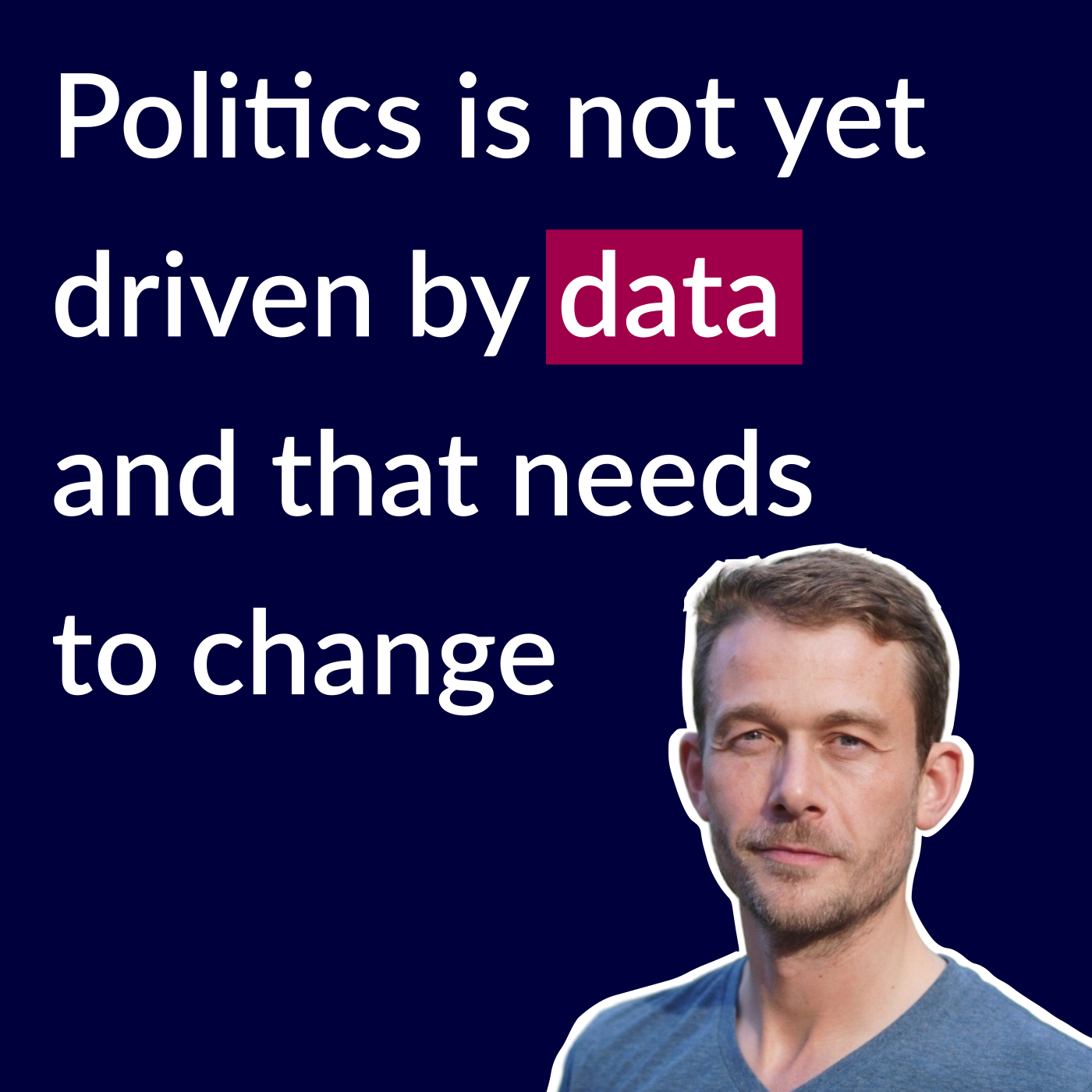
Andrew Gray about Suffrago and how to use the wisdom of people's voices for politics
Democracy Innovators | 2025-08-11 | 47:33
Andrew Gray is co-founder of Suffrago, a civic tech platform providing politicians with anonymized polling data, specific to their constituency. With his background in politics and law he is passionate about changing democracy for the better. He was especially amazed by how Polis is collecting wisdom from crowds, which had influence on Suffrago.
Top Keywords
- united kingdom 0.020
- kingdom 0.019
- united 0.013
- safrago 0.012
- polis 0.008
- politics 0.007
- wisdom 0.007
- parliament 0.006
- members parliament 0.006
- anonymous 0.006
- well 0.005
- everybody 0.005
Transcript
Speaker 0
0:00 – 0:09
Welcome on another episode of Democracy Innovators podcast, and our guest of today is Andrew Gray. So thank you for your time, and welcome.
Speaker 1
0:10 – 0:11
Pleasure. Thank good to be here.
Speaker 0
0:12 – 0:30
And, we said that we are, in some ways, some, democracy nurse and, in a good way. And, yeah, if you would like to tell us what you are working on, And, I know this is Safrago, maybe.
Speaker 1
0:31 – 6:44
It's definitely gonna come up. Yeah. So and, Alex, please stop me because I'm so passionate about this. I could talk about it for a three hour podcast. So, yeah, I'm the CEO of Sifrago, which is based in The UK but has global aspirations. In fact, we just announced today our CTO for India has, just come on board because we're opening in India. So Safrago essentially is a mission or a vibe to make democracies better in every democracy that we can get into and not to do it in a new colonial way of The UK recolonizing countries via democracy. It's not like that at all. It's more a disparate, cooperative way of doing things. And the idea is actually quite simple, but there's lots of bits to it. So we are a bit of a tech company, certainly politics. We're a little bit media, certainly into AI, and and meshed into politics. But and our our theory essentially is that there are two types of people in the world, we think, people who would like humanities and people who like numbers. And most politicians are into humanities, and journalists are into humanities. And in fact, most people are into humanities. Maths is an unusual thing for one to be in. But in this modern world, we have vast amounts of data, particularly in United Kingdom, and that data is not being analyzed, and it's not being really used to drive policies. And the politicians aren't aware of it, and the journalists aren't aware of it, nor are average people are aware of all of the data, which could affect make better decisions. So we're connecting all of those dots. What we've done in The United Kingdom, Alex, and we want to do it in every other democracy, is we've picked up the census in The United Kingdom, which was recent. So we surveyed everybody in The United Kingdom. We picked up the census, and we've picked up postcodes or ZIP codes, those two, and then we've picked up datasets, public datasets. It could be about health, crime, housing, whatever it would be. There's vast amounts of data in United Kingdom, and then we have modeled those datasets. And in so doing, with my cofounder, doctor Simon Wallace, we've created data dashboards for every constituency. So in United Kingdom, there are 650 MPs, members of parliament, or 650 constituencies. Broadly, there's a 100,000 people in each one of them. And nearly all the time, the members of parliament do do not have access to the data in their area. And that is mind blowing to anybody who doesn't understand politics. I think an average person who doesn't understand politics imagines that a member of parliament opens their laptop, and they see all of these dashboards of all of the data in their area. For example, people think a member of parliament to The United Kingdom will know how many pensioners are there in my constituency, how many children, how many schools, how many policemen, and frankly, they don't know. So we have connected those dots as best as we can. And once you do that, you create accountability. You create league tables of 650 constituencies or members of parliament. You do that. And just to make things more complicated, we've wrapped around polling into each area so we can collectively harness the wisdom of everybody in an area. And we've done it in an anonymous way, so you have freedom of speech. And on top of that, the missing link, we think, is the media. And in The United Kingdom, I suspect this has happened in lots of other places, print print media is dying and local media is almost dead in United Kingdom. And part of the reason is is that the media hasn't really understood that anybody with a smartphone who could tell a story is essentially a journalist. And in this ad world, this click world, most local press are dying. Nobody wants to buy local newspapers. And when local press dies, local accountability dies. There is very little accountability of members of parliament, of more junior, representatives, of the police, of hospitals, all of it. Everything that we think falls apart when you have lack of media, and the media is being replaced by dodgy algorithms from the tech bros, which are dominating world politics. So the Safrago way is to solve a lot of those problems within, one, system, so to speak. So we are we've hired 30 journalists, or we call them local democracy reporters, and we want to hire another 620, one for each area, to humanize this, a place to tell stories. And our view is that very few people like party politics. You've got to be a little bit of a weirdo, I think, like me, I'm a weirdo, to like party politics, to join a party. And I've been in four political parties, which is terribly promiscuous, and everyone thinks I'm crazy, and I'm a little bit crazy. But it's gonna be strange to join a political party. And in The United Kingdom and probably the same in Italy and other countries, if you say to people, do you like politics? Usually, the answer is no. No. All politicians are dodgy. They're corrupt. They're in it for themselves. They're liars. Blah blah blah. Everybody says that. But then if you ask a second follow-up question, you say, well, do you have a view about the economy or immigration or trans rights, whatever it be? People go, yeah. Actually, I do have a view. Blah blah blah blah blah. And also people mistake say that they are not interested in politics, but they love their towns. They love their country. They love their villages and their cities. To me, that's politics. I think everybody is political, but they don't know it, essentially. So our view with with Safrago is if we have our local democracy journalists talking only about local things with a local accent recorded in a local way with a with a smartphone, connecting data, politicians, stories, localism. We drive. We collate the wisdom of the area, which is fed into the representatives, and whether they follow the wisdom of their the people is solely up to them.
Speaker 0
6:46 – 7:00
And, how do you think, democracy could evolve, using, this system or maybe other, kind of system? Like, I'm talking about the civic tech softwares that can be used.
Speaker 1
7:01 – 8:41
Well, there's lots of amazing civic tech software out there, and I wish all of them well. Having been the first candidate, I think, in the history of the world to use AI in election, which was over two years ago now in Yorkshire, United Kingdom, and having run lots of AI powered conversations around the world, my main learning point is there is little point having amazing technology with amazing coders who are trying to make the world better if those in power do not hear it. And it's our job to connect those dots. So we think Safrago is a sort of world, democracy system that needs to have its own flavor for each country, be run by people in their own country, in their own language, with their own ethics, and their own people. But we would be very happy if other political tech, civic tech platforms work with us to perhaps do citizens assemblies with us to have better conversations in a town hall type way. It'd be on a bigger areas than just constituencies, perhaps on a national level. We'd be thrilled to work with others, and we just wish them well. I don't know all of them things that are going on in the space. What I know most is polis. I probably use more polis than anyone in The United Kingdom. And for us, Safrago is a sort of step up from polis, and I absolutely love polis. And Safrago is inspired by it, but it's also quite different because it's wired into the political system. And in United Kingdom, we've had 47 members of parliament, log in to Safrago, and the company is only ten months old.
Speaker 0
8:45 – 9:02
And, talking about policy, would you like to tell, something your experience, I mean, with I don't know, the data the the data that you get read when you did the experiment, like, the people that participate? How it
Speaker 1
9:03 – 14:29
Sure. So I'm a politics nerd through and through. And during lockdown, a friend of mine who's really big in the techno tech world, me and him were wondering, how is democracy going to change? Why is it that you only get a vote every five years and you have to get a piece of paper and you've got to go to a primary school, United Kingdom, a sort of small school to cast a vote with a piece of paper. It seems antiquated given the speed of change of Zoom during COVID. My friend introduced me to Polis, best used in Taiwan, which came from Seattle from the amazing people at Computational Democracy Project. When I saw it, two things. First of all, I fell in love. I've never fallen in love with technology before. That absolutely spoke to me, Polis. But second of all, I was shocked that it hadn't taken off around the world, and that I'd never heard of it. It's like somebody being into cars, and they'd never heard of Ferrari. It was like that. So I felt, that there's something there's something gone awry there. I saw how how it worked in Taiwan, which is a very unique use case. Essentially, in Taiwan in 2014, there was a sunflower revolution. Taiwan is obviously an island. There's some existential crises that they might have with China and so on. People are into tech, and Audrey Tang came along and became the first digital minister and introduced Polis. What Polis does very well is it collates the wisdom of a group of people, and it collects multiple votes, and you can see where you are on any particular topic. Now the key one in Taiwan, I think, was about Uber drivers. It was an unbelievably toxic topic was should Uber be allowed in Taiwan. There's There's obviously issues in Paris as well where taxi drivers are burning stuff over Uber. Anyway, it was a big issue in Taiwan. And, essentially, the government used Polis to collectivize the collect the wisdom of the people in Taiwan as to whether or not they should use, as to whether or not they should use, Uber. And in so doing, they created a a law that had broad support. Everybody helped build the law, more or less. Everybody understood it before it was deployed, and it had mass, engagement. And people were happy. And that was a sort of a watershed moment for Polis. When I came across this, I was so inspired by it, Alex, that I set up a company, a nonprofit entity in The UK called Consensus Politics Limited. And I'm such a nerd, I bought did it as a birthday present to myself. I mean, who buys a birthday present for yourself? I mean, you gotta be odd. And to call it consensus politics. And under the brand, the Crowd Wisdom Project, we ran conversations all the way united around United Kingdom into America to some in Europe. And then when ChatGPT was launched a few years ago, I'd sold my law firm, and it just so happens there was a by election. So a by election in United Kingdom is when an MP dies or is basically kicked out, so it's quite a rare event. And I happened to live nearby, so all the sort of planets had aligned. And I thought I am going to be the first person to use AI, this is machine learning, in the world. And the way I did it as an independent, so I wasn't at a party, was I had 55, instances of polis. And this this constituency was disparate. It's, quite old fashioned. It's rural. It's quite conservative, with a small c. And I ran 46 conversations in 46 villages in a anonymous way. And I did TikTok videos in each one. I said, hi. I'm Andrew, your silly AI candidate. Here we are in your village. Here's a Polish anonymous conversation about your village. Why don't you answer some questions? Answer lots. And then I did three for the towns, and then I did a overall poll list about the people's political views in this constituency, all done anonymously. And we collected all of this wisdom and then created the world's first, I think, AI powered manifesto. And in so doing, I met my now cofounder at Safrago. And the manifesto, which is more than two years old, although it was, in a sense, frozen in time because it's built on data from that period, It has an element of prediction to it as to where The United Kingdom would go, which is quite interesting, actually. And, a lot of objections I had from some of my friends, particularly Jewish friends, was if you ask people really what they think, we're going to have the death penalty, and we'll have pogroms of Jewish people. Adolf Hitler came to power due to the ballot box. That was a, objection that people had to really asking people what their views are. But having done so many of them, I know that that's not really how people are. If you do it anonymously and you create wisdom, you create something just delicious. It's like a fine wine. It's it's it's of that place, and everybody's views are involved. So I don't personally think there's such thing as left wing and right wing anymore. I think that's gone. I think that's an old idea. Just because your parents voted one way doesn't mean that you will. Just because you're in pro environment doesn't mean that you're anti Brexit. There's a world's got much more complicated. And if you collect people's wisdom in anonymous way, you create amazing manifestos, and, essentially, any member of parliament who would listen to the will of the people will be in power forever.
Speaker 0
14:32 – 14:40
And, would you like to tell us something about, your background? So academic, professional.
Speaker 1
14:43 – 17:35
Yeah. My background really has inspired Sifrago. And I I speak of my parents, so it's a little bit weird on a podcast as a 45 year old man to speak of one's parents, but I cannot escape them. I was born into a very political household. My parents are minor, conservative sort of right wing, politicians. They believed in Brexit, which is regarded as a quite right wing thing. I'm very close to my parents. That was how I was. It's in my DNA. I went to university to study politics, and I did what nearly everybody else in the history of the world who studies politics does when he's a 20 year old, you become quite left wing. So I joined the Labour Party, and my Labour Party friends didn't like my parents. But my parents are great people, and I don't think my parents were thrilled that I joined the Labour Party and then became a candidate many times for Labour. I joined trade unions. I was on marches. I saw it. And all of the time, I was sort of split with this, that team of horrible They're scum. They're scum. They're scum. I'm thinking I love them all. And what unites them is everybody's trying to make their country, their world, their town a better place. They're my people. I love people who wanna make the world a better place. It's just sad that we end up in these football teams. And for me, politics is not a football team. It isn't. And I think to treat it as such is is silly. So, during this time, I became a lawyer as well because I was interested in politics and chaired my Labour Party, saw local media die. I saw Brexit, which happened in 2016, and that was a very politically difficult time for United Kingdom. We're still trying to get over the ruptures through families that we had with Brexit. And the big the bill on big learnings points is that certain if you were a Brexiteer, you in your social media feed, you only got Brexit stuff because all of your friends voted Brexit and retweeted them. And remainers only saw remainery things. And it was for the remainers when they lost, they were surprised because they didn't know a single Brexiteer. It felt really weird to them. But our country is massively split through North and South. The South mostly voted to remain. The North majority voted to leave and just up yours, essentially. It wasn't an anti European thing, anti immigrant thing. It was a we don't like the way our country is going. It was more of sort of that vibe. So we've lived through that, and then, obviously, COVID as well. I've been in the Liberal Democrats, and I see all these wonderful people who are hating each other, and I think there's gotta be a better way. And me as a lawyer, I know law better than most, Alex. Like, if you you're not a lawyer, I am a lawyer. If there's a legal question really in The United Kingdom, probably I'm a better person to answer it than you. But why should I necessarily have a view on the health sector that I know less of less of? And I can see how using AI powered conversations harnesses people's collective wisdom wonderfully well to essentially make their areas better. And who doesn't want that?
Speaker 0
17:38 – 17:56
Yeah. I'm thinking about, technical, and political decision. And, about more your, I don't know, personal life, like, now. Is there anything that you'd like to share?
Speaker 1
17:58 – 19:06
Happy to. Yeah. I'm lucky I'm married to my law school sweetheart who's a lawyer, Julia, and we have two teenage children as well. And on a health wise, I have quite rubbish health. And when my health declined and I stopped being a lawyer, I thought, well, what's the most impactful thing that I can do with my time? And to me, it was always politics. And and I realized it wasn't inter party politics and fighting and knocking lumps out of each other. It was bringing people together. And I also, sort of religiously, if you would, I come from a Quaker background. And Quakers, historically, like, don't have any clergy. They don't have vicars or priests, and they everybody's vote is sort of equal, and we run our own meetings. And the collective wisdom sort of comes out of a Quaker meeting. And I like doing that in other groups, bringing people together, and that's how we've grown Safrago from sort of Simon and I up to about 50 people who are now involved in less than ten months. We're growing quite quick. And then Zindia will be growing that as fast as we can. So that that's sort of my life. Do what's the most maximally important thing because you don't know how long, one has on planet Earth.
Speaker 0
19:09 – 19:22
And, I I was thinking about, the experiment that you did with Polis. And, if you know about other experiment that, they did around the world, if you had, maybe some,
Speaker 1
19:23 – 26:02
contact also. I'll be I'll be thrilled to. One two that I've been involved with, if I may, because I know them well. So I helped to facilitate a conversation in Ohio, The United States, about gun control. I did that about two years ago. And the American organization approached us, can we use your police instance? Because it was anonymous. And three, for us, we really strongly believe that anonymity is incredibly powerful online. One becomes more honest when one is anonymous. We become less horrible. There are no points to be scored. So this organization in America approached us to run a polis between Democrats and NRA ers, I. E. The people that most are into guns in United Kingdom versus those United United States versus those who are most anti guns. And this this organization called Dinner with a Fight, they were called a fabulous organization, they, put this post conversation out, but which I helped a little bit with or helped set up. And the to the outsider, anyone would think there is no way that Americans can agree on gun control. That is the narrative. Americans cannot agree on gun control. That's why there's very little gun control in The United States. That is untrue. Polis proves that it is untrue. The outcome of this Polis, with thousands of votes on it, was three things that stick in my mind. The first is that whether or not you were an NRAer and you wanted to have, you know, as many handguns and machine guns in your house and do what you like just in case the government ever come for you or whether you believe that all guns are wrong and we should go back to an agrarian society, where everybody agreed is that no American should have a gun more powerful than what the police have as a starting point. And that sounds obvious, but I'd never thought of it. No American have a have a gun that's more powerful than what the police have access to. There's almost universal agreements between these parties. Amazing. People agree. A second thing, there was vast agreement over how long it should take you to get a gun as well. And, again, it was, in some states in America, apparently, you can go into the shop and go, hi. I would like to buy a gun. They give you a gun there and then, and you can go and do something horrible with that gun. Whereas everybody agrees so that there should be a cooling off period, like a seven day period of time. Whatever side that you're on, amazing. And then the last wing was area of agreement is that everybody more or less agreed. And if you had a particular types of mental health issue, you should not have access to a gun. And when I saw that, I just thought, hallelujah. It's we all sort of know this, that our neighbors are good people. They're not horrible idiots. We are well, there's a lot of wisdom around. If the Americans were to deploy that as a law, not only does everybody agree, just imagine the lives that would be saved and carnage in America. And this is, to me, a absolute tragedy, a travestated everybody that that is not the law, that what the people want in Ohio isn't the law. They're craving for it, and they ain't getting it, and that's terribly sad. Second example, if I may, Alex, is close to home in United Kingdom. One of the local councils in London, so one of the local boroughs, was wanting to run a police conversation about the environment, about clean air. Now what they did was is they they ran a citizens assembly in in London. And I now I love citizens assemblies, but you have to be an engaged citizen that wants to spend four weekends in a row discussing clean air. There are very few people who are free. I wouldn't be free. My kids need me. I can't attend a citizen's assembly. It doesn't seem to scale, and you've got to be super interested in that topic to wanna spend, like, jewelry service to be there. Anyway, this council, wonderful council, sit in assembly over four weekends, and with that, they created their polis that I helped to run. And then this local borough, London Borough, they promoted this polis conversation everywhere in their borough about clean air. Now I thought, I know my politics, I love the environment, and I've done lots of Polish conversations. What could Andre Gray possibly learn from moderating a Polish conversation? And boy, was I wrong. This conversation went viral. The average person in London who voted voted 99 times either agree, disagree, or pass. And for those who don't know how a poll this conversation works, it will say, here's a conversation, say, about the environment, and there'll be a click into a statement. It'll say, would you give up your car to have clean air? Agree, disagree, or pass. And then in the moment, you're just clicking and it's rapid. And once you voted one way, you don't know what statement's going to come up next. And at any moment, you can go, actually, I've had an idea, and you tap in your own idea, and a moderator may or may not accept that idea. But the conversation flows in this organic way, and it becomes addictive. Now, I've never heard of anybody in any survey of anyone I've ever spoken to who's voted 99 times as an average. Some people were so into this conversation, they were voting 400 times. That was, like, the maximum number of votes. There were that many statements to vote on and that much wisdom collected from that from that area. And what would what happened, I could sense to these people. I don't I don't I've not been able to follow-up anymore voted because it's anonymous. But what I think is happening is if you're voting on average 99 times, you're seeing an argument from multiple angles. And once you've exercised this muscle that you thought you understood economics or environment, you realize actually you don't. There's all this wisdom out there. This is a mind blowing moment of, oh my goodness. I there was other things I don't know about. There were so many smart people in my area I didn't know. And the very act of doing it, I think it builds I've got no basis working on this, but I think it builds neural pathways in one's brain, opens the potential, brings people together, and I think people can take into their daily lives where they're dealing with their partners, with their children. There might be multiple ways of handling one's kids. So I saw that and thought, amazing. But what to me is sad on both occasions is amazing amounts of wisdom collated. Hardly anybody hears it. The politicians are under no pressure to enact it because there's no media, and that's why at Safraga, we believe we have that be for a political system to work, you have to be engaged, enmeshed, have your own media media output.
Speaker 0
26:04 – 26:16
I'm thinking about other application or projects that maybe you're following or maybe that you tried and you think they could be helpful?
Speaker 1
26:19 – 30:25
To me, it was just Polis. I've not seen anything better than than Polis, actually. So, Alex, I'm I'm aware of some of the platforms around. I I think I've seen Dembrain around, and there's lots of other cool people I've had, conversations with. But I'm so thrown all my whole lot into Safrago, it's hard to think of others. But we would love others to sort of bolt their system into ours, not so we can monetize theirs, but that, citizens in any country can go, oh, I'm gonna have a go at another platform. In fact, I might get my friends on here, and we're going to see whether we actually get consensus using that tool, or do we get a better answer doing that one? That that's our thinking. But we think believe the key has got to be anonymity. I really strongly believe that. And it's a it's a rude story about anonymity, Alex. I don't know whether your viewers are old enough to hear it, but there was a Stanley Kubrick film a while back called Eyes Wide Shut with Tom Cruise and I think possibly Nicole Kidman. And there was a moment where there was a bit of an erotic party, shall we say, and it only became erotic because people wore masks. And when people wear masks, nobody knows who they are. If they wear a a Superman's outfit, they they then act in a different way, possibly more honestly because they're not being traced. They don't know you're not going to be held to account. United Kingdom reform was to express a view on what's happening in Gaza. You may lose your friends or family each way, and in some respects, you might even get imprisoned. And this is percolating into The United Kingdom conversations, that it's happening everywhere. We've we've seen I think it was a Norwegian student who went to America, and I think the border force there looked at one of his memes on his phone, and apparently, it was anti the particular party, whatever it was, and that Norwegian student, I think, was put back on the plane. You're not coming in here because you had a meme of a political leader. And that is pat going all the way around the world of everybody needs to be careful what they say online, and that's yeah. So we although if someone was to say some absolutely horrible things, however, we would, report matters to the police in The United Kingdom, we think that matters such as trans issues, which are complicated in The United Kingdom, Brexit remains still, Gaza, Putin, etcetera. We have to have these conversations anonymously. And if I can, if I can, Alex, a a experiment cyclical experiment I'm most driven by is the question that Americans often see when they go to a fair in in one of their towns. You often see it on a Hollywood film. You go to a fair and there's a big jar with M and M's in it, like 3,000 M and M's in a jar. And there's two ways of doing this. First is you, you have a look at the number of jars. You you pay your $1 to guess how many in, and you have a look. And there's other people's guesses there. And you can see, oh, someone's guessed 1,700, someone's guessed a 100, etcetera, etcetera. And you can see, and then you guess. That's one way of doing the experiment. And a different way is you you look at how many m and m's are there and the piece of paper is blank. You don't know what anyone else has said. And you go, okay. Well, I'm gonna be doing a bit of maths at school. Make it all up. I've got my own wisdom. I'm gonna write my own number down, not impacted by what anyone else has said because you don't know. If you average those two out, the one that's been done anonymously, more or less, is exactly the right number of M and M's in a jar. If you look at what everyone else has done, humans are just gauging others all of the time looking at how each other addresses how we all act, all copying each other in a mimetic way, and the average is wrong. And for us, it's so important that we go out to the ballot box idea that when you vote in United Kingdom, it is anonymous. That's why voting in United Kingdom doesn't always follow their opinion polls. Opinion polls are not anonymous, are often wrong. They were in America. Anonymous voting, always accurate. So our platform for me is always that way. And if anyone wants to build their tool into ours, we'd be thrilled to hear from them because there's some really smart ethical people out there, and you've had loads of them on your podcast.
Speaker 0
30:28 – 30:42
I think about this, anonymous conversation. And, how do you think, like, how would you like to I mean, the next steps to to see that happen.
Speaker 1
30:44 – 33:44
So we we would describe it as nearly anonymous because I don't think anyone could ever be absolutely anonymous. So for United Kingdom, if you were to engage in Safargo and you need a UK postcode, we we'll know your email address and then which constituents you're in. That's it. And what we don't follow then how you voted on certain things. If you put a statement out there, we don't we don't trace it back. But, yes, the anonymity is only broken if someone says something that is against the law the online laws in The United Kingdom. For example, I want to, you know, kill a politician. That would be site of violence that breaks out. Anyway, that is how we are. But for us, it's so important that our platform is trusted. Now where your podcast is gonna be put on YouTube, I've been out meet meeting the Google people. Do you like Google's company? There's a general sense in the world, I think, and everyone I speak to, of lack of trust in big tech. And whether you're pro Trump or anti Trump, anybody who saw the inauguration, United States, where all of the tech grows all lined up there to pay homage and to pay in to the inauguration. I'm not gonna get into politics whether that was right or wrong, but the optics of that is American tech is controlling all of our lives and, essentially, is now being controlled by the American president. And I think that's a terrifying thing. And so for us, Safrago has to be trusted. So that's why we're trying to build within sort of the parliament system, United Kingdom, why MPs have their own dashboards, where we have real people telling stories, not just AI generated news. It's not that. And we have an AI and data ethics council that mark our homework. They sit within us checking how we handle our AI and our data ethics, and we have a political neutrality council that check all of our hundreds of videos, opinion polls that we're putting out to ensure that we're not going biased one way or another. For us, technology has to be trusted as a first point of call, and that's our our absolute obsession. So when people join Safra, I'm gonna say there's about 50 others. Only the people on the political new child's council do I really know what their politics are because they are sitting with a Labour Party hat on or a right wing hat on, whatever it would be. They are they have occupied those seats. Everybody else, we do not know what their politics is. I haven't got a clue. And we're just trying to be neutral and trusted. And then once that is the case, people will know that they are safe on us and our data is true and our state was a source of truth in this world of disinformation. We hope other platforms might try and, and and work with us within those confines. So it could be that we are the ecosystem that helps create something that's better than Safrago that comes out of it. But we think that they, as I say, has to be built into politics, has to be anonymous, has to be a source of truth and trusted. You have to have those before anything ticks off in the political world.
Speaker 0
33:46 – 34:08
K. I'm thinking about, I mean, now there are normal parties and, they it could be that in the future, they will use some, civic tech software to engage citizens, whatever. Or it could be that new parties will, will arrive. So what do you think about it?
Speaker 1
34:11 – 37:58
Yeah. Interesting. So I I don't think there are many people who are really into any political party, really. I think I'm not just seeing things through a United Kingdom tinted spectacles. Wherever I look, people are saying, well, I quite like bits of that party and a little bit of that party and a little bit of that party. Nobody quite fits into any of those things. That's why I see that everywhere. Let me go back though in time. I'm sure the people who watch your, podcasts are democracy nerds that know that essentially democracy comes from ancient Greece. Back in ancient Greece, most people know that free men, so no slaves, no women, they would go to the Parthenon or the Acropolis. I forget where it is in Athens. I confuse it too. And they listen to a debate. You know, for example, should they put Socrates to death? You know, yes or no. Everybody would have a pebble, black pebble or white pebble or sometimes a show of hands. So they listen to a debate. Also, the key citizens are there. They vote. That's the law. Essentially, no need for representatives. No need for parties. It was an issue based thing. One person, one vote on a one particular issue. Makes sense. So it's only when cities get bigger, issues more complicated, probably matters of money come in, is do you need representatives then? Of course you do. You need, I mean, citizens will say, I want low taxes, amazing health care, the best army. You can't have everything. So you do need representatives. I don't doubt that. But it seems to me that representatives are there now, often elected in The United Kingdom with very few votes. And I I see this disconnect, and everybody everybody senses it. And people also sense that they can go to a restaurant in Bologna where you are or in Yorkshire, I am, and they can give immediate feedback to the restaurant here. Was the food any good? Yes. Did I wait for a long time? No. Here's my Google review. Everyone's an oh, an Amazon review of a product, whatever it be. Everybody's used to giving feedback all the time, but yet you cannot do it with your members of parliament. And that is weird. Now people might say, well, you can email your members of parliament and let them know what you think. Yes. Of course, that that is true, but you're only gonna do it on the issues that you are most incensed by. And your vote your the MP is probably never gonna change your mind because you're voting. I am very strongly in, exercised by situation in The Middle East. I mean, I write to my members of parliament. Member of parliament sees it, maybe send you a standard reply back, but you hasn't really changed your view. A member of parliament knows that. The sense is we think you have to be taking the pulse of an area all of the time. The collective wisdom pick it up once a week, and the representative can ignore that view, whatever. But the job of the member of the our media team is to point it out. Member of parliament has voted this way. The wisdom of the people actually says that way. There could be a very good reason for it. Frequently, people are wrong. I know that completely. But MPs don't even have in The UK polling about what their local people think. And if they and they also know that what's said on Facebook is not anonymous. It might not be in their area, and the emails, I say, are just from really incensed people. So they are given really bad information upon which to make a decision. So what they do is in United Kingdom and more or less everywhere else, the parties tell them how to vote because that's how you get promoted within the party. That's how your career is elevated, and you've got nothing else to fall back on because you can't vote ask everybody. The technology is there, and it's been there since poll has created it in fourteen, fifteen years ago to do this. And our job is just to connect all of those dots.
Speaker 0
38:00 – 39:09
Yeah. Thinking about another experiment not related to policy, but that happened in Italy. There was the five star movement, and they tried with, the Russo application to, like, to receive, let's say, feedbacks from citizens related to some specific things. And, what do you think about that experiment? And, also, there is these things that when, like, in that case, people had to trust the, politicians. I mean, there wasn't there was not, like, a sort of, I mean, when they were elected, they were saying, I mean, before being elected, that they would, represent the people throughout the platform and also other things. But then, also some people changed their mind, and they exit from the five star movement. So if you have any idea.
Speaker 1
39:09 – 41:34
I do. I I'm aware of the five star movement. I do not know it in-depth, so I won't speak that much to it. What I do know, though, is some things are ahead are just advanced too too early. Like, Airbnb were not the first people to say, like, rent a flat. That's that's not that radical. It isn't. Facebook was not first. I think it was Myspace or Friends Reunited. Google were not the first. I think it was Yahoo or Ask Jeeves and all of those things. There are some things just catch because the time is right for them. And I don't know the five star movement into I really don't, but sometimes it's just too early. Second of all, the technology may not have been there at that time because I think we are going back probably, like, ten years in time. The technology has changed, but politics has changed too. And in the in the West, to The United Kingdom, there's a sense that nothing's working, and they ought to be. Like, United Kingdom was the industrial powerhouse. You know, we found the we had, like, colonies everywhere. We own United United States, Canada, or India, so and so. We create trains. All of these things that people in United Kingdom are quite proud of, we now then sense that things aren't working, that the dots aren't there. And my I have a very annoying 15 year old who's just come into the room on a podcast. I'm very sorry about that, guys. But so with the fact so if I start I mean, I spell it to you working from home. So so yeah. I think there's an element. It's gotta be of its time. About the right catch a wave. The risk that the text gotta be right as well. But I my understanding with Five Star from United Kingdom is that it was regarded as radical, totally radical. Now I don't think most people would regard themselves as radicals. My people, especially in The United Kingdom, we are just more slow. It's more we evolve more slowly. We don't have particularly in the Kingdom, we've not had revolutions and we've not deposed of leaders. We've not executed a king since, was it, 1650, and then the king was put king's son was eventually put back on the throne. So we are not a radical group of people. And so we think things must evolve, and it has to any system needs to feel as it's part of the governance of The United Kingdom. And we think we can do that by connecting data rather than just being regarded as total radicals. Most people are not radical. They do they wouldn't describe themselves that. We kinda copy each other. We evolve. So my answer would be that.
Speaker 0
41:36 – 41:50
And, just other two very quick questions because, maybe you have to leave. And, what are you struggling at? Like, is there something in your mind you would like to fix to
Speaker 1
41:52 – 44:38
Struggling? Oh, well. Yeah. Yeah. So Yeah. Sadly, we've we are had to set up as a for profit company. Now I prefer intellectually or morally, I prefer a nonprofit charity based sort of way, but you cannot compete with big tech doing it that way. You won't be able to hire the best coders. You can't scale in the way that a technology company, does. So we are copying the big tech playbook, and we are having to speak to, like, investors, potentially venture capitalists to provide us with enough, funds to scale across every single democracy. So I would rather not have to do that, but in some senses, for profit organizations are really good at collaborating with others, actually. They're not insular. Normally, they can hire top talent. The people that are joining us, I'm certainly not doing it for the money because we're not spending very much. They are mission focused because so many people just say my country is not doing as well as it could. My area is not doing as well as it could. It brings them in. But if any of your, what readers, viewers see this, they might go, well, what is Safrago? Who is it Andre Gray? Is it media? Is it AI? Is it data? Is it polling? Is it social media? Well, the answer is, Alex, it's all of those things. It's it's almost like a full system. Right? There is no word for what we're doing at Safrago. No one word. Social media doesn't capture it. So a problem is explaining something that's complicated and that has multiple, angles to it, and there is no one word. So that is a problem when you're talking to others. But people who really understand how politics works get it very quickly. And in fact, we were very privileged that the House of Commons, so the mother of all parliaments, that's been there for a lot of many hundreds and hundreds of years in that kingdom. They had a select committee, the Science, Tech and Innovation Select Committee. They invited us in a few weeks ago to present to the members of parliament as to what we were doing. It was amazing moment, actually. So, I didn't do it because my health wasn't good. My cofounder and Rachel discussed it with the members of parliament, and they seem to love it because we're on their side. We're wedded into politics, giving them data, giving them polling, given them media exposure, what's not to like? So what is Safrago? In a simple word, that is a problem. Do and do because it's a new thing. Who wants to fund this new thing? Right? There is very few people. You might say, I wanna fund a SaaS business that does fintech in The Balkans or something like that. We're not that. Our mission is to make the world a better place. Simple. Who wants to fund it?
Speaker 0
44:39 – 44:49
And, if if you have any any message for the people that are working in in this field, I mean, the civic tech, that that they are trying to find new solutions.
Speaker 1
44:51 – 46:39
Yeah. Very much so. I I am a sort of democracy entrepreneur, doing it not for money, but to solve problems. And what I've learned from running a number of law firms and businesses, some have succeeded quite well and some have more recently failed, is you don't always know what's gonna work until you do it. So you need to run multiple experiments. I regard myself as the guy, Safraga, with the vision of democracy and, like, obsession with it, but without a particular angle other than can we make it a bit better. Anyway but I also encourage my team to experiment like crazy. And very frequently, over the years of running Polish conversations, I was utterly dismayed to meet some amazingly smart people whose IQ was three times mine, who knew more about data and tech and politics than I ever will. And they were writing about Polish, and they wanted to interview me, like, for a podcast like this or their books. And they were they appeared to be more expert in Polish than me. At the end of the conversation, I would say, well, how many Polish conversations have you been? And they'd always say none. Haven't done any. And they were always scared. They were people were looking for perfection. Perfection doesn't exist, but you're gonna get closer to it by experimenting, asking questions, being open minded, just doing stuff. Don't be scared. Do stuff. Do it with a good heart, with a good mission. Try. Things won't go right, and you'll learn, and you just keep adapting. Adapt rapidly. That would be, the tip, and that's quite unusual. British people don't tend to wanna do that. They wanna do it more perfectly, and maybe Italians and Germans do too as well. But don't be perfectionist because you'll become more of a perfectionist by not being a perfectionist.
Speaker 0
46:43 – 46:44
So thank you a lot, Andrew.
Speaker 1
46:45 – 46:47
Pleasure. Thank you, Alex.
Speaker 0
46:48 – 46:52
If you want to add anything else, otherwise, it's everything.
Speaker 1
46:52 – 47:29
Well, if you were interested in, bringing Sfrago to, Alex, to Italy or to other other countries, please get in touch as well. We want it to spread in a viral or sort of organic way run by people in their own countries. That way that I would be thrilled if people I got in touch. And if anyone wants to get in touch with me as well, my email is andrew.gray@safrago.org. We've named Safrago after the suffragettes movement, suffrage voting. Apparently, when you Google it, it also means a little bit of a foot a part of a foot in Italian. A horse's foot in Italian. You probably knew that, Alex, but I didn't when we set it up.
Speaker 0
47:30 – 47:32
Thank you a lot again. My pleasure.