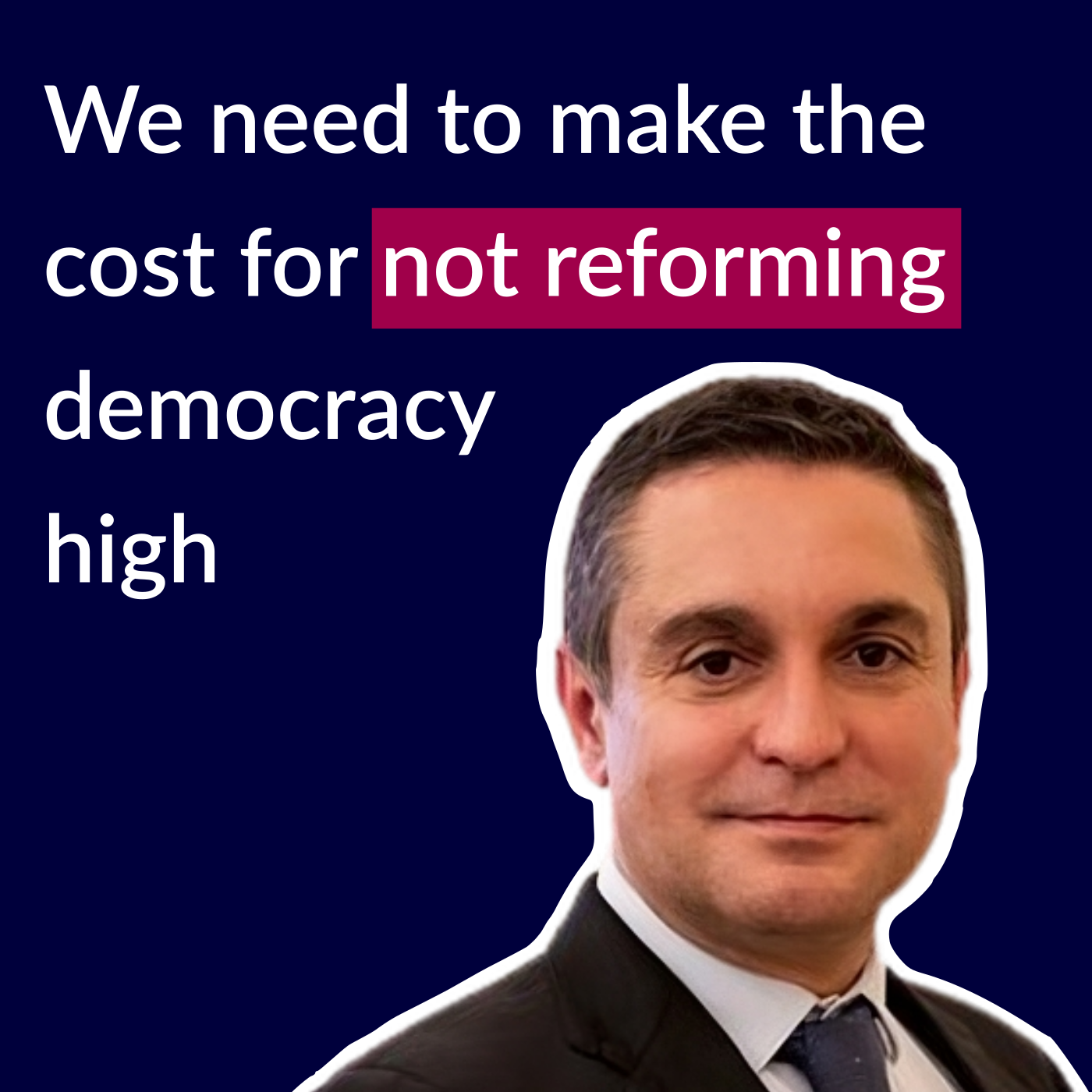
Tiago Peixoto about the role of collective action in reforming democratic systems
Democracy Innovators | 2025-11-19 | 1:06:03
Tiago C. Peixoto is an international civil servant and a visiting professor at the Centre for Democratic Futures at the University of Southampton. He has been recognized as one of the 20 Most Innovative People in Democracy and one of the 100 Most Influential People in Digital Government.
If you enjoy our podcast, please consider making a donation. It really helps us to sustain the podcast.
Top Keywords
- participatory 0.012
- participatory budgeting 0.012
- budgeting 0.011
- democracy 0.010
- mean 0.008
- vote 0.008
- power 0.007
- voting 0.006
- social movement 0.006
- participate 0.005
- social 0.005
- social movements 0.005
Transcript
Speaker 0
0:00 – 0:08
Welcome on another episode of Democracy Innovator podcast, and our guest of today is Thiago say, Peish Peishoto.
Speaker 1
0:08 – 0:11
I very sorry for the pronunciation. Peishoto. Peishoto.
Speaker 0
0:13 – 0:31
Thank you for your time. It's, as a first question, I would like to ask you, maybe a short presentation of about yourself, so your experience and, maybe the projects, you were involved.
Speaker 1
0:31 – 1:25
Oh, yes. So, I'm, I'm a visiting professor for the, University of Southampton for the Center for Civic Futures, which has met Ryan, Pablo Spada, and many people working with democratic innovations. And I also work at the World Bank. In the past, I did lots of projects related to citizen engagement. But, now most of my work, related to to democracy comes from collaboration with scholars. So and for disclosure, anything that I say here, it's like my personal opinion, of course, and doesn't regard by any any means the work of the bank of the World Bank or the or any of its member countries or its board of directors. So my very, very personal opinion.
Speaker 0
1:26 – 1:34
Sure. And, how will define how would you define a democratic system? Because
Speaker 1
1:35 – 2:53
Well, democratic system, I'll define it a bit in a sense of it is always measured against an ideal benchmark. Right? And then, you have the real existing democracies of what Philip Schmidt, political scientist, would speak would speaks of. But, well, a democratic system, it is it is one in which people can shape the decisions that affect their lives and that they have, like, enough information about it to shape those decisions. Right? But I think, also, if we go at the very, very etymology of of democracy, it's not really what people would like to select power of the people. But Kratos is more about the capacity to do things or capacity to achieve things. So it is, of course, it's a process that is inclusive in which people can, shape the decisions that affect their lives, but they're also capable of achieving things that otherwise would they would not be able to achieve. That would be my my short definition of it.
Speaker 0
2:54 – 3:18
Okay. I was thinking because, many times I thought, in Italian, the word like potere is like, is like, I can. Like, like, your post so far, it means, like, I can do that. And, it's very interesting how it is, also related to what is, one person is able to actually do.
Speaker 1
3:19 – 3:59
Yeah. Yeah. Yeah. It is less yeah. It is a power in the capacity of changing course of things, right, or doing things that otherwise would not happen. Right? So if you go, like, to some other classical definitions of of power, is the capacity of a it's has to change the course of b, which without a's action would not have changed its course. Right? So, so power in this weighs the capacity of doing things that would not be happening if if democracy didn't exist.
Speaker 0
4:02 – 4:47
And thinking about, technology and politics and also about the power that we have about, I don't know, shaping the future, of course, it's a small power. I wonder which kind of society we could have, like, using technology for, political user. So on one way, we could have an ex a very democratic society, and on the other way, a lot of surveillance, you know, all the this topic, movies. So I wonder what is your idea about, how can we use technology, that power that we have?
Speaker 1
4:50 – 13:00
Well, look. I mean, the the essence of the state is the is the legitimacy of the use of the force. Right? And to be able to use the force, the state is always tempted to enter into surveillance mode on one or another. Right? The polices have their intelligence services, and that's common and even in democracies. Right? The the questions that I think we are will always be in between an an equilibrium between a state that is more libertarian or more, not in an equilibrium, but you're gonna be along that continuum. Right? State might need to do surveillance for, like, security, questions and so on and so forth. But the problem is when the state starts to intervene on people's agency or people's freedom, which are inherent to them. Right? Because democracy as well, one of the definitions of democracy is the is the is the notion of agents. Right? It is your freedom to do things that we believe to your greatest fulfillment, as a human being to to be able to flourish and grow. Right? And, the problems when the state when when surveillance starts to enter into that. But, I mean, that's that's, the the the the negative effects of of of technology and democracy. I think it's not that I don't think it's important, but I think it's a it's a it's a field that it's already, saturated with concerns both in the public and academic sphere. Not that it's not important again, but I think when I talk about the risks, we need to talk about the possibilities. Then when we talk about the possibilities of technology in democracy, I mean, that's an area that I've been dedicated, I think, perhaps my last over twenty five years. Look. I think we need to think of technology's role in two areas, in in from from two angles. One which would be dedicated to democracy. Right? One would be what would you would you could call invited spaces, which are the spaces that exist by the government. So for example, elections, referendum, initiatives, or consultations that are done by the government. And you'd have what we would call, like, invented spaces, which are what you could call grassroots or bottom up, activities that are started by citizens. Right? And the role of technology on these two, sometimes it overlap, but sometimes it's completely different. So I think in invented space is a classic use of technology is, for example, Internet vaulting. Right? It's very, very well known, and we did some work as well of an invented of of of effects of the Internet voting, including participatory budgeting. We were some of the first to assess the impacts of that. But I think we don't discuss enough this and particularly when it comes to elections. Right? The impact of technology and probably the largest documented impact, impacts of technology and democracy, comes from the introduction of electronic voting in Brazil. Not evolting, but electronic voting. Right? So why? Because in Brazil, we had an election that was very complicated. So if you wanted to vote for somebody in the past, you'd have to choose candidates, for, like, president and this and that. You need to memorize the number of the candidate. You needed to know the number of the candidate. So it was a paper based process and was very complex too. And and what happened in Brazil is that those who had least education and, and, of course, the poorest who who are also the poorest, most of their votes would be, nullified. Right? Because they they wouldn't be able to vote correctly, so to speak. Right? And that created a huge bias on who got elected in Brazil. Yeah. And and this until, two decades, three decades ago. Now I don't remember. It was introduced precisely, I think, about '89. Yeah. So probably three decades ago, or a bit after. It doesn't matter. But what happened is that they created the electronic ballot in which citizens just would have to go, and sometimes they would just put one number, and the picture of the candidate would appear. And people would say, oh, yes. That's the person I want you to. Right? What happened is that all of a sudden, all those votes from four people that were not being counted before, right, started to be counted just because you improve the user interface of vote. And because the ballots, the electronic ballots they rolled out in Brazil, I would say not not all at once, you had the natural experimental design. So you could see what were the effects of with the ballot and the effects of without the electronic ballot. So what what, what one researcher, Thomas Fujiwara, one of the most beautiful papers in civic tech for me, finds is that in the places where you wrote out the electronic ballot, you had less people making mistakes, then you had more candidates of poor people getting elected. And that led to bigger priorities in legislation and on budget for pro poor spending. And years later, you even had an impact on health and infant mortality indicators. Right? So there you go. You just moved the ballot from a paper to an electronic ballot where the picture appears and it's easier to vote, and it changed. I mean, I don't I don't know of any other civic tech that had any other quantifiable impact and at the scale as a country as in Brazil on on, on infant mortality. Right? I mean, when people talk about, to me, about civic tech, I always think about that case, and I say, like, well, if you could get at least one good indicator, because there the bar is too high and but that's what I'm thinking. Right? Of course, you have the other, applications and so on and so forth, but then you have the invented spaces. Right? Well, let's still stay in the invited spaces. Then you have what we'd call invited spaces, but there are still participatory democracy, which are which are, like, participatory budgeting and so on and so forth. And you do see an increase in participation of people who otherwise would not have participated. Right? Because particularly voting via Internet and things like this, the idea is that you let people to participate who otherwise would not have participated because they have constraints in terms of time, distance, and there, they can vote whenever it's convenient from them pretty much from anyone.
Speaker 0
13:01 – 13:01
And,
Speaker 1
13:02 – 16:03
so this is for the invented spaces. Right? Then you have the invited spaces, which would be, where I think we don't look a lot neither. We look a lot on the participatory spaces and now on a on AI for citizens assemblers. But what I find interesting on the part of the invented spaces, which are those that I'm calling those that starts by citizens and everything, and I'm thinking mostly about social movements. Their technology plays another role. It's not about expressing preference just like voting. Right? But it's about connecting people, connecting people who otherwise would not connect. Right? And there, I think it's a huge power that, it is one it enables people to meet people who think like you, who are like minded. Some people think this is a bad thing. Right? But in some cases, you don't have collective action if people were not they don't share, like, some vision or, for example, at least around a certain issue. And, but also, it it allows coordination phase. Right? It allows to overcome coordination failures. So if you look, at the at the literature on social movements and collective action, you have, like, lots of of coordination failures. So for instance, not knowing if another person is willing to take action or not. Right? Or pluralistic ignorance. I kind of think that no. I think that maybe you should overthrow it in the certain government, but nobody, but I think that nobody else thinks like me. Right? And technologies as well there, and particularly if you have privacy and you can use it anonymously and things like that, it enables you to overcome that pluralistic ignorance and maybe realize that there are lots of people that are unhappy with a certain poor government, and they decide to take the streets. Right? So I think the mechanisms, and and these are, of course, different, only kind of, like, stylized examples, but this is to highlight that the way in which a technology plays a role will depend a lot on the type of participation mechanism that you're trying to do. Right? And I think this is one of the problems, a lot on the civic tech space is that we start with the solution, and then we go looking for a problem. But never before understanding really what is, one, what is the participation mechanism, what is keeping that participation mechanism to reach its full potential, and how technology can help overcome some of those
Speaker 0
16:05 – 16:16
barriers. So I would have a lot of question to to the things you just mentioned. I really like the distinction between invented and invited. And,
Speaker 1
16:17 – 16:19
Which is not mine, by the way. Okay.
Speaker 0
16:21 – 18:35
And, I was thinking also about the coordination between people that also that is a, a sort of collaborative power. I'm thinking about Anna and when she described power as people with the same intention. So if someone is able to meet another person on the other side of the world and talk about something that and then, yeah, the a question like, if you think that it will be possible in the future to have, like, a society where, like, everyone is basically able to participate. Because I'm thinking that you mentioned how changing the design, allowed, like, a lot of people to actually vote because before it was not, they they were doing mistakes. So, the vote was not registered. And I'm thinking that sometimes, it is also like, like, could it be that the previous way was, designed in that way, for a reason? Because I'm thinking like that, a lot of times, it happened that, political parties, the power, like, changed the, I I don't know, like, gave a vote, voting rights to a certain category of people, because for political reason. Like, I don't know, giving also, now in Italy, you can vote only if you're older than 18. But now they were discussing about also giving the vote to people, that are older of than 16. And so you can see, like, that it is cool if tech can vote, but at the same time, like, who is proposing this, is, also thinking about what that category of people could actually vote. So I'm thinking about, this, I don't know. Maybe it's was a bit confused.
Speaker 1
18:36 – 28:57
Yeah. No. Look. I mean, I think they think of, like, everybody wanting to participate. So first of all, when we think about technology, right, and, the rationale to introduction in technology, the whole rationale in the past about e democracy was precisely that one that I told you. Right? It's to make it easier for people to participate anywhere. Right? So the hypothesis is that if you lower the transaction costs of participation, right, more people will purchase, which is a very utilitarian view. Right? When you look at the at the effects of of Internet voting on turnout, for example. Right? It's the best measure that we have. If you look for the examples, in, like, effects of that on voting in Estonia, on effects on voting in, in Switzerland. Right? The effect on turnout is very low. Very, very low. And sometimes even some authors you find, like, it's an elusive effect. Right? It's like sometimes 1%, 1.5, sometimes nothing. I mean, you need to be looking a lot. So what does this say? First of all, is that first people decide whether they will participate or not. The big majority of people. Afterwards, they decide by which means. Right? Of course, you know, there's, like, some effect, for example, as well, in days that snow, it depresses a little bit to turn out, but very little, it's not huge, normally, or depends on depending on the weather. So The other thing that you could say, it is and that's something that even I sometimes advocate. People don't participate because they don't have an impact. Right? But, again, if you look at elections, in most elections in the world, the odd of your vote counting on your, it is much lower than the odds of you getting run by a car on your way to the ballot station. Right. So in some states, in some very disputed districts in The United States, the chance that a meteor flies from the sky and hits you in your head is higher than you casting the decisive vote. Okay? So what is what am I saying? It is that this assuming this perfectly rational behavior of the voter that if it's easier for everybody to participate, they will participate. Or if they have a have an impact, they will participate. You don't see difference a lot in turnout in those things. Right? So the whole thing of, like, the utilitarian view or the kind of, like, how do I say, like, utilitarian view or rash fully rational behavior doesn't exist. But, of course, we see, particularly in some things, like when you go, like, into participatory budgeting, you see a higher effect of Internet filter. Right? So it seems that in events that are low saliency, in which means, like, very few people participate or is less known stuff, it has a stronger. So just to say that technology and everybody participating, it's it's not supported by the evidence. Right. Now more people participating, probably, you could do. Right? But the the but still be far from being, everybody. And it is a bit somehow as well, but journalistic. Some people don't wanna participate. Right? I mean, you have, like, James Fishkin that talks about the liberation. Right? I mean, I think there is a bit of that on the deliberationist view that a citizen's point of view is only as good as far as he comes to a place, listens to the to different points of views, have enough time to deliberate. And then if they have enough time to deliberate, then the citizen is ready to express their opinion. It's a bit authoritarian then. Right? I mean, if you take this deliberative view to the extreme, you will stop people from voting on elections because they are uninformed. They didn't get the chance to deliberate. They didn't know, listen to the pros and cons and so on and so forth. Right? And, I mean, I'm saying that somebody was a proponent of deliberative democracy. But we need to be very careful about the claims that we're doing and how far they get, how far they, they, they can go. Now on the thing of lowering the voting age. Right? It's a super interesting quest. Right? One of the things that you see in the history of democracies is that every time the democracy, or the democracy was at stake or the state was at stake, you'd have a type of enfranchisement. Right? So you'd have, you'd expand the base of a good participant. Right? So you have social unrest in The United States. You let women vote. Right? Then afterwards, you have, like, a civil unrest in The United States, and you expand the pool of people who are who who could vote. Right? The thing that happened with representative democracy is that it's traditional way of allow of dealing with new challenges as we face now as humankind, global warming, or how do you say, right, like a poly crisis state. Right? Now the state has very little room to do to increase who can participate from an electoral democracy perspective because we already expanded to universal vote. Right? So the only little thing that we can do, it is decrease the voting age, number one. Right? There there's this proposal of, like, 16 years old. There are some people as David Rosman that goes as far as saying that you should let, five years old's vote. Right? It's it's super interest. Right? But let's look at the evidence. Right? There's one European country I'm not gonna nominate. We're lowering the vote voting age was extremely, supported by a coalition on left wing, parties. Right? They lowered the voting age, and the result was that that new pool of voters was captured by the extreme right. So thinking that youth because now they're like, I don't know, like, smoking pot and wearing their Che Guevara, shirts at the university, you know, and these kind of things that are gonna reduce the vote for you. Number one, you might be it might backfire. You don't know where it's gonna go. So expanding the enfranchising based on, as you said, on political preferences or anticipating political preferences is one of the stupidest political moves that somebody can do. Right? The other thing and this is there's a a good work from, political scientist. Other people did that. It's called his name is Mark Franklin. Right? The other thing is that people who defend vote for increased participation, they don't calculate one thing. Vote is a habit forming act. Okay? So if I vote, should the strongest predictor that if I will vote on next election, four years from now is if I voted on this one. That's the strongest predict. K? Now what happens? All else equal, younger people, depends on the cases, but in many cases, they are less likely to vote in that moment of life. Okay? So what happens is that even though you can increase the number of people voting let's suppose you had a thousand sick people between 16 and 17 years old. Right? If you enable voting, maybe you're gonna have, like, a thousand vote. Right? But what happens is that that 1,000 that did not vote, they'll continue not voting for the rest of their lives. On the other hand, if you didn't change the voting name, when they reached 18, you'd have 1,500 people voting and voting forever for the rest of their lives. Do you understand the difference?
Speaker 0
29:00 – 29:04
Yeah. You're it's quite interesting the habit that is formed.
Speaker 1
29:05 – 29:22
Yes. So sometimes lowering the voting age has long term depressing effects on turnout, I. E, democratic participation. But the people who defend that, they don't read literature. Right?
Speaker 0
29:22 – 29:28
Okay. Yeah. Because it was done in the past, many times, I think.
Speaker 1
29:30 – 29:31
And,
Speaker 0
29:34 – 29:35
yeah, actually, I had another question.
Speaker 1
29:36 – 30:48
Now if you wanna do that on the base sorry. If you wanna do that on the basis of normative gain in which, that's something totally different. Right? I mean, maybe you wanna even do something. Right? Maybe for example, for Brexit, maybe you should have given different weight of votes. You should let let, like, 12 year olds people voting. And given that there was, like, something to have a lasting effect, maybe their votes could have, from a normative standpoint, even have different weights. Right? Maybe when it's about global warming, maybe you should give them heavier weights for for citizens, for for younger citizens because they are the ones who will bear the highest costs, for instance, of of global warming. Right? But, but doing that, you need to do again based on a normative ground. But thinking on the ground that, oh, doing that will be beneficial for this or that agenda, oh, that's a big bet. And, normally, it's one that people lose very often.
Speaker 0
30:52 – 31:57
And, yeah, I I was, saying I'm very interested by the, I don't know, some hybrid experimentations that were done in the past, but also now they are doing. About, I mentioned, like, the via email, the five star movement that in Italy tried they tried to use this platform called Russo, to mediate. So people some people were elected, so they were politicians, and they had to, to do basically what was, said on the platform, then it didn't really happen. But by the way, I'm interested by this kind of things, because I wonder, like, if there is a new, let's say, platform, or a new, let's call it, protocol of governance, then it has to be tested in some way. And, yeah, what what do you think?
Speaker 1
32:01 – 32:04
Yeah. Rousseau, and all that. Right?
Speaker 0
32:04 – 32:05
Exactly.
Speaker 1
32:05 – 34:01
Yeah. Look. Super interesting. I mean, intra party democracy is a very interesting thing. Right? And I do, I do favorite. Right? I mean, if parties, they have, like, intra if parties were truly democratic, we would need all these democratic innovations, maybe. Right? Maybe parties could run their very own citizens' assemblies or delegates' assemblies. Right? But we know the parties in intra party democracies is is a is a is a difficult thing. Now before also, you had a zillion of other, experiments of intra party democracy, a bit like direct or semi direct semi direct democracy issues like this. You had, for instance, I think the first one documented in history was DemoX in in Sweden, if I'm wrong. Right? And after that, you have repetitively. I'm not even sure. Does Rousseau still exist, and do the party still uses it to to, to, to really shape decisions? If it does, great for them. No? Because then would be a case. Because normally, what we see in many of these, normally, what we see in many of these experiments is that they start doing. But, you know, democracy is about power sharing. And people who have the power, they don't wanna share it.
Speaker 0
34:02 – 34:20
Yeah. And how to fix this problem? Because, I wonder if there is a way or not because, I I think that, from a couple of years, they stopped using the platform because also Casaleggio, died.
Speaker 1
34:22 – 34:24
Oh, I'm sorry to lose it. Yeah.
Speaker 0
34:26 – 35:12
And, yeah, it was some years ago. And, but by the way, also, back then, I remember that sometimes the decision that were proposed were not really, I would say, important. So in some way, it is as, as you say, like like, people that have power do not want to share their power. And I I wonder if this is something that, I don't know if it is part of the human nature in a biological way, in a social way. Do we have to just accept this that it's going to be forever like this? Or
Speaker 1
35:14 – 46:56
I don't know. Okay. So let me let me let me start to say for what I think we should not be doing. Right? First, do not fall for the fairy tale, happy Masian fairy tale that the liberty of democrats, many of them truly believe, which is that the force of the best argument shall prevail. Okay. So and that's one of the things that I think deliver some deliberate of Democrats get wrong. It is that thinking, like, if you have enough a good argument, that argument will win. You know? I mean, I wanna know I was talking to you about expanding enfranchisement movements. Women, racial segregation, and so on and so. Which movement got power given to people based on good arguments? You know? I mean, Rosa Parks, worst use of her time, would be sitting in a citizen's assembly. Right? What Rosa Parks did is that she refused, right, to do that and to spark a movement. And one thing that people didn't know don't know often, Rosa Parks was an activist, a very well trained activist. Right? What I'm saying is that you don't get power sharing by making good arguments why you should be sharing. You do it by design it. You do it by making the costs of trying to keep power become much higher than the costs of sharing, or at least that it's a credible threat. Right? Vaults got extended day on that basis. It wasn't because people came there and said, like, oh, it's unfair or appealing to some kind of, like, universal logic. So so way to go about it, it is social movements. The way that you go about it, it is about exerting pressure. The way that you go about it is that if you if you wanna have power, nobody's gonna come and say, like, well, you know, I slept. I put my hand in my consciousness, and I thought, actually, it's you have very good arguments, and I'm gonna give you power. Right? Or that there's a clear again. Participatory budgeting. Why did participatory budgeting took off in places like The United States? Because they saw that it was electorally interest. Right? I think was the name I don't remember of the mayor of, mayor of a of a district in in in in Chicago. I mean, he did participatory budgeting. The next year, he won by a landslide even though before he didn't perform great. Then he went all hand all hands on deck for a participatory budget. But, again, justifying that democracy provides benefits. I was a person that believed. Right? When I started when I got interested in participatory budgeting, participatory budget, I was still very young, was not mainly Brazil. I looked at that, and I thought, like, oh, that's amazing. Actually, citizens participate. And, oh, wow. They don't burn their money. They make good choices. Right? I thought, like, well, it's a matter of time for it to catch, like, fire. Right? And it's gonna spread like wildfire across democracies. They don't work. Right? Then I think in the meantime, Paulo Espada from the University of Southampton did something, actually showing what I'm telling you. Right? That participatory budgeting increased the odds of reelection. Okay? So participatory budgeting not only is not crazy, Number two, it increases the odds of people getting elect reelected. Then there was another research, two researches, one by Brian Wampler and Michael touched on and another one from Sony, I think, Sony Goncalves, two different researchers, which to what they found, municipalities with and municipalities without participatory budgeting. In the municipalities with participatory budgeting, after you put participatory budgeting, you had much more investments in, like, sewage, treated water, and health. Right? And after some time, you could see that those cities with participatory budgeting, you had less infant mortality. So okay. So now participatory budgeting, people don't burn their money. They make good choices. It helps you get reelected, and it's it saves lives. Right. And maybe there was missing something. Then I got together, myself, Michael touched on a brand went to and went to see to the fiscal effects of participatory budgeting in this. And what we saw participatory budgeting, but participatory council. We saw that by implementing participatory budgeting, governments collected much relatively much, much more taxes. A municipality with participatory budget and a municipality without participatory budget, they're the one with participatory budgeting. They their investment or capacity is 40% higher. It's 40% more money to be spending on things. So now people don't do burn the money. They go. They make good choices. They live happy. You increase taxes. You save lives, and you're more likely to be reelected. What argument more do you want? Right? If by Hamburgers' perspective, the force of the best argument will prevail, you'd have participatory budgeting in every city in the world. And it's nowhere there. And all the other democratic innovations that we now talk about, the citizens assembly, citizens initiatives, participatory councils, neighborhood associations, blah blah blah blah blah blah blah blah. I like every every innovation that they are, none of them come one inch closer in terms of having evidence that they work beyond the fact that citizens don't make stupid choices. But none of them have, like, solid evidence that, one, improves quality of living, two, is politically beneficial, and three, even increases how much taxes government can hold. None other than participatory budget. So when I look at this, and I think that people think that they will, on the force of the best argument, convince people. That is naive. That is totally naive. Maybe you're gonna start doing, which I doubt to collect evidence on that. Maybe twenty years from now, you're gonna collect all the evidence, which would make it, like, totally a 100% acceptable type of policy. A policy that you should do and you're not gonna do. The fact that a policy is reasonable doesn't mean it gets adopted. I can give you a list of policies that are factually reasonable, and they're not adopted. Now for other types of policies, which are democratic innovation policies or democratic innovation policies, you don't even have that evidence base. And you're expecting to make it pass on a normative basis, that's not gonna happen. That's not gonna happen. So, yes, it can happen. It should happen. I would like to see it happening. But the only way that it will happen it is if you have collective action so that you make it for a system, people who are able to make democratic reforms, the costs of not making democratic reforms much higher than the status quo. But to do that, the democratic field needs to start fighting. Right? And particularly the the deliberative democracy field needs to lose its antipathy of social movements. Right? Or thinking that people are only reasonable if they deliberate, get their booklet, get them mediated there and stuff. Right? It needs to lose its antipathy. It needs to build alliances with those and needs to agree on a democratic agenda. But the field of democracy, activism, They are united by two things. One, they believe that every citizen should be hard. But the other thing that they have in common is that they think that whatever other democracy field should do not be here. If it's the other. Right? Okay. So every citizen citizen is intelligent as long as it is only my case. No. Those guys are stupid. They're doing the wrong thing. Right? So it's it's very inclusive, but only from each point of and, it's a field that that's why it's stalled. That's another reason why it's stalled. I mean, then you could say, oh, but the number of x or y and zed is increasing. I mean, there was a moment that there were 10,000 participatory budgetings in the world, probably producing all of these results. Nothing changed. And these were producing dividends, including political dividends. So unless you have social movements similar to the ones that led to previous waves of enfranchisement. We're gonna be on this democracy, Pollyanna, train me, model. Right? Or this very idealized model, which I sympathize. I would like to see it happen, but it doesn't happen.
Speaker 0
46:57 – 47:48
But I was wondering. So, if I know it's open question, maybe, you said that I mean, participatory budgeting is very helpful from various point of view. So there should be a lot of interest, but there isn't. Not as much as we could like. And so, this is more like a culture related to the people that they are not aware. But you also said that is, also from a political point of view, if you are the mayor of a town, you get more chance to be reelected. So it is convenient if you're a politician to adopt that system. But I wonder, like, from a politician point of view, why they do not adopt? There there should be, like, some cons. Some,
Speaker 1
47:50 – 47:52
Because sharing power is Sharing power.
Speaker 0
47:53 – 47:54
Yeah.
Speaker 1
47:58 – 48:42
I mean, to have a house of your own and, have a house of your own or a business of your own and and try to do it. Right? But so I mean, I'm I'm I'm yet to see a grassroots democracy, NGO without a CEO that calls the shots. Right? I'm yet to see I'm yet to see a a a democracy activism organizations where these all the decisions are taken collectively.
Speaker 0
48:47 – 50:12
And so I wonder, like, from a sort of realistic point of view, like, to see a sort of social movement that, let's say, use a platform. So it should be, let's say, from the beginning that, the power is, equally distributed because, otherwise, there is no way. Because also, I understand that, horizontality is very hard to like, if you are if you want to share power with other people, then everything becomes slower. And so I see why, I don't know, inside an organization, there is someone that in some way lead the organization. But that is not allowing, let's say, a social movement that then use a platform and then doesn't have a CEO or or, or a leader that then keep the power and doesn't let people to actually participate in the platform. So I wonder like, it should be from the beginning, like, a social movement that grassroots that use a platform. And, with that platform, with that system, they tries to run for election.
Speaker 1
50:13 – 53:29
I mean, one one thing is you're wanting to deny the the presence of the the the leader. Leaders you need. But, I mean, what I was saying is that you have lots of literature about workplace democracy. Right? And I'm very interested in seeing how many organizations are advocating for for that openly. So how much of a workplace democracy they are or they are not. Right. There might be one or two, but their majority, I haven't, I haven't seen. Many, many, many organizations are even transparent about their budget, their donors, and so on. Right? And, this is not to bash democracy, activists, and and they do a very good work. But I think there's a bit of a missing spot in terms of not understanding the importance of collective action. That's the biggest point that I wanna make. Right? And you don't and collective action sometimes is not Or collective action is sometimes not very organized. Right? And they, they they, I mean, I'm just telling and, I mean, I spent one year looking at that. Look at every critical moment in history in which rights of participation were expanded, in which one of them, they happened by force of persuasion. No. They happen because they they threatened either political or economical interests. So and this is the field that I changed now, but for me, any any, organization that, works in that or for me, any credible any credible long term it's not to say, look. It's great if there's a government doing citizens assemblies or participatory budgeting. Great for them. And I think they should be doing, and they're doing the right thing. Right? But for this to grow, right, I believe that it only grows with collective action and pressure. Just that. There is no other strength.
Speaker 0
53:33 – 53:42
So social movement. Yeah. Yes. And, also related to this, because now
Speaker 1
53:45 – 53:57
now there are I mean, I'm not the person to say that, but then you have in Italy, Donatella de la Porte whom you could talk to and probably would give us a good class give us both a good class on that. So
Speaker 0
53:59 – 54:30
it's I was thinking because, social movement, like Internet, as we said, allow people to to meet, based on the their interest. And so social movement are not just related to, I don't know, being Italian or being, it could be a social movement that that, is global.
Speaker 1
54:31 – 55:55
There are social movement that Yeah. Yeah. Well, you have. I mean, we did some analysis of change.org on this. We have a paper with Holly, Russ, and Gilman, and others in which we show a little bit of this transnational dynamic, right, in which is you have what I think we call that. But at some point in the past, I was working with Philip Schmitter, and he liked to call it ideational constituencies, right, which are constituencies that are not defined by the territory in which they are, but much more by the, sharing of common views. I don't know if you wanna protect the green whatever animal that has purple eyes. In your lot little territory, you're not gonna find. But maybe if you're gonna search around the world, you're gonna find 10,000 people who who one of that, and that becomes a strength. Right? And here's one of the problems with representative democracy and that with technology becomes and I think will become even more increasingly problematic is that the definition of the state, the modern state, and electoral democracy is still essentially territory.
Speaker 0
55:58 – 56:36
Alright? Yeah. And, yeah, there was also my question related to states. If also national states can, be non tied to the territory, trace this theory about decentralized states and, that that that is also in different ways also in a remember was I was reading a Padurai, an anthropologist. And, and it was anthropology of globalization. And, it was, of course, very different, but he was also thinking about, this kind of things, like, the world is very globalized. And
Speaker 1
56:37 – 58:17
and so I see I mean, the the problem is that the world is very globalized, but politicians are feel feel pressured by their constituents, by people who vote for them. Right? But then you have the whole thing of, like, global movements and stuff. I mean, we did some study in the past looking at e petitions on change.org.org that we saw this. Right? Maybe some people in their country, they were not strong enough, but they would launch petitions internationally. And when that government would see that the global public opinion are mobilizing, they would be more responsive, which is a bit there's, some some political scientist from, from Johns Hopkins. I forgot her name now. But when she speaks even of kind of, like, this boomerang dynamic. Right? You throw it out, and it comes back flying. Right? But what we saw this is that this this phenomenon of being more responsive to global social movements was much more present in nondemocratic states. In democratic states, they were much more reactive to their local, to their national constituencies only. Right. Essentially, non democracies care about what other people think, and democracies care a bit more about what other people think.
Speaker 0
58:20 – 58:52
The if we think about, I don't know, the the possible political system in ten or twenty years, I mean, more from a technical point of view than, I don't know. Do you have any idea or thoughts about how it could evolve? Also considering that, you said that when you were younger, you had a lot of trust in the participatory budgeting, but then it didn't really
Speaker 1
58:55 – 59:24
No. Look. I mean, if you ask me the ideal, I would prefer that. Like, I don't know. Every you Every every country would have, like, a bicameral system in which, a part of that bicameral system is composed by elected people, and another part is composed by randomly selected people. I totally subscribe to that. Right? What I disagree is how we get to that.
Speaker 0
59:29 – 59:32
And how can we get there? Like, if we
Speaker 1
59:33 – 61:17
Then, yeah, then you gotta work with social movements. You know? Then, and then have the whole artificial intelligence. You know? Like, a data model, they likes to say, I don't know, like, a thousand high stakes in a data center. Right? I mean, what we need is a thousand Mandela's in a data center. What we need is a thousand rows of parks in a data center. Right? But yes. But we need these people who are willing to risk and troublemakers. Even Gandhi was a troublemaker. So I'm not saying necessarily I'm not saying by any means that your violence is required. But what I'm saying is the only way to do is to make the political costs of not reforming democracy so unbearable that people have no one with their option than to reform. They share either some of their power, and they need to see a credible threat that if they're not sharing some of the power, they're gonna lose all the power. And that's the only way. And how you get there, it is through social movements, organizing, and so on and so forth. And the field of democratic innovations uniting, altogether and understanding that there's not one good solution, but there's a it's a it's a repertoire of solutions. The only one good solution that I think that we really need is kind of like social movements. But still combined by everything else, combined with everything else. But what I'm saying is social movements might not be a sufficient solution, but is, is an essential solution.
Speaker 0
61:19 – 61:27
K. Because I was thinking, like, social movement, then you mentioned also some leaders. So social movement and leaders.
Speaker 1
61:28 – 61:29
You need a moment history?
Speaker 0
61:32 – 61:58
Yeah. And and so I also had a question because we if you have a message about, I mean, for the people that, I don't know, they're working on participatory budgeting or, like, they are, I don't know, coding a new tool or but you already mentioned, like, social movement. So
Speaker 1
61:59 – 65:36
No. Look. I mean, there are other things that we could be doing. I mean, let's suppose. Right? If there's if this moment comes or let's suppose there's an illuminated person that comes and decides to give power in a certain country. You still wanna have some things that work or not. Right? But, I mean, for people who are coding something, get people to participate is relatively easy. For people that are coding something, I would always start for me, at least, I'll start the question is, how do I get the government to respond? Right? How do I afterwards, you're gonna work on how to you get the. Right? But why is the government failing? Because if you wanna create participations, because the government's failing to respond to something. Right? Otherwise, if it works perfectly, people won't feel the need to participate, probably. Right? And if people feel the need to participate participate and they cannot participate means it's not working perfectly. So but then there, you need to select, why isn't the government responsive to that? And I would start coding my tool by the result and not by the mix. Right? Please, please, please, not one more deliberation platform. Please, please, please, not more one more whatever participation platform. There's plenty of them, and, don't waste your time on that. I know. I come across as negative. But, and by the way, now even, like, people at DeepMind with their hardware's machine, they're good people with lots of money doing good stuff. So at least for people to be participating, DeepMind is taking care of it for now. Right? I mean, try so the the the the the technology of participation is easy. The technology are relatively easy. The technology of making a difference out of participation is the difficult one. And if I were coding, I would be thinking of that. If I were on parts working on participatory budgeting or anything else, I'd be saying, like, how do I connect this with the energy, with the potency of the people? Right? If I'm on a social movement, how I can connect with people who are creating structure, spaces of participation, give them citizens and with some person for budgeting so that together we're strong. Right? I mean, I don't remember when, but I think it was long time ago. I had a small involvement. The beginning of the Obama Foundation. Long, long time before the foundation started. And and I think it was afterwards, I got some of their newsletters or something. Right? But one thing that Obama said, it's kind of like, look. First thing that I do is try to get people on your side. Right? And then he's true on that. And, I mean, that's what he will say, but that's what Marshall gains will say. Right? That's what, probably Mandela would say. And, and so so getting people and not only the ones that think about you, particularly about democracy. It's it's difficult enough to find somebody who cares about democracy. Don't get too picky about what type of democracy.
Speaker 0
65:40 – 65:50
Thank you a lot. It was, it was very, very interesting. I still have a lot of questions in my mind.
Speaker 1
65:54 – 66:02
Thank you. It was my pleasure. Yeah. With that, so other questions another time. Yeah. Thank you. It was fun.