Speaker 0
0:00 – 0:08
Welcome on another episode of Democracy Innovator podcast, and our guest of today is Bruce Bruce Schneier. And, thank you for your time.
Speaker 1
0:09 – 0:13
Thanks for coming. Thanks for having me. This is, it's gonna be interesting.
Speaker 0
0:15 – 0:18
You're an expert about, cryptography. Right?
Speaker 1
0:19 – 0:55
You know what? I started doing cryptography. Right? So if you look behind me, you'll see a bunch of my books. Right? That's sort of that shelf over there. There are no cryptographies on books on that shelf because I wrote my last cryptography book couple of decades ago. So I really write about cybersecurity. I write about privacy. I write about safety. I've written about hacking social systems. Right? That's that book over there, A Hacker's Mind. And I just wrote a book on AI and democracy. So I'm really thinking more broadly. So I started out in cryptography, but I have generalized since then.
Speaker 0
0:58 – 1:00
And, how did you started? Like,
Speaker 1
1:03 – 1:31
Yeah. I'd never have a good origin story. I mean, it's it's funny. I'm asked that all the time. So I just should just make something up, some really fun, exciting story of how I started. I don't have an answer. I just started. And, you know, it's it's it's what I do. And, really, I've always been interested in in general, the the meta meta meta idea, which is really why, you know, my thinking and writing has expanded from cryptography to these more general topics.
Speaker 0
1:34 – 2:35
And, I mean, I I'm thinking about this that, cryptography is widely used in, also in our society. I mean, because we use computers and we communicate, via, smartphones and so on. And so and cryptography is the technology that makes it safe to exchange information. I wonder what are the can it be considered safe when, we exchange messages? Because, if it is just, I mean, nowadays, we are just using chats, but it could be that, I don't know, with AI, then, maybe, we delegate more power to machines. And so I wonder, like, is it safe to do this?
Speaker 1
2:37 – 5:14
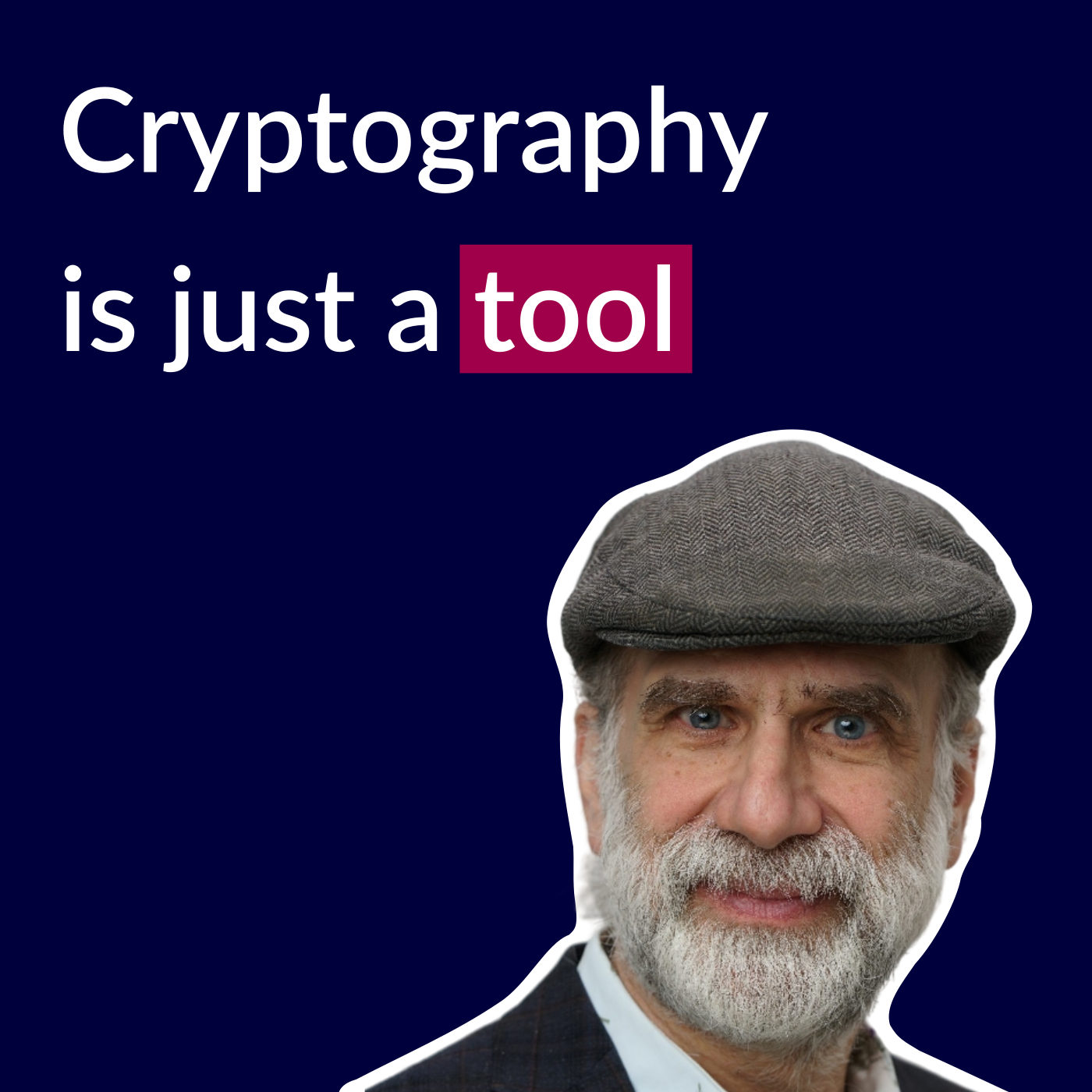
Well, it it it is a very hard question. Like, what does safe mean? Right? You know, I could slip and fall tomorrow on the ice, so that's not safe. But it's nothing I can do with cryptography is just a tool. Think of cryptography as the inner workings of the lock of your front door of your house. Is your house safe? Well, I don't know. Right? I mean, all I know is that the inner workings of the lock of the front door. You know? Or, you know, someone could break in through the windows. There could be a fire. There could be a flood. All All sorts of things could happen. Right? Cryptography is a minor tool. It's not right to say that cryptography is what keeps us safe on the Internet. Cryptography is one of the many, many things that might possibly, potentially, if they're used properly, keep us safe on the Internet. So, I mean, you ask about messages. Signal is a messaging program. It uses cryptography. It It uses cryptography very well, and it is a secure messaging platform. Right? But that has nothing to do with whether, you know, someone looks over your shoulder when you are typing your message, or someone takes your phone and threatens to hurt you unless you unlock it, then they read your archives. Right? Or if you're on a group chat and one of the people on the group chat works through the police, and it's like, you know, telling them everything. Cryptography is a tool, and all these security technologies are tools. I don't need AI here. I don't need to delegate. I I'm delegating already. Right? You know, when I use this object, I'm trusting, in this case, it's Apple and all the apps, to be secure. I'm delegating everything to this object. And, you know, that's the way it works. You know, we are now, on Zoom where you have to be using my account, and I've configured it to be end to end encrypted. And that means this conversation is encrypted from eavesdropping, but you're recording it. Right? You could do whatever you want with it. So how much is that encryption protecting us? I'm trusting you. Well, a couple of things. Right? We know this is gonna be made public, and, really, I'm trusting you. And that's a social thing. So, you know, security is is harder than just some math, and this is really what I write about and why I've written, you know, so many books and not just cryptography math books. Because making it work in real life is is a lot harder than the math.
Speaker 0
5:16 – 5:26
Sure. I totally understand, like, the that is the the reason just one point of failure and,
Speaker 1
5:27 – 6:16
Right. I mean and and think of your house. Again, same thing. It's not just one point of failure. Right? It's the doors. It's the windows. It's did you lose your key? Who else has a key? I remember there was a group of criminals that would steal art by cutting holes in people's walls. Right? Yeah. It's a sort of crazy attack, but the art was valuable. Didn't matter how good the doors and windows were. Didn't even matter if the doors and windows were alarmed. If there weren't motion sensors in the house, then then the criminals would get get get away with it. Or I guess if they were fast enough. If you think about the criminals in France who who stole Jules from the Louvre. Right? There were there were very secure windows. There were alarms. There were guards, and they still got away with it because they took seven minutes in and out.
Speaker 0
6:18 – 6:52
And thinking about, I don't know, electronic votes that this is also something our society is, in some way moving toward this. Which other kind of point of failure, do you see? I mean, there could be many, I can imagine. Do you see something that is that is specifically dangerous or, like, people should point their attention to?
Speaker 1
6:53 – 9:26
Yeah. A lot of us write about, electronic voting, whether it's electronic voting machines or voting on the Internet. And pretty much all computer security people say don't ever do this. And the real problem there's a lot of problems, and and you you sort of said there's all sorts of things we can talk about. But the real problem, the reason this is a hard security problem is that voting is anonymous. That I bank online all the time. Right? I go on my app and I move money around and I pay bills and I, you know, deposit checks. I do all of that. And you could ask, why is that secure? It's secure for a couple of reasons. The the apps are pretty good. The phones are pretty good, and it is all audited. If I try to cheat, it's discovered in audit, and then they roll back the transaction. Right? If I if I deposit if I, like, go on Photoshop and create a check and then deposit it, they'll eventually take the money away from me. Right? They won't let me get away with it. The problem with voting, unlike all these other applications, is it's anonymous, that there isn't a connection between you and your vote. In the same way there's a connection between you and your bank deposit. And that additional requirement makes security much, much harder. We cannot, period, secure an election that is online. Right? Because it can be hacked in ways that are undetectable because of that anonymity requirement. That mean, the easy way to solve it is make votes public. Right? If you eliminate the secret ballot, I can do this easily. But if you don't, I can't. And right now, in our in, you know, in our in our century, in in our lives, the the secret ballot's important. It wasn't always important. When you go back hundred fifty years ago in most places in Europe that were voting, they're voting, you know, by public acclimation in the town square. Right? They're voting that your vote is public. But if you need a secret ballot, I cannot secure it if you're voting online. I just can't. I know it's annoying. Right? We all wanna be able to vote online because it would be so good. Right? It'd be so easy. Turnout would be great. We could vote, you know, once a month. You just get there's so many things you can do, but I can't do it securely.
Speaker 0
9:30 – 9:41
I'm thinking maybe there could be a sort of, hybrid between, secret vote and non secret vote, I think, in the future.
Speaker 1
9:42 – 10:35
Because I think though. Because the problem with a non secret vote is coercion. Right? If I pay you money to vote my way, I can make sure you did it. And the thing about a secret ballot is I can bribe you, but I don't know how you actually vote. And that's real important. So, you know, you really have to really think through hybrid because hybrid just means you get the worst of both, not the best of both. But you know? And and people are thinking about this. This is this is you know? I mean, people a lot of people more a lot more people do this kind of, electronic voting theory than I do. The organization, if you're interested, is verifiedvoting.com. They're American, and they mostly, work with American elections. But the work they've done on these types of systems in general is phenomenal. And that is where I would send people who want to learn more about about voting security.
Speaker 0
10:37 – 10:58
And, thinking about, how in some way, I mean, electronic voter is, I mean, exercising in some countries nowadays, I'm thinking, is this related to some, ignorance from politicians that don't know the technical
Speaker 1
11:00 – 11:53
details? Or So anyway. Because Estonia does electronic voting. And and you wonder, like, what are they thinking? And I don't know. You know? I mean, I think there is an optimism in there. There's some thought in that the the ease of voting and the the turnout increase might be worth the risk. Now I don't think we should ever do The United States. I think that'd be crazy. I mean, the election is just too important. Too much money is spent on the election, and and it would be subverted. I mean, I just I just can't imagine it not being subverted. Maybe Estonia is politically more neutral and more safe from that. But I don't know. I mean, I don't know the thinking. I have not spoken to Estonian elected officials and asked them or any place else where there is that kind of electronic voting. But I do know, like, as a security person, it is freaking not safe.
Speaker 0
11:56 – 12:48
And, I mean, with, talking about, safety in systems, it also bring, something that they think it's quite interesting, trust, in the system. And, I also had some thoughts about, how it is in some way the same trust that people in the past had, relation to other things. There could be religion or, like, ideologies. And, I wonder if this can be a parallel list that can be done about having trust in in a technological system and having trust in a ideology or, like, in a in religion?
Speaker 1
12:50 – 15:00
I don't know if there's, I mean, it's certainly related. Trust is a really complicated concept. I mean, it is a really, really complicated concept. And, you know, how it plays out is subtle and, I'm gonna say weird. That's not the word I'm looking for, but it it it's not simple. And your intuition's right that it's that it's social. Right? You know? I mean, if I if I'm trusting you or trusting a technology I mean, it's not because I've I've analyzed the technology. Right? I mean, I'm I I said it earlier that I trust signal. Now I have not looked at the code. I know a couple of the engineers, but I I'm trusting a process. I'm trusting people. I'm trusting a company. I'm trusting Meredith Whitaker who runs the signal foundation. So, I mean, there's a lot of trust in systems. I did write a I write a book on everything. I did write a book on this. I'm gonna get it. Right. So this is liars and outliers. I wrote this in 2012, I think. And it really is about trust and security. And I spent a lot of pages trying to understand how trust works, how it is engendered, how things are come to be trustworthy, and not people. I'm thinking about systems. Like, why is it when I go to a foreign country, I stick my card into an ATM machine, and I get currency in that foreign country. Country. I don't know what's happening. I'm trusting this weird interbank transfer system that I know nothing about to, like, to do that without too many ridiculous charges. And and that's an example of of this sort of of what we do all the time. I get an airplane. I trust all sorts of things. I eat food. You know, you and I are using Zoom. I have a Windows machine. I have an Apple phone. I mean, all of these things, I'm I'm I'm trusting all sorts of things.
Speaker 0
15:02 – 15:12
And I'm thinking, like, in the past, I mean, money was, what do you say? Like, it it was the king
Speaker 1
15:13 – 16:00
that basically the state that was releasing money. And some of that is right. You know, you you often trust the powerful. Some is because you have no choice. Right? Sometimes you trust something because, you're familiar with it. Sometimes you trust it because others trust it. You know, I go to a doctor. I trust what the doctor says. Right? You know? I I don't I don't know anything about medicine. I trust what the doctor says. I trust that the doctor's done their research, and they know what they're doing, and they're not trying to kill me secretly. And society works. And this is what I tried to, you know, figure out in in in the book Liars and Outliers. Why does this all work? It seems kinda weird, but it does.
Speaker 0
16:02 – 16:11
Yeah. And then it has to be, like, trust at a collective level because I'm thinking all the people, I mean, recognize the king to be the king,
Speaker 1
16:12 – 16:35
and so they trust, that the demonic can be a Right. And you probably, of course, never met the king. Yeah. But you just trusted that the king exists. You don't know. You have no firsthand knowledge. You should've been told there's a king. He lives in that building over there. You can't go in. There's a lot of guards. Right? You know? You know? Trust is super interesting. And it's not just humans. I mean, other species trust or not.
Speaker 0
16:38 – 16:50
And can we say that, because in some way, we said that that we trust the authority. So the authority in some way is changing, from akin to the
Speaker 1
16:50 – 17:07
technique as to the I I think there's some of that I mean, there's a lot going on. I sorta I sort of sort of urge you not to I'm gonna say jump to conclusions, but not think you figured it out. This is hard. I mean I mean I mean, a lot of things I don't understand.
Speaker 0
17:12 – 17:30
And, thinking about democracy, what it is democracy for you, and, how can we use, let's say, how not to trust democracy or to trust democracy?
Speaker 1
17:31 – 18:56
I so I it's a question. I mean and what is democracy is actually a surprisingly complex question. And and, you know, when in writing this book, I had to come up with a definition of democracy. And some people define it as a way of of changing who's in charge. And democracy is a system by which the winner assumes power and the loser cedes power, which turns out to be, you know, a a weird rare thing for our society. Usually, that happens with violence, and democracy waves that happen peacefully. When in our conception democracy, which really lends itself more thinking about it technologically, is that it's a system of figuring out what to do. Right? It is a fair system where everyone to collectively decides what we do. So it's a system that solves problems. You know, what should the tax rate be? What should the unemployment policy be? You know, right, how should we how should we regulate airplanes? I mean, all of these questions. It's a mechanism by which we figure it out. And so in that way of thinking, democracy is an information system. Right? It it's a way of of solving problems.
Speaker 0
18:59 – 18:59
And, if
Speaker 1
19:00 – 19:59
You answer the question, like, why should we trust it? You know, it's another really good question. And, you know, that goes up and down. You know, right now, at least in The US, we're in a very low, you know, a very, sort of a nadir of trust. There's a lot of non trusting that's going on. People aren't trusting these, you know, these systems that they are fair, that they are are are giving us the right answer. So, you know, maybe, we shouldn't trust it. You know? But that's that that's bad. You know? If that kind of trust fails, then a lot of things fail. So, you know, I I don't have a good answer of how do you trust it. But it turns out we do largely. And I guess letting largely is because it works. But but these are these are subtle questions. These are not easy obvious questions.
Speaker 0
20:01 – 20:04
Yeah. And, also, the answers are very hard, like,
Speaker 1
20:05 – 20:15
an at least And they're hard and they move around and they're dependent on all sorts of things. Yes. But, I mean, I think these are the interesting questions. These are the kinds of things I like to write about.
Speaker 0
20:18 – 20:54
It's it's very interesting to talk about this because, they they can in some way also influence the the future. It could be possible, using technologies, to decide things, let's say, in a collective way, because we say that voting is not safe. So I wonder if other kind of, if technology can be used in a safe way to do something, to decide about what to do, let's say, in our city, in our state.
Speaker 1
20:55 – 22:51
Well, mister Shorff, two things that are two possibilities there. One is technology decides, which, you know, like, is ruled by machine, or technology will help the humans decide. So let's talk about the latter because I think that's a better one to think about. There are a lot of technology, a lot of work in, using technology, AI in particular, but also communication technologies, to help people discuss, debate, and reach consensus. And, the country that is, I think, most ahead on this is Taiwan that has, any number of systems. A polis is, I think, the main one where citizens can, interact directly with the legislators and and give feedback and discuss things and policy positions get modified. There are other examples, around the world. So this is I mean, I got a really interesting application of AI. It's not doing something that humans can't do. I think it's interesting. Right? Humans can also be these kind of moderators, but we don't have enough humans. Right? Humans don't scale. So technology fills in where there aren't enough humans to do the job. So and there's a lot of good work here. I'm excited by it. I I like seeing it. I think it's a it represents a way of making democracy more responsive to people instead of less. But, of course, it requires the pea the the legislators to want it. Right? I mean, technology can't solve the problem if a legislator, like, doesn't wanna hear from their constituents. That's not a tech problem. That's a democracy problem. But there's a lot of cool things tech can do.
Speaker 0
22:54 – 23:13
Yeah. And nowadays, technology yeah. As you said, it's, political problem, so it means that it's very hard to solve. And I wonder, like, do you think that in the future, we could see, like, a sort of democracy where citizen assembly,
Speaker 1
23:14 – 25:22
everyone participate in a citizen assembly with AI system that maybe can, record translate. Maybe not every the point of the citizen assembly is it's not everyone. Right? That it's a representative sample. It's sort of an interesting way of doing democracy. The, the the example that exists mostly, in the present day is the jury. If you think about what a jury is, we, we we pick, you know, some number of people to basically act as everybody. They, you know, they sit the the people sit in the room, they hear the evidence, and they make the decision for us. Citizen assembly is is is similar. Right? You know, there's a policy issue. We might convene a 100 people to sit in a room and to get, you know, to get information and to, hear testimony and to learn about the issue and eventually decide. And we and we as a group, as in a jury, we say, okay. Whatever those people decide, we will do. And it's a different way of doing democracy. Instead of everybody voting a little bit, a few people do a much more deeper and intense and and complex dive into the issue and produce a much more nuanced answer instead of just, you know, yes or no. I think they're they're they're growing in popularity. I think they're really interesting, and I would like, governments to use them more. We'll see what happens. Right? I mean, right now, they are largely a niche. They are often just advisory. They're not binding, which kinda makes them not real. But, you know, things are changing. We need to figure out democracy in this century. It's unlikely gonna be, you know, it was invented in the mid seventeen hundreds and France and The UK and then then, you know, newly formed United States. It's likely to be something different. I don't know what it'll include, but these are all exciting ideas to think about.
Speaker 0
25:24 – 25:31
Yeah. I'm thinking about, I mean, basically, casual extraction of people that can, discuss about the problem.
Speaker 1
25:32 – 25:58
And then you can imagine, you know, AI being used in these systems. Right? I mean, either as as mediators, as moderators, as information providers. I mean, assuming the AI is trusted, it's a big if. But assuming we can build a trusted AI, right, there there's a lot of ways it can facilitate us humans reaching a collective decision.
Speaker 0
26:03 – 26:09
And I'm also thinking that, if we say that, voting is not safe,
Speaker 1
26:10 – 26:34
on using technology Voting is safe. Online voting is not safe. Oh, yeah. Oh, actually, no. We don't know. I mean, there are places where voting is very dangerous. You can get yourself killed. Right? But, normally, the act of voting is not complicated. There are lots of ways to vote an election, and, no matter how you vote, there are always ways to support election. Online voting is very unsafe.
Speaker 0
26:35 – 26:39
Okay. So you would exclude the, let's say, direct democracy
Speaker 1
26:40 – 26:52
in the future as something that could be possible. I would not. I think direct democracy is really interesting and and and something to think about. Be careful. All of these questions are complex and nuanced. There's no single quick answer.
Speaker 0
26:55 – 26:55
Unfortunately.
Speaker 1
26:57 – 27:00
I know. Right? If it was easy, we would just solve it. Yeah.
Speaker 0
27:04 – 27:24
And just a clarification, because you said online voting is not safe. So, like, a voting system where the people goes and there is a sort of machine, provided by institutions. Also, that could be considered as an online vote. Again, it's complicated.
Speaker 1
27:25 – 28:47
I recommend verifyvoting.org there. But, basically, the two things you need for a secure voting system is a voter verifiable paper ballot. One. And there are different ways you can get that. There are ways you can do that with with machines and electronic accounting. Generally, the the the the gold standard is optical scan. You get a paper ballot with a bunch of ovals. You fill in the ovals. You feed it into a machine. So you have a paper ballot, which goes into a box for recounts, and you have the quick count. That's the first thing. The second thing you need is something called a risk limiting audit, which is a complex math thing, but, basically, you audit the results in proportion to the margin of victory. Right? So if it is a large margin of victory, they only have to do a small audit. If it is a small margin of victory, you have to do a larger audit. Those two things are what we believe are necessary for secure voting. Now that doesn't solve gerrymandering. Right? That doesn't solve voter intimidation. That doesn't solve the government who arrests the opposing party's candidate. But the process of voting, that is what is needed to have bSECURE.
Speaker 0
28:51 – 29:05
And, which other, ways to express their volunteer no. Their desires, we can see the difference. To
Speaker 1
29:05 – 31:13
express our desires. We can protest. Right? That is a way to express your desire. We can testify. Right? We can write to our legislator. We can, advocate for an issue. Right? Democracy is not just voting. There are all these different ways that society provides input into the system about what it wants. And here again, you know, tech can do good things. So I live in Massachusetts in United States. There's a platform called Maple, Massachusetts something platform for legislative engagement. I think I got that right. And this is a platform that allows people to submit legislative testimony, makes it easier. Now if you were wealthy, if you had time, you could always do that. But if you didn't, you had more trouble. And this platform makes it easier, and it uses AI. It uses AI to summarize legislation. There are thousands of bills in Massachusetts every year. It uses AI to help people, compose their thoughts and to create their comments. So it's not an AI system. It's a system of, you know, feedback to legislators, but it uses AI. But notice what it doesn't do. Doesn't it can't force the legislator to read the comments. It can't force the legislator to take them seriously. Right? All it can do is, you know, produce those comments and hope that the legislator is, you know, responsive to their constituents. Right? That's all it can do. But this it's a that's a really good platform for helping people participate in democracy in ways other than voting. Yeah. I I've seen several platforms that are very interesting that, Yeah. It's a bunch. You know, other other governments have similar platforms. I think Polis is similar in in in Taiwan. I I just know Massachusetts because I live here.
Speaker 0
31:14 – 31:17
So I think in, like, we can say that the point of failure is between,
Speaker 1
31:19 – 31:52
like, I mean, basically, it's that politicians don't have to follow what has been discussed. There are many points of failure. Right? I mean, money in politics, The United States is a major point of failure. Right? Gerrymandering, the ability to really manipulate, districts and then without forceful representation is an enormous point of failure. Oh, yeah. We point of points of failure are throughout democracy. And, you know, unfortunately, they're being exploited. They're increasingly being exploited by people who wanna take advantage of of democracy.
Speaker 0
31:57 – 32:21
I I'm thinking that, the the division of power I mean, executive, legislative, or, like, judicial power. Like, in some way, they are built to be balanced, between each other. And in some way, each one has a sort of point of failure that give advantage to the other two. Right. And what you want is those points of failure to be different,
Speaker 1
32:22 – 33:11
and then they support each other. Right? That well, at least, like, countering them supports each other. And that's the idea when these systems are set up. They are strained. I mean, they're not right now, United States is not working. You know, we do not have those three points of power, and they're all watching each other. We don't. Right? The courts are deferring to Trump. The legislator completely doesn't do anything anymore. So we largely have an authoritarian government. Even though on paper, we have all these checks and balances, they're not working. And and we've seen this before. Right? You know, like, Soviet Union had a phenomenally good constitution. They just it just never actually worked. So, you know, we have lots of its examples of the difference between the way it looks on paper and the way it looks in real life.
Speaker 0
33:16 – 33:39
And I'm thinking, you you mentioned before, like, hacking social systems. So once that we have a sort of political system, that centralized power, in the way you described, then, the system should be hacked again to have the division of power.
Speaker 1
33:41 – 34:59
So this is the yes. I mean, then then this is hard. Right? So this is another book I wrote. I'm gonna get it. And so this is, my previous book is called Hacker's Mind. And in it, I I try to I try to answer that question. Like, how do we deal with a world where the systems of power are being hacked so effectively that they no longer work? And, yes, I mean, your intuition is correct. We need to, like, update the systems. But that's hard to do. In the in you know, right now in The United States, the system to update the system no longer works. So we have an amendment process. We can amend the constitution. Pretty much all constitution have amendment process. But in The United States at the federal level, it's not done. It hasn't been done for decades. And you need to go to other countries, the constitution amended all the time because things change. Right? You have to update the rules by which you live under. And The United States, the state constitutions are updated all the time. Federal level, it is broken. So now we have a problem that the system is broken. The system to fix the system is broken, And we don't have a system to fix the system to fix the system. Like, we never thought we need that, and now we do.
Speaker 0
35:01 – 35:04
And what we do? Right.
Speaker 1
35:04 – 35:09
You know, if I had the answer to that, I'd be doing different things.
Speaker 0
35:12 – 35:22
And, would you like to share something about, I mean, your, professional and academic background is public, but maybe something about your personal background.
Speaker 1
35:23 – 35:28
Yeah. I'm a security and privacy person. I don't talk about personal background, basically.
Speaker 0
35:29 – 35:31
It's a good reply.
Speaker 1
35:31 – 35:49
I know. I know. Sorry. Again, like what you the first question you asked, I should just make some stuff up. Right? I I have three dogs, and I take them for walks, and I fly model airplanes, and I, you know, spin plates on, on sticks. None of that's true.
Speaker 0
35:52 – 36:41
And, I have a couple of other questions then. Many times, talking about, let's say, the future of governance, there is this term that is a blockchain that came out. I also when I studied history, I did my thesis. I was very interested by the topic, so I did the thesis about that. Thinking about social and political system could change. But then I also identified some point of failure, I will say, because blockchain, they said they should basically decentralize more name and power,
Speaker 1
36:41 – 37:31
but then it it is not Maybe I should start before you go further. Yeah. I don't know if you I don't know if you read I don't know if you Googled Bruce Schneier blockchain. I'm on record as saying it's the stupidest thing in the history of ever. It has no value. It has no use. It is not distributed. It is not secure. It is not anonymous. It is not a good idea. Just just don't do it. Any system that uses blockchain can be made better by removing the blockchain pretty much always. Right? Its value is it enables, ransomware and, buying and selling illegal activities online. It has no value. Zero. Now it's here. We're stuck with it. Right? It has monetary value, but it is it is a horrible thing for society in every possible way.
Speaker 0
37:33 – 37:35
And, yeah. Yeah. I know that,
Speaker 1
37:38 – 37:51
I was interested in your opinion. That's why I asked. Right. Well, that's what it is. And then and, you know, and I have written about it. If you Google my name in blockchain, you can see my essays about it. It's it's no waste no need to rant again now. Okay.
Speaker 0
37:53 – 38:08
And, maybe this is, different question. Like, do you think that will be possible using technology to, decentralize power? You
Speaker 1
38:08 – 40:39
know? So I mean, no. Right? Because power decentralization is not a technological issue. It's a social issue. I think tech if we decide to centralize power, we can use technologies to help make that happen. But the technologies can't do it unless the humans want us to do it. Now that's a generalization. Some technologies are naturally decentralizing, and some are naturally centralizing. Like, email is naturally decentralizing. Right? Anybody can have an email server. Anybody can have a domain. Anybody can have an email address. Facebook Messenger is naturally centralizing. You have to be a Facebook user to use it. But the idea of, you know, communications, right, you could have designed it either way. So technology helps but doesn't push neither direction. Right? So now I'm gonna contradict that. AI might. So AI in different applications might be naturally centralizing or naturally decentralizing. So I'll give an example that we we talked about in our book. Notion of AI assisting attorneys. It's a lot of of money right now in startups to help attorneys using AI. All sorts of things. Because there's huge amount of money in litigation, especially in United States. So here's a question to ask. We don't know the answer. Will these technologies largely make the best attorneys better, or will they largely make the average attorney better? If they make the best better, that further centralized power. Right? The rich get richer. If it largely makes the average attorney better, then it raises the average attorney's capability and more people have access to justice. Now I don't know which one it's gonna be and, you know, what are you gonna see over the next few years? So there's an example where the technology could, you know, decentralize power. Now it doesn't have to. You can imagine all sorts of rules and laws that humans could put on these systems that would remove the decentralization or remove the centralization. So it really is what the people want.
Speaker 0
40:43 – 40:50
I'm thinking that, I mean, usually actually, I don't know if people want decentralization or centralization.
Speaker 1
40:52 – 40:54
I know. Right? We're gonna see.
Speaker 0
40:57 – 41:13
Yeah. Because maybe not really they yeah. I mean, if we see at the past, mainly, you know, like, the strong men that then became the dictator and so on, A lot of time, it was supported
Speaker 1
41:15 – 41:25
by people. Right. And, you know, and this is, like, not my area. You know, we're seeing United States right now. I mean, I I I I don't know how to, I don't really know how to think about this.
Speaker 0
41:26 – 42:04
Yeah. It's, but it's very interesting how, like, my question that were related to some technical, things, how you, underline that they are social problems. And and it's, up to the people to and also what you said about AI that can be used also to decentralize power based on, who is going to help. If the average guy or, like, the one that he's already at the top of the, let's say, hierarchy. Yeah. And right now, you know, AI is being built
Speaker 1
42:05 – 42:26
to benefit the existing tech monopolies. And the real my real fear of AI is not the technology, but it's, it's the economics behind it. It's the fact that the the the gains are are accruing to these very small set of, you know, basically white male tech billionaires in US companies, Silicon Valley companies, and that's very dangerous.
Speaker 0
42:28 – 42:40
And maybe as the last question, like, what could be done to, let's say, to fix this issue so that they are owned by big tech, basically.
Speaker 1
42:41 – 42:58
I mean, that's easy. Antitrust. You know, breaking up the tech monopolies would be probably the single best thing we can do. So it's not hard. It's just politically hard. So very hard. So very hard. Right. Exactly. It's not hard, but it's also impossible.
Speaker 0
42:59 – 43:18
Thank you a lot, really, for and, if you have maybe a message for, the other people that are working on, maybe on the tools that you described for citizen assembly or maybe that are researching about new ways for governance, if you have a message for them.
Speaker 1
43:19 – 44:16
Yeah. I don't have I don't have a message. Right? I mean, I the message of this book really is there's a lot of cool things that are happening with AI and democracy. It's really easy to be a doomsayer. It's really easy to say it's all bad. It's all stolen material, and it hallucinates, makes stuff up. It's not good for anything. Turns out not to be true. There are some really interesting use cases for AI and democracy right now. And around the world, there are governments, there are citizens, there are watchdog groups that are experimenting with really interesting and innovative ways for, to make use of AI in a democracy. And and while it's important to resist the, the bad uses, we will we can't ignore the good uses. Let's use the technology where it makes sense. Doesn't make sense everywhere. Lots of of details about how to design all these uses, but there are some really cool uses out there. So that's my message.
Speaker 0
44:18 – 44:19
Thank you again.
Speaker 1
44:19 – 44:20
Thank you.