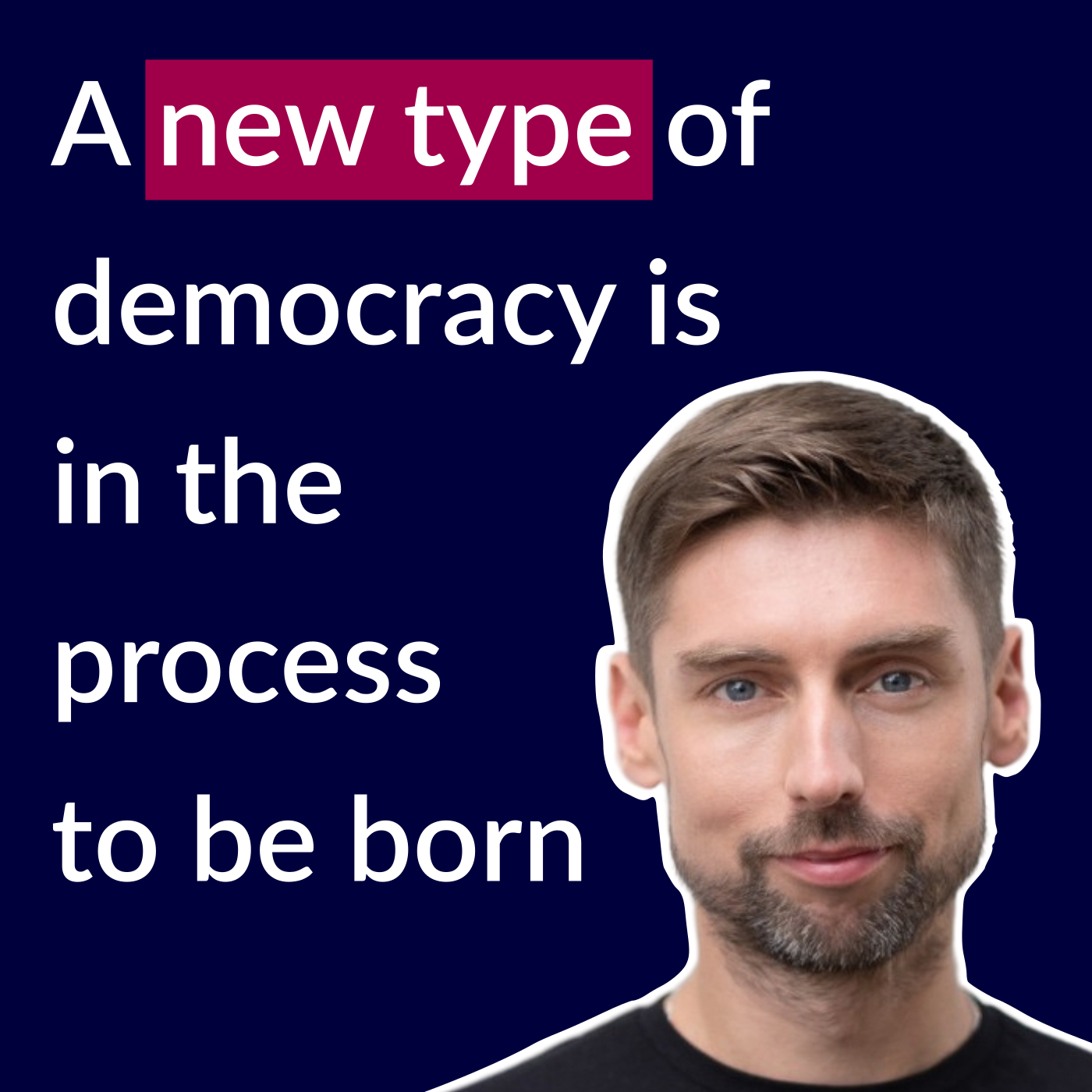
Margo Loor about CitizenOS, an open-source, community-based, grassroots decision-making platform
Democracy Innovators | 2025-09-01 | 58:10
Margo Loor is CEO and co-founder of CitizenOS, an open-source platform for grassroots decision-making. The platform allows communities to gather ideas and take decisions. As an early adopter and optimist, Margo draws a picture of a technological and participatory future of democracy, though he favors a careful integration of AI into deliberative processes.
Top Keywords
- estonia 0.011
- citizen 0.010
- civic 0.009
- idea gathering 0.006
- mean 0.006
- time 0.006
- identification 0.006
- civic tech 0.005
- thinking 0.005
- online 0.005
- tool 0.005
- countries 0.005
Transcript
Speaker 0
0:00 – 0:13
So welcome on another episode of Democracy Innovator podcast, and our guest of today is Marco Lour, from Citizen OS. Right? And, welcome, and thank you for your time.
Speaker 1
0:15 – 0:21
Hi. Hi, Alessandro. Thank you for for having us. Very, very happy to be here for this this, podcast.
Speaker 0
0:22 – 0:29
Thank you. And, as a first question, I I will ask you, what is a citizen OS? If you can.
Speaker 1
0:30 – 1:31
Yeah. Sure. So citizen OS is, an online tool that grassroots communities, organizations, networks, people, villages, can use to make decisions jointly. It has several functions. You can use it for idea gathering at the beginning of the decision making process. You can then move on to discussion where people present their, arguments, have an online discussion about the the ideas. And then you can move on to, a voting phase or or seek consensus, depending on what you're after. And finally, there's a follow-up, stage where the, proposals that have been accepted by the community are followed up on to see if if it's if it's actually being being put into practice. So it's it's an an online tool for for sort of grassroots joint decision making.
Speaker 0
1:33 – 1:42
And, how does it work? I mean, for the for the citizen, is there an interface you can, use? How
Speaker 1
1:43 – 2:09
Yeah. So so it's it's, a a a a sauce tune. So it's a it's a software service. You go you go on the website. You you log in to the web app. You can use your your mobile device. You can use use your your laptop, desktop, and then then there's an an interface that that you use to to, interact with with these, functions.
Speaker 0
2:10 – 2:24
And, at the moment, like, can, citizens also organize, any idea gathering discussions, or, like, is it more like a forest institution that, decide to use the software?
Speaker 1
2:25 – 3:25
So, institutions can use the software, but we intended it for, grassroots networks for for, non formal citizen groups. They they can be formal. They there may be an NGO. There may be a a local municipality, for example. We have we have several of them using, citizen OS. But the original, design was was done so that that it was, either individual people or or small, unorganized groups of people or or or slightly organized groups of people, movements, and and the like, who can initiate, idea gathering, who can initiate the discussions. So, it's not primarily or first and foremost, it's not an an involvement tool or participatory policy making tool where it's, like, from top down, but it's it's primarily its primary design is is bottom up. And
Speaker 0
3:26 – 3:36
do you have any, use case that was, I mean, by sign commute by some community, by some institutions, some topic that was discussed?
Speaker 1
3:38 – 6:20
Okay. So so let's look at a couple of of, of, examples. One example comes from from, Indonesia. So, in Indonesia, on a number of islands, the smaller islands, Indonesia is a nation of islands. There there's there's very, very many. And on smaller islands, there was a big issue with, waste management. So on a on a in a lot of places, waste management was fairly nonexistent. It was it was piled together and then torched occasionally. I don't know if you can call that waste management. So so people people were having that that problem. And then, discussions were initiated about what could be the possible solutions. And and during those discussions, people, took the photos from their their islands, different different, areas of the the problem, and they posted it on on, citizen OS into into these discussions, and then they were were talking about what the possible solutions could be. And then some some solution some potential solution ideas emerged, and then then these were were, voted on. And at that point, then the government became involved because, due to logistics, it it required the participation of of, some some government institutions to implement some some of the ideas that have been originally sort of initiated by by, citizens from these these islands. And, and and working solutions came from that. So so that was that was one, one example. The other is very recent. It's actually ongoing. It is, it comes from from the the, country that I'm in, Estonia. And, it was initiated by a group of, people who felt that, we need to set or or we we we as a nation or as a as a, as a people, Estonians need to, set a a future vision and direction for the country. And, obviously, there's a constitution which says, you know, the purpose of the country is to maintain the nation and the country. But, it is a it was sort of a a spreading feeling, among people that, there's no, agreed vision of of, like, where do we want to go as a as a, you know, as Estonians, as a peep.
Speaker 0
6:23 – 6:30
And, I I was wondering. So this tool is mainly used in, inside, Estonia or, like, also outside?
Speaker 1
6:33 – 7:27
Citizen OS can be used anywhere, but the the most recent example was within Estonia where then the idea gathering was about the dreams that people have about where they want the country to be in in, thirty years, time. And it's it's ongoing, so people are right now submitting different streams. There are these groups of people gathering in different places around the country. They're doing the the dreaming of the future, and then they're writing things into into, citizen OS. And then in a few months' time, it will be, taken and and, written into a sort of a cohesive text about, you know, where do we see the country going. So but it's very much crossroads initiated. There wasn't even an an organization. We're just a group of group of people that started it. I
Speaker 0
7:28 – 7:56
like it. And, I I was thinking, how how it is, like, relationship with institutions? Because I know that in, some places also, I mean, politicians or people that are working, inside the institutions, they are not aware of the of the solution that can be technological solution software that can be used for political, use to engage with citizens?
Speaker 1
7:59 – 8:47
We don't actively seek them out. However, if if there is, someone and usually the story is that someone who has been, a civic activist, joins a a a movement or a party, and then ends up not ends up, but starts working for a local government or or maybe even even go goes to the national parliament. And then because they are already aware of civic tools, including citizen OS, then they sort of take us with them. But we don't we don't directly, market to or or somehow do directed contacts with, either, national or or local, local governments.
Speaker 0
8:48 – 8:57
Okay. So they contact you, basically. Like, I mean, you or a citizen OS to use the tool, for some,
Speaker 1
8:59 – 10:10
Some sometimes they do. Sometimes I just noticed that they've started using. Okay. Because you don't need to you don't need to tell us that you you can just, come to the website, start start up the web app, and and register an account, and you can you can start creating a a public topic or or a private topic or an idea gathering. So but but sometimes, if it's if if, they feel that they need us to do some training for them beforehand on on how to use the tool, in the best way, then then they do contact them. We're actually in the process of writing up, we had we had some good co cooperation with with some local governments, and then we are, in the next month or so, we're writing up, a a a, like, a better described use case, about how how citizen OS was was used by a local municipality to engage, citizens. So, just to showcase that that you can use it the other way around, too. It doesn't even though the primary design is is, bottom up, then then it can be used for for participatory voice making as well.
Speaker 0
10:11 – 10:26
I was curious about the design of the platform. What is the story behind, like, if there was someone that designed a team of people, how old it is a citizen OS?
Speaker 1
10:28 – 13:20
Yeah. Okay. I'll try I'll try to make it brief. So citizen OS grew out of another civic movement, which was, called at first, let's do it Estonia and later, globe world cleanup. There was it was an ecological, movement. And and and different countries were doing these, like, massive national cleanups where people would come out and in one or two days clean up their country of garbage that was lying around that were like, in nature and places where it's not supposed to be. And then, a few countries after they had done it for a few years, like, once once a year, but then the next year, they'd find see that it it needs to be done again because, you know, waste management wasn't proper and people were still throwing garbage in places where it shouldn't be. They asked, okay. So how do how long do we keep doing this? And and that's what led us to think that, you know, maybe we should, create a tool that enables or or what if there were a tool that that would enable people to, jointly think about, you know, how do we how would we like the waste to be managed so that we wouldn't have to clean the country, every year. And, and and that sort of started the the thinking towards, okay, let's let's let's create this, this tool. So design wise, we're right now on our third version of of design. So it's been, iterations towards what where we are now. And there are, a number of design choices which you like, maybe if you if you go to the the the, portal for the first time, you don't consciously notice, but but a lot of thought has gone into them. So, for example, I think in most places these days, you can create a personal profile. You can put your, like, photo and things. We we don't I mean, there is somewhat a very minimal profile, but we don't show whenever you post an argument, you we don't show your picture next to it because, we don't want it to be about persons or people. We don't we want it to be about, the discussion to be about the content, the arguments. So, unlike, many other, places where people can comment and and we and for example, there's no comments. You can post arguments. So it asks, okay. So what's your point, and how do you explain and prove it? So so there are these, like, design choices or design features that aim to make it a a a rational, discussion instead of something that becomes emotionally bloated.
Speaker 0
13:22 – 13:35
Yep. So and, I I was thinking you are probably updating the software, I mean, with new ideas or not. I mean, is there anything you're working on right now, new features?
Speaker 1
13:37 – 15:25
There's there's a bunch of things in the pipeline. But, the past two months, two, three months, and the upcoming, few, are are difficult for us right now. So right now, within the next, I would say, like, two or three months, we're we're solving some some bugs and issues, but we're not coming out with with, new, big new features. Obviously, there's a lot of thinking around. And and so far, we've been very careful about AI, due due to all kinds of different reasons. But, the world seems to be moving in that direction so powerfully that, it may still be useful in in what we do, as well. If I give you one quick example, then then, if very many people give their idea or opinion or argument about something, then it becomes overwhelming. And it's it's difficult to have an an overview of, okay, so what's the what's the general mindset that that is being expressed? And and in in such things, AI obviously has its strengths. However, it also has the things we're we're careful of, like the biases and and, things. So so, are we maintaining the code? Yes. Are there features we're thinking about or that are, in the backlog? Yes. Right now, a lower period for for us within the the half a year period or so.
Speaker 0
15:26 – 16:07
It's interesting because, some other projects that we I mean, people that we interviewed, they were, working on, some, new software for Silvik Tech, and this and the software was new and was also using AI while, CitizenOS is is pre AI. It's Yeah. And so at the moment, it doesn't use AI at all. Right? Yep. Okay. And so you are trying a way trying to find a way to implement it in a cautious way in a in a way that okay. To to take what's valuable,
Speaker 1
16:07 – 17:26
but without the problems that have already been sort of identified. So I'm not I'm not saying, you know, AI is is, bad or it's good, summarily. I think it like, if it's a considered aware design choice, and you build your tools so that you know about the possible problems and you design for them, then then, I don't see a a problem with it. And and I'm I'm certain that we will be using some in fact, this isn't right now a feature of citizen OS, but the the Estonian dreaming project that I described, there, actually, AI is going to be used because, if, you know, 35,000 or or 50,000 people submit their dreams, then it will be very difficult to work with that amount of of information without using a large language large language model. So so one will be used to, detect common themes and and bring out the the the common dreams that people have about the the country. So so, yeah, that's that's the direction it's it's going to take anyway.
Speaker 0
17:27 – 17:48
And I was curious about, all the other ideas in the pipeline. I mean, I suppose ideas that, maybe will require, maybe a lot of time to be developed, or maybe they are just idea at the moment. But if you, can share any of them or maybe you can't, I don't know.
Speaker 1
17:51 – 19:39
There there's a a number of things that have to do with with integrations, which aren't that exciting to talk about. But but, maybe it's more more important or relevant to say that if someone someone is listening and and they have been using CitizenOS, say, a few years ago, because we've been around for for a number of years now, then what they haven't seen and they should come and see on the platform, is the the idea gathering functionality, which we released quite, recently. It's the the latest, like, big big big update to the to the platform, because, again, we put a lot of thought into into it, and there's there's, I've I've been doing, as a as a moderator, I've been helping, some of the processes, in Estonia where where people have have come together for citizen assemblies and and, you know, joint decision making processes. And based on on that and and sometimes in the beginning of those, idea gathering was done using, like, very simplistic tools like like, here's a Google form, submit, and nobody could comment on or or upvote or downvote each other's ideas or or or any of that. So so all of the dreams that we had about, like, what would an ideal idea gathering look like, we put into, the design brief and then then, eventually released as as a big sort of feature update. So, so I would I would say, you know, if you if you haven't used that but but, you're aware of citizen or anything, then come and give that a try. It's it's something that I'm I'm, sort of excited about and excited to use.
Speaker 0
19:40 – 19:52
I'm also curious to try it. And, and and I was thinking about integrations. Could it be also integration with other civic tech softwares?
Speaker 1
19:57 – 23:18
That's a that's a that's a very interesting one. I mean, I mean, we can we can definitely talk about that one because now when I said integrations, I was thinking more along the lines of integrations with, identification tools because one big area in in, in civic or participatory or etcetera tools is is how do you make sure that, you you know, the people that are participating are real people, at the same time without, endangering people's identity somehow if someone is is a bad actor wants to wants to target them. So so it's a big thinking, area. But, the one the question that you actually asked about integration with other civic tech tools, I've been thinking about it for almost as long as citizen OS has has existed. We have data formats for a number of things. So if you if you have a, I don't know, a spreadsheet, then we have data formats that you can, use. And, you know, if you open up it in if you open the file up in Excel, it will look like a table. And if you open it up in Google Sheets, it will still look like a table and all the data will be sort of there and correctly formatted. Or to look at the larger example, something that I'm also working with are are online courses. And and online learning and online courses, they have this data format called SCORM. So if you create an online course, you can import it into many different learning management systems, and it will still look more or less the same because the SCORM format is is recognized. We don't have that. Or at least I'm not aware. Maybe you are. But I don't think we have that for, a decision. But I think we should because, like, when we started thinking about, citizen OS in the beginning and we thought, okay, what are the stages of decision making? Then we thought or or and we still think that that they're fairly standard stages. So gather ideas, talk about ideas, you select the ones that you want to vote on, vote, follow-up. So so why couldn't we? But but we can't do it single handedly. But why couldn't we create a sort of a data data interchange format where if you if you have a a and I think it's less likely that in the middle of the process, you would want to transfer from citizen OS to Mudamos to the the, Icelandic software, etcetera. It's more realistic, though, that, if you have a, like, a say you're say you're, I don't know, Fridays for future, and you've been using a civic tech tool, and you have a history of decisions you've made, and then the civic tech tool, I don't know, closes down, something happens, and you want to migrate it, so that you wouldn't lose all of your, like, history of the the past decisions, and maybe some of them are still, like, being applied. That's where, something like this would be immensely helpful. So if there are people listening to this podcast that are are, aware of maybe already a preexisting tool or or are are running other civic tech tools and have also thought about the same thing, I think this would be extremely interesting if it came out of of this.
Speaker 0
23:19 – 23:55
Yeah. Interoperability, I'm thinking, I know that I mean, also Metagov is, working on that, and, also other, organization. I'm very interested by, maybe creating this standard between, so that, yeah, that is interesting about recovering the history of, and moving it to a new software. But also, like, I'm thinking about maybe, I don't know, doing a brainstorming with a platform and then annotation on another platform
Speaker 1
23:55 – 23:57
and so on. Okay. That's also Yep.
Speaker 0
23:58 – 24:08
But, also, that is a little, it seems not so easy to do it at at the moment, but, I know that there are people that are working on,
Speaker 1
24:08 – 24:24
on it. Okay. Okay. That's excellent. Yeah. At at the moment, I think it's quite quite difficult to do this, or or there's a lot of manuals of copy pasting or whatnot. But, but if that would be the case at at one point, I think that would be a tremendous addition to the whole civic tech field.
Speaker 0
24:25 – 25:09
Yes. Maybe yeah. At the moment, some, trials with the human in the middle can be done Mhmm. To see if it works, and then automatize everything and maybe, also, I'm thinking that, probably in the next few years, with this increasing I mean, AI is, is becoming better every every month. And so, probably, we will see also a new kind of civic tech, software that maybe revolutionize everything. I don't know. I'm very curious, actually.
Speaker 1
25:11 – 27:27
It's yeah. Well, I just had a discussion today with with some people about the the moment in history where we are is like, it it it's, I don't know. Maybe maybe, again, you or someone else has has, other, other ideas. I personally think, that it it looks like AI is going to free up peep people's time. It looks like there's going to be, more people who have less to do. Now there's a bad way to think about it and and and or or a negative way to think about it and a positive way to think. But the negative way to think about it is, okay, lots of people unemployed. But I have a I have a good friend who says that it is strange that in the twenty first century, countries still measure their success by, how many people have to work. So, if we combine the the ongoing AI revolution with things like civic salary. I'm not sure about the English term. Basic universal income, something like that. Yeah. Yeah. So, if we imagine a positive future around this scenario where, we go from a five day work week to a four day work week to a three day work week okay. Three is maybe thinking too far. Maybe four day work week. And then there's an element of of universal basic income, then there's a question of, okay. So people have extra time. Right now, in a lot of cases, the counterargument to more civic participation has been, I don't have time. Like, I work nine to six, nine to seven. I don't have mental space. I don't have physically, I don't have time. Then more people would have more time. So my hope, is that as as it goes on, we can increase the amount of input people have into running their societies and running their communities. But I'm an optimist, so.
Speaker 0
27:29 – 28:03
Yeah. I'm thinking also about what is, work, because, now it seems that one of the most important things are data. And so if we are talking, also can be like a sort of data extraction, data mining. So in some way, we are also working, just if we talk. So I imagine, like, with some civic, with some software, the the the transcription of what we say can actually be, like, the production of something, valuable.
Speaker 1
28:05 – 29:07
We we do. We do, and I think a lot of civic tech tools, work with universities, because there are sort of researchers looking into, the data that is is, coming out of civic tech, tools, to to to better understand, you know, digital participation and and, and how to govern communities and and societies digitally. And and we also have have cooperation with, and and are right now negotiating a new, cooperation with, with an Italian university here here in Estonia, but but a few others too that we've cooperated, with in other countries over over the years. So, I I very much think that civic tools are a source of valuable, data, as long as, you know, it's it's properly properly managed and and and, and guarded.
Speaker 0
29:08 – 30:45
Yeah. Absolutely. And, I was thinking also about motivation, because, it is true what you say. Like, a lot of time people say, yeah. I have to work. I cannot participate in the public life. And so I thought yeah. Of course. In the future, if people have more time, maybe they can participate. It is also true that apparently now people have more time that in the past, but still there are a lot of distractions, media and so on. So I'm wondering if there could be other ways to motivate people. So I'm thinking about gamification and, also thought about system where, I don't know, if a student, decide to, participate in something related to climate, change to environment and so on, maybe, I don't know, they can receive, like, a a free bus ticket or like a free pizza in a restaurant or these kind of things. Because I also feel that, there are a lot of people, that could be the owner of a pizzeria that maybe he is a sensible tools. He has a political sensibility. But maybe he doesn't have time or he doesn't have the, the energy or maybe he doesn't know where to start to, because it's also like, usually, young people are the ones that want to change the world, while older people, usually, they are demotivated in some way. And
Speaker 1
30:47 – 33:50
well, let me let me quickly share a a dream that I I have, and it relates to what you say. It's, you talked about it on a more sort of granular level, and I think it's interesting, especially if you, think about, you know, how could we create the sort of a a wider system where where civic participation would be, again, a a value to trade, but not in the bad sense. But but, I I do think we, in certain areas, should and and, in fact, in certain areas, we do compensate civic participation. My, the the dream then, is that in Estonia, we have a one chamber parliament. So it's only elected representatives that that sit in the one chamber of the parliament. But I've I've asked people, what if we had two chambers where one chamber is the representatives, the elected representatives, and the second chamber is a sort of a permanent people's assembly, where, a random but representative body of people would participate or or or discuss the most important issues for, some period of time, let's say, half a year. So so you you are similar to some national, okay. Maybe mandatory national service isn't a good idea. Maybe US jury service is a good idea good example. So so when they select the jury, they look at the voters list and then they randomly pick the people's people from the voters list, and then they invite them for jury service. And if you don't have a good reason to say no, you can't say no. So in in the same manner, citizens would receive invitation to participate in this this, permanent people's assembly or the second chamber of the parliament. And, while they are participating for that half a year, their time would be compensated. And and and that would then mean they would need to look at jointly and and discuss, the, like, the most important or the most the the the bills that influence people's lives the most. Like, they couldn't be expected to look at everything that the parliament works with because there's lots of like, small amendments and things. But but look at the big big bills. And then in half a year's time, they are are thanked. They go their own way, and then a new body of of people is is, is invited. And and, you know, if something like that were to happen, then I think we can't make it happen, or shouldn't make it happen by saying to people that, okay. This is something you you must do, and we won't compensate. I think there, compensating people's civic participation would be very much, appropriate.
Speaker 0
33:52 – 35:24
Yeah. Absolutely. Also, I think, like, in, ancient Greek democracy, I mean, citizens were compensated, because they were losing their, losing I mean, their day, because they had to vote, and so they could, could not work. And, also, it's the same with professional politicians. So, I mean, they are paid, and so they should be citizens. And I think about, many times I I asked to myself, what could be the future of democracy? I think it may be in twenty or thirty years. And, and that could also be a question if you have any idea about it. But, also, it's very interesting like, the the approach that can be taken to arrive to that, kind of democracy. So because now we have a certain kind of system, and mainly in Europe or in The US, western, democracy liberal democracy system. And and, yeah, I'm thinking about what you proposed is a sort of, maybe hybridization. High Yep. A sort of test. And then other test can be done so the the the system doesn't change from day to night from, so if you have anything to share.
Speaker 1
35:26 – 38:42
Yeah. I I think, like, revolutions where we throw out everything that has preexisted and then try to put a new thing in place. I think those are are dangerous. And and, and, you know, Karl Popper said that you shouldn't experiment on on, on people and societies. You should sort of properly, think about and and create all the all the best arguments, but best arguments require good evidence. And and evidence isn't sort of readily available unless you run these tests, unless you try try things out and see how it goes. And, therefore, whenever, either a city like like Paris or or some other, place, uses, either, you know, participatory or or or online participatory, methods, I always look at them with with curiosity because how they go provides arguments for for or evidence for arguments, for or against, change. Well, I I mean, the most common sentence that you hear around, and I I I I agree with that sentence, is that we're trying to run twenty first century century, you know, highly technological societies using sixteenth or seventeenth century political technology or political system. And and and, the gap is growing. So so, on the one hand, I'm I'm worried, a great deal worried when I look at the democracy indexes, which, year on year are are showing the decline of democracy. So less democratic countries and within the countries, less less democracy or less, civic space. But at the at the other, we're at the same time, on the other hand, I I think it might be that we're what we're seeing is the transformation of democracy. And if we measure the the sort of old classical, indicators, then we see decline. But if we looked at a new changed set of of, indicators, we would actually see, more activism, and more desire and wish to participate by people, but it looks different. It it's not the same type of legitimacy that we were looking for in democracy in the previous century and not the same type of, you know, formal organized participation that we were looking for. So so in terms of the future, I I can't paint any exact picture, obviously, but but it definitely has a techno a strong technological component because that's what the human future tends to to look like in all all, areas. And it seems to and that's what's something I'm I'm happy about. It seems to also have a strong participatory component because people seem to be willing to not not not just willing to, but, like, demanding to participate in in, certain aspects of of, of, society. If if any chance at all is given to them, obviously, if if everything is suppressed, then they can't do it, which worrying is also a trend in some countries.
Speaker 0
38:43 – 39:10
Yeah. I agree with you. I'm also thinking like this, yeah, I mean, less people are voting, but I'm thinking that, a lot of people are using such a networks. Yeah. And, also, if, putting like is not as voting, it's like a a sort of necessity to participate and express it in this way because those are the tools that we, that most of the people are using at the moment. But,
Speaker 1
39:11 – 40:22
I mean, most people in the world don't have the experience, of of online voting because only, a few countries in the world, have it. But but, you know, I've had that that experience luckily in Estonia for, well, ten years now where, liking something on social media and voting in national or local elections is only very slightly different. The the difference I mean, in in terms of what what it, like, involves as a process, the only step that goes in there is the identification step that I I need to, verify my my identity with the the, ID infrastructure. But, otherwise, it's I'm I'm selecting who I like on screen and then clicking like and and voting, for them. And, it's been very, very controversial in the world. In Estonia too, there are there are people that that have arguments against it. But, I think we would see a lot more voting if this was available in in more countries.
Speaker 0
40:25 – 40:38
Interesting also. I I know that Estonia on this, side is quite progressive. No. How do would you define it, compared to other countries?
Speaker 1
40:39 – 42:23
Yeah. The the where's mine? Wait. Just one second. The thing we all carry around, the the national identity card, because it has an electronic identification side to it, so it's not just a physical card, enables, if I if I need to or if I want to, to identify myself beyond any doubt or hack or anything, online, which is which means that when I talk online or or interact online with my government or my country, then my government or my country knows that it's me. And and that enables a a lot of other things. So it it enables a lot of eservices, and it also enables online online voting. And it is this component, I think, mostly even this component, which is something that people oppose in many countries. Like, they don't want a a government, issued national identity system enabling your identification online. And and historically and and, you know, I I can understand their reasons. But in the modern day and age, I think, you know, you're traceable online anyway, and may maybe, you know, doing the good stuff online with online identities is is something that we should be more open to.
Speaker 0
42:23 – 42:36
Yeah. I I agree that, it's a quite, sensible topic. No. That can, I can understand why some people disagree? Yeah. Because it can be
Speaker 1
42:38 – 43:33
but going back to the And then and then by by the way, the the the last comment is that that that's because on citizen OS, we enable people to either use their hard identification, the the ID system in Estonia, or then use the soft identification just, like, use their Google or or whatnot, logins. So, because some of those decisions that communities or people make, if they want them to be sent forward for implementation in Estonia to local government or or even as a proposal to the national government, then it it needs to be, it needs to have strong identification. However, if you're just making a a decision for your own village, there's no reason to, necessarily do the strong identification. You can just, do your your, Google login and then then use citizen OS that way. So so we enable, both.
Speaker 0
43:34 – 43:51
Okay. Different layers of, authentication. Okay. Yep. It makes sense. And and, I was wondering about the team. Mhmm. Because, about the team of citizen OS, how many people are working there? What are the
Speaker 1
43:53 – 44:47
Modern organizations. It's it's difficult to to say an exact number. It's more like a cloud of of people. We have we have more people in Indonesia than we have, in Estonia. We have we have two main locations. So so one is one is Indonesia and and one is one is Estonia. But, between the the those those two locations, I think I'm I'm not incorrect when I say that that altogether around 25 people are are, in in one way or another contributing to citizen OS. So so they might be, working. They might be volunteering. They might be contributing part time. Like I said, we're in a difficult period right now, so we've had to scale that that back. But that that applies to mostly Estonian side. Indonesia is doing great.
Speaker 0
44:49 – 45:24
And, what are you struggling at as organization? Or you specifically if you're working on something or you know something someone in the organization, you're working, I don't know, on a new feature or something, but you need, I don't know, maybe you're not able to solve something, and you're thinking day and night about, maybe someone that listen can, can decide to contact you and with with a very good idea. I don't know.
Speaker 1
45:25 – 50:53
So, I mean, or or organizationally or or but that that, I think, isn't something that would interest your organization. They were were reworking our our financial model. So, we we used to have a a a for many years, a a a very, good and steady source of of income, and and that has recently changed. And now we're, in a fairly short period of time having to rework our our, financial model, which does actually mean that if, that that we're looking for, especially in, within EU countries, we're looking for, sort of cooperation, partners that we can, join, to because different EU projects require, organizations from from other member states to to coordinate. So, and and we've done that in the past, but but it would be interesting to to find maybe new partners, as well. But, otherwise, I, I think a few years ago, we we wrote down these, like, like, big unsolved issues in in, participatory decision making. And and I've mentioned, them them here during the discussion already, but but to sort of clearly name them, one is the issue of identification. So it's easy when a country has some kind of national system. A lot of countries don't, and then it becomes even, like, more problematic. It's like, how can you? We've talked to Switzerland, and, a lot of time, they're they're trying to, move their very excellent offline participatory system into a more online because, of of, younger generation and and and and struggling with identification among other things. So the sec second big thing, is, the problem of sort of massive participation. So if you have so so say you're the European Commission, you ask for citizens of EU to participate on a decision, and then 5,000,000 people participate and contribute their opinion. And then you're like, yeah. Okay. What do we do with 5,000,000 opinions? Or, like, how do we how do we understand what what people actually, want to say? So that's that's another one, and and I think there are interesting solution or interesting ideas that have been, created. But it's it's not I wouldn't say, like, check mark solved, AI came and and and, solved it, due to due to the sort of, like, biases it can have and and, you know, say some of some of the other, like, known known, sorting, issues. Then, obviously, there's the big big problem is is, of deliberate bad actors. So if you have, someone, inserting, you know, fake news, or information attacks, into, the decision making, It was interesting when we, when we started creating in Estonia, a separate tool, which was originally based on citizen OS code. We have an open source code, so anybody can come and take the code and do with it, what they what they wish and also check check it. And and people have. But, we created a separate tool for the Estonian parliament so that, people could do, petitions or or people's yeah. Yeah. Let's say petition. And and you you need a thousand people to sign it in Estonia in order for it to be considered by the national parliament. And then we asked the parliament information office. We said, you know, what if, a hostile country, will pay a thousand people, I don't know, €500 a piece, and ask them to submit three petitions per day and and sort of overwhelm the parliament. So so so, do a sort of a denial of service attack, not the technical one, but, like, a content one. But they seem very, very unfazed. They said, you know, let's solve the problem when we get there. But I see it as a as an issue. One one thing is if someone does, like, an overwhelming, you know, information attack. The other thing is if you're, you know, being clever about it and inserting bits of, like, false data or false information into a a public, or or or a participant or decision making. So so, you know, those kinds of things is is a third thing that not only we, but but I think many others are are, thinking about. So Yeah. Does it keep does it keep us up at night? Not really. But but is it something we we think about, then then yeah. Absolutely.
Speaker 0
50:55 – 51:34
Yeah. Yeah. Both the registration and the how to scale the information system are both, I would say, very interesting problems. And, I also thought a little bit about, the identification systems. I don't know if I have any solution. Not not now. Not at the moment. And, I haven't asked anything about you. So if you'd like to share anything about, your professional background, so and those academic, how it happened that you become passionate about civic tech participation.
Speaker 1
51:37 – 53:56
So every everything I've I've done in my my adult life, falls into a triangle, which is technology, then, open society and education. So so within that triangle is is where I I, operate. Even though I I was originally, studied law and and, I even even worked in a law firm for for four or five years. But, The the technology part is is simple. I I grew up in the first wave of, like, home accessible computers and and early Internet, where you had to write your own own tools and and coding was massively exciting and and, and and and that sort of, you know, got got me started on the technology. And I'm I'm very like, an early adopter of of things. So even though Citizen OS isn't using AI at the moment, I myself am am a heavy user. So so that part is is, easy. Now the open society part, that that came to me via something called the debate movement, which is something I got involved in when I was in in high school. And that led me to the ideas of, your car popper and and having, you know, good arguments, and and trying to make rational decisions and and building processes where you, don't primarily look at the the emotion, but look at what what is the reason and what is the the evidence. And that sort of grew into, also at the time in in Estonia, the whole, organized civic sector was starting up. So we, established the the the the first data NGOs, which are still still around. And and and so that that sort of got me got me started. So it's it's been these kinds of activities that have brought me to to where where citizen OS, was initiated and and, and is today.
Speaker 0
53:58 – 54:08
And do you have anything to share about your personal life? Like, or did you grow up also related to your childhood.
Speaker 1
54:09 – 55:54
Sure. Well, I mean, there there's Estonia was occupied by the Soviet Union at the at, at the time, when when I was born and and during my early early childhood. And so so I have a vague memory of of what the, sort of repressive communist regime looks like from the inside. Obviously, I didn't bear the brunt of it because I was I was a kid. But but, I vividly remember the moment where Estonia was nearing the the regaining of of our independence. And, I had to before that, on my school uniform, I had to wear the the red red flag of the Soviet Union. So, I I took it off, and I remember the the the bush on my school street where I I sort of threw it in the bush, and, and replaced it with with our our, national flag. And, and and I've I've often then said that I couldn't picture myself living in a non open society. So this is it's it's something which is a very vital part of of me, and that's that's why I I, do what I can to to preserve, the participation, the the discussion, the the the the openness of of talking about decisions and and jointly making decisions that influence people's lives. So it's it's sort of personally important.
Speaker 0
55:57 – 56:12
Thank you. And, as, maybe the last question, if you have any message, for the people in the civic tech space that are working, I don't know, Creating new tools or maybe trying to do what we are doing, but in other countries. Or
Speaker 1
56:14 – 57:55
Oh, sure. I mean, like, keep innovating. There's there's a number of fields where, outside of civic tech, I mean, where where we can say that, okay, we've we've arrived at at some plateau. Civic tech isn't one of them. I think I think it's a vibrant, area. There's there's, like, challenges to address. Maybe I'm a little like, sometimes I'm I'm I'm a little, not worried, but it makes me think that that, there there are, e governance tools, but maybe a little less e democracy tools. So so I would I would be even more, like, enthusiastic or joyful if I saw, the within the whole, like, civic tech, field, the the e democracy tools part of it, to grow more or more innovation, happening, there. And, you know, some of them will only be sort of time limited tests as you said, but those tests are valuable. So even if we're doing something with, like, project funding for a limited time period, then if you're able to document and leave the results you achieved somehow to lost, even when the the tool maybe maybe, shuts down, then then that is very valuable because it provides evidence for the arguments for a a new type of of democracy that is in the process of being born. And it's an it's an I think it's very, very exciting to see where it goes. So keep innovating.
Speaker 0
57:57 – 58:01
So thank you a lot, Margo. Thank you. It was a it was a pleasure, really.
Speaker 1
58:02 – 58:06
Yes. Very nice. Really enjoyed the discussion.
Speaker 0
58:06 – 58:07
Thank you. And