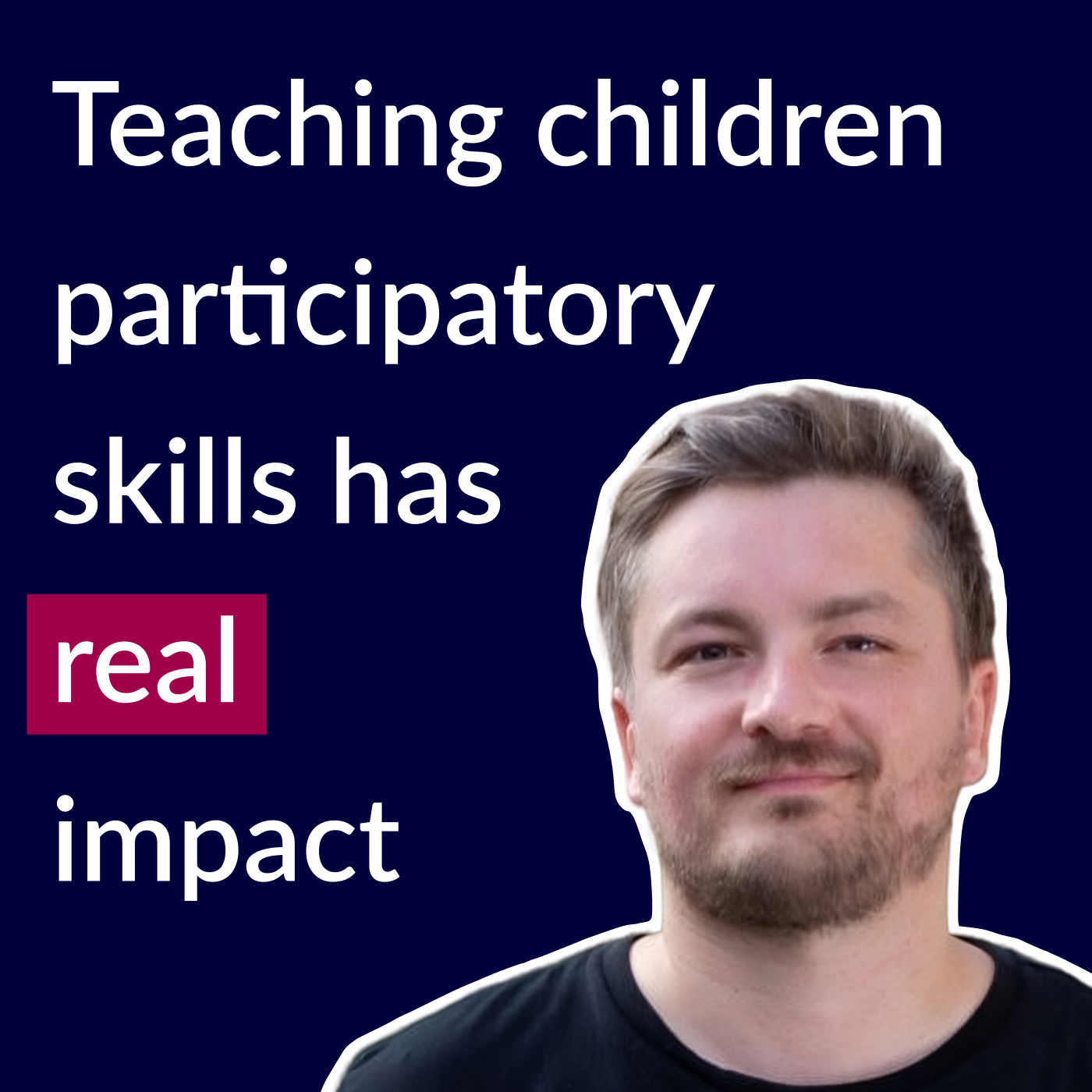
Tomas Rakos about Participation Factory and why fetishising a single method or tool is a bad idea
Democracy Innovators | 2025-09-10 | 1:00:41
Tomas Rakos began his career in the Czech media industry. In 2013, he was co-founder and CEO of his first participatory company. 6 years ago, he started the social enterprise Participation Factory, through which he designs, consults, and manages participatory projects around the world. With his extensive knowledge and experience in this field, he is able to offer valuable insights on participation.
If you enjoy our podcast, please consider making a donation. It really helps us to sustain the podcast.
Top Keywords
- participation 0.016
- participatory 0.007
- projects 0.006
- work 0.006
- participation factory 0.005
- obviously 0.005
- civic tech 0.005
- civic 0.005
- central eastern 0.005
- factory 0.005
- project 0.005
- europe 0.005
Transcript
Speaker 0
0:00 – 0:10
Welcome on another episode of Democracy Innovator podcast, and our guest of today is Tomasz Rakus. And, so welcome, and thank you for your time.
Speaker 1
0:11 – 0:13
Thank you too for having me. And,
Speaker 0
0:14 – 0:18
as a first question, what is Participation Factory?
Speaker 1
0:20 – 1:39
Participation Factory is, formally, it's a company, but it's a group of people that decided, to, be working on, Impact through mainstreaming, good participatory practices and work. We basically we do four four things, in in order to simplify that. We do a lot of, participation designs, implementation of the projects, or evaluation of, any type of participatory process, mostly working for public sector. Second, we also focus on systematic participation, meaning it's kind of change management type of work. We help local regional governments and others to create their own internal teams that, focus on, participation agenda. We also teach, so we have, very kinda, stream of work, big stream of work where we just, provide capacity building and trainings to mostly, public officials, but also politicians, NGOs, anyone who is interested, as well as we do a lot of, civic tech engagement platforms, e participation, advisory and consulting.
Speaker 0
1:41 – 1:46
And, about, how do we evaluate a good,
Speaker 1
1:50 – 3:42
okay. Let's, I think it's the first time that anyone ever asked me that as a first question. We have come up with our own, monitoring and evaluation framework, for participatory processes. It's actually it's not it's not a rocket science. It's about, being able to set up a good M and E plan and a good, basically indicators of, let's say, quote, unquote success of the project, through which you can monitor if the project, the participatory project, actually actually is of the quality that you kinda decided it would have. So, the examples of the indicators, you can obviously monitor how many people are engaged if the transparency, is really met, if all the information and data is shared with everyone, if there is an access, you know, to the process itself as well as to the outcomes. If the project management works very well, if the online layer of the whole process is working as you kinda plant, it to be in the beginning and so on and so on. I think that right now we are having, we have about seventy, eighty indicators, that we are able to apply to any type of process. And it's a really it's a really detailed work. As I said, it's not such a big deal. It's not as complicated, but, obviously, it's, requires a certain skill. And we believe that at the end of any participatory process or project, besides, the reports of the outcomes, there should be also the, MNE report, meaning monitoring and evaluation report, kind of measuring and showing, if, really, the project went according to the plan.
Speaker 0
3:43 – 3:52
Yeah. May maybe that question, should have been the the the last one and not the first one, but I was curious about the evaluation.
Speaker 1
3:52 – 4:38
But I was I was happy. I'm happy that you are asking because as as you know, we are based in, the heart of Central Europe. Participation Factory is, Prague based, organization. And to be honest, monitoring and evaluation is not really, required, in Central And Eastern Europe by public sector. It's not really a habit, unlike in, you can say, Western Europe or US and Canada. So, it's actually pretty important, topic and issue. Unfortunately, not, really being used, in every, participatory process there is, unfortunately. But the times are
Speaker 0
4:39 – 4:55
changing. And, and I was curious, starting maybe from the beginning, like, how, what will be good practices for, like, design participatory, processes? Mhmm.
Speaker 1
4:56 – 8:25
Again, very complex question. We could be spending, literally a week, talking about it. I would say, I like to say that when you are a participation practitioner and you are asked, to design a process and that it doesn't matter what topic, if it's a public space renewal, if it's a strategy making, if it's a, some type of, I don't know, repurposing of, empty building or simply, you know, even kinda common, concepts or or methods such as participatory budgeting or citizen assembly or whatever you name it. Obviously, the design is crucial for success of the project because it kinda gives you, roadmap on what to do and what detailed scripts and methods and tools to use. And I think the best way how to approach it is to be extremely practical, because, obviously, you don't have all the time in the world. You don't have all the budgets in the world. You don't have all the, workforce, in the world to be helping you. So, it's always pull and push type of, process where you are trying to fit in a very tight, I would say, window, and the window, the kinda like the frame of the window is formed of, how much money you have, how much time you have, what is your internal and external capacities, and what are the desired outcomes. It means what the results should look like, what the value of the data and the format of the data should be, what the engagement should be about. And when you kinda put this all on paper, the window is never never looks like you imagined in the beginning. You know? You always had kinda screwed since you need to really fit fit in. So it's it's it's about finding it's about finding, ways how you need to be creative, definitely, but it's, also about using vast institutional personal institutional knowledge on what actually works best because not all the methods are are are great for all the scenarios, obviously. So, for example, us in a factory, we have right now catalogs of, I would say, 80, maybe 100 plus, methods and scripts that we either, gathered from elsewhere or we even designed ourselves. Then you have the whole big world of civic tech and engagement platforms. You know, again, not every tool is fit for best fit for every single project. And then you obviously need to really walk the tight rope between what's the, I would say, client in our case, either if it's a city or ministry or regional government, what they need, what they want, but also how much capacity they have. You know? What is the size of their team, or what is their experience? What is the know how of the participants, and so on? So it's it's a it's a it's a mixture of, a lot of lot of lot of extremely important details, that you need to take into account. And sometimes some of the like, the design work, sometimes we spend literally dozens of hours. Dozens and dozens and dozens of hours on drawing and redrawing, how to approach, big complex projects.
Speaker 0
8:26 – 8:37
And, do you have any example, about some participation processes that, were particularly effective?
Speaker 1
8:40 – 12:58
I I would say, I would say 99% of the work that we do, I hope at least, is effective. And, we at Participation Factory, we do about 30 to 40 big robust projects a year, annually, so across all themes and topics. So, there's a lot, happening, and, I I would say that, it has become and I can talk, especially what's happening in Central And Eastern Europe. It has become finally a standard. It's not everywhere, obviously, but the mainstreaming is taking place. It has become a standard that, for example, if you wanna renew some public space such as a street or neighborhood or square, luckily, the cities, towns, districts, they understand, finally, after years of, you know, piloting and trying and kinda innovating that it's actually very effective, to apply a participatory layer, to the process because it mitigates conflict, so it gets way better results. It also inevitably teaches the communities about those topics. So I would say that, public sector is something that is common, very much common. If it's zoning plans or feasibility studies and so on and so on. Also, what we are, seeing recently, is an increase of projects that, participatory processes or projects that are connected to strategic infrastructure, building such as high speed rails or highways or, again, you know, you have a big strategic, construction, being planned that can, you know, be going through, I don't know, for 30 different municipalities, two different regions. And, obviously, all these people have their needs, and they need to talk. They need to talk, with the planners, because they have their own, questions and needs. And, obviously, you can adjust muscle through such a, a big, project. So that's where participation definitely has its, big, impact. The last one that I would, maybe last two examples that I would like to mention is, projects where, sustainable energy, projects are, being planned, either if it's wind turbines or solar farms. Again, it's a textbook participation. You know, you you have a investor coming to small municipality, maybe small village. They wanna build, few wind turbines. It's a pretty expensive thing, but they need to negotiate with the community and the leadership about benefits and about compensations and about the structure itself or even, maybe you are about, citizens being parts in kind of co op, format of the the whole, endeavor. And you need, independent facilitator that, designs this process and kinda, you know, holds the hands of, all of them and then walk them through. So, for example, that's something that we do as well. And the last one where I would see the biggest impact is, and it's I think it's genuinely, easy to understand, is any type of participation that is happening in scores. So, basically, giving a voice and giving the skill sets, teaching the skill sets of kids, and young adults, not just high schoolers, but even younger. That's where I would say the impact is actually the highest because, you implicitly don't just, you know, allow them to do and be part of some exercise, but you also allow them to, enhance, what we call, participatory skill sets. You know? How to facilitate, how to talk, how to debate, how to campaign, how to vote, and so on and so on. So I would say there, the impact is, definitely the highest.
Speaker 0
12:59 – 13:24
And, I I was curious about, the participation processes, that are done, with institutions. I mean, institutions are also committing, like, to do, what to follow the output of the of the participation process, or is it, just a sort of advice, a sort of
Speaker 1
13:29 – 16:30
it depends. It depends on many factors, obviously. And, again, I can talk mostly about Central And Eastern Europe, how it works here. The participation is, in most of the countries, participation is not required by law. So it's basically it's a habitual cultural thing. I would say that in, regions or countries, and not every region in every country actually is matured when it comes to participation. So I would say in the areas where, this is happening, and it's being, considered as a best practice, it's usually in places where, the public officials, not just politicians, but also officials who work, for local and regional governments and ministries, already know that, if they do certain projects in a participatory fashion, their lives will be way more easy. You know? Way more easier because, like, as I said in the beginning, it mitigates conflict, you get better data, you know, people are less angry, you get results, and so on and so on. So actually, it has a practical, effect. But, it's also about, we have many various types of, participatory projects. Either those that and you need to set it up, and kinda announce it clearly, set the rules, in in the very beginning, either those were really people decide, that were really, you know, it ends with, I don't know, one or two options that, either some stakeholder groups or broad public decides on something, either if it's a budgets or projects or whatever, or it can have, consultative formats, as simple as that. Again, when you are when you are, redoing, for example, public square, it doesn't make sense for people to decide, what color of benches or paths, how paths are gonna be planned, you know, through lawn. That's that's the work of the architect. But the consultation is extremely important so the architects who do it know what the needs of the locals are. So it has, it it definitely has a, like like, a quite a large ballet of, different formats of what you can run, and it's up to, those who design these processes or manage these projects, to actually properly decide what form it's gonna take and what methods, are gonna be used. Sure. And, and I was curious, like, which platforms, have you tried? Like, I mean, how the participation, processes are?
Speaker 0
16:31 – 16:37
You mean digital platforms? Yeah. Digital platform or also other ways in which the
Speaker 1
16:40 – 19:41
okay. So the digital platforms, I would say that in The Czech Republic alone where where where we work, predominantly, I would say 70% of our projects are here. We have a pretty, saturated markets, with, quite a few, I would say, about dozens, about dozen different products, that can, you know, take care of the most common digital jobs, for participation. Either if it's voting, surveying, polling, proposal making, some type of online deliberation, or engaging, in the format of maps, even crowdfunding, even the local currencies, you know, and so on and so on. We at Participation Factory, we we we take it a little bit different. We don't have our own tool. We basically monitor what's out there on the market across the whole EU, and we always try to find the best fit tool for the very project that we are working on. So, I would definitely like to highlight we are also members of, Association Civic Europe of, ACTE, which is based in Brussels. So I would definitely highlight all the members, of ACTE that truly are the industry standards, for, you know, use of civic tech and engagement platforms, in EU and beyond. And then, obviously, every country has its own players, superstars, kinda commonly used, either if it's a open source or not, if it's a proprietary software. So I wouldn't say that we have one favorite one, and I would I I don't wanna mention, I'd like, specific ones because there is not really a reason to. Definitely, active members are are kinda, like, on the top of on on on, definitely on top of the game. But, it's developing fast. The market with the civic tech tool right now, we we also published a market report last year, mapping about 80 tools, mostly from EU, but also elsewhere. And in the our internal database, we have around 200 products, that we are kind of following and assessing, you know, what features they have and pricing models and so on and so on. And it's it's just developing so fast. Every quarter, there's a new product. Every quarter, you know, every company comes with the new features. Now now obviously with AI, it's, changing a lot. So, back to your questions, I I would just be listing names randomly. I don't think it makes sense. What I would say, anyone who is interested, go to ACTA, Association of Civic Tech Europe websites, check the members, there is about two dozen of them, and take it from there.
Speaker 0
19:43 – 20:14
And, so a lot of you're using a lot of platforms, and I was curious, are you using also multiple platform for a single participation? Okay. So maybe I don't know. It could be that you do brainstorming on one platform, and then you discuss on another one, you decide on another one. How this Absolutely. And how this workflow is, happening? Like, is everything automatic? Is there, like, human in the middle? How
Speaker 1
20:17 – 22:35
I don't think that it's automatic. I haven't come across, the project where, you know, the data would be flowing seamlessly, between different platforms. I would say there is a kinda like a two approaches, of the platforms right now on the civic tech engagement platform market. One is kinda, yes, we do it all. You know, we can have a big entity, go vocal, banging tables type of, type of platforms that were can take on any job, any basic job, that you want, and you can really run, I I would say, 80% of the projects on them. But then you have, specialties or specific, requirements such as, I don't know, advanced work with maps, where you want community to really work with map. You want them to add data to the map. You know, you wanna work with different polygons and so on. Somewhere between, I would say, GIS and, Google Maps, somewhere in between. So you have a myriad of, tools for that. Or if you really wanna focus on the sec keywords, voting, that's also kinda common, request, on these kinda, like, a specific uses usages where where where the standard, you know, a to z platforms don't have to excel necessarily. And it's fine. You know? It's it's it's actually I think that's that's good for for the customers. So, yes, we do use multiple platforms, but, I don't think that, the kind of automation is a big issue or requirement because, the projects are usually pretty straightforward. They usually work on smaller things, meaning engaging up to couple top up couple dozen thousand people, not that we would work with millions of people where you need to really, really, you know, make the the the data flow, kinda seamless. So, yeah. But it's common. It's very common to work with, multiple tools.
Speaker 0
22:38 – 22:43
And, I had a question, then I forgot about it.
Speaker 1
22:44 – 22:44
Okay.
Speaker 0
22:45 – 23:00
That was in relations to platform. So I'm it will come back. So, but I had another question to ask you. And, what is the history behind the participation of factory? How did it happen?
Speaker 1
23:04 – 25:40
We started factory seven years ago, after me and my former colleague, current cofounder Katya Petrijevic, after we quit our previous job, which was working for, I would say, one of the first maybe the first, civic tech, products, voting, actually, voting solution that, has been, coming from Central East in Europe, which was called d twenty one, which I was cofounder and CEO of the first five years. And back then, seven years ago, if I may call it ecosystem or markets with the participation in civic tech, obviously, it was a completely different game, than now. Like, to us, it was a prehistoric times. And we decided after that experience, of working, at d twenty one, which was quite a success, success. You know, New York City Council used it for participatory budgeting voting, for example, Vietnam projects in multiple countries, and kinda where, I would say, one of the players who were mainstreaming, participation definitely here in central in Eastern Europe. So we we thought it will be kind of pity to just, like, leave it all behind and not to continue. So decided to create participation factory, but basically changed the service offering and a business model and truly became an advisory, consulting firm that doesn't just advise, but also goes into the fields and actually does implement, the things. So, we are not just sitting at our desks and writing reports or, you know, commenting on things or advising, but we really do a lot of field work, a lot of field work. That's the bread and butter of the factory. And, yeah, seven years later, we are happy we did it. It was hard because we started a company and the COVID hit, obviously. But, we are happy that, we survived it. And now seven years later, we have around, 10, people that are working as a core team, plus, obviously, others. And, we in those seven years, we did, I would say, around small and large, around 200 projects. So, pretty proud of, what we were able to achieve.
Speaker 0
25:41 – 26:02
Okay. Thank you. I also got my question back. And, related to this field work, were you able to provide, I don't know, significant feedbacks to the, creator of the civic tech platforms? I don't know something that was, very helpful for them. And,
Speaker 1
26:03 – 27:33
Yeah. Yeah. I mean, it's common if things sorry for the noise from the street. It's common. If if there is something that doesn't work, we obviously communicate, with them, And I would say that with majority of them, we have a very good relationship trying to be hopeful, not functioning as resellers, but as, you know, basically independent, kinda offering public sector independent expertise. So there is a good understanding that if we understand the platforms, we are really trying to bring, new business, to the companies, as well as serving the public sector. Definitely, yeah, giving you feedback is part of, part of what we do, 100%. And, also, yeah, they're asking us quite a lot on kinda, like, how to shape the product and what agendas, you know, we should focus on and so on and so on. So, we are trying to help as much as we can, whatever we are because I truly believe that the, the meaning of all of what we do and especially at this stage of the markets, more we will all cooperate and more we will all help each other is just gonna have such a massive impact, on on, on, communities to start with, but also basically the whole kind of democratic system, as it is. So, yeah, we definitely do help.
Speaker 0
27:34 – 28:09
Thank you. And, maybe in some ways related to the question about the the good practices about participation processes. But, I was curious, like, if someone want to start a participatory process I mean, sometimes, also, I had a friend of mine that, he wants he he used police, to organize a very small, participation process. So maybe not something very big, but also something small that can be with colleagues. Mhmm. So if you have any advice,
Speaker 1
28:10 – 32:24
both I would say, there's a certain skill sets that you need to have. I truly believe I I I was questioning it in the beginning, to be honest, about those seven, ten years ago if it's really separate field of expertise or not, but now I'm thousand percent convinced that, it is, a a very unique field of expertise, that consists of, multiple skill sets that you need to have in order to do the good job, in no one to really do good work. Some of the examples are, start with the basics and and more better you get with boring stuff that you cannot even see, but that are on the back end of things, better you will get. Because sometimes people people, mistake participation just for the pinnacles of or kinda like the pinnacle points of those projects, which is literally standing in front of people, running in a workshop, and so on. That's tip of the iceberg. You know, the real work is actually before and after, this happens. And I would say the the basic thing is learn facilitation. Learn the facilitation techniques, Learn the basic methods. Go, you know, and be in front of people, either if it's a group of three or five or 30 or a 100 or a 150. And either if they are cooperative or the opposite on the opposite spectrum, they are extremely angry, and you need to, you know, deal with conflict and and nasty situations. It it's part of the game. So I would say start with that because that's that's that's what will teach you the practicalities of participation. And it's kinda, it's, it's not all, but it's the basics. If you cannot do this, usually, you will lose or you will not do the good job also in kinda in the granular, kinda, you know, grand scheme of things. Because it doesn't make sense to start learning participatory design until you really experience what it means to fail when you are standing in front of people. Because participation is about, you know, being face to face with people and in interacting and trying to find a solution and consensus and, you know, drilling, information from people and in exchange giving them information and and so on and so on. So I would say start with the facilitation and then the boring stuff, project management. Like, you like, so many processes fail or don't have a good quality just because the people who organize it don't understand project management. You know? Just basics, basic like that. The third thing would be, I would say, sure, use the tools, the digital stuff. Sure. But probably more important is to learn how to actually create a compelling narrative that convince the participants to take part, you know, that they really trust, that they see they understand the quote unquote why. Why should I go somewhere and spend three hours talking to a stranger or strangers, about something which is usually very abstract, and, don't feel, you know, either mismanaged or betrayed or, you know, just don't feel just just simply people don't wanna feel stupid or be part of stupid things. So so you, if you wanna organize it, hypothetically, do the same thing. You know? Don't don't turn it into something embarrassing and dull and stupid and just, focus on, I will really say the basics. You know? Facilitation, project management, and setting up a good narrative. Because you can have the best civic tech tool in the world, but if you cannot and to understand these three that I just mentioned, it's not gonna be a success.
Speaker 0
32:27 – 32:46
And, related to why, I mean, why a person is participating? I mean, I mean, are they doing it for free? Are they receiving, like, a compensation? And, also, there is this question that is why people do not participate?
Speaker 1
32:48 – 37:18
This is this is this is obviously the most common challenge. First of all, after doing this for thirteen years, I genuinely believe that people do want to participate, at least in Europe, even in Sub Saharan Africa, you know, Latin America, anywhere anywhere where we operated, in the past, I truly believe people do want to participate. If they don't, it means that the design of the process is bad. It's not their fault that they didn't receive the information. It's not their fault that kinda the proposition, or offering that you give them when you try to invite them to the project is not compelling. Maybe it's not comprehensive. Maybe they just don't understand what you are trying to say. You know? That's a very, very common mistake that is happening very, very often that, we as someone who I mean, I don't work in public sector, but I see it over and over. You know, the beginner's mistake is to kinda talk to the public and talk to the potential participants in technical phrases and very, complicating complicated language and so on. Sure. Then you discourage them. You know? Then it also has to do with, tiny little important practicalities. People want to participate, but also they will participate if you provide them with proper opportunities to participate. It's very naive to think that, okay, I'll organize, for example, one meeting Tuesday at 4PM. Oh, and then I'm surprised that nobody really came, just two, three, I don't know, citizen seniors. Well, why? Because everyone is at work. You know? So you need to take into consideration, what, the citizens in those specific communities, how how they live, you know, what is their challenges. If you if you create a space where people who have little kids and don't have, someone to look after, they will not participate. You know? So what is the solution? Either offer them also online, alternative where they can take part or, bring, someone who can look after the children, when the workshop is happening. You know? So it actually gets it it it boils down to a lot of down to earth practicalities, that are blocking the participation. And I think that's, that's, something we found out very early on is the solution to these challenges. The biggest mistake is to be looking for shortcuts or magic pills. You know? I'll create this amazing AI driven digital tool, and everything is gonna be solved, and everyone will enjoy it and will participate. No. After COVID since COVID, people are sick of working on on on on screens. You know? They wanna talk. They wanna touch sync. You know? The it kinda like I said that it's we are back to haptics, you know, back to working with hands and actually working with materials and and actually, you know, having a human face to face conversations. So it's a mixture of, issues. But as I said in the beginning, if people don't want to participate, something is wrong with the design, or maybe the trust in that very community or town or whatever has been breached for so long that, they just don't want to participate because they don't trust you as an organizer, you know, as an institution. So it will take time. It might take another year to gain the trust back and so on and so on. There are so many so many, potential issues that can block the participation, but I truly I don't believe that people don't want to participate. They wanna be serviced. They wanna be hurt. They wanna take part, but we are just, as a society, still learning how to, service them in a in a in a right way. And it doesn't matter if it's through tech tools or in person, in person activities.
Speaker 0
37:19 – 37:46
Yeah. Maybe the, tech tools can facilitate in some way this participation. And there was like, how do you imagine society in the future, like, if these kind of practices are yeah, if there are more participation processes all around the the world.
Speaker 1
37:51 – 42:07
K. Let me think. I think there is few options. Not all not all of them are positive. I would say the realistic scenario is you'll be facing, more and more and more, participation washing and civic tech washing, you know, kind of, politicians or PR agencies or communication companies and others kinda re rebranding or basically taking campaigning and approach and outreach and kinda, like, sugarcoating it in participation. So that that that might I I think that's a big risk. Hand in hand with that is obviously disinformation and fake news, and just being dumber and dumber and, you know, inhaling, not not healthy, and poisonous, information. That's kinda negative part. Definitely, I would say, as you can see all around the world, the interest in the, you know, traditional politics is decreasing. Either if it's really boring or, again, from the process design point of view, it's ineffective. You know? You you once in two years, perhaps, you just give a blank check to either a party or a candidate, and then just watch watch what is gonna what is happening, you know, in the next four years. So the interest is decreasing. On the other hand, if we, you know, happen to kinda mainstream and standardize what we are trying all of us to do and other guests on your podcast, the things that are happening between the elections, which means the literally the participation on all different types of agendas and projects and public policies and and and so on and so on. That can trigger an interest and truly, you know, give people chance to influence whatever they see from their window. You know? May you know, if I need to change something, I know how to organize and and so on and so on. Either if it's a bottom up or top down participation. That I see as a hopefully a positive, outcome. And, obviously, the tools can help that, but, to be honest, you don't really need as much of a digital tools to run a good participatory process. You know? It's it's it's still, it's good, but, it's 10% of the success, of the whole project. It cannot be, tech driven. So I would say, I really wish, there would be more, of these projects, because it truly helps communities. I wish there would be more of these, and it will become kinda, you know, day to day normal thing and mainstream, especially when it comes to the youngest generation. That would definitely help because I don't know how it's in Italy, but, elsewhere, whatever. I have an opportunity to travel. You have 17, 18 year olds, who, you know, everyone is expecting to be a first time voter, in a no time, and everyone is expecting them to take a stand and be a responsible citizen. But besides few, you know, besides few theories and, curriculum in school, we don't really give them hands on experience on what it is to be, really engaged and really influence something and really see results, thanks to their effort and so on and so on. So I really wish, there will be more of that. But, I'm I'm positive. Like, I'm trying to be positive, and I think that, it's one of the best ways how we can, you know, secure the old goods democratic systems and actually, you know, get people excited and interested in the environment around them.
Speaker 0
42:09 – 43:13
Yeah. I I was thinking about Italy, and, now the situation is not the best one. Something that, made me a little bit mad sometimes. It's because, you know, sometimes it happened that, there are small things that, in school, you have to decide, like, if to take the if the windows has to be open or closed. And, and several times I've heard, but this is not a democracy. And the professor decide. This made me, like, how can we democracy or whatever, like, cannot just be a name. It has to be, like, something that you put in practice every day, and I can understand that it can be in some way problematic maybe for the professor to to stay there and debate if the windows has to be open or closed. But at the same time, I think it can be a a nice example where everyone can understand how maybe can be difficult also to,
Speaker 1
43:15 – 45:47
I I I understand what you're trying to say, but it's a perfect example. Let me let me elaborate on that. We should really stop connecting the potential activities that our youth and children can do with small things such as, as an example, such as opening windows, yes or not. We should really be engaging them in a serious projects. You know? And, it's a super interesting socio demographics, that has, understanding of where they live, the the future generation, future voters. And from my experience, children of 10, 11 years old, of age, can very easily be part of actually very important, processes such as on city's public space, such as on, you know, coming up with different strategies and so on and so on. They can just be one of the target groups, that we work with and giving them the chance to actually work on something very meaningful. That's, I would believe, with what which is implicitly, you know, kinda convincing them, oh, actually, debating and finding consensus, it actually makes sense. You know? We're making things better. Oh, and then, by the way, you know, after you turn 18, you can do this exercise of voting this dude or whoever, you know, that you want him to to represent you in a parliament, as on the side. It's basically a side quest. Then politics becomes a side quest, not not the main thing. But the main thing is you should be really interested in what's, you know, is happening around in your city or in the region where you live. And especially now with the climate change and with the environmental issues, it's very easy to get the children, and young people engaged. It's on us and the leaders, the public sphere leaders who don't really open as many, agendas to the young people as they should. It should be a norm, to my opinion. You know? So so that's exactly what needs to I hope it will change that we actually become serious and start, you know, working with them on real stuff, as early as as as possible. And participation is a great vehicle for that.
Speaker 0
45:48 – 46:04
And, is there a difference, in relation to the participation between adults and, young people or children's, like, in the way you organize it, in the tools that you are using?
Speaker 1
46:07 – 47:49
To to be honest, not really. Not really. The only thing that you need to always, double check is the level of know how of the participants, know how they have of the agenda you wanna, you know, discuss with them or you wanna feedback on, because, again, that's one of the one of the biggest obstacles for any successful participatory project that we are expecting people that they come to the meeting and they know it all. You know? That they did the self study and they they and it's a very naive approach, a very, very naive approach. It has become, for example, one of our kinda, you know, stepping stones, when we plan the project that first we always map what is the know how, of the participants, and then we tweak the narrative, you know, the narrative that we talked about. The narrative, the the information, if there needs to be some extra trainings or capacity building for those, and And it doesn't matter if it's kids or adults. Obviously, when you are working with 13 year olds, 12 year olds, you cannot bring on, you know, the vocabulary, that you're using when you are working with, I don't know, some professional expert stakeholders, on the same topic. It's gonna be a different different game. But, I don't think there is a much of a difference, honestly. People are people. You know? And if you are engaged and curious as a young 14 year old, there is a big, big, big, probability you will be similarly, you know, curious and engaged when you're 65 and vice versa. So it's not really about, I don't I I don't find a difference.
Speaker 0
47:51 – 48:17
Okay. It's very interesting also. And, I agree about, the importance of, of participation for young people, because it seems to me that, once that you see that, you can actually change something. You can, you can contribute to something, then you don't feel powerless as it happened in,
Speaker 1
48:18 – 49:33
our society. We we call it that you experience participation catharsis. You know? You put an effort, something happens, and you see the results, and you see your own imprints on the result. That's extremely important. And to be honest, majority of the adults that we work with haven't experienced that. You know? It's it's extremely common when you have 45 year old, 60 year old coming to whatever workshop on wind turbines, and it's first time in their life ever when they are taking part of a public debate ever. You know? And they never experienced anyone asking for their opinion. Maybe they went to the ballot boxes to, you know, take part in elections. But, again, it's a super private experience and very intimate, where you don't have to, you know, stand up and be, you know, center of attention for a moment and actually be asking questions and listen and, you know, change your opinion and find consensus and so on and so on and so on. So, and this is the experience that needs to be, passed on to young and old alike in order to make the participation even more widespread.
Speaker 0
49:36 – 49:53
And, now I have a couple of questions related to you, to your experience. So your professional or academic background, how you ended up. Yes.
Speaker 1
49:55 – 52:32
I'll I'll just cover it briefly. It was, it was a coincidence. I in my previous previous previous career, I worked in media for a long time. Czech TV, Czech radio, a couple other newspapers here in the country, and I focused primarily on Middle East, in school. I didn't graduate, but I studied, for a long time, Arabic and Hebrew philology. So my I I I didn't know nothing about participation till 2013. And then kinda, you know, the chance occurred since, was, I think, in the right time, in the right place and took part in developing that, voting solution, digital solution. As as I talked about it before, d twenty one, which I was a CEO, and this is how I got into the whole world of participation about thirteen years ago. So, I never studied it, in university. I never, even thought about it. But, what really caught my interest is how much impact you can create, how much, change you can deliver to specific communities and specific people just thanks to organizing, you know, good, solid, transparent, trustworthy participatory project. So it really caught my eye. And, yeah, thirteen years later, still doing it. So I I I don't like my lifestyle that much anymore because I travel a lot, and, it's, very active, but I truly, truly enjoy what I'm doing still, even more than before. So it's it's really exciting, and it's really exciting to see us, at least in our part of the world, that, it's really taking off. It's being mainstreamed, and, seeing a lot of, you know, ministries, regional governments, local governments, anyone, not just in the Czech Republic, all around, essentially, in Europe or Balkans or elsewhere, how they're taking seriously and they really truly see the value in it. So, because you are you are basically servicing citizens, You know? You're providing them with a good citizen experience, and that counts. Like, that's what what's, there is very few other professions, I would say, that, are so connected to to impact.
Speaker 0
52:33 – 52:42
This is beautiful. And, any anything about your personal background, like, also starting from where you were a child
Speaker 1
52:42 – 53:34
so long? Oh, gosh. I don't think that's to be honest, it's not an interesting Okay. Just a normal normal kid, growing up. I don't know. I like dogs. I have a dog. I love I love ice hockey. That's my favorite sport. I I grew up listening to a lot of punk rock music and skateboarding, and, I love arts. I don't enjoy traveling that much since I have to travel a lot for work, but, definitely definitely, like, have a very, quite a few favorite places around the world where I, enjoy returning to. And, I don't know. I really don't know what else to say. I'm not that interesting, to be honest.
Speaker 0
53:34 – 53:42
But now I'm also curious about how much you travel. Like, so, like, like, every day, every
Speaker 1
53:43 – 56:05
I would say every day. We and the participation of factory, like, traditionally, past the past seven years, we always have about, I would say, 20, sometimes 30%, sometimes some years, it was even 40% of the projects, we do outside of the Czech Republic, either if it's for, you know, ministry cities in surrounding countries or Balkans or, you know, Georgia or Northern Africa or wherever. Katya recently, we did, like, projects in nineteen nineteen or 20 countries with Ukraine, 20 countries. I just got back from Ukraine on Monday. We do a lot of capacity building and teaching, which is very rewarding, especially in, places where participation is just starting. You know? Like and it's goods not good. It's interesting to see, that there are, places where that are experiencing basically what we were experiencing here ten years ago. So, it's definitely easier to get them up on up to speed very quickly. So we do a lot of teaching, lot of mentoring, and, I would say twenty, thirty trips a year, shorter or longer, depends. Also, we just do projects outside. So it's not always either it's public speaking or, you know, being called to run, I don't know, before the summer, we finished the large participation project in a very, very eastern town in Slovakia on the border with Ukraine. It was a, participation needed as a preparation for architecture competition of, like, old spa, old spa kinda area, that has been neglected for past three years. So that's kinda public space related projects. So for example, we do that. You know? And I was just in Lviv in Ukraine, having a keynotes, about, participation and civic tech mostly on behalf of participation factor as well as ACTA, association civic tech Europe. So it really depends. It depends kinda quarter by quarter, month by month.
Speaker 0
56:05 – 56:23
Okay. I was just curious. And, is there anything that, you're trying to, I don't know, fix or solve into your organization or something? You have an idea. You don't know how to do it. Maybe someone will listen and think, okay. I have the idea.
Speaker 1
56:25 – 59:06
Interesting question. I would say we've been we've been playing a lot with, we are really obsessed with the boring stuff, you know, as I said. Project management, process design, monitoring and evaluation because I truly believe this is what brings the quality, to those projects. And, obviously, as everyone else in every other field around the world, we're trying to figure out how to make certain workflows more effective thanks to AI. So that's interesting. That's kinda like a challenge of this year, and, I think it's a must, to think about it, how to basically, you know, decrease the number of hours that you you you you focus on the boring stuff. I I truly don't believe that AI would be able to just, you know, you press the button and you have it everything, and, designed and checklists, and you can do it. I don't believe the reality kicks you in the butt always, you know, because people are people and small practical things matter. So I don't I don't I don't buy this. But in a specific cases and specific parts of our work, AI can definitely be helpful. So that's a challenge. Otherwise, trying to trying to do more projects abroad, and trying to trying to figure it out. That's actually interesting. We're trying to figure it out right now how to help, the civic tech companies more, especially bringing them into Central And Eastern Europe. So if there is anyone who is representing whatever civic tech company around the world and would like to kinda explore the markets in Central And Eastern Europe, contact us. That's something that we we are we are trying to figure it out because, I think that's the next frontier, for a lot of, companies. Central Eastern Europe is a very specific place thanks to its, municipality system. For example, Czech Republic, even though we have 10,000,000 people, 11 close to 11,000,000 people population, we have 6,300 municipalities, which means 6,300 clients for civic tech companies. You know? In other countries, it's usually in the hundreds. And there is a lot of interesting things going on. So that would be probably kinda like the major challenges that we are working on now in 2025.
Speaker 0
59:07 – 59:23
Okay. And, as last question, if you have any message, for people that are experimenting with, software or maybe that are doing something similar to you, but in other countries, in other places. So yeah.
Speaker 1
59:24 – 60:32
Just just do it. Just do it. Experiment, but be humble. Maybe the message would be, don't turn a specific tools and methods into a fetish. You know? If it works once and twice and if it works in one place, it doesn't necessarily mean it will work in other context. So constantly reinvent and develop No single method, script, tool, or, kind of process, is magic for all. You know? And I think it's a it's a very sad to see when when, you know, someone kinda gets into the ecosystem and learns about a specific method or a tool and then kinda sees everything through the lens of one tool or a method. Obviously, if you are a developer and, you know, you have a specific product, obviously, you're trying to sell it, and it's perfectly fine. But, especially when it comes to participatory methods, don't turn it into fetish.
Speaker 0
60:34 – 60:36
Thank you a lot, Thomas.
Speaker 1
60:37 – 60:39
Thank you so much. Alright.
Speaker 0
60:40 – 60:40
I