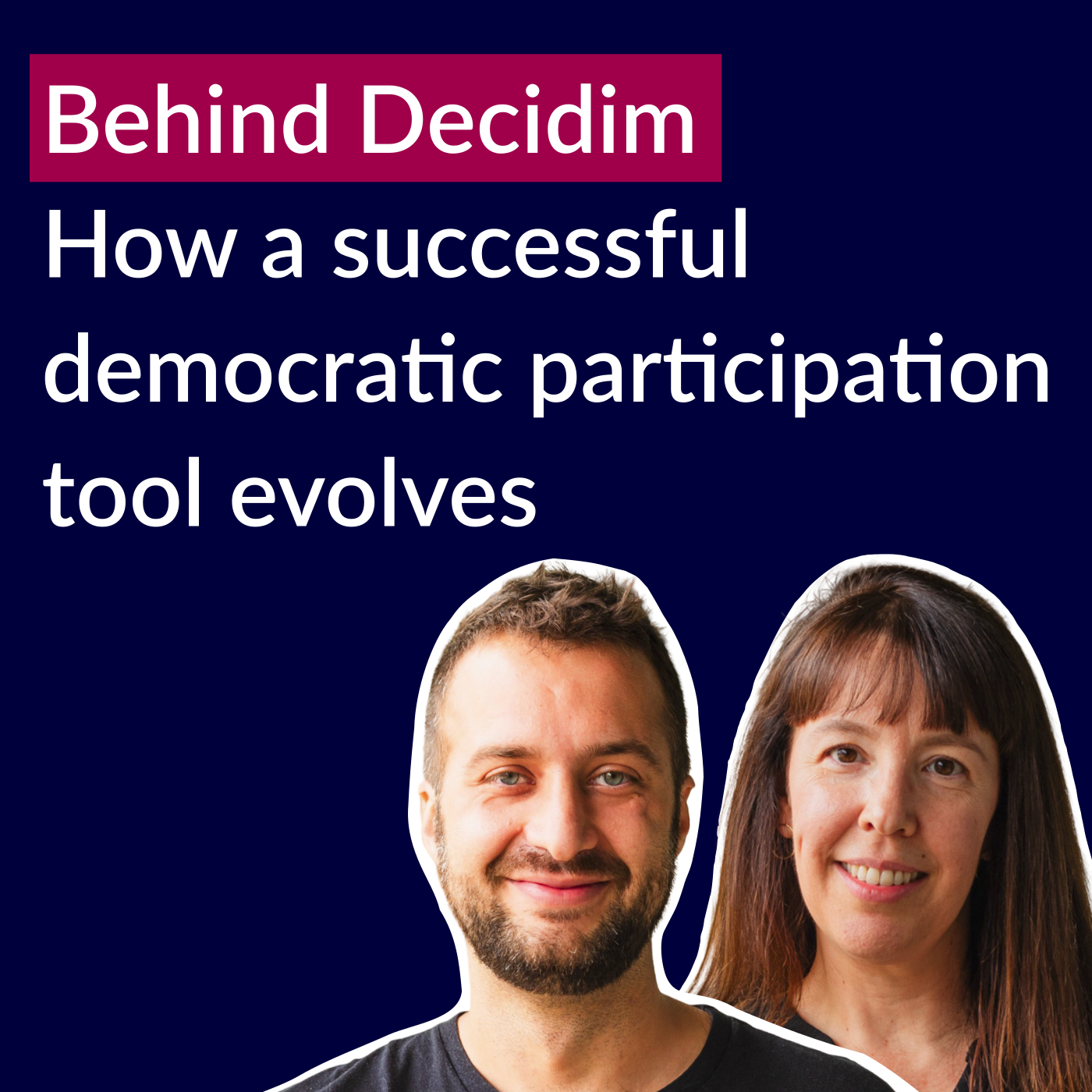
Carol Romero & Andrés Pereira de Lucena about Decidim, and why technology is political
Democracy Innovators | 2025-10-28 | 1:07:49
Carol Romero is CPO and Andrés Pereira de Lucena is CTO of Decidim, a well-known open-source tool for democratic online participation. With several hundred instances actively running and nine years of development behind it, Decidim is a widely used and battle-tested software. Building on this experience, the Decidim team is now working on a more refined and mature release.
If you enjoy our podcast, please consider making a donation. It really helps us to sustain the podcast.
Top Keywords
- platform 0.011
- barcelona 0.010
- community 0.007
- different 0.006
- project 0.006
- mean 0.005
- political 0.005
- andres 0.005
- using 0.005
- working 0.005
- started 0.005
- city 0.004
Transcript
Speaker 0
0:00 – 0:11
Welcome on another episode of Democracy Innovator podcast. And, our guests of today are, Carol and Andres. And, so thank you for your time.
Speaker 1
0:12 – 0:15
Nice to meet you. Thank you for the invite. And
Speaker 0
0:16 – 0:25
you are working on Desir Dim? You also cofounder Desir Dim? How how are you to enter the the story?
Speaker 1
0:27 – 0:27
Okay.
Speaker 2
0:28 – 2:10
Yeah. I'm gonna start with with the story. Yeah. The long the the short story, I will try to summarize it. It's basically, I I was contacted to work with a new city hall, in 2015 on on Barcelona. This was a new political party called, Barcelona and Como. And it came from a protest that happened here in Spain on 2011, the the ending of the fifteen m movements. Much of the party, especially, like, the the founding line, came also from the housing movement. They were activists, at a colau. It's it was a measure at the time at this time. So they wanted to work with the democracy, and they didn't have much idea. So so they called me to to give her give them a hand. And I we actually have started with a fork from console, you know, the the city Madrid platform, because they were just starting out also, and we wanted to contribute with them. But then, like, we after one year or so, we realized that their architecture, didn't allow us actually to grow and do the things that we wanted to do. We also feel that, yeah, they could open up, beat the the community. You know? And in the in the meantime, like, at this moment, we were only working, with Barcelona, but at this time, Carol reach us. She say, yeah. I I work with Carol if you want to join in. Yeah. On my side,
Speaker 1
2:10 – 3:50
I come from working with public administration for almost twenty years, for a local consortium of municipalities in Catalonia that aims mainly to, facilitate the digital transformation of the city councils. And one of the areas was, in fact, citizen participation. We we had actually another digital platform for participation, but this platform ran out of resources, And we were looking actively for other solutions, other projects that we could, reuse for offering to the municipalities in in Catalonia. And that was perfect timing because more or less at the same time, I joined the project at 2016, one year later that the Barcelona team was working on the Barcelona platform. And when we had the first conversation, it just felt like a natural match. I I explained to them that we were looking for another digital platform, that they were building something in with free software, and we might we could collaborate on on that. And, yeah, and and this is when we had the idea, no, having a reusable, platform that could be used by any other city. In in at first, in the in the area of, Barcelona, we didn't anticipate it at all that this could became an international project at that time. But, yeah, this is this is how it started. And we signed an agreement, and we started working on that.
Speaker 0
3:51 – 3:52
And soon
Speaker 2
3:53 – 4:56
okay. Now if you want to add anything else. No. No. One of the main things that we wanted to try, like, at the technical level was all the the modular aspect. No? Like, we wanted to have different models, and this is this isn't something that console allow us, allowed us to do. So, yeah, the idea is that, we provided we and we provide, you know, some some modules, for instance, participatory processes. And inside of these participatory processes, you can have, for instance, proposals or meetings, debates, service, or whatever. And and, yeah, this allows the platform to keeps keep keep growing because people can create another kind of spaces or components. It's, I think, one of one of the main aspects of of the ceiling that allowed us to to grow as as we are now is is to have, like, all this flexibility on the architecture and the technical level. No? That yeah. It's a nice thing to have.
Speaker 0
4:56 – 5:31
Absolutely. And, also, the the model, aspect is very interesting also to me. And, I wanted to ask you because, soon, there will be the the system first. And, but, I mean, the stream exist from, it it's a long time. So years. Mhmm. Yeah. How it was the journey up and down? I don't know if you before maybe talking about the the the SlimFast. You mean the evolution. Right? Yeah. Like, in all those years.
Speaker 1
5:32 – 10:07
And just if you want, I can go. But please don't have to rock me. Yeah. I I I feel like we had, like, different stages of the project. When we started at 2016, 2017, we were, like, really focused on the local community of cities that were starting using the platform, and we started building, really from the very first moment this community. But it was very local, of course. And I would say that there was a turning point around 2000 late two thousand nineteen and definitely 2020 with the COVID pandemic and so on because this was really like I mean, we already saw in 2019 an extension and a growth of the community and and the use of the platform in France, especially, because there was this company that, I think you had here as as guest, open source politics. They were very interested in what we were building, and they jumped, into the, yeah, into the whole philosophy of the project and started implementing the platform around the different city councils in France. But in 2020, it was really like explosion of, organizations in different context and places, other open source communities, like, for example, Code for Japan, Code Ando Mexico, in other places that they were able to install the software and just started using it. And at the same time, we were starting to be more decentralized from Barcelona. Because the story here is that we started as a professional team, linked to the Barcelona city council in different formulas. For example, Andres had a contract. I had an agreement with my consortium. There were people from the university, but we were, like, a a unique team in the in the department of democratic innovation in the city council. But then when we saw that the project was starting to grow internationally, we had this governance process in the community, and we came up to the conclusion that we need to organize formally as a community, mainly because, first, Barcelona couldn't attend the necessities of other context beyond their natural, let's say, administrative limits. And then, you know, that we were subjected to the political context, changing political context, and we weren't sure if for the next elections, the project would continue under the umbrella of the city or not. So in 2019, we created this association, which is the the City Inflict Software Association that is now they're responsible for taking care of the code base and managing the community. And we had this agreement with Barcelona. They seeded us the control of the repositories and everything. But at that time, twenty nineteen, twenty twenty, this association didn't have any person working on on it. It was just like their structure. You know? And at the same time, the the growth, of the the the project exploded in use, and and we started to to get a lot of demands and petitions. And it was kind of a crisis, moment, growth crisis moment. And from there, I think we managed it very I mean, quite well, given the circumstances because we already had this active community also willing to help and to push, for the project, no, for the common project. So I would say that from the last four, five years, we achieved a certain stability. We are still a small team. Maybe some people don't know. I think this is both as a compliment and as a curves for us because everybody thinks that we are, like, a really big team. We are just seven people in the association. But, yeah, we I think we are starting to work more in sync with the whole community and the ecosystem and and still growing. So, yeah, I'll just stop here. I don't know if Andres wants to compliment.
Speaker 2
10:08 – 12:08
Yeah. Just to compliment, one thing that we knew from the beginning, no, was that we wanted to have, like, this community around the project. No? And we we realized that this is, like, really important for being a a resilient project. No? Because, like, if many people are actually using it and also contributing to the same code base, yeah, that would allow us to to keep growing. No? This is something that we I I think, like I don't know which year exactly, probably 2017 or something like that. We well, from the beginning, we created a process inside of the sedin.barcelona, like the installation of Barcelona, where we say, okay. We are going to discuss about meta residency. No? Like like, the whole platform, the seed inside of the seed. Then we realized that, okay, this process, it's really small, and we need something bigger, bigger. So we went with, our own installation of the CDM, that it's, meta CDM. And and that's, like, the government's place for the for the project. Here, we decide, both the governments of the association and, like, for instance, where the elections, for the coordination committee happen, but also it's like the technical governance. Like, for instance, right now, we are in a process of a strategical decision for the product, but we also will have a process for new features of of the project. You know? So so this is, like, one important aspect with, like, the technical, part of the community. No? But there is also, like, the, human part of the community. You know? Because everyone like, we are people, and we have bodies. So, one thing that we we have been doing, it's, a yearly gathering.
Speaker 1
12:09 – 12:09
You know, where,
Speaker 2
12:10 – 12:43
it's always well, have been always on Barcelona, at least for now. And, it's called now the the slim fest. At the beginning, it was called the the jams. No? It was like, yeah, the gathering, most of the year happened on October or November. And it's, like, two or three days, a big conference where where, like, total people come to talk about one day about the and two days about topics around the the project, knowledge, governance, etcetera.
Speaker 0
12:44 – 12:45
Okay. And And
Speaker 2
12:45 – 12:57
this year, it's two two months from now. No? Well, eight or nine one months. No? Okay. Yeah. Yeah. I'm I remember We are already in the summer. Yeah. Yeah. We are. No. Yeah. Don't worry. Crazy.
Speaker 0
12:58 – 13:08
And, and, I can imagine that maybe you will talk about new functionalities, new ideas related to the system.
Speaker 1
13:08 – 13:09
During the first?
Speaker 0
13:10 – 13:18
Yeah. The first, like, in one month. So would you like to share something, or is it like a surprise?
Speaker 1
13:19 – 15:17
Yeah. I mean, we we, changed a little bit the dynamic, in fact, and this is going to be, like, the first year that we apply a fresh internal regulations that we approved in the last general assembly. We decided that we wanted to have, like, more part active participation from the community in the direction in the strategic direction of the roadmap because until now, we had, like, an open space, more as a pool of ideas to improve the software, but we didn't get ready to manage it efficiently because, I mean, there are, like, 800 proposals there. Most of them are in fact implemented, but, you know, the dynamic of having something open without clear, phases, it wasn't really useful. So we decided to open cycles of, prioritization and discussion. Like, everyone everybody puts the focus on thinking about what do we want to prioritize for the next two years. And now we started this project, this this process about the more broad strategic directions. And during the first, the idea is that we'll have a session, about gathering and, agreeing on which are the two or three most strategic directions and then start, proposing improvements aligned with that strategies. So, yeah, it's it's a bit complex because I I think that for the community part, we have discovered. Then it comes the challenge on how we match this with the, you know, the contracts, the projects that we need to win in order to get the resources for, implementing that. But it's part of the, yeah, it's part of the game and having a com an open community participating in in an open source project.
Speaker 0
15:21 – 15:41
And and, I don't know. I wanted to ask, if you have any module that you are developing because, the CDM is modular. And so I'm very curious about this. Also, because now there is AI, and so everything is related to AI. So
Speaker 2
15:43 – 17:12
Yeah. At the moment, I would say, like, the two newest models that are actually, like, we are finished them. No? And we are starting to do pilots and and, like, learning, what improvements will come next are are actually a elections model, no, and the collaborative texts. And, yeah, we we try to be, like, really, how to say, septic about AI, especially because, like well, there are, like, lots of things that we are not so sure about the the current usage of of generative, artificial intelligence. I could say one aspect is, like, all the, yeah, money associated in order to to in you actually using it. And one other aspect that we we see is the the open source. No. Like, we we have a a social contract that, one of the things things that says about it is that everyone should be able to to yeah. The stream should be like a transparent platform, and everyone should be able to actually read the source code, you know, with a with a free software license and so on. And this is something that, most of the LLMs, platforms, don't provide. No? But, Carol, you want to mention about the say something about data models because she's like the
Speaker 1
17:13 – 20:20
yeah. The the head of product. So so she has the best of things to say about it. The question would be which model aren't you building? Because as you know, the same thing has a lot a lot of models. We we we are actually in this process of, I mean, we could consider this platform is already like a mature platform in their functional, aspect. So, our mission now from the association is just like, okay. We had a lot of hypothesis, initial hypothesis eight years ago. This was a platform that was, initially designed for covering the use the use case of a specific city, and everything went there. Like, everything was in the main repository. But now seeing that we have so I'm I'm listening myself with a bit of echo. I'm not sure if you okay. Thank you. So right now, seeing all that needs and different and a variety of organizations using the platform, we think that from the association, we need to really maybe take a few steps back in the sense that build a lighter and more robust framework and core, and at the same time, enable, the fine tuning and even better personalization by other actors in the ecosystem. This is quite challenging because once you get something in a platform, it's not that easy to remove it. So, Andres mentioned elections and collaborative text. We actually have already some of these functionalities, but they are, like, in some cases, half baked. And what we are trying to do is replacing these half baked features with maybe simpler, functionalities and modules that are really useful to anyone. And, yeah, and try to the big goal here right now is, like, trying to release the first long support stable version of the product because we really feel that with all the features that the scene has, yeah, it would be a good moment for releasing the one point zero version and then maybe starting a new cycle of, you know, exploration of new features, experimentation with AI. We don't, oppose AI as a concept, but we are very aware of the hype around it. We see some logical use cases regarding translations, transcriptions, and these kind of things. But, yeah, this doesn't sell like, you know, the same sexy thing that other people do, but, yeah, we prefer to be cautious on that because we already had the blockchain hype, and I'm not comparing. I think they are separate and and different things. But, yeah, we we prefer go to go slow and and take care of things instead of move fast and break things.
Speaker 0
20:22 – 20:58
And I understood the concept. Also, yeah, AI and blockchains maybe, they're not mature enough. I don't know. They they will be probably in the future, and there there will be time to implement them if they are needed. And, I wanted to ask you, like, if there is anything you're struggling at, like, from a technical point of view, from, another kind of point of view. I don't know. There is, like, a source of maybe problem that you're not able to, Mhmm. Don't know. Maybe someone is listening and can have an idea.
Speaker 1
20:59 – 21:01
But I think one
Speaker 2
21:03 – 21:44
one thing that we have at least at the technical level is is like this, how to say, like, the combination of models. You know? Like, we don't we don't know for sure which models would be available in a given installation. And this sometimes generates a problem because we are expecting that someone has, I don't know, the proposals models, but they may not have it. And this this check could generate bugs and so on. But, like, this is one, I think, that we have been struggling for a couple of years. So if anyone has experience on this topic, you you can reach
Speaker 1
21:45 – 22:15
us. No. Yeah. I agree. I agree completely. I mean, because we are just we're now trying to work with a even bigger level of abstraction just because of that that I mentioned before that we need to step back a little bit and let others to finish the product itself. And it's, sometimes, yeah, quite challenging to, yeah, to anticipate all the possible, users now of the of the base layer.
Speaker 2
22:17 – 24:11
Yeah. The other like, we have lots of problem, I think, that we are still working on. No? Like, for instance, not the documentation. Okay. Like, we have, like, a big product that it's always evolving, and and this means that the documentation is always lacking, you know, like, one or two versions ago. And it's, like, an effort, you know, to to actually have, like, general the screenshots updated and so on. And and related to documentation, I need something that we would want to work, but we know we want to work, but, yeah, we don't have, like, infinite resources. It's it's the problem of the of the white page. No? Like, okay. The, it's, we we we allow administrators to configure a lot what they want to do. But by default, like, you have an empty platform. You know? Like, you need to create and think about, you know, which kind of spaces you want to have, if you want to have processes or assemblies, like, if you want to have a proposals, which configuration for the proposals, you know, if you want but participants can create proposals, how many proposals, they can vote it in this step or a a new step, our new phase, you know, and and things like that that yeah. At least now we don't have it solved or at least, like, the solution that we have, it's not optimal because, like, yeah, you can read the documentation or play with the platform, and it's it's like an effort, not for for actually, using it. Yeah. Of course, we have, like, all these, companies in the ecosystem, you know, that, can give you a hand explaining all this stuff and how to configure it and giving you examples, but, yeah, it's an effort.
Speaker 0
24:15 – 24:41
And regarding the models and maybe, examples of how they they have been used or, like, example of, I'm also hearing from Mako. I don't know why. So how was the Desitin platform used around the world if if there is something that was particularly significant to you?
Speaker 2
24:44 – 26:23
Yeah. The the name name dropping moment. Okay. Basically, our biggest installation, I I say I think it's, Brazil. It's like the platform for the whole country of Brazil. I think they have maybe 1.5 or probably 2,000,000, participants registered. Like, they they started doing some strategic planning processes, but at the moment, they have, like, lots of processes. Another big installation is New York City where where they have all the aviation phase of, like, the participatory budgeting that they they do. And, yeah, other big installation where, of course, European Commission is using the CDN for the participatory citizen platform. And we also have the French government, both the the the assembly, you have to say the deputy chamber and also the senate is using the ceiling for their initiatives. So, yeah, you can use it for, like, participatory budgeting, but also strategic planning processes and initiatives that are, like, petitions. No? You know? Like, someone proposed something, and then you gather signatures. And, yeah, this is, like, probably the three biggest use cases, and, like, more mature models. No? Yeah. I don't know, Carlo, if you have many more name dropping to do.
Speaker 1
26:24 – 27:25
Like, the weirdest, name dropping in the sense of surprising use cases. I like to recall this, use case from the Lutheran church. I don't remember if it was it was somewhere in Germany, maybe Hamburg or but, yeah, it was a church that they were using the platform for discussing, like, their, you know, their their community and their, I don't really know exactly, but I guess, religious matters. And, yeah, I mean, sometimes you learn about some instance because we routinely scan the Internet just to find or maybe someone write to us and, hey. I'm in Colombia in some indigenous community, and we are putting this, for the indigenous congress in Colombia or something like that. No? So we really expect any any use case or yeah. Yeah. I think
Speaker 2
27:26 – 28:33
Yeah. Like, they did other use cases that we have seen is, like, for instance, universities, political parties. Like, here here on Barcelona, there there is also an agreement with lots of of of organizations like cooperatives, associations, like neighborhood associations, something like that that that they are also using the the platform. For instance, when when, like, we're we're, stuff, not that we are, like, seeing is, the how do you say, the Barcelona Federation of Neighborhood Association, like, a a big name. They they they were using the for actually tracking down, like, the restaurants that were using, you know, like, the terraces, like like, having tables outside, and and they were actually, using more space that they should be using. So so, like, they were, like, yeah, using the system for tracking and, like, denouncing, you know, this kind of usage of the public space. No?
Speaker 0
28:36 – 29:30
I I was thinking that, community is a community. So if it is a political community, religious community, or, like, a neighborhood, they still are a community made of humans. So as you said before, bodies. And, I was curious if you if you saw any difference in how because maybe, I don't know, political party use, the platform in a different way or, like, compare, like, from Beirut or if there were some differences in, related to the different countries. I don't know. Like, some countries, maybe they were you mentioned that I know that France has a lot of, is using a lot of testing, and I wonder, like, the other countries in Europe or in the world. You mentioned Brazil before, but if you want to
Speaker 1
29:32 – 30:51
I mean, for sure, every context tries to adapt the platform for their cultural codes and the ways of understanding how democracy, works there because there are nuances and and differences. But something that, has always been surprising to us is that, for example, the name. A lot of, instances keep the name, like, the, which is a Catalan name that means with the site. And the fact no. The the the to see, for example, in Japan, something called the is something, like, shocking in a way. We know, for example, in Japan that they were struggling at the beginning with some of the concepts in the platform like assemblies. They really didn't get the the idea because they don't understand maybe the assemblies is the same way we do. But I would say in general, everybody just, like, embraced the the architecture and the principles and the way we, thought about deploying participatory democracy in the digital layer. I would say so. This is my feeling, but I don't know, Andreas, if you have another
Speaker 2
30:51 – 33:17
idea. Yeah. Yeah. Yeah. I would I would, like to also point out one one of the problems that we still didn't solve, but it's actually, like, a a a huge problem, is about the name of things. Like, for instance, like, here we say participatory processes because on catalog, no, it's a process participative. Like, it's a concept of, you have, like, one big space with different phases and and each of these phases, for instance, you have, like, an information phase and then, like, a proposal phase and then a prioritization phase and finally, like, a results or whatever. No? But other countries or other places, they they this same thing, they say it's a consultation. Oh, like or or maybe, I don't know, the proposals. No? This is like a big building block of of the city. Some places, they want to say that there are proposals. They are maybe ideas or suggestions. You know? Like, the like, the name of the thing that you are talking about, it's different. And okay. Yeah. We have a model for for this, that it was made for from the people of of of Finland. No? And, how how do you say it? The term customizer model, and it's like a big model. Lots of people are using it, but it's not optimal because, like, yeah, there are, like, lots of places where this proposal concept is used. And then, like, you need to translate and maintain all these whole translations. And especially if it's in different languages, it's like, an effort also to to to do this. And this is something that it's a recurrent idea that the community has known. Okay. How can we solve this issue? And, like, at least for the moment, I I think that it's not a a software issue. It's like a linguistic problem because I don't know, like, you know, like, languages are, like, really difficult, and I would need, like, some linguistic, yeah, academic, you know, only thinking about this and, like, making a a proposal on how this can work on, like, the different languages.
Speaker 0
33:18 – 33:25
And, I can imagine that, different, linguistic expert, they will also call things in different ways.
Speaker 2
33:26 – 33:28
Yeah. Yeah. Yeah. You have, like, the meta problem.
Speaker 0
33:31 – 33:58
Yeah. Exactly. I think that, in some way, maybe this is one of the reason why we need to actually govern ourself because we say something, but we all mean different things. And we have to sit down at the table to really understand what you mean when you use it, that word or what are you when I use it. And, and, yeah, I don't know, Carol, if you have anything to add. Otherwise, I have a a another question.
Speaker 1
33:59 – 35:12
I was just going to mention because, Andres was mentioning the thing of the languages that we even had this discussion more from the gender perspective, in in the platform, because we we try to keep, you know, the feminist approach to building software. And we had this, lab webinar where we invited, different feminist collectives to analyze the platform from this feminist point of view, and they already saw, like, for example, the use of language was really very biased. So we tried to compensate. And at least in Catalan and Spanish, we are using the feminine plural as a generic plural, but this also sparked some discussions across other languages that noticed that, and they were having also questions, you know, about the use of inclusive language. So, yeah, I'd say the name the the the way we name things, it's goes beyond what you expect maybe in the beginning. No? It's a complex it's a complex topic.
Speaker 0
35:14 – 36:03
Wonderful, the, the approach you had about, inviting feminist collective. Because, I mean, most of the people inside the civic tech or that are working with technology are mainly men. And, and I think that if we I mean, now the CDM is a platform, and, now also there are other platform. And I don't know, like, in twenty years which platform there will be, like, which models, with AI blockchain or I don't know. But I think that in some way, we are building a sort of new world, and it has to be built by all of the people, like, not just, half of them.
Speaker 1
36:04 – 37:21
Yeah. And now that you say this, we also, had this conclusion from this lab about also the who is contributing to the code, for example, from the technical level. No? And we realized that, of course, most of them, there were men, and we, in fact, had, like, four editions of grants for trying to promote, the active participation of female or, you know, non binary people contributing to the code. And some of them, in fact I mean, it was a program like twelve weeks, I think, and it was a paid grant so they could dedicate really time. And they had this, mentor time with some senior developer from the project so they could learn, how the CDN worked at the at the technical level. And some of them, a few of them later worked for the companies that are providing services, on top of the CDIM. No? So it's something that you really need to be proactive and, yeah, to facilitate. Unfortunately, we didn't have more, funding for that, but this is something that we would like to continue doing.
Speaker 2
37:23 – 38:38
And also about the feminist aspect, one thing that we didn't do well at the beginning was we regarding the speakers of the the slim fest. No? We we well, people started to mention. No. Okay. Yeah. We had this big issue where, most of the speakers are actually, like, men. And so so I think that maybe five or six years ago now, we started to do, like, this, how to say, active effort on on, like, saying, yeah, one part of the speakers should be a woman or non binary. No? And and this is something that yeah. You you need to do, you need you need to do, like, the effort and, like, make lists and talk to people and say, okay. We who can came who can come here and talk to us and be interesting? And there are, like, lots of people, but it's the, like, the easiest thing, especially on on software and development, but also in open source. No. Open source has a really big, gender gap. It's something that you need to to think about it and and search for strategies.
Speaker 0
38:40 – 39:44
Yeah. Unfortunately, both politics and technology have, more or less the same gender gap. And, also, when we started the podcast, the idea was, like, we want to make it, balanced. But, I have to admit that, we we failed. I mean, we we can, we can improve from this point of view. But, yeah, the original idea was to make it balanced, but, maybe more proactive pro proactiveness could be could be something to do. And, I, yeah, I wanted to ask you now because we are, talking about this gender. And, if you notice any maybe difference regarding contribution from different genders.
Speaker 1
39:49 – 39:50
Yeah. That's a good question.
Speaker 2
39:51 – 41:48
That's a a good one. A good one. I would say, for instance, once we are subject with, when one thing that they mentioned, when one of the of the woman know that we're participating was that, we we should have, like, some kind of space, where people could discuss and talk about it and be a a a bit more informal. No? And, yeah, that's no. Like, for instance, our main, channels, no, like, on the meta community was about the, especially the, yeah, Meta Residim and GitHub. No? But they they are, like, really cold places, not to actually talk with people. So with that idea in mind, though, how how can we improve new commerce, new people to, yeah, to to reach to us and have, like, a closer connection. We we started with, element chat, you know, at matrix.org. It's like on a Slack, but, free software. And we also this year, we started to have the monthly developers and implementers, community talks, you know, with, like, a monthly gathering that it's usually the last Thursday of the month where everyone can, join in and, like, make questions and, like, know about what we are working on this last month and the next month and so on. So it's like opening this kind of spaces. And this is something that came from this experience. No? Code wise and feature wise, I I would say it's it's the same. You know? Like, the the code, this is I I couldn't find any difference. I know Carlo.
Speaker 1
41:48 – 43:05
Well, talking as a woman, as a woman, interacting with other developers. And and given that I am not a developer myself, although I am the product owner of the project, I can assure you that I think this is something that as you mentioned, before, Sandro, this is widespread, not only regarding technology, but we are quite unsure in general, in public participating in public spaces. We check everything two or three times just to make sure that we are correct, that we are not making any mistakes. I'm not that sure if everybody, from other genders do the same. But, yeah, I would say that, luckily, I have this feeling we should check with the whole community. I have the feeling that we have a quite welcoming community, and we don't have, you know, like, aggressive we had some, really isolated cases, I would say. But in general, we have a although it's quite masculine dominated still, but they are quite welcoming. And, yeah, I I I wouldn't know what example to tell you in terms of references in contributions that aspect.
Speaker 0
43:08 – 44:28
K. I yeah. Because many times, I wonder, like, because I I saw that, in computer science, there were mainly, males. So I wonder, like, when there will be also women, because, I think I thought that I think computer science is is interesting. But at the same time, I also recognize that the way you teach something, it change a lot to the subject. So I thought, okay. When there will be, I don't know, women that can teach computer science, then, probably it will change completely. And so I was very curious about, about this because in some way, maybe this is happening now or in the next, few years. And, and and then I also had a question before about, if you had any relationship with, politicians. You you mentioned some political parties that are using the platform. And so I was wondering, like, what was their preparation regarding, the platform? What was their goal?
Speaker 2
44:33 – 47:05
Okay. This is for me. No? Well, at at least from the beginning, no, we're we're like, the main idea was having this huge strategic planning, you know, on or about the they they here on Barcelona, they had this, project that they need to do that it's called the PAM, you know, the municipal action plan, and it's something that happened for the next four years, you know, at the beginning of the tunnel. And and then, like, you discuss all the things that the government want to do. And then, like, this strategic plan, it's, yeah, it's done by the government during this, tenure. No? And, one thing that, this new political party, you know, that I was mentioning at the beginning, the Barcelona and Como have done is to, like, gather up all these huge documents or of, I don't know, 200 pages and actually split it in different proposals. So it's much easier to actually discuss. And, like this, I think, were, like, 800 proposals, was, like, the beginning of the first process on the city in Barcelona. And, yeah, this is, like, one thing that I I I guess is something, that lots of politicians know struggle, no, on on, like, actually opening up what's what they think that you want to do so people can discuss it and propose new things. No? And, like, improve it or reject it maybe, you know, this proposal because they say, okay. This idea that you have for changing this square is actually bad because we are not, aligned with this. You know? And and I I I think this is something that politicians, sometimes struggle and have fears, you know, about, you know, actually opening up the the governance or or or some part of the governance, to the people. No? Or or, like, on on participatory budgeting. No. They they say, okay. Yeah. We will, do participatory budgeting, but only, I don't know, maybe 2% of the, you know, whole budget of the city and things like that. No? Yeah. Karen, go ahead.
Speaker 1
47:05 – 49:14
No. I was thinking more on the use case of the political parties. I don't know if you were also thinking about this, Alessandro, with your question because we were, hesitant maybe at the beginning about advertising, you know, the use of the from different political parties that they are in in general. But there is, actually, like, a very specific use case for them, no, regarding, like, making these votings and elections and this kind of thing. So we've seen an increase, I would say, of different parties using the platform for that. And at the political level yeah. I mean, we we had these discussions on the community about where to draw the line in our relationship with different political or governments that we don't necessarily agree with. So, yeah, it's been, like, a very interesting topic that from time to time emerges in the community. We had this example from Chile from the in 2019, if I recall correctly, that people were in the streets, in Chile, like, reclaiming, I mean, denouncing the brutality of the police and so on. And we had this approach from the CBM government to implement the platform and trying to we had that, feeling that they wanted to whitewash a little bit the the participation and so on. So we had this open debate, and we came to this conclusion about we are, of course, a free software project, and the license states very clearly that you can do whatever you want with the code. But we are also political community, and we have positions political positions regarding the democratic or undemocratic practices of certain governments. No? And I think it's also important to to maintain this aspect of the this dimension of the project.
Speaker 0
49:18 – 50:44
Yeah. I I can imagine that is hard to maintain, to be in some way neutral, but in some way also having principles and political ideas. And, yeah. Yeah. I can understand because, here on on the podcast, sometimes, it's, there are technical solution that I like, some that I don't really like. But I think, like, on my side, when we talk about technology, I said that in some way, we are building a new world, but, also, we don't know which world will be created. And, so we have to know the good project, but also projects that, I I don't know. From my point of view, maybe are contributing less to this new world. Like, I'm thinking about the difference that there is between, let's say, civic tech and gov tech. That sometimes is not very visible, but sometimes it is. And, but I think that is interesting both to understand what is happening in the world, and so then we can decide what to change. And no. No.
Speaker 1
50:46 – 51:48
No. Just because you say this, we were, talking with Andres before the the podcast that we also have this feeling, you know, that, very often in the civic tech I mean, you I I know you make the difference between GovTech and Civic tech apart. But even in Civic tech, I have the feeling that most of the time, the conversation, the discussion is so focused on discussing features and not what political implications those features have. Because, I mean no. It's like okay. Civic tech is more focused on tech than in the civic part. And I think we need to make an effort to remember that we are not just doing a technical platform that that do that does things that but it's really designed, with democratic implications in mind. And, yeah, it adds complexity, but I think it's worth to to have it always as a, yeah, as a direction.
Speaker 0
51:51 – 52:09
Yeah. I totally agree about, the political aspect, and that sometimes it's, sometimes people are too much into just about technology. And, yeah, I totally understand this.
Speaker 2
52:09 – 53:13
Yes. This is something that that I I I think that, yes, as as software developers know, sometimes people ask questions like saying, okay. Yeah. But, like, what they are actually asking about, it's like, okay. If I install the, like, everything, it's going to you know, like, the as a solution. You know? Like, the it's going to solve all your democracy problems, and that's not going to happen. You know? Like, the is a tool. And you can make a democratic process and citizen participation which with with any tool. You know? Like, the important thing on democracy is not the tool or the technology. It's the people. You know? And, like, what normative and what, yeah, process you built around, like, these tools. You know? And and the tool will allow you to, yeah, improve what people want to do, but it's always the the important thing. It's the the people. The the tool, it's it's a secondary thing. You know?
Speaker 0
53:14 – 53:43
Yep. Absolutely. And, also, I realized that, about the people. I mean, we always talked to release, about the tool and not about the people. So, I mean, Carol, you mentioned something about you were what you were doing before, joining the team. Like, but, what is your background like? Also personal background, not just, professional.
Speaker 1
53:45 – 55:46
My personal background. I mean, yeah, I would say that in fact, I start sorry that I come back to the professional thing. Maybe the the personnel will arise. I started working with maps. Actually, my first my very first job was digitalizing cartography. So I've been always in the digital realm, we could say. Yeah. And then but I've been always interested, of course, in social, topics. I studied social education as a, you know, as a main study university university studies. So I've been always interested in this kind of social struggles and yeah. And with an interest with, social justice issues and and so on. But professionally, my career evolved more towards working in public administrations, always with digital process, as I said, first with maps and then with citizen participation. And to me, when I discover, the city and the team behind it, again, the people behind it, to me, it was, like, kind of a dream, really, because it had this activist component that I couldn't find in the public administration context. And at the same time, it had this, you know, the digital innovation, the hackers, the the the the yeah. You know what I mean? No? Like, this kind of hungry, hunger for, change things really from inside the institution. So, yeah, to me, this was really really like an epiphany moment, we could say. And, yeah, I would say that's it. From the last eight years, I've been devoted to the project, and I hope, many years to come.
Speaker 0
55:51 – 55:52
And you, Andres?
Speaker 2
55:57 – 57:55
Okay. Yeah. My my my background, my my history personal history. Okay. Let's say I'm I'm I'm actually I didn't go to university. I'm a self thought software developer. I I would say first, I started working with with computers, and then, yeah, I realized that I didn't like all the big companies on the industry. So I went to the Linux way, you know, with the free software and so on. In the meantime, I started getting involved with social activists with central social social centers movement like a squatter houses on on Madrid. And there, I joined and started a a hack lab. And with the people from the hack lab, we created an association to actually work with, all these, free software, citizen participation, and so on, on twenty ten, twenty eleven. In the meantime, all the protests, that I was talking about, the indignados, and we were starting with the association. And I was thinking about, yeah, we are going to go broke because, like, if we are on the squares and we are not actually working, you know, like, finding clients and so on, it's going to be hard. But, yeah, we managed to to get by. And, yeah, afterwards, we we started working with the with the political parties. And then when they joined the governments, they asked, yeah, we want to do what we were doing with the political party with opening the participation and making people to to actually have a voice, for for the governments. And, yeah, that's how it went. And and now I'm working with the with the decision association. So yeah.
Speaker 0
57:58 – 58:26
Wonderful. And, I I have, a question that I wanted to ask before, but it's it's more about it's it's more, about a future. And so we we just said that the futures are not all. But I wanted to ask, like, if there is, like, some sort of federation system between the different Destiny instances.
Speaker 1
58:28 – 58:30
We have it in our book.
Speaker 0
58:30 – 58:32
This is something we have it
Speaker 1
58:32 – 59:34
in the book. And, yeah, yeah, it's an idea that it's been around for a lot of time. We we keep thinking how how to do it. I think it yeah. It's like, natural thing, no, to have this kind of federation, the CDM instances. Maybe we need, as usual, the specific use case that let us just, like, start working on the specific details on how this federation works. We we already have some ideas on how to federate, for example, the the governments in the here in Catalonia, no, that are using the the instances. And it's in the road map. I wouldn't say, like, in the immediate road map because as I said, I would say that the the primary goal is to stabilize and so on. But, yeah, for sure, this would be something really cool to to have on the CV.
Speaker 2
59:35 – 62:26
I think there were there was a project from open source politics, that they they wanted to do some kind of pilot, around the, how to say, municipal entity because they have, like, this government that it's not only, like, on the city of, but also, like, all the, cities, you know, and towns that are around the the actual city, like a super municipal government, we would say, on on. This is, like, the only use cases that we could come up, but, I could I could say it, like, one thing that we need before actually doing, like, this whole federation, it's, well, something that we are actually working on now that it's all these, features of, the right API. No. Like, right now, we have an API, well, from since day one, actually, that it's, GraphQL API that allows, like, external developers to connect to any instance of the that has this enabled and actually, like, yeah, gather this data from the platform that it's already public data. No? So our main idea here is to actually lower in, the barrier of entry so any any developer, can access the information weekly because, like, we believe in open data, on openness, transparency, and so on. And, something that we didn't have, but, we are working, like, right now is to actually, allowing also to external developers, to to create resources inside of the platform using this API. No? The idea is to, yeah, make the platform, more easy to work with with different tools. And one use case one use case that we have, of course, it's chatbots. No? Think about it. No? I'm having, I don't know, maybe a a Telegram or a WhatsApp or a signal bot where where people can, talk with with a platform and say, oh, yeah. This is a nice idea. I want to comment on it, or or I want to create a new proposal, and everything is or most of the interaction will happen through the the mobile phone. No? So I think this is, like, one thing about the future. No? That's thinking about the platform as as okay. This is like a central place where things are happening, but all these different, tools, can connect connect to the platform and and actually, like, use the data and contribute, new things, around it.
Speaker 0
62:28 – 63:06
So thank you for, explanation. I I I was sure that you had the some idea about the federation. I was curious to know the, the actual state. And, as, I mean, the last question will is, if you have any message to the people that are doing what you are also doing, or maybe different, aspect, like, I don't know, people that are working on, civic tech project that are people that are working on participation, people that are working on communities. Any
Speaker 1
63:07 – 64:21
Yeah. I would say that we love to connect. In fact, in each testing phase, we get to know people from sometimes from other projects, in the area from the civic tech field. Or if we go to conferences, we get to meet those people, and we are we are always keen to, you know, to talk about these issues that worry as, as a as a community of people working on that. And I would say that the collaboration part is central for us, and and the openness and the and sharing everything. So, yeah, I would maybe say this. And and, yeah, and just highlighting the the political aspect because, you know, the g the the current geopolitical context, I think it brings an alarm for all the civic tech community just to maybe I don't know if we need to take a stand of building anti fascist technology or something like that to being a bit, for being a bit provocative. But, yeah, I think there are a lot of stakes right now, and we should collaborate more than ever.
Speaker 0
64:25 – 64:28
Absolutely. And,
Speaker 1
64:29 – 65:19
please understand. Just Okay. Sorry. Because I I don't want to forget that, for taking the opportunity that let everybody know that we are going to have the open tech week in Barcelona. So this year, the swim fest won't be alone. We are partnering with Motilla. Motilla is having its most fest, in the same week. So we took the opportunity together, and we are calling, in fact, all the open source communities, the techno political communities to to meet in Barcelona and having this moment of thinking together. So, yeah, I think it's, it it's nice if anyone that listens to this, this is going to happen between November 3 until November 9, so everybody might.
Speaker 0
65:23 – 65:30
That would be would be nice also to participate. And, do you have any message address?
Speaker 2
65:31 – 67:20
Yeah. Yeah. I I would say that, yeah, to to people to actually try to gather with more people to work on the same problem. Because if you are only one person, it's, like, really difficult to to actually achieve, something big. But if you have, like, different people that can work with the different aspects of the same problem, yeah, that will that will allow you to to actually, think about the problem on a, like, transversal way. You know? And and taking into account things that you couldn't imagine because you are only one person with one experience and, like, multiple people can, yeah, have, much, better ideas. No. With all the, yeah, big brain of different people. And another thing that I say that, yeah, worked for us is is to actually be ambitious. No? Like, at the beginning, like, we we save sync things like, yeah, we're going to be, like, the WordPress for for democracy. You know? That this was, like, a main meme that we had, on the on the team at the beginning, and I think that, yeah, this allowed us to have, like, the mindset of, yeah, we are going to to be big, and we are not going to be like a a a small project here in Catalonia and so on. And with this thought in mind, yeah, all these different decisions that you need to make along the way, are much easier because you always are thinking, okay. How can we keep growing? How can we, yeah, make the big community bigger? How can we, make the software more, resilient and things like that. No?
Speaker 1
67:21 – 67:22
Yeah.
Speaker 0
67:23 – 67:38
So to use, I mean, the collective intelligence and also collective energy to Exactly. To make it happen in some way. So thank you a lot. If you have any other question or
Speaker 1
67:40 – 67:43
no. It's been a pleasure. It's been a pleasure to talk to you.
Speaker 0
67:43 – 67:45
Also for me, thank you. Thank you again.
Speaker 2
67:46 – 67:47
See you, Alessandro.