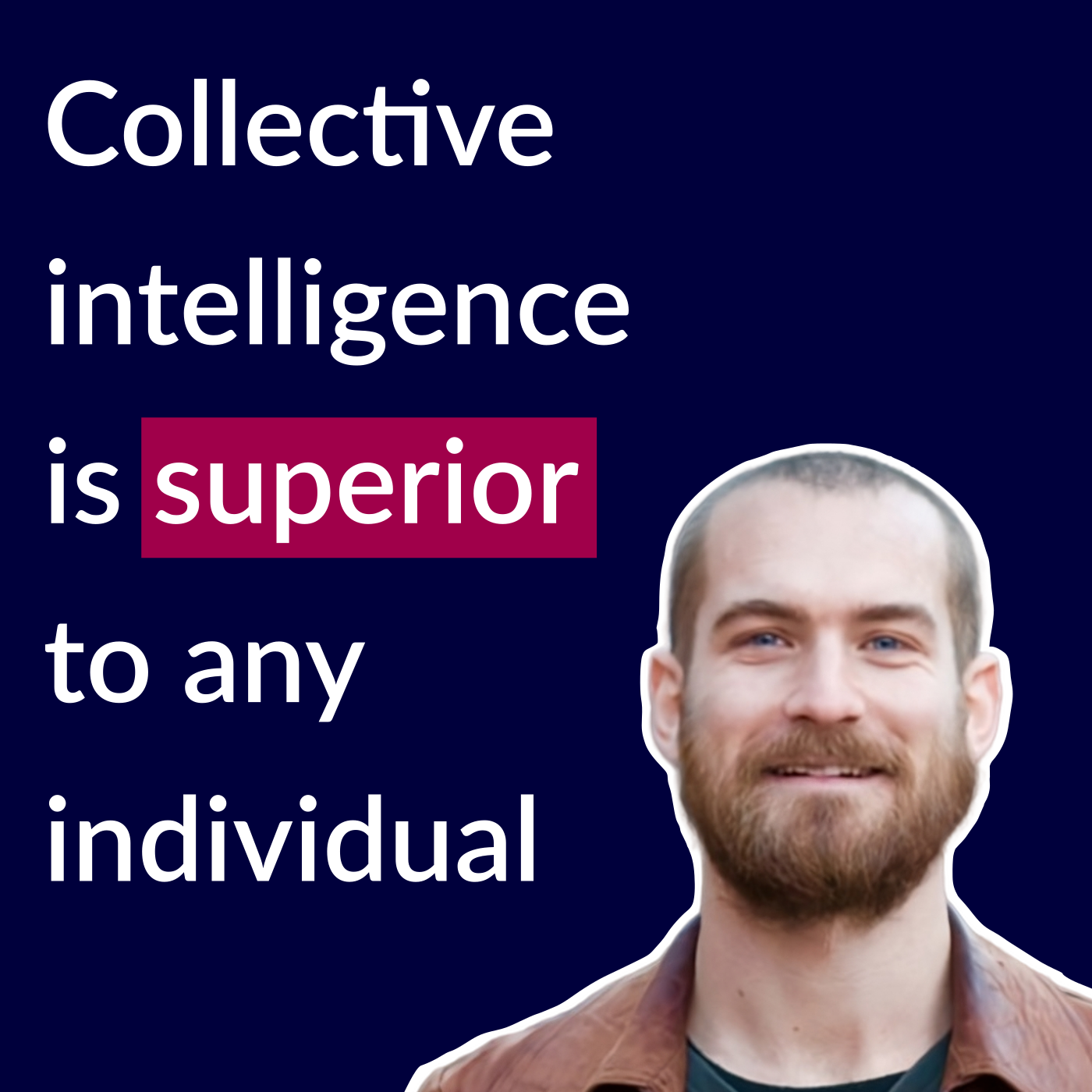
Richard Bartlett about Loomio and how horizontal decision-making is different from society's habits
Democracy Innovators | 2025-09-24 | 49:58
Richard Bartlett is the co-founder of Loomio, a collaborative decision-making tool for communities and organizations. He started his career as an engineer, but the financial crisis caused him to change direction. He joined Occupy Wall Street and eventually founded Loomio in 2012. With over 13 years experience in digitally assisted consensus decision-making, he has valuable insights to share.
If you enjoy our podcast, please consider making a donation. It really helps us to sustain the podcast.
Top Keywords
- scale 0.006
- mean 0.006
- different 0.005
- consensus 0.005
- hierarchy 0.005
- good 0.005
- confused 0.005
- social 0.004
- large scale 0.004
- organize 0.004
- much 0.004
- occupy 0.004
Transcript
Speaker 0
0:00 – 0:08
Welcome on another episode of democracy innovator podcast, and our guest of today is Richard Bartlett. So thank you for your time, Richard.
Speaker 1
0:09 – 0:12
Yeah. It's good to be here. Happy to talk about this important topic.
Speaker 0
0:13 – 0:39
And, so as I told you, I'm very interested by governance technology politics. And, I saw that you cofounded Lumio. Mhmm. And so as a first question, I'd like to ask you, I don't know, like, a short story about Lumio and, how it happened that it became a platform.
Speaker 1
0:40 – 7:35
Yeah. So I think it's very important to understand the political context that it comes from. You know, I I graduated in 2008 with an engineering degree, and I got my first engineering job. And then there was a financial crisis, and then I immediately lost my job, and I was unemployed. And that was, like, my, the start of my career immediately. We got kind of interrupted. And so I was quite lost and confused for some years. And then in 02/2011, we had the Occupy Wall Street movement get started, in The US, and it spread all over the world and linked up with some of the other pro democracy movements that were happening, like, the fifteen m in Spain and, other things going on around the world. You know, 2011 was this moment of effervescence or excitement or, like, fresh energy around democratic innovation. And, yeah, that transition from, like, I'm unemployed and lost to, oh, that's because of systemic reasons. The the economic the economic systems we're living in are not really designed for the well-being of all people. The people in government are not necessarily competent to create a thriving society or to look after the environment or, yeah, to make a good environment for people. The the social movement kind of was an outlet for my feeling of being ripped off, my indignation, you know, of like, hey. I've just put all this energy into growing up and getting educated and becoming a a useful member of society, and there's nothing here for me. And occupy was really my first introduction to activism and and and, like, taking politics seriously. Before that, I hadn't paid very much attention, but but I was just captivated by the the organizing model, I guess. Like, I had some experience with open source software, and open source hardware, building electronic devices. And, you know, I I was one of these kids who was online from a very young age and found most of my friends online. And I really like the the organizing spirit of the Internet, this thing of transparency, of participation, of, you know, like, in in open source culture, you can fork. Like, you you're working on one project, and then you don't like how it's going. So you can just kind of split off and do your own thing and take it with you. That that kind of freedom I found very inspiring. And then at Occupy, it seemed like one of the reasons I was drawn to occupy, it felt like, it was a face to face in person group that was organizing on digital principles somehow. And that the the way that all of these you know, there was, like, I think, multiples, like, 3,000 occupied camps in different parts of the world, I think. And that there was no central coordinating organization. There's no, like, hierarchy saying, you know, we should have a camp in San Francisco and one in Wellington in in New Zealand, where from. That it was more like a protocol and that anyone who was willing to, like, subscribe to that protocol could participate. And it was just, like, popping up everywhere. I found that extremely inspiring at the global scale. But then at the local scale, things being organized by consensus and, you know, in quite a strong contrast to my engineering career, which was all about expertise and being correct and finding the smartest person in the room to make the decisions. At occupy, it was more, yeah, a different attitude towards people, like, an attitude that everyone has got an important perspective to contribute. And when when we have a good social process, we can take all of these different perspectives and use them to build consensus, and that consensus can be like, the collective intelligence can be superior to any individual. That was also very compelling to me. Like, I I had never really thought about these issues very much. But when I got to participate in it, it was really mind blowing. You know? It was really mind blowing to to to see, like, a good idea can come from anywhere. You might be like an eight year old kid, and still you might have a a suggestion or a proposal for the group that everyone agrees that, oh, this is brilliant. This is such a good idea. We should do that. You don't have to be qualified or you don't have to have some kind of special status. So I was extremely inspired by just being exposed to collective decision making. And and and and a weird kind of irony, it's like, at the local at the local level is very strong consensus, and at the global level, it's very decentralized, really chaotic. So it's kind of both of those are, like, radical ways of organizing and kind of at opposite ends of the spectrum in some in some sense. I found both of those things really inspiring and gave me the impression of, like, oh, all of the all of the aspects. You know, the things that I'm scared about for the future around, economics and justice and environment, those are all coordination problems. They all stem from bad governance. And I, for the first time, had some hope that, like, oh, it's possible to innovate our governance systems that we can we can find new ways of organizing together. We can, use different systems for making decisions and therefore make better decisions. And the inspiration for Lumio was like, maybe we can make a decision making protocol that is that generates high quality decisions and then use that and apply it to itself and get a, you know, like, a kind of singularity or kind of feedback loop of self improving systems. I was very inspired by that concept. And so my friends, from Occupy, as the movement was kind of, you know, losing momentum, we just got started with this idea of, like, okay. Can we make a software that kind of replicates something about the occupy experience? And we were really thinking, in this moment in history, there's a lot of people there's a lot of demand. There's a lot of people that want to do assemblies and inclusive collective decision making. And all we're gonna do is provide a software that makes it easier to do that rather than always doing it in a meeting. It's like text based. It's like a forum. And in the discussion forum, you can raise proposals and people can vote. That's kind of the core idea. It's always been that way, and it's this hasn't really deviated from that original mission. And that was actually quite easy. You're like building a tool that supports people that wanna organize in that way. What's hard is not that many people wanna organize that way.
Speaker 0
7:37 – 8:19
That's a challenge. Yeah. I can imagine this. I mean, also nowadays now there is also AI. Building a platform can be something that, is doable in a weekend. Then, it's hard to, to find people that would like to organize in a certain way. Maybe because we are not used since, from when we start, from when we are child in school. We are not used to organize in a horizontal way, or to use consensus and, can be quite hard. And so then what happened? Like, because
Speaker 1
8:19 – 10:55
people are using LumiR, I think. People are using LumiR. There's still a small team building LumiR. Like, it still exists. I'm still on the board. Like, there is a small, you know, like, for example, a lot of cooperatives are using Loomio. A lot of labor unions and political parties and the the kinds of organization like membership organizations where the this principle of one person, one vote is really essential to how they organize. That's definitely a significant there's still a lot of there's a lot of people in that group. So we're still serving them. But I think from my perspective as a as an innovator or a founder or an inventor, I was really counting on the social movement from 2011 being the kind of start of a revolution or something rather than a temporary moment where people got a little, you know, a little more open to experimentation for a few months. I thought I thought when we started, I thought, oh, this is the ground swell, and this is a big change coming. And, yes, like you say, people in their school or in their family, they can get exposed to this way of doing things. But now there's this new exposure. There's this new way of doing things, and we're gonna see this transformation. And I miscalculated. Like, I I underestimated how much that kind of culture or social expectations or psychology, how how strong that resistance is to change, and how strong is the conditioning that people have for yeah. Most people grew up in a family with one or two adults and that they have extra authority and they kind of call the shots and they're at the top of the hierarchy. And they go from the family to school, which has the same pattern, and then from the school to a job and sometimes from the job to the state. And and then all of these different social contexts, there's a hierarchical decision making authority that people are so well trained in that way of doing things that, asking people to relate to each other horizontally with without that chain of command, without that, centralized responsibility and authority. I underestimated how radical that concept is and how the cultural side of things is the big bottleneck as far as I'm concerned rather than the technical side of things. I thought because I'm trained as an engineer, I just thought we'll we'll make some really nice technology and that that'll fix that'll make it easy. And once it's easy, then it'll be more popular. And now I don't think I don't think it's so simple. Yeah. It it's probably
Speaker 0
10:56 – 11:31
yeah. I think the problem is cultural. Like, if we wanted to organize in a horizontal way, we probably don't need the technology at all. Like, we could just do it. But then because of society as how it is at the moment. So I think I mean, technology could be could be helpful in some way. Also, because maybe, it's a sort of training for us, and then we understand what to to teach to the next generation.
Speaker 1
11:31 – 13:01
Mhmm. Absolutely. Yeah. Yeah. This is part of the part of the inspiration for me as well is, that I would like I think if we're gonna live in in a democracy, like, there's different depths of democracy. And and most of us, I think, at the moment are living in a kind of reality TV show version of democracy where, like, okay. Someone gets voted off the island at the end of the week. But there's no sense of collective intelligence or deliberation or, that voting in general elections every few years is kind of like a tribe tribal sport. You know? It's like, you do you like the red team, or do you like the green team or the blue team? It it's not really about developing deep understanding of your fellow citizens and building building agreements and and developing empathy and learning the skills of taking other people's perspectives and really considering trade offs between, well, this thing this person thinks the environment is very important, and I think the economy is very important. And we're gonna have to make decisions that balance those trade offs. And, for me, part of the inspiration with Lumeo is just, like, to give people more experience with deliberation and participatory democracy so that they are better equipped when they go to participate in in a national level democracy that they've actually got some experience of these of these dynamics of perspective taking and participation that most of us just don't get much exposure to otherwise. Yeah. Because, as as you said, though or we
Speaker 0
13:02 – 13:47
we are in the school and there is, the hierarchy is quite present or we are working and also there in most of, workplaces. I mean, you have the boss that is telling you what to do. But this is something like, because this is about power. Mhmm. And, you know, there was a professor. There was a seminar. He was a professor of political science, and he was like, we don't know how power work. I mean, there are certain kind of rules that we can, imagine. But then it's not we don't know why I don't know. A lot of people are following just one person.
Speaker 1
13:49 – 16:52
Yeah. This is it's I'm I feel quite confused now. As I get older, I feel quite confused where when we started, you know, that was more than ten years ago. I had that that clarity of vision that young people have. They're these sort of it's very clear. This is what needs to change. We need to get rid of the hierarchy. Things will be better if we are more collaborative and more inclusive. I was very straightforward on that. And now I'm now I'm confused. Like, right now, I'm, my wife, Natty, and I, we've opened this retreat center outside of Barcelona, and we currently have 20 something people 23 people in the house. And they're here for ten days, and they're, like, doing projects and collaborating. And it's very clear that Nati and I are the top of the hierarchy. It's our house. And the group is very harmonious, and people are having a great time. And it's it's being very productive, and it feels good. And I think it's working well partly because of the hierarchy. And the hierarchy is not us telling people what to do or saying giving people roles or delegating authority to them or something. We're not doing any of that. Like, there's a lot of freedom, and people are doing whatever they feel excited to do. But when it comes to, I don't know, what time should the meals be or some basic house rules or like, everyone knows it's our decision. We decide it's our house. We decide. And that, because everyone in the group trusts us, delegate like, once they're delegated to us to make a decision for a temporary time, they're here for ten days. So it's not like it's not like we're controlling their lives, but we are setting some of the constraints on how we're gonna interact as a group. The coordination is extremely efficient, and people are getting along very well. And if there was some kind of conflict, it would be up to us to be the kind of justice system that would help create some shared understanding and negotiation and get to some new agreement. And then and if you contrast that to if we had 23 people in the house and there was no hierarchy and it was purely driven by consensus, we would literally spend half of the day in meetings. And we might build, like, quite an extraordinary degree of bonding if we were doing things by consensus. Like, that's one of the great things about consensus building is that it means that you like, any small thing, like, how should we keep the kitchen tidy? It very quickly draws up people's deepest values. And that's very interesting if you wanna get to know someone to run a consensus process around how should we keep the kitchen tidy. You'll get to know, like, some of their life story and their history and what what values are most important to them. But for coordinating, it's not efficient. And that's to me, now I'm in this dilemma of, like, oh, am I now just, have I sold out? You know? Am I just a little, microfascist that likes my little kingdom and I'm the little emperor?
Speaker 0
16:52 – 17:58
The dictator of the kitchen. Yeah. Yeah. I have to say that I'm also, I also had similar thoughts, regarding how people behave. And and and, also, yeah, I'm very confused. I think that, in some ways, sometimes we, generically speak about hierarchy, but then there are very different kind of hierarchies. Like, I think it's very different, if there is someone that in some way decide for me, like, the time of the lunch, but it's there. And I can also talk to you. Or, like, maybe in a small town, I can also talk to my major because maybe it's the uncle of my friend, and we are just 500 in the town. While in big towns or, like, in a in in a big office where there are multiple level of hierarchy. I think that is something,
Speaker 1
17:59 – 19:10
Yeah. I completely agree. Like, that that the accessibility, the feedback loops so that when you say or if I get multiple people telling me, hey. This lunchtime doesn't work. I'm like, oh, I can take that into consideration. And if people were giving me feedback and I was consistently ignoring them, I would the group wouldn't work anymore. You know? Like like, my role only works because there's an alignment between how I'm behaving and what people want. So there is a kind of sort of informal kind of democracy happening there that that people could very easily withdraw their consent and say, like, you're annoyed. Yeah. It's easy for any one person to sort of rebel or say, but I like what you're doing, which, would have a big impact on that. So so, like, there's strong feedback loops on me to to stay accountable to what people need. And it's temporary. I think the temporary thing is a huge part of why it works. That if if we were living here permanently, I wouldn't want to live under that arrangement where I'm the boss and I get to say it that I I mean, that would feel really strange. Yeah. I would feel yeah. It feels very prehistoric maybe.
Speaker 0
19:12 – 20:06
No. Yeah. I can understand. And, I'm thinking because this is very interesting. Like, there an experience that you had before, like, trying to horizontalize, conversation decisions. And then, with this position of micropower, I will say, but in some way, you can experience, like, in a, ethnographic way, I will say, what happened, in a community that, that changes continually, if I understood correctly. And they in some way, also also Internet has this kind of speed. I mean, you create maybe a Discord group, a Telegram group, or there is a small community, and then,
Speaker 1
20:07 – 21:54
people travel really fast on the Internet. Yeah. And And and that, you know, one of the really important roles that I'm playing here is deciding who's in and who's out, and which for any kind of community, whether that's online or in person, like a Discord, it just takes one person to ruin the Discord if they're, you know, if they come in on their own agenda, which is not related to the the purpose that everyone signed up for. Like, you really need the power to kick people out and say, you're in the wrong group. You don't share our values. You and And it's so much easier easier to do that with a single person who's empowered to do that that's acting on behalf of the group rather than doing that by a consensus process again. And so it's really unlikely that consensus is gonna lead to people getting excluded because this is how groups work. Because that consensus tends to give a lot of space for all of the doubts. And people say, oh, wait a minute. Maybe we should think twice about this. Yeah. There'll be a lot more patience and a lot more tolerance. And so you wind up with a more inclusive group, but with less focus, with less trust, with less enthusiasm and more divergence. And then, well, okay, we were nice and inclusive, but then everyone left the discord because it was not interesting anymore because there's way too much chaos going on or way too much debate or conflict or something. So, yeah, I'm very, very confused about where to draw the line. Like, where do you want to where do you wanna use consensus, or where do you really wanna have a a strong democratic process? And where is it appropriate to have more of a private ownership or delegated or an expertise driven? Or, like, I I would love to develop a stronger framework for understanding
Speaker 0
21:55 – 23:27
at which scales should we should we use which model? Yeah. I I actually don't know. I think there are a lot of people that are asking themselves this question because, I see what you're, what you're saying about a community. Like, because in some in some way, you have to give freedom to everyone also to express ideas that are maybe different from one. They could give fresh ideas. At the same time, you have to keep a sort of, focus. And I I don't have an answer, unfortunately. What I think is that, maybe it's like a sort of technocratic dream. I don't know. That maybe, technology in some way could also help us to do that. Let's say, I don't know, I'm in your community, and I want to do, I don't know, a community or I want to play music, but that is not part of your community. Instead of instead of asking you, can we please play music, play music, play music, maybe like, I can find a community that is similar minded to me. But, like, sometimes it's, sometimes it's, sometimes it's not hard to find what you are searching for. And that's why maybe you insist in the wrong place. I don't know.
Speaker 1
23:27 – 25:28
Mhmm. Mhmm. Yeah. I think a lot of us then get excited about democratic innovation. The idealism can get in the way of the pragmatism, you know, that the ideology Like, you said you did some research into blockchain. I I feel like that's a perfect example where you have, a sort of idealistic understanding about how large scale systems should be different than they currently are. And then that mentality affects your decisions about how how small scale organizing should work. And and some of my work with, you know, like the DAOs, for example, and Web three, they're very ideological about how things should be organized, and they're not at all practical. It's because it's like this commitment to a vision about how things should be different and the inability to distinguish that maybe the way that we wanna organize a government or a currency is quite different from how we wanna organize a team, and that different principles apply at different scales. Like, that's hard to it's hard to keep track of. The freedom as well, the freedom of association, like, knowing that you can go to different places and get different things and that they would have different modes. I think that's really essential on that. It's funny, man. Like, this is so, I feel so stereotypical in a way that the older I get, the more normal and the less radical I get that the vision that I have for a really good life looks like, looks very similar to, like, I don't know, the suburbs where you have all of these little private places with a family in each house, and some good collaboration. There's there's sort of like, I have my little mini dictatorship in my house, but I have very good relationships with my neighbors. And that your house is more musical, and my house is more political, and their house is more into vegetables. And we're collaborating freely across the across the fences, but then we can always retreat to our own private place. What I'm describing is not a radical vision. You know? Like, that's that's, like, kind of a nineteen fifties suburban dream. Yeah. Yeah. I think about
Speaker 0
25:31 – 26:12
this thing about hierarchy and also about the roles because sometimes, I thought, okay. A community that wants to do something, I don't know, to park a car. Maybe one is driving, but that doesn't mean that he's the leader. Mhmm. Because, also, they are the guy that is out of the car, explaining, how to drive. I mean, in some way, he's the boss because he is so I think that, Yeah. Actually, I'm also very confused. I I think there are some studies about hierarchies
Speaker 1
26:13 – 26:14
and different,
Speaker 0
26:15 – 26:15
roles.
Speaker 1
26:17 – 29:23
I mean, you know, like, the with the example of the micro dictatorship in my house, the way that it works is the good feedback loops. And this is something that's very hard to scale, is good feedback. And I and something that's one part of that's one part of the system that I'm actually quite optimistic that technology can make a big contribution that so much debate and division between people emerges from a lack of understanding of the other person's perspective because we're using the same word to mean two different things, or we're using two different words to mean the same thing. That we just have these, like, these local dialects, which all okay. It all sounds like English, but, actually, when you say capitalism and when I say capitalism, we're talking about two completely isolated objects. And one of the things that these new large language models do very accurately is to create a universal translation that identifies concepts separate from language, concepts separate from a specific label. That's that's, like, that's what the math is doing. It's, like, identifying, oh, this is okay. In this cluster, they use this word, and in that cluster, they they mean that word. But it's all mean it's all pointing to the same object. It's the same concept. Like, that, that gives me quite a lot of optimism that we're we we are able to use that kind of technology to take very large amounts of feedback from citizens, that citizens could be having a much stronger role in setting the agenda for what we want our politicians to be talking about at all. And then when an issue comes to the top of the agenda, that citizens can have a lot of input into their perspectives, their views. They're like they're what they think is important and that with the new technology that we can sample a huge amount of information and generate really solid recommendations. Like, I'm quite optimistic for the way that AI can be a scalable kind of participatory democracy mediator, like a facilitator. Like, that could be that could that could it's it's it's imaginable to me that we could have a new political movement. Like I said, we need the we need that culture slip swing, that sort of that wave of narrative change and and and values change, it's quite easy for me to imagine that technology could catalyze that when we say, like, hey. Did you know you know, for example, there's this platform Polis, which I think is one of the more compelling ones for large scale participation. One could imagine that a political party says and people have tried this in the past, but I could imagine them trying to build a case that says, the reason you're gonna vote for us is because we have this very robust digital participation system, and we're not gonna set the agenda. You are. And, anyone from any place can have their say and and shape how we are voting in parliament. Like, I can see that being a compelling story that that gives people some inspiration and some, you know, fresh hope for how things can work in at the at the national scale. And we just have to see if if, yeah, if anyone takes that opportunity.
Speaker 0
29:25 – 30:14
Yeah. Can you hear me? Because I saw some messages regarding my microphone. Yeah. That's fine. I absolutely share, with you the your thoughts about language and also about AI that can mediate, so I don't like yeah. Exactly what you said, that one word has different meanings for me and you. And, but maybe for the AI, the AI can see both of the meaning. And, also, regarding, what you said now, is it maybe, like, finding, designing, I don't know, a good platform that could do that? Because I'm thinking, in Italy, there was the five star movement
Speaker 1
30:14 – 30:14
Mhmm.
Speaker 0
30:15 – 31:08
That, they tried with this platform called Russo, not to have a direct democracy, but was in some way to receive feedback from the citizen from their, from their electors. But, I mean, back then, there was not AI. I mean, not LLM. And so I'm thinking if, maybe, like, building a platform that, like, a really good platform. Because at the end, I'm thinking that, if, a political party in, The UK or in Spain or in France or in Italy I mean, you don't have to build the platform several times. You can just build one and, make it very, very and make it perfect.
Speaker 1
31:11 – 31:43
What, I guess the question with something like the five star movement, do you think because I'm not very familiar with it. Do you think that was, was it a sort of universal sample of different political beliefs, or did it wind up being a kind of segment a segment of the population that, you know, they're all, I don't know, very right wing or very environmentalist or very social justice oriented or like, did it did it sample broadly, or did people cluster around specific opinions?
Speaker 0
31:44 – 32:12
Good question. I mean, I think at the beginning because, it will be very interesting to interview some of the people that were there ten years ago. At the beginning, there were around 100,000 of people registered to the platform, and then they closed the registry. So it was, I would say, left wings in some way than what is left.
Speaker 1
32:15 – 32:16
Different podcast.
Speaker 0
32:17 – 32:42
Exactly. And, I I think I mean, I remember that they were using it not in a very good way, I would say. No. It was not very, bottom up. It was more like, hey. Do you like the color of our logo? You know, that kind of decisions.
Speaker 1
32:45 – 32:46
Yeah.
Speaker 0
32:46 – 32:47
That are
Speaker 1
32:47 – 33:57
our starting point. I'm just thinking about this, like, from a political strategy point of view. Would you want to have a genuine, completely horizontal, bottom up, mass participation that anyone of any set of beliefs can come in and share their view? Or would you want to take a segment of society and say, yeah. Yeah. If you're an environmentalist, come and use this platform, and and we're gonna build strong proposals on this topic. Like, I really don't know, which strategy makes the most sense. These decisions about who's in and who's out, I think, are pretty essential that like, when you say build the perfect platform, it's like, okay. Well, what needs to be in the perfect platform? Do we have to have, geolocation, for example? Do we have to track citizenship? Like, how do you define who gets a vote? Because, obviously, if these things have any power, they're gonna be subject to adversarial conditions where people are gonna try and break them, and they're gonna try and, cheat, obviously. They're not all gonna be so I'm like, should we should we try and design it for everyone to basically replace an entire democratic system, or should we design it for, like, party members that at least have a lot more good faith and a lot more, they're less adversarial with each other.
Speaker 0
33:59 – 34:14
Good question. I don't know. I I I think, it's, I mean, these years will be years of, experimentation.
Speaker 1
34:15 – 34:15
Yeah.
Speaker 0
34:17 – 34:28
So maybe there will be several experiments. So someone will build a platform just for a specific segment of people. I don't know.
Speaker 1
34:29 – 36:29
And then and then the the next sort of philosophical question for me is, like, do you want a purely, like, mass participation bottom up driven system for generating priorities, Or do you want to have some interplay between the top down and the bottom up? Where like, for example, where I come from in New Zealand, we have the Labour Party who are they have a history of what we would call social engineering. Like, they make policies that are unpopular, because they think it's the right thing to do. So they, they made it illegal to smoke smoke cigarettes inside. It was very unpopular. They made it illegal to hit children. That was very unpopular. They made it legal to do prostitution. Very unpopular. They make these kind of moves that kind of alienate the population to an extent, because they are leading on a particular set of values that they believe is important. And they also have made a calculation that people's attitudes are gonna change about smoking cigarettes or about prostitution, and that they've got a role to kind of advance the population's maturity or their beliefs. And they they've been quite successful several times of doing this kind of social engineering. We're now, like, now it would feel absurd to smoke a cigarette inside in a public place. It's like, are you crazy? Like, are you an animal? But when they brought that policy in, it was very unpopular, and everyone was outraged. And I I I wanna have my freedoms. You would never get a democratic or that democratic consensus would take much, much, much, much longer to form if that was the only mechanism you had was to allow opinions to bubble up from the bottom. Like, I think there is a role for some kind of top down leadership, and it just wants to be somehow balanced with the bottom up. I agree.
Speaker 0
36:31 – 36:51
Maybe a mix of bottom up and top down. But as we said before, like, sometimes, once that you dig into social system, you see that sometimes it's more complex. As we say, the who is the boss? The one that is driving or the one that is, giving the indication?
Speaker 1
36:52 – 36:52
Mhmm.
Speaker 0
36:54 – 38:03
And so I think there are, there could be a mix, but a lot of theoretical things has to be, considered, like, the difference between, I don't know, political decision and a technical decision. And, also, yeah, of course, considering skills and considering, like, a certification if a doctor has a degree, whatever. Yeah. But, I I mean, I I I think that, was Balanchi, the the guy about, the one that founded an exchange and the The network states. Yeah. The network state. He was saying that, and I also shared these things that was saying about that now technology allows us to decentralize things, centralized power, while before, technology was mainly used to centralize power. And so I think that, we should experiment.
Speaker 1
38:04 – 39:46
Yeah. Yeah. Yeah. I I, I feel a little self conscious about how politically confused I am, philosophically confused. Like, you know, if you look at the, the history of Europe I mean, look at the history of Italy. Right? Like, we used to live in in Luca, which is over the hill from Pisa. And you read the history of Luca and Pisa, and it's like, there's hundreds of years of, like, murder and bloodshed and war between these two places and this decentralized power. That's these are two independent nation states, constantly battling each other. And then you centralized power, and you build the Italian state or you build the European Union. And that centralization comes at the expense of people's freedom. Like, it does reduce the diversity. It, like, forces people to become to have more conformity, to become to lose some of their difference, become more same. But it also means there's much less violence between LUCA and PISA now because they're part of a bigger thing. You know, like, they're part of a bigger centralized system. And this idea of, like, oh, now we've got technology that allows us to to to decentralize. Do you want to live do you wanna live in a Europe that's composed of, like, 600,000 nation states? I suspect that could be really, really violent. You know? Like like, I I'm very grateful for the amount of peace that we have, and part of that comes from centralizing more and more into a larger and larger populations. So this is the part of the confusion again. It's like, well, I don't want some global empire where there's a dictator that tells everyone what to do all the time. But I do like not having to have wars with my neighboring city. That's quite good.
Speaker 0
39:47 – 40:45
Of course, like, with a global dictator, there will not be, like, probably any conflict between, I don't know, US, Russia, China, and so on. So, yeah, I'm thinking, like, the state is the the entity that detain that has the monopoly of violence. So, of course, if the state is big and strong, it means that in some way, there is less violence in the street, I would say, but then the violence goes into something else. Yeah. And this is also a thing like, because several times I heard about, and it is true that now we have less violence on the street, compared to the past. At the same time, like, every now and then, it happened that there is a very big episode of violence. And I mean, like, world war. And then how you do the average.
Speaker 1
40:46 – 41:29
Yeah. Yeah. Yeah. It's I think what I'm saying with all of this, though, is just that, the way that I used to think, I used to have a very strong position that we need more decentralization. That was just obvious to me. And now I feel more the my position is much more complicated than that, and and and that's that I've got more apprehension of the the trade offs that we're that we're getting into, and more appreciation for how systems work as well as they do. And I'm more humble about, oh god. Like, if we were gonna change something, what would be the unintended consequences? Yeah. This is a humbling process of trying to do something.
Speaker 0
41:32 – 41:50
No. But I I really like this. I mean, also before the interview, you you told me, like, that now you're maybe thinking less about the digital governance and these kind of things, and, maybe it was a process of growth. I don't know. Maybe.
Speaker 1
41:52 – 44:10
So I think a big thing that changed for me, I now have a very strong opinion that there is some correlation between small scale and large scale. And that when I was working in technology and working in social movements, I was constantly with people who have some claims about how the large scale should be done differently, and that things should be more inclusive, more transparent, more accountable. But that these people were often unable to prove a small scale prototype with their own organization. And now I feel like if I'm going to make any claims about how the large scale should be done, I need to prove it first at the small scale. Like, if I wanna say, there should be no police, for example, then I should be able to organize a a group of 50 people that doesn't have something like a police force. I should be able to prove that you can you can develop protocols of safety that work that that without resorting to that kind of centralized authority. Or if I wanna say, yeah, every decision should be transparent and can be interrogated by anyone. I should be able to prove that in an organization of 50 people before I inflict it on a on a nation of 50,000,000. And so now so much of my work is operating. Like I said, you know, we've got 23 people in the house at the moment. Like, I'm working at that scale of 20 people or 50 people or 500 people sometimes trying to learn as best as I can about how do you create a social organism that brings out the best in us and that reflects my values. And that's the humbling process. It's like, wow. It turns out it's really hard. Well, I seems very important that I have to exclude people. And when I started out, I wanted to be completely inclusive. You know? Like, I have this lovely, naive dream about inclusion, but it turns out, at some point, you gotta include people who exclude other people. So you have to decide where your exclusion criteria is gonna be. And so, like, I feel like my philosophy about the large scale has been tempered by the small scale experience and that and now I don't have that much time for people talking at the large scale if they haven't got the small scale experience. Yeah. Probably, it's a a needed experience, like, to
Speaker 0
44:10 – 45:09
to experience both, small scale and, and large scale. But large scale is hard to to do experiments. But but but I see what you're saying also about the alternative. Like, because a lot of times when, we could think, okay, without a police or so on, maybe society could work. But then, it's probably, as you said, once that you actually do it and you prove it, and that is power because power is like a potentiality of doing something. Mhmm. And so if you actually do it, then, okay, it means that it's true. You don't need, a dedicated dedicated people that does the job that, that speak about safety and and so on. But, yeah, it's experimenting
Speaker 1
45:10 – 46:19
as as I said before, like, in real life. And, you know, when I said that we're waiting, I think, like, Lumio came from a specific moment in history with a specific political cultural context. And I feel we're we're kind of to me, it feels like we're waiting for the next political movement. Like, we're waiting for the next social movement, the next narrative. Everything I've been saying for the last half an hour is like, oh, you need to get more humble. You need to get more complex. You need to have more nuance in your perspective. But the next social movement is not gonna be complex and nuanced. It's gonna be simple. Like, the the way that you build popular power is with a simple narrative that just says, hey. Look. This is the problem. This is the solution. This is what we're doing about it. Let's go. Like, you need to be able to convey it in in twenty seconds to a taxi driver, and then you get popular support. So all of this like, it's good to be doing this, like, philosophical inquiry and developing a more nuanced understanding of how social change works. But at some point, it needs to be distilled down to a slogan and a very simple manifesto that says, hey. Look. This is what we stand for, and this is what we're doing. Yeah. And
Speaker 0
46:20 – 46:40
that is also I'm very confused about that, because I see that, with a manifesto, then all the complexities are reduced. And so people would just follow you as a leader. Yeah.
Speaker 1
46:41 – 47:51
Yeah. Yeah. I mean, I saw this in the occupy movement that, you know, the slogan, we're the 99%. This idea that 99% of people are on the same team, but there's, like, 1% who are exploiting us, and we just need to, like, rebalance the power against them. It's a very compelling like, it feels good. Nah. 99%. Oh my god. Our team is enormous. Of course, we can win. It's not true. It's not actually true. You know? But you can't divide the world like that. But it's still motivating somehow, and I felt like it was a useful a useful orientation. A lens that you put on reality and you say, oh, yeah. Let's let's imagine it's true that there's 1% of people that are the problem. And, like, who would those 1% be and what kind of systems would we have to put put in place to, like, remove those bottlenecks or make it more equitable and more just? Like, it's a useful lens even though it's, like, so, so unsophisticated that it's not at all true. Like, it's still useful. And I think that's that's a big part of what communication design and social media social social movement design actually looks like. Yeah. I actually think that it, explain a little bit,
Speaker 0
47:51 – 48:26
the composition of society. 1% own 99% or 99% own just one. Then, of course, when it became as Logan, then the the question, okay, as as 99%, how do we organize? Or there will be a 1% of the 99% that we'll organize. We're the 98%. So, probably, we just have one I don't know. 101%. I don't know.
Speaker 1
48:27 – 48:30
Yeah. Yeah. I think that's the one as well. So
Speaker 0
48:32 – 48:42
so thank you a lot. I mean, I have I had a lot of questions that I haven't asked to you, but it's fine. We just follow-up the the flow.
Speaker 1
48:43 – 48:45
Yeah. It's really fun to think about it, Lydia.
Speaker 0
48:45 – 48:49
If you have, I don't know, anything else to add.
Speaker 1
48:51 – 49:43
If you want, I have a couple of other questions. I think I think the last the last thing I'll say before I have to go is I have been advocating for complexity and nuance and, like, oh, it's not so simple. But for anyone that especially anyone younger than me that's listening and is thinking, hey. I've got this cool idea, and it's radical. And it's like, it's simple. We just gotta use this system. We got this blockchain. We got this. I really wanna support people that have that energy. Like, I think I think the simple, enthusiastic, radical proposition is actually, like, fundamentally necessary. And And I don't wanna discourage anyone by saying, like, oh, it's too complicated. It's never gonna work. No. Like, you should be doing unrealistic idealistic things. I think that's I think that's a completely essential ingredient, and I just wanna, yeah, balance out everything else that I said and say, no. Go and be radical. Burn it all
Speaker 0
49:43 – 49:55
down. Bring us your proposition. Or believing what you're doing. That's all. Yeah. Yeah. Yeah. This is essential. And, yeah, thank you a lot. That's all.
Speaker 1
49:56 – 49:57
It was great to meet you too.