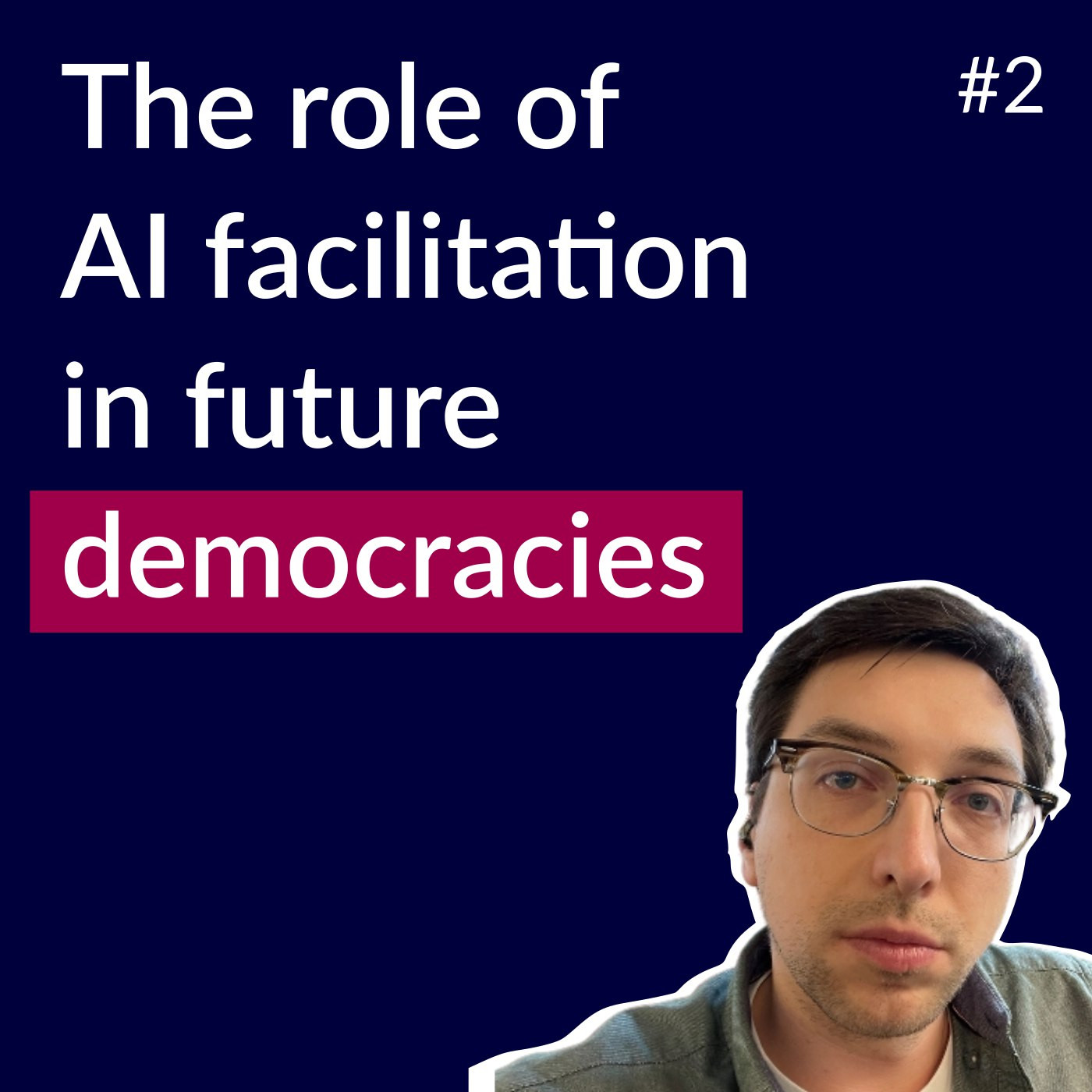
Artem Zhiganov, Harmonica: How to improve collective sense-making with GenAI
Democracy Innovators | 2025-04-14 | 1:09:38
A conversation with the creator of Harmonica, an open-source tool using AI to support collective sensemaking in online communities. We explore the origins of the project, its design for asynchronous dialogue, and the vision behind building democratic infrastructure without relying on venture capital.
Top Keywords
- harmonica 0.032
- facilitation 0.010
- conflict resolution 0.007
- conflict 0.007
- sense making 0.006
- resolution 0.006
- community 0.005
- basically 0.005
- need 0.005
- gitcoin 0.005
- retrospective 0.005
- mean 0.005
Transcript
Speaker 0
0:00 – 0:30
So we are here with, Artem Tsikhanov. And today, we'll, we'll talk about, Harmonica. And this is another episode of the Democracy Innovator podcast. So thank you, Hartamn, for your time, and I'm very curious about for having me. I'm very curious about, Harmonica. And so the first question is, what is, actually Harmonica?
Speaker 1
0:36 – 0:43
I can tell you about Harmonica, but maybe you want me to give you some quick intro, like my background.
Speaker 0
0:44 – 0:48
Also your background. Yeah, whatever, like, you'd like.
Speaker 1
0:50 – 6:49
Okay. So my background is in product marketing. I used to do, like, a lot of user research and communication strategies, and, eventually, product strategies, for clients, like product innovation, you know, like design sprints, customer experience design. Then I got very tired of all that, and I decided to make, like, a pivot and, find something that would be more that would more that resonate with me more. And that's why I decided to, get a, like, a some education, like, a degree, and, I went to The UK where I studied, innovation management. And part of that program was writing a thesis, and I decided to write my thesis about cooperatives. And then I learned about commons, Elnor Ostrom. And I realized that, this is, like, super profound theory that she was working on. I mean, her research that took forty years maybe, and eventually, she got a Nobel Prize for that research. She was the first woman to ever get a Nobel Prize in the economics. So Elna Ostrom was a great great, political, political scientist, maybe political economist, anthropologists who believe that community shared resources or communities with shared resources is an alternative to markets and states. So, basically, this is like a third, economic paradigm that is very different from both companies, like private companies, and also the states. The state based management or, you know, state owned companies or planned economy and so on. So that that was very, very inspiring for me, and that's how I got into Web three. I was a governance lead in a DAO, and I consulted a few DAOs, after that. That's how I got into MetaGov, because Metagov is, like, this community that is researching cutting edge governance and Web three governance in particular, and I was learning a lot from, Metagov. And, also, I got into Newspeak House, which is a very interesting place in London where they kind of try to cross pollinate, ideas that are related to governance and open source and civic tech and, basically, like, intersection of democracy and technology. It's one of the most interesting places, in the world, I think, in in for people who are interested in democracy and technology, and that's where Harmonica, started. So I I came up with idea for Harmonica while living in Newspeak House in London, and also working at as a governance lead in a small DAO. And as a governance lead, I was first I was really struggling with, you know, getting some input from the community, like, trying to get people comments on proposals in the forum, write those proposals, you know, join workshops and can contribute during those workshops, fill out the surveys that I asked them to fill. All of that was very, very difficult. Like, people didn't want to do anything. They didn't want to write proposals. They didn't want to discuss proposals. They didn't want to fill out the forms. They didn't want to join workshops. It was like herding the cats. Right? So at the time, I didn't know that, but, basically, this is what I call sense making, right now. So when I was, you know, during my residency at Newspeak House, Chan GPT came out, and it was, like, a very, very big topic, like, for a lot of conversations that happened in late twenty two and '23, which some of those I was part of. And so we discussed how language models could be used to improve governance of communities. And that's, again, that's how Harmonica started. Like, I thought that maybe we could use, generative AI to help with sense making, to help community managers, governance leads, and everyone else who has to act as facilitator, not necessarily being a professional facilitator, but everyone, you know, who is, managing a community has to facilitate discussions from time to time. They have to facilitate. And so how generative AI could help them? How can we empower those people, the in those roles, to, basically do decent, collective sense making? So that's what Harmonic is about.
Speaker 0
6:54 – 8:05
Okay. It's, I I've seen I I was looking at about your curriculum that is, I I would say, alpha economic and, and, yeah, innovation management. And it's interesting it will be interesting to know, how you develop this product. I mean, I this, this software. Also in terms of, I've seen that you applied for some grants, and, that was, something I think that allow you to build the platform. But it's it will be interesting, I think for the people that want to build a platform. Also to know a little bit about, the background because, yeah, your background in economic, I I think it made the, in a way for you, it was maybe easier for you to find some some money to sponsor the project
Speaker 1
8:05 – 12:17
or not? Nope. No. First of all, I don't have background in economics. I started at the high school of economics. That's the name of the university that I studied where I started when I got my bachelor's degree. And it was, like, a long time ago, twenty years ago. I graduated in 2007. But, I I didn't study economics. I I studied management. And, then I went I I worked in advertising, and then I worked in product management. And, I tried to build some startups before Harmonica, but I never you know, it was more like experiments, and I didn't raise any, like, venture capital for those. Sometimes I just invested my own savings. Sometimes it was, like, friends and family. And, with Harmonica, it's actually the same. I invested the my savings, and I got some grants, got some donations from friends, through Giveth, which is a platform for crypto donations. By the way, we're participating in the quadratic funding round on Giveus right now, and we would really appreciate even, like, $1 donation if anyone, can do that before February 14. And Harmonica is open source project. So while we discussed a few times if it's possible to fundraise I mean, to raise venture capital for open source projects, and I think there are some examples of that. I think that's, basically, it's possible. But, you know, after reading Elnor Ostrom and, going into this kind of post capitalist thinking or school of thought. Not only, I mean, not only thanks to Elnor, but also some other researchers and thinkers like Michelle Bowens, for instance, from p two p foundation. Like, I I became very disillusioned in, venture capital. Like, I really don't want to go that route. I want Harmonica to be, like, truly open source with without this kind of growth imperative or for profit, imperative. Like, I don't want to to build Harmonica for profit, which may makes it much harder to build it. Like, we we won a few grants, actually, two grants through Gitcoin. I think one of them was, like, $3,000. Another one was, like, 7,000. So that's not a lot of money. And, I hope that we will figure out how to make it, more in a more systemic way and, make Harmonic, self sustainable without, compromising the open source narrative or ethos that we, are committed to. So right now, it's a free tool. There are no subscriptions. And, we we might introduce some kind of premium features, for, you know, b to b customers. Maybe that would be certain, yeah, to to address specific use cases that are important for b two b customers, which, would be, yeah, which could be, I think, available as, like, additional thing. But, the core, product the core experience of Harmonica should be free and available to everyone. And so we rely on grants, and we rely on donations.
Speaker 0
12:19 – 13:45
K. Yeah. It's so important for this kind of product or projects maybe. It's this word fits better. Yeah. I think to be open source because, we are talking about, very serious things. I mean, you are talking about sense making, and it's a nice way to describe what the software what the software does. Mhmm. And, yeah, it seems quite hard for innovative projects to have some funding. And, yeah, sorry for the misunderstanding misunderstanding about your background. Mhmm. And, and I was thinking about, like, the first question. Like, what is Harmonica? Like, for someone that has never tried the the tool. Like, I've tried it, and it's a it's a chat in a way. And the user has a conversation with an LLM about, a certain topic. Right? And the the idea is to collect all the different positions. How would you describe it in, to someone that, has never tried it? Yeah. So what's the actual product?
Speaker 1
13:46 – 19:32
How it works? Yes. You're right. We decided to focus, at least, for now, focus on one on one, dialogues with the participants of each, process, each session. We think that it has a lot of benefits. People can be much more honest or open, and, they can be anonymous. And they don't have to, you know, think about what what other participants or maybe their team members or, like, people from their organization, how they might interpret their words. They can do that at their own time. Like, it's important to note that, Harmonica is facilitating asynchronous, discussions or asynchronous workshops, asynchronous deliberations. So yeah. So the host, creates a session and invites, the participants. And participants join the session, and they start talking to the AI, right, the language model through our web app, through the chat interface that you mentioned, which is very similar to ChargeGPT. But unlike ChargeGPT, it's a multiplayer experience. It's a multiplayer session, which means that even though you talk to everyone talks to AI, the AI is saving all those responses to a vector database, and it can ask follow-up questions or additional questions based on other participants' responses, what we call cross pollination. So, basically, we want participants to be able to comment on each other's ideas or build upon each other's ideas while talking to AI. So, like, they talk to each other but indirectly. They talk to each other through the AI. And the the AI synthesizes the statements, the responses, and it can identify the clusters of opinions in a way, like, similar to what Polis how Polis works. Right? So with Polis, you create some seed statements, and participants can react to those statements, but also they can add their own statements. And then other participants can react to those additional statements from other from from you. And so, eventually, you can create this kind of clusterized or, like, you can map the opinion clusters of of your community. So we want to do something similar with Harmonica, but with conversational, in interface so that everyone can just chat with the AI. And, also, we are working on, additional modes of input like voice so that you will you won't have to type. You can you will be able to talk to Harmonica. And, also, we want you to add the, like, additional, like, elements like sliders, like, maybe, like, multiple choice, and so on. So it would be much more, flexible or dynamic experience for participants. But most importantly, their responses will be saved in this session database or context window, session context. And the first of all, the harmonica will identify, like, important statements or maybe outliers, like strange ideas that, it think it thinks are original. And then, for instance, ask participants what they think about those, strange ideas, outliers. Because, what we believe is that consensus is overrated. Like, consensus or common ground is, you know, it it it it can be it's it's great when community is very aligned and, like, everyone is on the same page and, you know, on that common ground. But, also, in I think especially in larger communities, like, common grounds can be quite bland. You know, like, when there's a lot of people, something that all of them agree on can be quite small or, you know, banal, like, obvious. You know? And then it's it's very, very important to get feedback on less, obvious ideas coming from some of those members, some of those groups. We want other groups to comment on those ideas. And then it would be hopefully, it will be much easier to, for instance, like, develop a strategy that would be very inspiring for most of the community, but it wouldn't be boring. It wouldn't be obvious. It would be based on some of the outlier ideas coming from some of the members, which are supported by other members. You know what I'm talking about? So it's not just finding common ground. It's not just finding something that everyone agrees on. It's about amplifying the good ideas. And then that's, I think, what sense making is about.
Speaker 0
19:33 – 22:03
Okay. So I will say a sort of AI mediator mediation and also a sort of collective brainstorming with the LLM. Yep. This is very interesting. I was also thinking about, the voice input that, could make everything, easier. Mhmm. And about, there is also an, an idea that, I thought about. So collectivization of problems. Like, someone has a certain kind of problem. Maybe in the same town, another person has the same problem. And, eventually, this tool, this project could show that many people in that place share the same problem. And so, eventually, they can also try to find a solution to to that. And, you told me about, a little bit about, the idea, how you had it. And, but I would like to ask you, if you were interested in the in these, topics, not maybe not in civic tech, but, like, in your experience, have you had any previous thought experience about conflicts? Because, you know, sometimes it's normally we disagree. And, sometime we understand the other person, but we not share what they say, what, that person say. And, I don't know. Was there for you, like, a moment when you thought, okay. We need the new tools. I don't know. Maybe a personal situation, something that you thought, okay. We need the new things because it's it's hard to to agree, if we use normal, if we just communicate in a normal way, while with AI and, the use of LLM could facilitate
Speaker 1
22:04 – 31:48
conversations. To be honest, conflict resolution wasn't, something that I thought about when I came up with the idea for Harmonica. I like I said, it was more about my struggle with just getting input from the community. Like, it was very you know, it took me a lot of time. And, also, I had to process the inputs. Like, for instance, you know, when I did the, like, workshops in, Miro, Miro. Not sure how to pronounce it. You know, people added some stickers to the whiteboard. And then, after workshop, I had to copy all those stickers somewhere and, like, try to cluster them and, synthesize them so that it would be, like, something, like, actionable, like, some kind of summary of the workshop. And to me, it was, like, one of the most difficult things with in terms of workshops, virtual workshops. So it's but it's it's also about time, basically. Right? So it's it was, very it took a lot of time, and, also, it was hard to engage people just to get, like, a lot of people to participate. And finally, you know, like, with for instance, with, like, OKRs. Right? Like, objectives and key results, which is a very popular framework for setting, like, objectives, for, organization. Like, I tried to do that with with my team, with, other teams. But, first of all, I didn't have much experience with it, so I wasn't entirely sure that I'm doing it the right way. And secondly, other people didn't know about OKRs until I told them about it. And so for them, it was, like, learning experience, and they they they didn't quite understand what they need to do. So I think what, Harmonica one of the benefits of Harmonica is that it helps you to use the right framework in the right way. Like, for instance, if you want to develop OKRs, like, Harmonica will know how to do it. And if you want to develop a theory of change for the community, Harmonica will tell you or suggest one of the ways to to develop a theory of change. In terms of conflict resolution, I think that's a very interesting topic. Basically, for me, conflict resolution is one of the key elements of governance. So a lot of people, I think there's, like, a very, like, popular, like, misconception. A lot of people think that governance means decision making, and, actually, that's not the case. Decision making is one part of governance, but it's not only decision making. It's also, you know, code of conduct, for instance, like, certain, like, principles of how your organization is, like, operating. And that can there's a big overlap between, those principles and decision making. Ideally, the decision making should be, like, synchronized with your values and your principles. And there's also a very important topic of tools. Like, what tools do you use and who has access to those tools? Like, who can actually edit or delete, you know, important documents, in the cloud. That's that's a very, very big part of governance to me, which some people just don't think about enough. Some communities just don't think about. And then there is conflict resolution, which is also equally important. Like, how do you actually resolve conflicts or disputes? Which is, by the way, like, it's one of the design principles of Elinor Ostrom. Like, Elinor Ostrom got her Nobel Prize basically for developing eight design principles for building successful commons, like, how to how to create a successful commons. Like, if you want to build, like, a open source project, like, or if you want to maintain a forest. She was obviously researching forests and, like, fish in in in the water, but the same principles apply to open source projects and, other digital commons. So conflict resolution is one of those eight principles. Like, if you want to if you want your community to maintain or develop shared resources, you need to have conflict resolution in place. And I don't I I don't know if, like, how exactly AI could be used for that. I'm sure there's probably, like, a few different startups that are trying to develop to to build a tool for conflict resolution, with AI right now. But But Harmonica is so I think for conflict resolution, facilitation is also very important. Basically, facilitation is something that is important for sense making and for conflict resolution. So and Harmonic is trying to understand how to turn facilitation wisdom into code, like, how to codify facilitation wisdom so that AI could facilitate workshops in a specific, way, like, for instance, like a retrospective. Right? Like, Harmonica can run a retrospective for your team. It will talk to use, participants, to team members, and it will ask them about, you know, like, the standard retrospective questions, like what was good about the last sprint, what didn't work so well, what can be improved, and how could we actually improve it, or how can we fix the problems. Right? So there's, like, three main questions in a retrospective. And it's kind of obvious, like yeah. Like, you can write a prompt for, like, GPT and explain all that for the language model, and then it will this prompt will be used to, like, you know, talk to each participant, collect the inputs from them. And then another prompt, which is also part of the retrospective session, will be used to synthesize all those responses and generate a summary of your retrospective. And it that summary would be pretty good. Like, it will be very close to what, you know, like, a retrospective output should look like according to, like, agile thinking, like, you know, experts in agile management who we really want to collaborate with and, like, we want them to give us feedback. Like, if the prompts that we are using is not very are not very good, then we are happy to, change them, you know, improve them, or maybe those experts wants to create their own prompts and their own templates, as we call them. And, it can be not only about agile. It can be about anything. And so maybe conflict resolution could also be, you know, part of that experience. Maybe those there actually can be, like, a lot of different templates, a lot of different frameworks, that help people to resolve conflicts. We just haven't thought about that yet. But maybe it's actually important, like, direction for tools like Harmonica. Like, how how, you could, yeah, how the AI should talk to people. But the what I'm a bit skeptical about this is I think conflict resolution is emotional. Like, with when you try to develop, like, OKRs or a road map, it's basically, it is just about ideas. It can be quite rational. It doesn't have to be emotional. With conflicts, I think there's much more emotions in place, and I think it's very important not to lose those emotions in the process. Like, you need to actually be ideally, you want to be in the one in one room with, someone to resolve the conflict. Like, if you just talk about that stuff through Zoom or some other, you know, video conference, tool, it's already, like, harder to resolve the conflict. And if you do that through chats with AI, I'm afraid that you just, you know, you just lose all the emotions that you need to actually hear the other person. Like, not just, what they not just the words, but also, like, the body language and stuff like that. So I don't know. I mean, conflict resolution is a very big topic. Like, you could you could think about, like, projects like Claros. Right? Like, Claros is, doing kind of decentralized conflict resolution, but that's more like, court. Right? Like, you just have people who, try to resolve conflict, as a service using blockchain, but I don't think they're using AI.
Speaker 0
31:50 – 31:52
I think right now. No.
Speaker 1
31:53 – 31:53
Yeah.
Speaker 0
31:54 – 32:03
And you made me think that, maybe facilitation is the step before conflict resolution. I mean, because I think we are
Speaker 1
32:04 – 32:09
fundamental skill that you need, for conflict resolution as well as sense making.
Speaker 0
32:10 – 32:41
Yeah. Yeah. Exactly. If we have a way to understand each other before we have a conflict, then hopefully, we do not have to have a conflict. And so that's why I think, tools like Harmonica could be very useful. Mhmm. And, I'd like to ask you if you encountered any kind of problems. I don't know. Maybe you were thinking about something. Okay. We have to do it in this way or in another way, and then you faced some something unexpected. I don't know.
Speaker 1
32:45 – 38:55
Well, you know, every startup, has, like, dozens of, things like that until they get to their, like, product market sheets, and we we haven't got there yet. So I guess we have something like that, like, every week. But, also, like, when you asked me about this right now, I just I need some time to, like, remember something that would be interesting to talk about. Like, you know, in general, this is all very fuzzy. Right? Like, for instance, we we started with, Discord bot. Like, the first prototype that we built was a bot for Discord. And then, we realized that it's not that easy to, like, facilitate a workshop in DMs on Discord through through DMs on Discord. Also, like, a lot of people that I talked to about Harmonica, they were not on Discord. Like, they had to install Discord and register just to be able to test, Harmonica. So then we decided to move to Telegram. And, like, last summer, I was invited by Zuzalo community. I don't know if you know Zuzalo or Zuzalo. It's, like, conferences sponsored by Ethereum Community Foundation. So the first one was in Montenegro in '23, and, last year, it was in Georgia. Georgia, the country, not the state. So they invited me to help them organize, one of the weeks because it's a long conference. They call themselves pop up village. So I think it took, like, six or seven weeks in total, and one of those weeks was about decentralized governance. And, so I helped them organize that week, and, also, I thought that it it was it would be, like, a good opportunity for us to test Harmonica, like, a pilot project for Harmonica. And so we built a Telegram Telegram bot, for that week. So we tried to use Harmonica at the conference at Zoo Village, Georgia and invited the participants of the conference of that week, people who attended the the sessions that I organized, you know, like, with speakers, and some workshops. We invited them to use, the Telegram bot, Harmonica on Telegram, which also wasn't very successful. Like, a lot of people joined those sessions but never finished them. They didn't, respond to the questions. And, I realized that, yeah, we probably just it wasn't the right solution for that context. Like, people who attend the conference, they're not members of the same team. Some most of them don't know each other, so they didn't have any, like, skin in the game. They didn't want to discuss anything with each other. They didn't want to help, us, I mean, Harmonica. So with all that, feedback I mean, not feedback, but feedback, but also, like, just kind of you know, basically, that wasn't a very successful experiment for us. So we decided to start using to to build a web app, like, to just to create something like ChargeGPT on on the web. And, I think that this is currently, working pretty well, the web app. But, it also has its limitations, and I think that people, a lot of people just don't want to open links. Like, if someone sends them a link, especially if it's not, direct messages, but it's if it's, like, a channel on Discord and, like, everyone on the community is invited to join the session, very, very few people actually click on the link. And that's what we've seen recently, for instance, in Arendelle community. Like, they tried to do, like, a year retrospective with Harmonica in, like, late December, early January to reflect on 2024 as a community. And I think it was, like, 10 people who joined the session, with, yeah, I think, like, a few 100 members on on the Discord server, like, maybe 500, 600 members in R and Dao. And only 10 of those, users actually joined the session in Harmonic, which, you know, it's it's a problem, for us. And we haven't figured out how to solve this yet, but one of the hypothesis that we have is that we still we we need to go back to building a Discord bot. So we maybe we'll make, like, the full circle. And, but it will be a new kind of bot, that would be using, that would be connected to an agent. So it will be basically like Harmonica agent that would be joining certain channels or threads in a community server. And maybe it will be, trying to facilitate, discussions happening there, like, so that people wouldn't need to leave Discord. They wouldn't need to join any sessions. It will be it won't have any it will be, like, sessionless, sense making experience just happening on the community platform that the community is using.
Speaker 0
38:55 – 39:05
So the bot inside the group, the Discord group, Telegram group, or whatever, instead of, the user that has to write to the bot privately.
Speaker 1
39:06 – 39:10
Or joining a session on the web, which is the current solution.
Speaker 0
39:11 – 40:00
Exactly. And, I'm thinking about this problem. I mean, someone build a a project, a platform that could be very useful, and then people, maybe they are, yeah, as you said, afraid of opening a link or maybe they are just lazy. I don't know. They have things to do. They are they they have their life. And, maybe gamification systems could help in a way to, yeah, to stimulate users to to do a certain thing, to reply. But, also, as you say, like, the audio could be easier. So you just, the user just say something to the cell phone.
Speaker 1
40:00 – 45:09
Yeah. Yeah. Absolutely. I think people can share, like, 10 times more information if they talk, instead of typing. And we basically, we want to increase the bandwidth. We want to for sense making, we need to get as much information as possible from, the community or from the organization. So we really need to, on the one hand, be able to use different, modes of like, accept different kinds of inputs, including voice. And on the other hand, we need to be able to join the conversations that are happening already. And, you know, that could be a bot that is deployed to a Discord server, or maybe it's just something like a Zoom call. Maybe we should be able to join Zoom calls, so we could build a Zoom app, right, that would be invited to those calls, or we could use the transcripts that are already generated by tools like Otter and Fireflies, you know, those AI note taking tools. So that's something that we are working on right now. We want to be able to add those transcripts as context to the sessions. So it's not just what people say or what people, tell, Harmonica in our sessions, but also being able to import conversations that happened elsewhere, maybe, on Zoom, maybe in Discord, we want to be able to kind of, combine or merge all those different, conversations to form this kind of, you know, collective intelligence or, like, context for AI. And then the next question, I'm I'm no. Not a question, but, something that we are working on, that I want to share with you is that if we manage to, like, form that collective intelligence or context, based on all those conversations that could happen in Harmonica or outside of Harmonica, then we also want to be able to turn that into an agent itself, and that agent would be able to represent the opinions or the perspectives of that group of people, somewhere else. So this is what, we call AI avatars. And I think that could be, like, a really fundamental breakthrough for, like, online governance when, groups of people will be able to deliberate, on certain topics and then create an AI agent that would represent them based on all those deliberation, based on all those conversations, based on all those responses that people shared and, you know, what they agreed on and disagreed on. So I think it would be very powerful way to scale, deliberate democracy because, you know, it's very hard to deliberate on stuff all the time. Like, people have other things to do. They don't want to join, like, citizen assemblies every week. But if we manage to create something like a governance surface for the team or for the community, that would enable them to create an agent that would accurately represent their perspectives and values and, like, intentions. Like, what do they really want? Maybe within the company. Like, maybe a team wants to create an agent that would represent it, on, like, high level company, strategy meeting. Right? So that the interest of that team would be represented when the department is making decisions, and then maybe the agent of the department will be represented at the company level, decision making. The same applies to politics. Like, maybe a neighborhood, can, discuss a lot of different stuff, like deliberate for, like, maybe a few months. And then that context would be enough for this neighborhood to create an agent that would represent this neighborhood on city level deliberation. And then maybe the city, consisting of all those different neighborhoods, would be able to create an agent that would represent the city on national national level, deliberation. So this is, I think, very, very important because it allows you to scale, deliberate to democracy.
Speaker 0
45:12 – 46:34
Absolutely. It's very charming. The the the way the the agents can, represent people. And, that's also what I was talking about, when I said about the collectivist collectivization of problems. So eventually, like, some people that have the same problem can be represented by a certain AI agent to the, I don't know, the state level, town level, whatever. And, I'm thinking I mean, the platform now is, I mean, is developed, and, you're talking about a lot of, improvement that are very cool. And, which kind of, I don't know, like, problems you think you will face or skill you would require that you do not have now? I mean, Metagove, as you said, is a big community. And, luckily, there are also other communities, and, people are collaborating. So, like, is there any help that you need? I don't know.
Speaker 1
46:35 – 51:01
Yeah. Okay. Thank you for asking. Yes. We need a lot of different kinds of help. That's for sure. We are a small team. There's only, five, members, in team Harmonica, including myself. We have been bootstrapping. Like, we don't have external funding apart from the Bitcoin grants and the give us donations. So we definitely need, you know, we need to fundraise, basically, somehow for to to make it more to to be able to work on this full time. I think I'm the only team member that works on Harmonica full time, currently. But, that's kind of obvious. Right? Like, fun funding. Also, we definitely need, like, developers who would be aligned with what we're doing, who really, like, wants to fix the democracy, and, make the planet, more happy place. So developers is another thing. But I guess what we really need right now is the facilitation, wisdom. Because, like I said, I think facilitation is the core value that we are trying to deliver with AI. So it's Harmonica is basically AI facilitation tool in a way, like AI powered sense making tool. And the facilitation is a big part of that. So I wanted to use this opportunity to share some, an update, from the interoperable deliberative tools, program that I participated in with the Harmonica. I think you were also part of that, program. And so a few weeks ago, we decided to collaborate with some of other members of this, program, including AI Objectives Institute and, EYES. So I hope that other projects will also join us and maybe build benefit from what we want to do. And what we want to do is open source library of facilitation patterns. So facilitation patterns, facilitation tactics. Basically, we want to turn, different facilitation traditions, like sociocracy or nonviolent communication or maybe Cuneven or you know, there is a lot of different stuff that is very, very interesting that has been developed over, like, decades. Liberating structures is another great example. And, those are, like, different traditions. They are focused on different things. Like, obviously, like, agile is more about teamwork and, like, companies, tech companies in particular. And one mile communication is just about how you can facilitate a discussion in the room and how do you can how can you make people, you know, open and, create a safe safe space, for more open discussions. So those are the, like, different things different aspects of facilitation, maybe, like, different even, like, levels of facilitation. But we want to try to turn all that into code so that tools like Harmonica or Talk to the City or Eyes or maybe some other deliberative tools, which, I think, yeah, hopefully, will be open source as well, would be able to benefit from this, open source library, which we call open facilitation library. So we really want to engage as many facilitators as possible to share their wisdom with us. You know, facilitation experts from all those different, facilitation traditions, we really want to collaborate with them to create this kind of shared, facilitation library.
Speaker 0
51:05 – 51:17
This is quite cool. I mean, a library means that, it will help, yeah, new developers, new people that have, some new ideas to develop their project.
Speaker 1
51:18 – 52:17
Yeah. I I want to say that, you know, there are some examples of libraries like this. For example, there's a session lab library. There is a wise democracy project that also tried to describe this kind of pattern language of democracy. And there's, like, a big overlap with what what we want to do. But what we also want to do is not just to describe those facilitation, tactics or patterns, but also try to turn them into machine readable form. So maybe like TypeScript, so that, we could basically teach AI how to use those things, how to use those patterns so that, you know, the it we could just, like, copy those things to the prompts or turn them into agentic workflows and stuff like that. So it's also about the code in a big way.
Speaker 0
52:18 – 52:45
So a sort of machine learning on the on all the possible ways the Yeah. Humans use to mediate. Yeah. And the so it seems like that, what are needed now are people that are not from the tech side, from the tech field, but they are, yeah, studying the ways that people use to, resolve conflicts or to facilitate conversations.
Speaker 1
52:46 – 52:48
Well, so does not some beliefs. Yeah.
Speaker 0
52:50 – 53:56
Yeah. I felt like the same in, I mean, there are a lot of peoples that, have, some, I mean, technical knowledge. And so they are developing new tools, like, could be Harmonica, could be other tools. And, and a lot of people that have a lot of knowledge, like, people that maybe studied the facilitation techniques, they still are not in this field. But I really hope that in the next future, they will come and teach us all the the knowledge that they have. And, about, yeah, questions about other tools that, maybe you have seen around that they looked very interesting to you and, that maybe share something with Harmonica or maybe they are very different, but they were you were inspired by them. I mean, you cited Polis before.
Speaker 1
53:58 – 60:32
Yeah. Yeah. There's definitely a lot of tools that, yeah, trying to do similar things, as Harmonica. And there is also a lot of tools that, we are using, to to build Harmonica. But, yeah, I guess you're asking me about the the former. So, yes, obviously, Polis is a big inspiration. Unfortunately, it's it hasn't been updated for a long time. I think it's just, like, like, a public good now, and nobody is, like, trying to develop it, like, improve the UX. So it's pretty, like, old school UX. And, you could say that we're trying to, yeah, like, do a similar thing, but with a different UX that is more modern and conversational and AI powered. But Harmonic is not the only tool that is trying to do that. So I mentioned the Talk to the City. I think Talk to the City is a great project, also part of this, interoperable deliberative tools program. There is, Remash, which is a very mature, project, which is also using AI to run collective dialogues. So you could just call it a collective dialogue system. By the way, Remesh is not open source, and it's quite expensive. It costs, I think, around, like, 35,000 a year. $35,000 a year, I think. Yeah. It's a lot of money. I don't know. A lot. Yeah. I guess they maybe they, I know that they're working with the UN, and maybe UN, is like a pro bono customer for them. But, they definitely work with, like, large companies who can spend that much money on a collective dialogue system, which I find interesting. There's also another, American project called, ThinkScape built by a company called Unanimous AI, and I think it costs, about the same. I might I might be mistaken, but I think it costs, like, 3,000 a month. And Thinkscape is also using AI agents to organize, deliberative processes or some kind of, yeah, online discussions. And they have, like, a very interesting design. So those they they want they create small rooms for people, and people discuss different topics in those rooms. And then there are agents who listen to those discussions, and they and then they have other agents who represent other groups in your group so that you could, respond to ideas from other groups that are collected by one agent and, like, reproduced in your group by another agent. Something like that. I I might be you know, I hope I'm not wrong, but maybe it's not very accurate description, but I hope that's more or less how they work. So thingscape is interesting. Yeah. I don't know. Like, you know, there's it's so we're building a collective dialogue system. I've I've been talking I've been I mentioned a few collective dialogue systems, but there's also very interesting stuff happening, like, in bridging systems, like, how to identify different opinions and, like, with what they do with community notes. And I think community notes is just an early example of bridging systems, and there will be much more interesting bridging systems in the future. So I think and I I think it's interesting to, like, discuss not right now. I I'm afraid I need to jump off, soon, but I think it's interesting to discuss, sense making stack, like, what sense making stack, consists of. And I think, tools like Harmonica is just one part of that stack. So what what else do we need to, like, enable, good collective sensemaking. To me, it is, like, open question that I don't know the answer for right now. But, like, I think that, yeah, sense making is definitely something that, we need to work on as civilization to address the metacrisis. That's not my thought. That's, I think something that I heard from Daniel Schmachtenberger, which, is one of my which have been, like, a big influence on myself, in the last few years. And, yeah, I think it's important to think about, collective sense making and how AI can enable it. I think that's there is some irony that, on the one hand, AI is a dangerous technology. Like, it could potentially kill us, kill everyone. But also, basically, we can't solve the political problems that we have without AI. So I think that's a very interesting moment in history because on the one hand, we are building the tools that can kill us, but on the other hand, there is this growing political problems that can be solved only with the help of AI. And, basically, we have this window of opportunity. So we we need AI, but, also, it's dangerous. And we need to build AI that would help us to, like, fix the democracy, or otherwise, it will be very dystopic.
Speaker 0
60:33 – 61:52
Yeah. It seems like a sort of paradox. Mhmm. But, yeah, I completely agree that, AI and technology can be used, yeah, in in some good ways to to to make the world a better place. And, another small question. I mean, is there I mean, there are all these new all these people, I mean, you're part of, and I would say I'm also part of, that are trying to find new ways for people to collaborate, to to discuss. And, do you think that, all these people are collaborating in a good way right now? I mean, the the the intent of, I mean, is to facilitate dialogue and for for other people, like for DAOs, for companies, for, I don't know, institutions. But at the same time, I think it's important for people like in the civic tech space to collaborate. And, do you think that this is happening right now? Do you think that something should improve? Do you have a message for the people in the the civic tech?
Speaker 1
61:54 – 68:08
Well, you know, it's, it's a good question because I think there is a systemic problem here, which is funding. This stuff is not very profitable. And, if it's, is built for profit, it, becomes much harder to use it at scale. I mean, basically, you want this stuff to be open source, like Polis. But if it's open source, then it's very hard to, raise funding. It's very hard to hire, like, engineers because engineers are very expensive. So all of these projects, they get into this conundrum or, you know, like, a difficult situation, where you on the one hand, it's yeah. Like, you want to build something that would be very, like, useful for the humanity, but, also, like, it's not easy to fund it. So it's very hard to to build it even if you have some kind of, theory of change and, like, impact model. And, you know, there's, like, Gitcoin that is trying to solve this problem with grants. Right? Like, with quadratic funding and grants. And I guess, Gitcoin is, like, a great example, and, like, there should be more projects like Gitcoin. And, thankfully, Gitcoin is also developing a protocol that should enable other communities and other organizations to run similar, like, ground rounds using their protocol called Alo. And so I think Bitcoin is doing, like, amazing job, and, I want more people to know about Bitcoin. But, also, I think it's, just the way the capital is allocated in in the economy. And, maybe we need to just think of, new institutions that would be focused on, like, funding this kind of projects because, yeah, it's it's it's hard to fund them with venture capital because venture capitalist wants to, like, 10 x, growth, right, and, exits. And it's also not very easy to fund it with grants. Like, even though Bitcoin is doing a good job, I think, still, like, you can only get win so many grants a year, and those grants are not very big. So you can't hire a lot of experienced developers, if you just, if your funding is coming from Gitcoin. So one of the things that I was really inspired by, or excited about is, the idea of, guilds as, basically, like communities or networks that can fundraise and then allocate those funds among their members, based on much deeper relationships, with those projects than the Gitcoin can have. Right? So because Gitcoin doesn't care about your project. Gitcoin is using, like, this kind of mathematical models to identify projects that get a lot of, like, support from their communities. Like, if you can get a lot of people donate, then you get some funding from Gitcoin. With guilds, I think it's, much more it it could be much more basically, it could allow much more substantial funding, because if a guild, can find, like, an institution that is aligned with the mission of that guild, it could get a lot of money, and then it would distribute that money among members of the guild, like projects that, you know, part of that guild's, network or portfolio. So I guess it it is kind of similar to Venture Studio. But the Venture Studio is it's basically a company. You know, it's a company that is part of this kind of capital, capitalistic paradigm. And I think that venture studios are amazing. I think it's one of the most interesting things happening, in terms of, like, startups and venture capital. So, like, you know, companies that build startups. Right? Venture builders. That's a super interesting phenomenon. You know, there's a community called Arandao that is trying to do something similar, but with the, like, Web three projects. And it's, like, community driven. Like, they have a Discord server, and, like, everyone can join the server and start contributing to those projects. And, hopefully, Arandao will be able to raise funding itself to distribute it among those projects. But still, I think it's it's not a guild. And maybe Metagov could be that guild. Maybe what Metagov is doing right now, it could be something similar to what a guild, is supposed to do. And I hope that, with all the reputation and, like, goodwill that Metagov has built over the years, it will it would be much easier for Metagolf to fundraise than for Harmonica or other projects that are part of this, like, MetaGolf ecosystem. So I hope that, you know, we can, yeah, we can, design and implement this kind of new approaches to funding, which wouldn't be capitalistic, but also would enable to hire engineers.
Speaker 0
68:13 – 68:41
Yeah. Absolutely. It seems like, I mean, as as we said, before, like, funding is a problem. And, but really hope that in the next future, because of this, AI hype, yeah, there will be some, new kind of fundings. And it's very interesting doing the things about skills. And, is there anything else that you'd like to add the,
Speaker 1
68:43 – 69:18
that I haven't asked? Okay. No. I think, we have covered a lot of important topics. And, yeah, I'm grateful for the invitation. This is the first time that I've talked about harmonica with someone like this, like, in a interview format. So, it was great for me, just to, yeah, have this kind of experience. And, yeah, I hope that it wasn't, that I wasn't talking too slowly because that's one of my problems. I talk slowly.
Speaker 0
69:20 – 69:30
No. It's I I talk in a horrible way, so I it was perfect, and it was, was very interesting for me. So thank you a lot.
Speaker 1
69:31 – 69:37
Thank you for the opportunity to talk about all this.