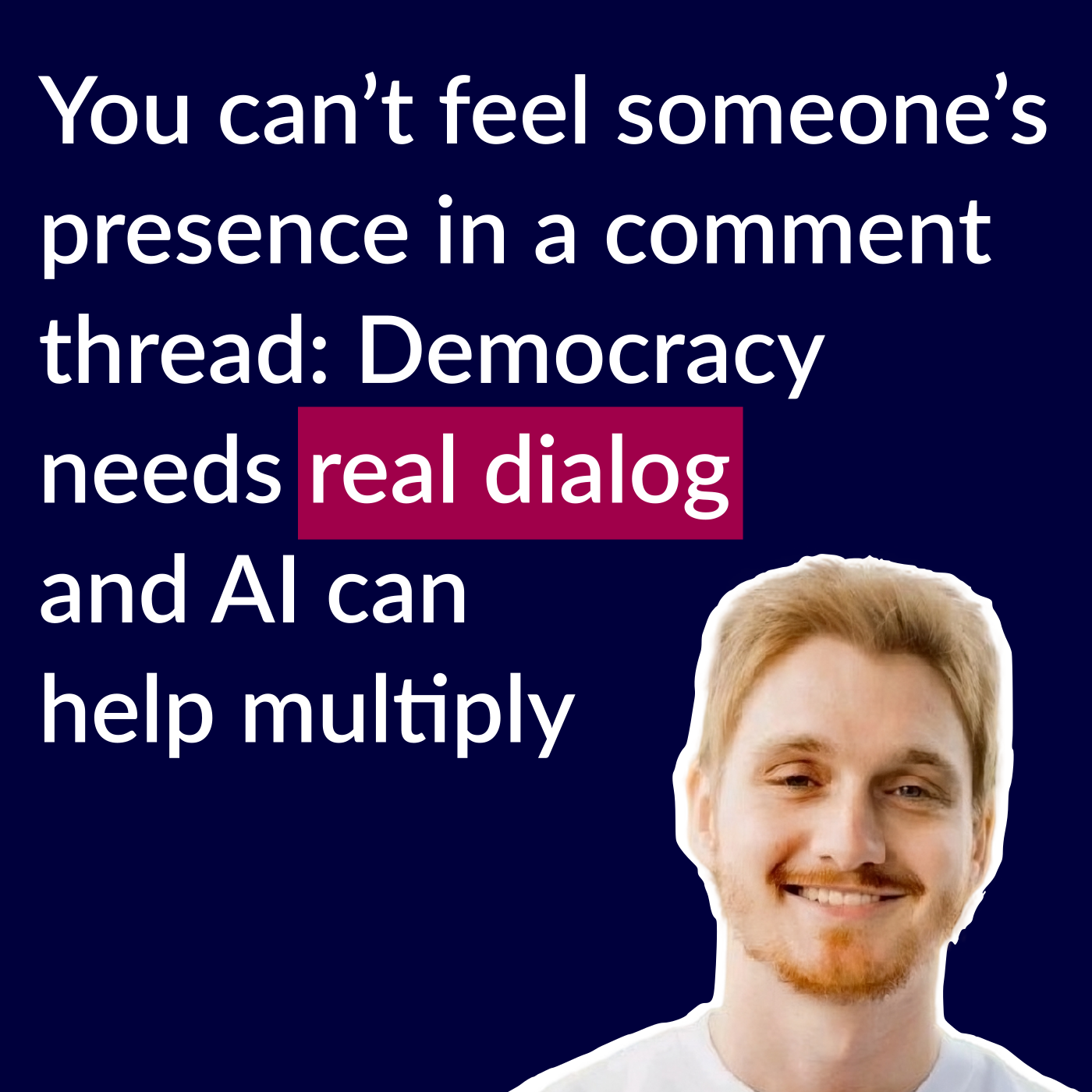
Lukas Salecker about deliberAIde and why generative AI makes a difference in deliberative democracy
Democracy Innovators | 2025-05-06 | 1:01:02
In this episode of Democracy Innovators Podcast, Alessandro Oppo interviews Lukas Salecker about deliberAIde, an innovative platform that uses AI to enhance deliberative democratic processes like citizens’ assemblies. Lukas shares how deliberAIde helps make democratic participation more accessible, efficient, and scalable through AI-powered transcription, analysis, and reporting tools.
Top Keywords
- platform 0.006
- participation 0.005
- assemblies 0.005
- time 0.005
- processes 0.005
- discussions 0.004
- political 0.004
- deliberate 0.004
- make 0.004
- parliaments 0.004
- need 0.004
- example 0.004
Transcript
Speaker 0
0:00 – 0:13
Welcome on another episode of Democracy Innovators podcast. And our guest of today is Lucas Salica, co founder and CEO of Deliberate. And, thank you for your time for being here.
Speaker 1
0:14 – 0:15
Hey, Alex. Glad to be here.
Speaker 0
0:16 – 0:28
I'm I see that you have cofounded Deliberate. And, how would you describe this platform software or idea? I don't know.
Speaker 1
0:29 – 3:36
So so before I get into the nitty gritty of what we're building, which is our platform, I mean, maybe give a little bit of background of where where this idea comes from. So it was around February by now when I I woke up in the middle of the night, Sunday to Monday morning at 4AM. And I I had this idea to use the power of these recently, publicized new technologies of generative AI, for a lot of people known through, Chativity team, and connect that to, democratic innovations like citizens assemblies to help make them better, make them more accessible, make them more scalable. And so that's that's exactly what we're doing at deliberate to, use these generative AI technologies, think about how we can, build them into applications that are made for processes like citizens assemblies or other deliberative processes for different purposes. And the main purpose that we're starting with, with our platform or the first version of our platform that we're launching in in March and in May is sense making. How can we help, organizers, or commissioners of these kind of participation processes to get to more easily get insights and summaries from from the from the discussions, and also to get better insights from them. And so that's exactly what we're doing in this first version, which, on a more technical level, starts with recording and transcribing discussions, with built in anonymization to protect people's privacy. Then we take that transcription data and in the future, also other kinds of data around around the discussions like manual notes or, pictures of of whiteboards, like whiteboards, sticky notes, for example. And we use that data to extract, contributions that participants made and to, then make sense of these contributions, like, what what what things that they propose, what opinions that they that they defend, what what's what's like, where where similarities across different contributions, in the future also where are agreements or disagreements, and so on. And once the organizers have, done this sense making, they can then take their analysis and summaries and also use AI assistance to turn turn the insights into meaningful reports that can then be passed on to the decision makers or the public. And, yeah, that that's, the set of functions that we focus on in the first platform version.
Speaker 0
3:40 – 4:12
I in the past, I was thinking about, software for civic participation, and, I thought a lot about this automation, about summaries and AI integration, and and it's very cool that, some tools like this one exist. And I wanted to ask you if you had done some experiment with some group of people and if is there anything relevant to share?
Speaker 1
4:13 – 6:30
Indeed. So, since we're about to launch our platform, we've been, going through quite a bit of testing in in real life processes over the past weeks and months. So we have worked with cities and municipalities in Germany. Or also next week, we're gonna actually do a test at a conference by the European Committee of Regions. And what we can say is that there's really a lot of, excitement about what these tools can offer to to people who organize these kind of participation processes. To give you one example, we're working with what's called social planners, in in the municipality of Siegen Wittenstein. It's a relatively small town or municipality in in the state of North Rhine Westphalia in Germany. And they what these social planners do is they organize a series of conferences where they involve citizens to to decide on future social social planning, social policy making. And so they they have tested, our software at various occasions now. They were already excited simply about the the possibility to record and transcribe, these discussions. But when they saw, for example, how they can even go even beyond transcriptions and can can can use AI to extract, the the ideas that participants shared to to cluster different ideas together, to to use our tagging functionality to extract even more specific insights and all of that, on a on a digital whiteboard. So we're actually we we developed a digital whiteboard like Miro or Mural, where they can work with the insights and the summaries visually and interactively. They they they they they the feedback we got from them was that this is exactly, like, what they need or didn't know they needed. And, they they really believe that this could help them tremendously in the in the future and especially speed up their documentation and reporting processes.
Speaker 0
6:36 – 7:44
I'm thinking about, the last thing you you just say that they didn't know that you that they they didn't know that they need the the platform because maybe they were not aware of, that some platform like this or that the technology could help so much in also in political processes. And, I was reading the description of the Libre Aid, and there is something very interesting. Our mission is to ensure that every voice is heard. And, I think this is what is very cool about, civic tech that could allow literally every voice to be heard. And, do you think that, this platform or, like, similar platforms, in the future could could be not just related to, to some experiment in a town, but really be, something that people use every day. And so all the political system eventually would, will change.
Speaker 1
7:46 – 12:17
I certainly believe so. That's that's the vision that that drives us, really believing that, if we leverage this new information technology that generative AI is, that we can create spaces, that that extend way beyond the current political arenas. So right now, political decision making, political discussions are very confined to, you know, people who've been elected or, people who are members of political parties or, the media or social media. But all of these current political arenas and spaces have a lot of shortcomings, especially when it comes to who do they include and who do they exclude. For example, to be elected, it's it it takes quite a bit of time, first of all, but then also you need to meet other conditions actually be elected as a representative and thus partake in the political conversation. And we believe that, democratic innovations like citizen assemblies and oftentimes also the selection of participants in these in these, mini publics through random selection. So a lottery, can help overcome some of these short shortcomings of of exclusion. But there there's still there's still even within these new democratic innovation processes like Citizens Assembly, there's still challenges to overcome. And that's exactly where we believe, technology, this new information technology of generative AI especially can come in, to tackle issues ranging from inclusivity to, the depth of conversation and quality of dialogue to scalability and costs of these of these processes. Just to give some examples in terms of inclusivity, oftentimes, language is still a barrier to participate in in citizens' assemblies, And we already know that Generative AI is really good at translating, and and there are actually startups popping up that help, with real time translation, for example. So that can help bring down, barriers to inclusion in conversations in citizens' assemblies. Then depth of dialogue, currently, even in citizens' assemblies that are well facilitated, you oftentimes only scratch at the surface of underlying conflicts, when people have disagreements or conflicting opinions. You don't really have the time and also the the the insights to actually dig deeper and and truly understand understand why certain conflicts exist in society. And we believe that generative AI and and and the the analysis that generative AI can enable can help us understand conflicts better and and, thus, mediate better between conflicting views. And the third example related to scale would be, if if you can use, like, our version one platform, for example, for summarization, sense making, reporting in like, very quickly in minutes rather than days, you save a lot of costs for for, organizers, for, analysts, for note takers. And that that allows you to organize a lot more of these assemblies, or organize such assemblies in the first place, if you have a very small budget. And a and a second point related to the scale would also be, right now, you to that to actually organize something like a citizen assembly, like a mean meaningful deliberative dialogue, you you need most of the time to do it well, you need professional moderators. But there's a there's a scarcity of professional moderators. So we believe in the future, with AI, we could empower participants to self moderate, for example. There are already some experiments in that direction underway. Stand for an online deliberation platform, first and foremost. And, but we believe we can do better. We can help we can use AI to to help, create AI moderation assistance that can truly understand a conversation and nudge it in the right direction to make it constructive. And that will allow for scaling or multiplying these kind of processes, by the thousands and thus help to include many, many more people than than currently is the case in an average citizen assembly, which which normally is only around 100 to a hundred hundred and fifty people.
Speaker 0
12:21 – 13:16
I share with you the excite excitement about, AI agents that moderate because I, I really agree with you that, good moderators are not, there are not a lot of good moderators. And, yeah, AI agents could help a lot. And I'm thinking about, scalability I mean, about participation. Like, is there anything, that you were thinking could stimulate user to participate? Like, I'm thinking about some gamification system or, like, people just participated when, you did the experiments in I mean, with the experiment that you have done now, like, in some towns, with some institutions. People just participated or they received some kind of, I don't know.
Speaker 1
13:19 – 15:57
No. So I'm actually a bit cautious with, attempts to incentivize participation that are more on the technical side, like gamification, for example. So I'm not sure if they're really the solution. I think that there need there need to be other incentives that are more on the process side for people to want to participate. And I think a lot of times what actually prevents people from participating is not that participation is boring, and therefore, you need to gamify it to make it more exciting, But there are more structural barriers in place, like, people just next to the job or sometimes more than one job just not having the time to to to take take to to go to an event like that in in in the evening on a work day, or they're too exhausted to to go and participate in a in a process, like the social planning process I just talked about on the weekend. They may also have other responsibilities like caretaking that simply can't they simply can't afford to participate. And so that then in order to tackle those, we also need to, put structural solution solutions in place. For example, in big citizens assemblies like the citizen assembly on nutrition by the German parliament, last year and and 2023, 2024, and that's also the case in other assemblies, people will get paid at at a small amount, but at least they get some form of compensation so that they can participate. And in the future, we need to go beyond that so that they don't just need to get paid, like, a €100 per day or something, but they actually need to need to be able to, get, like, get get freed from their jobs for for the time they participate in such processes. Or, yeah, if you if you think it even even more long term, why why shouldn't someone who participates in a in a citizen assembly be almost equally compensated to an elected representative? So, they are representatives, after all, that take time to deliberate on the nation to inform themselves. It's hard work. So why should they only get, like, a €100 per day if they do almost the same work as elected representatives? And so I believe these are structural solutions to structural problems that prevent participation nowadays, that are more on the process side rather than than than than the technical side.
Speaker 0
16:01 – 16:15
I agree with, your analysis. And, I would like to ask you if you want to share some of your personal background, eventually also starting from when you were a a child.
Speaker 1
16:18 – 21:16
So starting all the way back from from when I was a kid, I think, might be a bit boring and long. But I I can start at, like, quite pivotal moment or or time in my life, which was almost, like, half my life ago, around fifteen years, which is when when I was 16. And, before I was 16, I, you know, I grew up in a small town in Germany. I'd I'd actually never left Germany until then. And so my you could say I grew up in in quite the bubble. And but when I was 16, I had the privilege to actually go on an exchange here abroad in Mexico for one year, to, yeah, go to high school there for for a year, learn learn language, get to know the the culture, meet meet new people, extend my horizons. And extending my horizons, it it truly was. It's because it it literally burst this bubble of of privilege that that I grew up in because it was the first time when I got this outside view of of where I grew up in Germany, in Europe, in the global north, and and made me realize, well, how how unequal the world actually is and and also how unfair the world is, which makes the world so unequal. And so since then, you can say well, retrospectively, I say I call it, the moment when I found my purpose or the time when I found my purpose in life because it really motivated me since then to to keep her to keep trying to to to learn and study and educate myself, and find find the work so that I could do something against these inequalities and against these injustices that I had first seen when I was in Mexico for the for that year. And this kind of purpose only got reinforced over the past fifteen years while still studying, why these inequalities exist. I had other chances to live abroad, also in in other countries of the so called global South, where where, yeah, I saw even more starker inequalities and injustices at work. And for so for a long time, I thought I I might want to help tackle these problems as as a development worker. So kind of working for the United Nations, working for the World Bank, and you name those institutions, German Development Agency. But eventually, I realized, okay, I don't think well, that hasn't been working for seventy, eighty years now since development corporation started, and it's probably not gonna work because there are other bigger structural issues in place, power inequalities especially. So actually, we need to look at ourselves in the global North, in Europe, in the West, and think about, okay, how are we actually preventing other countries around the world, especially in the so called global South, from pursuing their their own visions and ideas of of a better future. We we are we have been kind of imposing our idea of how how societies ought to look like, which we call development, and we've been trying to promote that through development cooperation. But I I think that's that's the wrong approach. And so what we what I realized eventually around the time I was studying my master's, we need to look at our own systems, at our own economic systems, and then our own political systems in Europe, in the West, in the Global North, and think about how do they suppress systematically and how do they take away space for others to truly flourish and pursue their own visions of the future? And so I started to study, things like like degrowth ideas, like degrowth, post growth. How can we transform our economic systems to make them more ecological and social? And eventually, then I realized, okay. Well, we probably also need to change our political systems to achieve this kind of deep economic transformation. And so then I became interested in deliberative democracy because, essentially, deliberative democracy is about redistributing political power to ordinary people. And I I I truly believe that this is what's needed to achieve the the profound transformations that we need to make our our, economic political systems, our societies more ecological, more just, more more social. And, yeah, that's what led me to, my passion for deliberative democracy and then eventually two years ago, kind of connecting that passion, to how how can we use technology to enhance these these new forms of democracy.
Speaker 0
21:21 – 21:26
Would you like to share some of your academic or professional background?
Speaker 1
21:28 – 23:01
Yeah. So, I studied, broadly speaking, political science or political economy. So I did a bachelor's in liberal arts and sciences, global challenges, that's how it was called, in The Netherlands at Leiden University College. And that it was a very open interdisciplinary bachelor's where I could really choose my my own focus from from a lot of options that I was given. And I decided to focus broadly on on economics, on on international development, and on, governance. And, in my master's, I then decided to do development studies, because partly because I was still thinking about becoming a development worker, but also because I really want to to understand this idea of development and I and that I wanted to critically engage with it. And I did that in in in The UK at the University of Oxford. And what what what's really special about that master's was that it takes a step back and and critically questions this whole concept of development. And I was very glad that that I did this master's because as I just explained, it it really led me to question the whole idea of development and then, start to focus more on what can we actually do in Europe, in the West, in the global North.
Speaker 0
23:05 – 25:11
Yeah. I I also had the impression that, I mean, sometimes cooperation, it can be in a way I I mean, cooperation not as a word, not the cooperation that can be done by me, you, and someone else, like, related to NGOs. And, I mean, sometimes it cool seems like a sort of neocolonization in some way. So I I share some of the, doubts about, if that is the solution. And, I also agree about all the, you use the structure, many times, like, also before. And, I totally agree. Like, there are some structural problems. There is, some violence that is structured in our society. And, yeah, we can try to change it in some way with these new tools. And, I see also talking with the other guest, that there are basically two ways. One is to take, I mean, the democracies that we have right now, and we just put some AI, some automation, some transcriptions tool, and we try to make them more efficient, or the other ways to find new solutions completely different from the past. And I think that, deliberate is on this second way. So you're trying to find new solutions for people to be able to decide and to talk. And, I was reading about peer parliaments. Is it, it seems connected in a way or not.
Speaker 1
25:13 – 30:57
Very good. Yes. Actually, it is. I I just realized I also forgot to to answer the second part of your previous question on my professional background. So, I mean, it's it's not not a very long professional experience that I have. Only around four years now, and two of that has been deliberate. But, right after my master, I actually started working in in organizing citizen participation at a company called Ifoc, which is a German company that's that's, yeah, one among the European market leaders, you could say, in organizing citizen assemblies and other participation processes. And I worked there for half a year. And during that, during those six months, I actually, helped organize what's called the peer parliaments that you just mentioned. And that was a process by or organized on behalf of the European Commission, to involve citizens European citizens in EU climate policy making. And what I think was was special about this is that this was one of the one of the first times, and not the first time, that a high level political institution organized a distributed, deliberative participation process. And and what does that mean? So, basically, European citizens were asked to organize small scale, discussion groups or we could also call them house parliaments, where they invited their friends or neighbors or colleagues gathered at home or at a bar or at community center to, discuss different topics related to EU climate politics. And at the end of their discussions, they were asked to take a decision on what what recommendations they they want to to make to the European Commission, what to change about, certain aspects of of EU climate politics. And they submitted those recommendations back to us, who organized these processes. In total, there were, I think, around 500 or 600 parliaments organized throughout the whole of Europe. So there were around 500 participants. And I thought that was that was really new, because instead of saying, like, what what has happened a lot of times over the past ten years, all here is an online participation platform. Just go and and have a just, like, comment on others' ideas on an online participation platform. They really localized these processes by us and and decentralized the process by are asking people to organize discussions at home, like real time face to face discussions. And I think that's really crucial because what's missing on in mass online participation is this very essential human element and and the human connection and and the ability to look each other in in in in the face, see each other's emotions and and mimics and gestures, and and very importantly, hear hear each other's stories. All of that is missing on online participation platform, and it's also missing on on social media. And I I believe that's also part of the reason why social media is so polarizing because people are not looking into each other's eyes when they when they discuss. But in these peer parliaments, they preserve this this this essential element by by focusing on the small scale and interpersonal discussions. But then they they they they scaled that by multiplying these small scale deliberative discussions, which eventually allowed several thousands of people to participate. And so where's the connection to what I'm doing right now? In a way, that's a part of the vision that's driving that drove me to start deliberate and that's driving us at at deliberate. Because back in the days when when I organized the peer parliaments, I had to manually sort through and summarize and analyze all the submissions that we got back from participants. And I can tell you it was a mess, and it was not good, and it was hard work, a real pain. And it did not do justice to the nuance and multidimensionality that that that their discussions probably contained. But I think with generative AI, we can really use that information technology to, first of all, do more justice to the complexity of discussions that people are having, in such distributed processes. And second of all, I think there's also a possibility to inter interconnect the different, discussions. On the peer parliaments, the house parliaments, they were isolated. They took place isolated in isolation from each other. There was no exchange of information between them, but I think we can use generative AI to cross pollinate between them. And that's actually what Elaine Lorna Moore in in one of her articles called, multiple rotating mini publics. And that's really an an idea that's that's been quite inspiring for me and and kept kept me going because I believe like that, we can really scale small scale conversations to thousands or even hundreds of thousands of people and thus get back the the essence of what makes her good political conversations by it, but at the same time allowing masses to participate in the conversation.
Speaker 0
31:01 – 32:12
This will be awesome. And, I think about polarization, in a way, I mean, talking, with someone to someone that that has a different ideas from us. It's what is needed to not be polarized. But sometime, we are used to think, like, in a sort of binary way. So if if you think in a different way from me, I I do not talk to you. And so I see this kind of software very useful. And, I was wondering because, about the platform. So it can be used by different users. So institutions, political parties, I think, NGOs. I don't know. And, is there any difference related to the user? I mean, how they will they use the software, or, like, would it work in the same way for every kind of, entity?
Speaker 1
32:13 – 33:20
So so right now in this first version, it's really mainly targeting, we call them organizers, as opposed to, like, every every participant or, like, an ordinary participant in the process. But for organizers, like, no matter if they're part of a political institution, political party, municipality, or even within a company, it's it's all the same. So they they have there's one interface. Like, sure, they're, like, different roles, access different access. Like, there may be admins, there may be facilitators, there may be project managers, but, essentially, it's the same. Everybody has access to the transcription, to, the sense making, to the reporting. But, yeah, participants at this point, unless they are self organizers, will not interact much with the platform itself. They will mostly see, kind of interim results like clustered ideas, or or the final reports that have been created with the platform.
Speaker 0
33:24 – 34:35
Have you thought about, collectivization of problems? Because it's something that, I mean, I was not thinking about this question when I was preparing the interview, but, it's something that I thought, about also now. Because sometimes, I don't know, a person has a problem. I make this example. I don't know. I fight, though. I always fight with my brother. And, I can think that that is an individual problem. I mean, it is my fault or my brother fault. But then, I don't know if in the town, everyone fight with his or her own brother or or sister, in a way, is a sort of social problem. And, I think that nowadays, it's very hard to be aware of this kind of problems. But using this kind of tools, as you said, that we could have small discussion groups and then have all the the problems that, goes in a summary made by AI. And so then people can be aware of a certain problem that, we're not.
Speaker 1
34:37 – 35:48
So Indeed. Yeah. I I think there's there's real potential to, like, move move the conversations back from kind of private spaces. Like, I fight with my my family at home, and everybody fights with their family at home or, I don't know, neighbors fight fighting with each other, like, but in a more private space. And also from what has become the the main public square these days, social media, and and also more traditional media. And take take those conversations back from these two spaces because they have they have their issues and really try to create a new public public square. Or actually, not not a new one, but get back the old ones in a way. It's kind of back to the future, because we used to be able to have these conversations before social media, before mass media. And I think we just need to get back to that. And, yeah, we we really believe that, generative AI and and other emerging technologies can help with that.
Speaker 0
35:52 – 36:30
And, I wanted to ask you, what is, the actual state of the platform? Like, I know that it is working in some way because you have done a test, in, with municipalities and other institutions. But, I'm wondering, right now, I mean, what are you working on? Is there also also, if it's the is there any problem that you're stuck on any skill that you're searching for? Maybe someone that listened to the podcast can say, okay. Maybe I can help on that. So we are
Speaker 1
36:32 – 38:31
still still working on on developing the first version. So there there are some features that are already quite advanced and that we have tested, especially around sense making. But there are other features that we still have to have to fully flesh out, like like the final reporting, for example. And we also need we are also working on making our platform more more stable and scalable. So so far, our sense making only only allows for, summarizing individual discussion sessions. But one thing that we're actually tackling as we speak, is to also make sense of discussions, across sessions. So compare different sessions with each other and find similarities, differences, and so on. What are we struggling with? I think a lot of the the the challenges are are in the in the details. So it's very easy to to produce something that work works 80% well, but to actually make something reliable and accurate, like summaries, for example, 95% of the time, and to make that fast and secure and, protect data data privacy in in the process, that's the real challenge. So anyone who knows how to how to make LLM systems reliable, evaluate them systematically, working on knowing how to do prompt optimization, working interested in in in data protection, so, like, anonymization before using LLMs. Yeah, that that would be very helpful. And, so please please get in touch.
Speaker 0
38:34 – 39:27
Was it expensive to build such platform, or, like, are there relevant cost? I mean, I think about the transcription, the use of AI, the analysis of, the of the transcription. And, yeah, was it challenging in a way to find the found fundings money to build the platform? I don't know. Also, if you are working fully full time on this project or if you have a side job, and also, how many people are involved in the team. Like, this money side that makes everything a little bit difficult as I've heard also from other people interviewed.
Speaker 1
39:28 – 42:51
Definitely. So, actually, the technical side of building it was not expensive at all. I think our our technical costs, like, you know, LLM calls, hosting costs, and and you name them, they're below $1,000. So really not expensive at all. But that doesn't figure in all the, like, human labor costs, because my my seven cofounders and I, we've we've been working completely for free For two years now, some of us full time, most of us next to their PhDs or studies or full time jobs. So if we had we had we figured in all the costs, labor costs, then it would probably have been much more expensive. And you you named the key challenge, which is to find funding for for this kind of project. So we're in a little bit of a tricky in between situation where, so so we are a start up and very purposely decided to become, like, a business and and not an NGO because we we want to be independent. We want to be independent from public or philanthropic funding. We want to generate our own revenues that we could reinvest in furthering our mission. But we are a nonprofit startup. So, that does not really attract big funders because they're we we we will structurally make it impossible to get, to privatize profits from what we do. We want to reinvest all our revenues, all our profits into the mission. And that puts us in a in a very difficult place, because, it makes it hard to apply for public funding, like grants. And we've been rejected from a lot of them, I can tell you. And at the same time, it also, yeah, makes it hard to attract more conventional investors, for example, like VC Capital, how you call it in business speak, because they are looking for more returns on their investment that we just can't give them and don't want to give them. However, we've been quite lucky to, have have quite a few supporters throughout, after all. So despite all the rejections we got, it only needs needs, like, a few handful of of of people or organizations that believe in you. And, so we like, from very early on, we gained the support of Oxford University innovation and a startup incubator, and they actually gave us a bit of funding as well, that allowed us to, I don't know, cover cover some costs. And recently, we got, the German government startup called a scholarship, which is called Exist, and, that's starting from April. And that will actually allow three of us to to start working full time, with a monthly scholarship and also quite a bit of additional funding to cover other costs, like like development, for example. And, yeah, that that will really be a game changer for us because it's been a a long and rough two years.
Speaker 0
42:55 – 44:06
Yeah. It doesn't seem so easy. And it it is quite crazy. I mean, because I think that, this kind of solution I mean, in a way, I don't know, in the future could could really avoid, I don't know, something bad. They could eventually avoid wars, civil wars. I mean, we for we forget about about all that. But it was, very common for people in the past to just sometimes kill each other. And, I think that this is one of the most important things like politics and understand why people participate and, yeah, make the process easier for all people to to participate. And and, yeah, I wonder, like, collaboration in civic tech. Like, do you think have you had the collaboration with other, I don't know, platforms? Or do you think that this will be important?
Speaker 1
44:10 – 48:06
100% for sure. Very important, and we have had only good experiences so far. So, it's probably, like, from the perspective of established organizations, like, I don't know, GoVocal, make.org, Decidum, Consul. I'm not sure how often probably more often than we think. Like, new like, people with new ideas come along and and try to do something in the space. And, well, to some extent, like, if you if you thought about it conventionally, like, in in conventional economic competition terms, then the the big or established players, they probably wouldn't welcome you with open arms. And and then then they might be skeptical. Like, what are what what what are these people doing? Like, are they a threat to us? That that's that would that that's what you would would think, conventionally, I guess. But in this space, in the civic tech space, I I've I've only experienced the opposite. So really, all of them, all the ones that I named and more, just really welcoming us with open arms and being interested and curious in what we do. And not just interest, but actually also, like, proactive support, like, realizing, okay, we are really covering a new niche. We're not exactly doing the same thing. So they thought, okay, this can enrich the ecosystem, so let's help them. And and that's that, transpired in invitations and and people, added at this established organization telling their clients, their partners about us, which then led to important partnerships for us. Just generally multiplication, talking about us, helping helping us gain more visibility. And, so that that has been very helpful, for us. Generally, also, we've been very welcomed by the Civic Tech Association, for example, even though, yeah, we don't have any resources right now to contribute to become a member, but still they they welcomed us. And very recently, actually, two weeks ago, at the OCD co creation boot camp in Lisbon on using emerging technologies for civic participation, we are also cooperated with other startups, like ourselves, Dembrain, Harmonica, to create a a new solution for AI consultation analysis. And also that was only a positive experience. You might think, okay, these startups are doing very similar things, so they're our competitors. And and to admittedly, these are also thoughts that had previously crossed my mind and because it is is really similar what we're doing. But then just experiencing that cooperation can actually lead to new solution and to to kind of broadening the the the market, so to speak, was a really great experience. And I think for me, that that was a reinforcement that collaboration always wins over competition, because at the end of the day, everybody benefits. If the field grows, if the industry grows, the market grows, and ultimately, what's most important, democracy benefits because that's what we're all here for. We all have the same mission. Yes, we all need to make our our revenues to sustain ourselves, But at the end end of the day, we want to strengthen democracy. And, I think that that only goes through cooperation and not competing with each other.
Speaker 0
48:09 – 49:08
I also had the the impression that, the things that you have said that they in some other field, someone that does something similar to you is a competitor while in this specific field, he or she became a collaborator. This is awesome. And, so, DeliverAid is a sort of standalone platform, and I think also the same about Harmonica, while the city is more modular. Have you had any thought about this? Because I see that every everyone is building new platforms. That is basically a different approach. So I wonder if you thought also about an integration with the CDM or, like, sign something like this.
Speaker 1
49:09 – 51:39
Definitely. So first of all, we are thinking midterm, long term of deliberate also as a more more modular platform. We're getting started with one module right now, but we want to make it multi modular in the future. And that means, being open to other tools integrating with ours or our tool integrating with other tools, especially when when they're complementary. And I think that's really the case for Desiderm, for Console, for for Harmonica as well. Participation processes are very complex and multi multi step, And I think we are covering a different we're we're focusing on a different step in the process than, for example, Decidim and Harmonica are. So, we would really love to have conversations with Decidim, but also other providers of online participation platforms because I think they can be, for example, a great step before citizen assembly for agenda setting, for for instance, or afterwards for disseminating results. Similar to Harmonica, they they they it could serve a function like, getting a first impression of what are the most contentious issues that could then be deepened in something like the citizen assembly. And so what does that mean concretely for us? Well, we're we're thinking of the design of our platform in the long term as modular, and we're also, thinking about open source. We still have to make our minds up about the exact open source strategy that we want to pursue, but that's these are discussions that we're having. And I think what's also often not talked about enough is interoperability, so kind of our outputs, our output formats, integrating with other other platforms' inputs, formats, and the other way around, other platforms' output formats integrating with our input formats. So that, yeah, it's they they can seamlessly be integrated and mod different modules from different platforms can be connected and tailored to the exact, uses and needs, in relay processes.
Speaker 0
51:43 – 52:03
About interoperability, do you know if, right now, is there any kind of protocol for API related to civic tech? Because it's something that I I was thinking recently that maybe there should be some kind of protocol. So if I want to build a new platform, I already know how to
Speaker 1
52:04 – 52:53
how to build it. Right. So to be honest, I I haven't done a lot of research on this yet. So I can imagine that there's some attempts to do it, but I haven't come come across them. What I know, though, is that Metagov, for example, which I believe has also funded, Harmonica and, I think also a recent GoVoku project. Their recent funding call was also about interoperability. What I'm not and I'm not not familiar with the outcomes. Haven't haven't looked into that. But, yeah, I I I see people to start, like, start talking about it. I've also had conversations about it with, the Civic Tech Association. So there are attempts to, like, get to that point.
Speaker 0
52:57 – 53:37
Yeah. I've also, I've seen that there is some, movement inside Medeco about, the interoperability. Because right now, there are many tools, and so it will be very cool to integrate all of them. And, if you have, some more minutes, I have a couple of questions. Okay. So if if someone has an idea related to civic tech to participation, how would you how could that person start, the project? How it was for you? How how did you start? Like
Speaker 1
53:39 – 57:54
So I know it's a bit bit of a cliche, but it's true. I I didn't believe it before I did it myself either. I was more of a planner. But the the main kind of recommendation is to just get get started. Start and start talking about it and start doing. Stop endlessly planning and then not implementing. Just get started somewhere. And the great news is that nowadays, it's because of AI, it's become 100 or a thousand times easier to get started. There are tools out there that we're also using internally at deliberate that can help you prototype in, like, a minute. So you have an idea? Go to v0.dev by Vercel, and within a minute, you have a functional prototype of your idea. It might need few iterations to actually make it nice, but an hour later, you actually have something that you can show to people, and that will help you explain your ideas better. And then if you wanna take it further, there are even tools nowadays for for actual software development and web development and and so on. And I myself, I knew literally zero about AI before before I started this. The only the first time I ever started engaging with AI was chat g p t. Before that, I had just, like, been completely ignorant of it. But then really showed me the potential of it. And, well, I I realized, okay, this is powerful, and then I started learning more about it. I started playing around with it. I did a boot camp, in machine learning and data science for three months, just to get the the basics, like, understand the basic concepts, how does AI, how do a neural neural networks work, and so on. But to be honest, if you don't have access to boot camp, like in my case paid by by the employment agency in Germany, you can find a wealth of resources and materials online. Their website where you can do courses. One great example is deeplearning.ai. Excellent courses, very beginner friendly. Just start familiar familiarizing yourself with these more, like, tech, tech tech things that, how to say, the more tech side of of your idea. But then you can you can get started in no time. I am not a developer. I still don't know how to code, but I can use AI right now to actually code or develop. And I think that has just lowered the entry barrier tremendously for anyone who has a has a great idea. So start doing would be the first part of the recommendation and start talking about it. The second one might actually be more important than the first one because if you don't talk about your idea, nobody will ever know about it. And most importantly, no nobody will ever come and help you with it. So no matter how, basic and unrefined and flawed your your first initial idea is, start talking about it. I know it's not easy. It requires a bit a little bit of courage. But if you don't believe in your idea enough to talk about it, then, well, then then maybe you might not wanna start it in the first place. But if you do believe in your idea enough to talk about it, then go and talk about it, because then others will get inspired and inspired so much that they that it will actually want to join you and help you create this. And I can tell you, for me, over the past two years, it has been one long, beautiful, very humbling and honoring experience of talking about it and then people joining and and giving support and making it their own idea. And, yeah, that's, at the end of the day, what I what I can recommend to you. Start doing and start talking about it.
Speaker 0
57:56 – 58:37
Yeah. As we say, the people here really wants to collaborate. So talking about your idea and the network with other people, I think, is essential, even more than in other field maybe because of this specific collaboration. And, do you have any any message for the people that are working on this kind of tools that are experimenting with in the civic tech field, the democracy field, something that you would like to share?
Speaker 1
58:39 – 59:50
Well, for for other fellow civic techers or deliberative techers, let's continue collaborating and expanding our collaboration. I think all of us can only benefit from it. And for people working in more more on the on the process side of democratic innovation, so people organizing citizens assemblies, people organizing dialogue forums, town halls, and so on, be skeptical of the dangers of these technologies for sure, but also don't let the skepticism dominate the conversation because there's so much potential, in in using the these technologies for good and especially in this context, that that it would be a shame if we only if all we ever kept talking about was was the dangers of it. Yeah. Let's let's shift the convert let's not forget about the dangers, but let's shift the conversation to what we can really use these technologies for because every technology can be used for for good and bad, for bad and good, that way around. And, that's especially the case in democratic innovation.
Speaker 0
59:53 – 60:11
Thank you. Thank you a lot for your insight, for the conversation. And if you have any other any anything that you will like to add that maybe I didn't ask? Or otherwise, I I ended all the questions.
Speaker 1
60:12 – 60:53
Well, thank you very much, Alessandro. Go to our website, www.deliberate.com. Or if you wanna stay, in the loop on what's going on, follow us on LinkedIn. Connect also with me on LinkedIn, if if you'd like to collaborate. And on the website, you also find we'll soon find in the next few days a wait list. So if you are an organizer who's interested in in using our tools as a pilot partner right now or as a user from May onwards, sign up to the wait list, and you will receive all the information about launch and any any other updates, firsthand.
Speaker 0
60:57 – 60:57
Thank you again.
Speaker 1
61:00 – 61:01
Thank you.