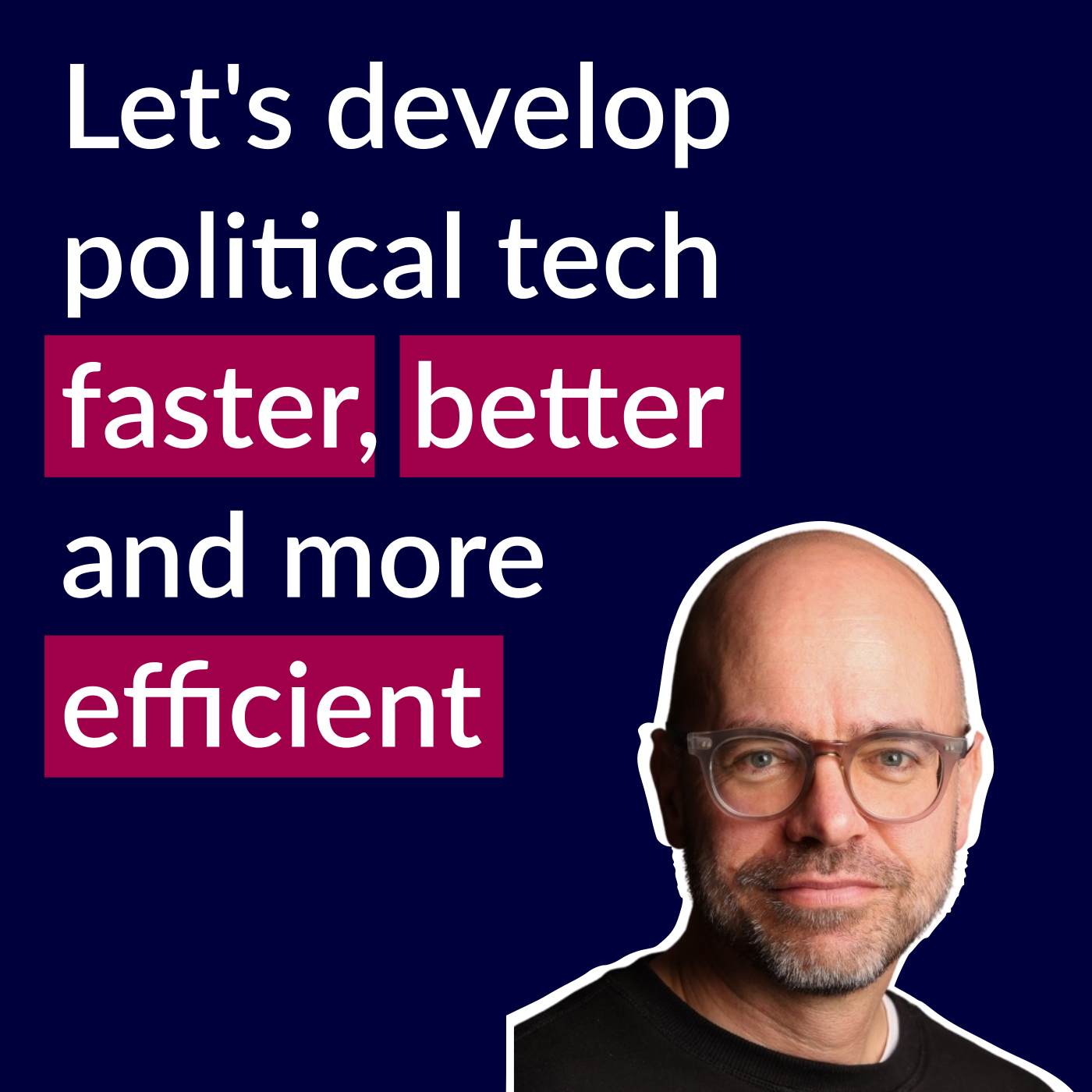
Josef Lentsch about the Political Tech Summit and huge potential in digitally assisted democracy
Democracy Innovators | 2025-05-12 | 55:29
In this episode of Democracy Innovator, Alessandro Oppo interviews Josef Lentsch, founder and CEO of the Political Tech Summit. Josef shares insights on political technology, the distinction between civic tech and govtech, and how technology can strengthen democratic processes. Drawing from his background in psychology and public administration, Josef offers a unique perspective on the challenges and opportunities in digital politics.
Top Keywords
- political tech 0.017
- political 0.015
- course 0.015
- tech 0.012
- tech summit 0.008
- politics 0.008
- democracy 0.007
- summit 0.006
- mean 0.006
- much 0.006
- data 0.005
- stuff 0.005
Transcript
Speaker 0
0:00 – 0:27
Welcome on another episode of Democracy Innovator Innovators podcast. And, our guest of today is, Joseph Blanch. Sorry. I mean, you're a political entrepreneur, book or you have written books, and you're founder and CEO of the Political Tech Summit. And so as a first thing, thank you for your time.
Speaker 1
0:27 – 0:29
Thanks for having me.
Speaker 0
0:29 – 0:42
And, would you like to tell us something about the political tech summit? I mean, because it was, it was last month. Yeah. So
Speaker 1
0:44 – 2:38
Happy to. Thanks very much. So, yeah, the political tech summit was, a premier. It was Europe's first, event in that of that kind. And, we've been preparing it for, about a year now. The idea was to to close a gap, in the in the landscape in the political landscape, but also in the market, a gap, because their politics is a very fragmented landscape still in in Europe. Politics is very much still nationally based, and, of course, it's organized, alongside political families. So there is not enough learning, particularly, within the the democratic center from center left to center right. And so we thought it would be great to create a space where peers can learn from each other very practically, with a few to technology, but also where, vendors and providers could meet with potential clients, where people could meet new partners. And, I'm very happy to say that, it has been very successful with more than 600 people from more than 40 nations. We have had great feedback. We did lots of surveying and interviewing, and people are really positive about it. So we already announced that there will be a second edition, in, January 2026 in Berlin once again. But for now, I think, we we are, yeah, very, very happy and delighted how well this has actually worked and and actually the impact it already has had. We've heard from from people that they already took stuff and and applied it within their organizations, within their political parties, unions, associations, and, and and that's great. That's that's exactly what what we want to happen.
Speaker 0
2:41 – 2:58
And, I was thinking about, I mean, the summit is about political tech, and, there is the distinction between, civic tech and global tech. If you could, tell us something more about.
Speaker 1
3:00 – 4:57
Sure. Happy happy happy to. So, civic tech is about empowering citizens, digitally. So, for example, with, transparency apps about, you know, parliaments and and and mended owners or stuff like fix my street where where people can can, put in complaints or can suggest, ideas for improving city life. So this would be all, under civic tech. Also, civic participation. So when it comes to, you know, deliberative formats or con consulting citizens, there are also quite a lot of platforms for that, and it's quite an established field. On the other hand, GovTech is about digitizing the public sector. So it it looks at the administration, and and how we can, improve, how we can make administration and government more efficient with digital means. And and in between between GovTech and CivicTech, there's a space, where organizations like political parties live, but also, you know, unions, associations, some nonprofits, businesses, anyone who's, involved in the political arena, who's doing political communication, campaigning, electioneering. Those organizations have quite, distinct and special needs. There are, of course, touch points and intersections with GovTech as well as CivicTech. Absolutely. And some organizations could be, I think, called, for example, GovTech as well as, political tech and so on. But but we really saw also at the summit that it's quite, a special community that has not had the chance to get together, so far. And the political tech summit brought this political tech, community together for the first time.
Speaker 0
5:00 – 5:26
Yeah. I I see the both, civic tech and, gov tech. I mean, that sometimes they overlap each other also because it's a very new field. And, before going back, talking about political tech, I wanted to ask you if you would like to share something about your background, personal background, also, eventually starting from when you were a child.
Speaker 1
5:29 – 9:52
Well, I'm I'm I'm Austrian by birth. I now live in Berlin with my family, but I grew up close to, Vienna, close to to the Hungarian border. So to me, I I remember two very important moments in my life politically speaking. One, of course, was the the the fall of the Berlin Wall, and the other one then was when the the Iron Curtain, came down, close to our home. So, you know, we always had to go to Hungary to visit France and wait for two, three hours at the border, and suddenly the border was gone. And and both of these things, of course, happened in close proximity, around the time where I was 13 or so. So in my youth, really. And and so they were quite of course, left a big impression on me. And this is why I think me and also, you know, many of my generation are really quite, optimistic about, progress and about the future, which is, of course, very much challenged right now. But but not too long later, of course, also, you know, Facebook emerged and back in the day Twitter, and then there was the Arab Spring. So the all this optimism then was projected onto technology. So, you know, I I was, among the first to to to use those things and really loved them because it helped me stay in touch with friends and and learn about new things. And, of course, you know, Facebook, Twitter, many other platforms, are very much being critiqued right now for for many things. I I still think they they they have, they have value to a certain degree. But in any way, I think back back in the day, the the the techno almost utopianism when I grew up of, you know, tech helping to improve the, democracy and and and helping to fix some problems, within the political system has now almost turned into the opposite where people now, almost have a kind of dystopian view of technology that it destroys and undermines, democracy. I I, of course, I'm not a believer in extremes. I I think while they're you know, we can make fair arguments for both of those things. I think what's interesting to me is how can we use technology and what's out there, to, improve political communication management, campaigning, because we know that democracy is under attack, also partially by and through technology. We know that that politics needs to change. We know why. We know even what needs to change. I think the hardest bit is how. So what I've always been interested in and back in the day in 2012, I was involved in in founding a new political party in Austria, which is now entering government. It's called Neos. So my interest was always in alright. So we all we have all those ideas, and ideas, of course, are cheap. Anyone can have ideas, but not everyone can or is is is willing to to put in the hours to actually make stuff happen. So I've always tried to help make stuff happen, not always successfully. But what always what gets me excited is doing stuff, creating stuff, cocreating stuff, getting others to use the stuff, and then, like, with political tech summit, finding from their feedback and their responses and directions that it's actually useful in a very practical sense. So I think this is what we need much, much more of. I'm I'm glad to say that, there are more and more what I would call political entrepreneurs around, doing, establishing new initiatives. There's still not enough funding, but that is as well also changing. There's more interest from investors, also philanthropists in helping to do those kinds of things. So I I think we we see, a positive development. The only question really is, are we fast enough? And and I don't think so. I think we need to become faster, and bolder and and more courageous because as I said in the beginning, democracy is under threat, and and it's a it's a you know, we're in a battle against time, I'm afraid.
Speaker 0
9:54 – 10:21
Very interesting thoughts about the one about, the speed about the and, yeah, I have another question more related about your professional background or academic background. You partially also talked about it, I mean, about your professional background. But, yeah, if you like to say something.
Speaker 1
10:23 – 14:16
So I'm I'm a psychologist by training. I I did my first masters at the University of Vienna, in psychology. And so I'm I'm very interested in in the individual perspective. Psychology is about individual behavior behavior, and and impressions, and decisions. And, of course, over the last years, a lot of stuff has happened in combination with, neuropsychology, really understanding how the brain works and how people, make the decisions and also how, you know, in intellectual thoughts, how ratio relates to the emotion, and and that actually emotion is very much what drives us as as human beings even though we like to believe otherwise. So so that's to this day, I'm still taking often a very individualistic perspective also of politics. Right? Understanding why individual actors, act as they do, why they take certain decisions, sometimes, of course, disastrous decisions, sometimes for the better, What are their motives? What drives them? What are they looking for? What role does emotion play? So that that that's one part of of my scientific and academic perspective. The other part is that my second master's, has been in public administration. So, if you will, a a more abstract, more systemic perspective of politics, of government, of of the state. So really zooming out and trying to understand how do those structures and processes of politics then produce a certain policy. And I think as we have seen over the last years, really, is that that policies often are not so much the problem as the politics, because the politics is, in many cases, these days, the bottleneck. You cannot get stuff done. You cannot get stuff decided upon. There are a lot lot of blockages. And then, of course, know, it's very hard even if you can get something done to communicate it, which is still, of course, part of the politics and the implementation. So this is what I've always been interested in. I've been more a politics nerd, if you will, than perhaps a policy nerd. I'm still interested very much in policy, of course, and it's it's essential to politics. But but this is always the part and how do people act in it, which is, again, more the psycho psychological question. And so I've written a book, which is called political entrepreneurship, where I I looked at at NEOS, the party I helped cofound in Austria. But back then in 2019, also, other new political parties in Slovakia, in in in Spain, in France, and asked, you know, how have they managed to be successful, how have they managed to enter parliament, what have they done, who are those people behind them, what has driven them, how have they acted, what methods have they used. So, again, very much practical, pragmatic book on on how you can actually do something that complex as founding a new political party and then get it to enter parliament and even perhaps governments. That that is the combination, of many, many things that I'm interested in, public administration, psychology, politics as a whole. That that's that's what get me what gets me excited.
Speaker 0
14:19 – 15:26
Yeah. The the question about why some people participate in public life and some not is something that I asked to to myself many times. And in a way, it's also why I'm interested, by, yeah, this word that is, I mean, civic tech, but also, GovTech and everything related. And, I'm thinking about what you were saying. So I think there is a, like, a sort of cultural problem because this is also something I want to tell you about, if politicians, I mean, policymakers, if they have enough knowledge about, these political tech platform movements, because, I mean, there are, policymakers, then there are citizens, and it seems seem I mean, technology evolved very fast, and it seems that we, I mean, most of the people are not aware of, the potential use of technology.
Speaker 1
15:27 – 19:35
Absolutely. I think you're you're spot on that there is, of course, an awareness, right, of of technology and and and an increasing awareness of that technology is political and and that it can again, right now, you know, how it can harm, the the politics and and democracy. I think, in general, people are aware of that. Right? What they're not aware of are so what tools do I have, available? What what tech stack can I build to do my job, which is, you know, campaigning, communicating, winning elections, better? Right? There there is a gap. And and I just talked to somebody, from a a political organization yesterday, and and they told me, well, you know, political parties but, also, I think that that applies as much to, you know, to unions, associations, and other political organizations. They burn an awful lot of money on on useless tech. Right? And and and that means it might not be a bad tool, but it might not be the right tool. Sometimes it may also be bad tools. Right? I mean, we know, in political tech, there are many, many custom developments, because every organization thinks they're unique and they have unique needs. And, of course, there are big, big platforms that you can buy off the shelf that are very expensive and often too big and too too powerful, so that's also a problem. But then, the conclusion that you have to build stuff by yourself because you know best what you need, is not necessarily, the right one, because often those platforms and tools that get developed for a specific organization get developed once, are not necessarily programmed very well. And then and then they don't get developed because this costs money, and effort, and people don't use it. And then you have, these these legacy legacy tech landscapes of of tech stacks that are, you know, years old, out of date, are not being used because they're clunky. So so, yes, there is a big, innovation gap, in politics. What we saw at the political tech summit is that, people, once they see what they can actually what they could have, what they could use, and and how they could, you know, potentially stack tools, together. There's a CRM. There's a social media management tool. There's a data analysis tool. There's a mobilization platform, and you can put those together. Then you suddenly realize what potential is is in there. Right? Of course, it's not done by just buying it or subscribing to something and paying for it. Of course, it needs to be implemented. That's the next problem. Right? Because then you talked about culture. You need a certain organizational culture. You need, structures. You need responsibilities and account accountability to actually then, make the organization use that tool and learn that tool and and, you know, getting into the the the muscle, so to say, of of of the organization. So that that's all quite complex. It's it's it's it's it's doable. Right? It has been done before. And, of course, as always, some organizations do it better than others. So what we're also trying to do is we're trying to make case studies available and speakers available who have achieved something, who have done something in the field of political tech and really, get people to learn, how they can actually do something like that. You you never can copy paste, you know, from one organization to the other. But, of course, you can learn, about success factors, about, you know, what what about fails, which is also important. So I think there's an increasing awareness. I think people look for solutions and for tools, and this is what we want to provide.
Speaker 0
19:38 – 20:45
I I I saw this fragmentation in political tech, like, where every organization build their own custom platform or maybe they, they buy the platform from from someone else. And several times, I thought that, maybe people that are working in civic tech or GovTech, they can also collaborate on, building a platform that can be, like, modular. And so that, like, it it can be customized. I'm thinking about Desidiem, but, also about other kind of platform. So you don't have to build the platform from zero every time, but you just modify something. And, I'm curious about, like, for a political party that wants to use some news new technologies, what has like, how to be successful for a political party?
Speaker 1
20:46 – 24:53
That's a big question, of course. How to be successful? Well, I think it's a it's, it's, of course, it's it's there's not just one factor. Right? It it's about, realizing, first of all, what is out there. Right? We we have, 250 or more organizations already on our radar, in Europe and beyond who provide, different, tools and platforms and apps for for political organizations. Right? I I would bet that most political parties and other organizations can probably name two or three. You know? So so there is this big untapped potential of tools. And I'm not saying, you know, that that you don't have perhaps you have the best tools and then, you know, congratulations, but chances are you don't. And then, you know, what are the alternatives? But it starts with realizing, of course, one's needs, and conversations with potential partners can help because people often don't realize what they could have until they see what they could have. So so this is where it all starts. And then as I said, it's really about the the the implementation. It's about, not just buying the tool, but but but getting the organization to use the tool to to get everyone to understand why this makes sense and to show them how this helps drive a continuous improvement across the organization. So it's really a a a quite, complex and challenging process. But once you get a get you know, a lot of people, adapt sorry, adopt a particular tool, in in your organization, then the magic happens because suddenly you get data. Right? Suddenly you get data that you can learn from from from conversations with citizens, from mobilizing your volunteers, from social media, and then you can make better, data driven, decisions. And and and, of course, then this becomes ideally, a virtuous, circle where you can show and demonstrate to people that their work has helped you to make better decisions, which has helped them to be more, efficient and about their job and more effective, which helps everyone, to be better at winning elections, communicating, and campaigning. I think that's that's where the magic lies. Of course, this doesn't happen overnight. Right? This is hard work. This also needs people to own this and drive this. We know from talking to to many political organizations, and, you know, parties, unions, associations that most of them don't have, a head of tech, for example. Right? Somebody who owns the technology within the organization. And if they have someone, it's often a person that is not necessarily on the on the executive level, but often more an operative person. Right? Well, this is not ideal. You need someone, to to really own the portfolio. What we see in many organizations is that, there's a fragmentation within the organization of tools. So this, you know, department uses this tool. The other department uses another tool. Those don't talk to each other, so you create different data pools. And then, of course, you lose, the the the big picture. You lose to 360 a few of, you know, your your your voters, your activists, whoever it might be that you're looking at. And that's a big, big problem because then, you cannot learn, what you could learn from from from those from the information that you can create. So those are some factors, that, you know, are not necessarily rocket science or new, but it still is hard to get them get them right. And if you get them right, I think, political tech can really make a difference.
Speaker 0
24:56 – 26:33
And, I'm thinking that, right now, there is a sort of transition, like, from the physical world to the digital one also related to governance and participation. And I I know that it's not possible to, to know when and if a complete transition will happen. Like, yeah, everything is changing so fast. Two years ago, we didn't have a ChargeGPT and, or other kind of, LLM. And, so I'm wondering if you I mean, I know it's impossible to say when and if, this will happen. But if you think if you think that, I don't know, in ten years or twenty years, like, there will be a transition toward technology. Because, I mean, nowadays, I mean, politicians, policy maker, they have their public social account. I mean, where they write things, citizens can reply, or maybe I'm thinking that, some, political party can have a private WhatsApp group or something else. But this is quite informal in a way. And so I'm thinking if, we can estimate when it will happen.
Speaker 1
26:36 – 29:54
Yeah. Yeah. I I I think there's, of course, huge potential in in in technology, in, making it useful for democracy, for for pro democratic politics. There's no question about it. Right? And, again, at the moment, we see, I'm afraid more the deleterious effects, but that doesn't make it, you know, less so that that there's a lot of positive potential. I'm really I really believe in that. So when when will we get there? Well, I mean, we we are I think, we're making progress in the sense of that, you know, there there are, for example, technologies that that help assist, facilitate deliberative processes. And and and then there's also, of course, now if you think about JetGPT and others other tools, this kind of listening and summarizing, of conversations. And I think there's so much in this, but but, you know, to your question, I'm not sure that we will, you know, leave and and that we should leave the physical space because I think politics will and should always be to a certain degree physical. So what I believe in is rather, let's say, digitally assisted democracy. Right? And, of course, we can also talk about stuff like, evoking. Right? And and and other things that that that lower the the hurdle for participation, that allow for participation in the political process independent of location of time. I think those are great things, but I think there's still a necessity in politics for people to get together in person, sit down, and and talk. I would I would even argue that that this hasn't happened as much perhaps as it as it could and should have, that people are more, you know, engaging in the in the digital sphere that this has helped or has accelerated a certain estrangement, from the, you know, from for citizen from each other, but also from from the political classes. So there there is this kind of undermining of of of cohesion, politically speaking, that I'm worried about. So I I absolutely believe, that that digital tools, that political tech, can help us, complement that and and and and and improve that experience. You know, why why should a human take notes if if if if a if a tool can do it, if they can help us facilitate an organize a discussion, better perhaps or or just as good as a as a person can. Very good. Right? But it still, I think, needs persons to sit together and talk and exchange views, and debate. I think that is at the core of of democracy. And and so I think that that will still be necessary, but it can be done much more smartly than it has been done in the past.
Speaker 0
29:57 – 30:21
Absolutely. And this is a point I would like to touch, later. And I'm thinking about all the different approaches in the inside the European Union. If you have seen some differences between, yeah, the understanding of political tech and the implementation of it in different countries.
Speaker 1
30:22 – 34:29
Yeah. I think if you look at brands, for example, I mean, Macron has has tried, a lot of things, particularly in the beginning, and I wrote about it in my book. You know, they used apps early on for canvassing. Basically, they took a lot of insights, and and learnings, of course, from the Obama campaign. Some of the people that were involved, helping Macron were also, involved with the Obama campaign. So there has been a kind of a cross pollination transatlantic wise. And and I think Macron was a big believer and probably is still a big believer in technology, and its potential. Right? So I think in that sense, France has been at the forefront. I'm not sure that Macron has really, you know, kept pushing this, as hard as he could have. But, of course, he recently also had the AI Action Summit, in in Paris that was organized by make.org, that that also showed, on, you know, very impressively what what you can do with with politics. And, of course, political tech was, also a part of that. I know that the commission, the European Commission is also trying out things, in helping, assisting, deliberation, the the deliberative processes with digital tools. I think if you if you look at at Germany, I would say there is, potential to, to improve and to and to catch up. The UK, you know, labor over the last year in the in the campaign has tried out stuff. So there is stuff happening. Right? It's it's not that, that there's nothing going on. Also in Germany, there are start ups and tools, that have been tried out in the recent election campaign, right, where you can where you use AI to, assist in informing citizens, and helping them inform themselves about the the programs and manifesto of the parties. Great stuff. Right? I think the the the the question as always in Europe is about scaling. So once you have reached a certain level, and and you have found your, you know, certain certain client base, perhaps even, that pays you. I think the question is how to go to the next stage, and this is where we get to the question of of funding, in Europe. There is no fund for political tech. Now in the aftermath of the political tech summit, there have been ideas, to to push something like that, to establish a kind of an investment fund. And, of course, if this happens, this would be would be great because this would then be a, a prototype that could be hopefully replicated, and grown. That that would be fantastic, because money is is is, of course, of the essence. You need to pay people to do stuff. You can only get so much, from from, you know, people volunteering their time. And I'm also not sure that that you should and could do everything through either philanthropic or or or, you know, public money. I think they have a role to play. But then again, you know, those tools also need to find clients to be sustainable. So, I think the potential is huge. I think the market is not there yet. Again, what we're trying to do with the political tech summit, and and the, you know, and and other things that we do, in in this field, trying to organize this community also digitally, with a new platform that we will be launching soon. I think this is really about, getting people together, share sharing ideas, and then, you know, really kind of getting down to business and getting stuff done.
Speaker 0
34:32 – 35:43
Yeah. I'm thinking about, yeah, what you were saying before. I mean, debating, it should be like the core of democracy. And, I'm thinking about the importance of data. Data, also before the digital era was very important. But nowadays, it is absolutely very important because, I mean, it can allows policymaker to know which kind of, things citizen would like to see happen. But also data is useful to train AI systems. And I'm thinking about, if you think it will be possible in the future for people that, participate in the public life with some, civic tech software, like, to to compensate them. Because I see this convergence between, like, I participate in the public life, so I use my time, my free time. And, also, I'm producing data that is both useful for technology and, public life.
Speaker 1
35:45 – 37:54
Yeah. I've you know, when when when I grew up, and I think this still is is is true for for many platforms, there was a saying, if you don't pay for the product, you are the product. Right? So this was, of course, about, selling your data. And and, of course, we know many negative examples of that. Of course, nowadays, it's also about, not not just selling, but also training models on on on your data. Right? And and and as you said, if there is a, value in this, if you add value by adding your data, you should basically, be owning your your data. And then, of course, the question is, you know, what's the model, in in in in monetizing that? So I think, absolutely, this is, you know, an an interesting, discussion. And and, of course, it's also about, you know, democracy, who owns your data. But but but in the end, it's also to a certain degree about business. Right? I mean, if if, again, if you create value, you should be able to to to to, capture some of the value, yourself, in in some ways. So, yeah, I think the discussion is ongoing. I think it's a very interesting one. I think data protection has undergone a significant change. I mean, when when I grew up, twenty five, thirty years ago, people didn't really care much about, data protection, and and and this has, of course, changed dramatically these days. I think these days, we we need to think hard, whether we haven't overregulated, sometimes, data protection, certainly, in some countries. So, I think we should look at that. I think we should experiment with that. And I think it could to the benefit could be to the benefit of everyone if we find creative models and solutions, that that benefit the the data providers, which are in in in that the case that you mentioned, also, of course, the citizens.
Speaker 0
37:57 – 38:17
But, I'm wondering if, right now there is some, I don't know, institution, political party, or some town that, is trying to use a civic tech platform and, at the same time, compensating people that participate.
Speaker 1
38:18 – 38:28
I don't know, to be honest. I I I wouldn't know of an example. Do you? No.
Speaker 0
38:29 – 39:04
Actually, no. But, I yeah, I was wondering if someone was exploring in this, direction because, yeah, I see that every one of us is very busy, like, studying, working, and everything. And so sometimes we forgot about public life that is quite important. And, and so I thought, okay. That could be a way to motivate people to participate more. And this is also related to the question why some people participate in public life and some not.
Speaker 1
39:05 – 40:38
Yeah. I mean I mean, what I know of, are are some parties use, platforms that incentivize you, through credits. So it's not the same as money, but but some parties use platforms that, you know, when when you volunteer for an hour or for certain amount of hours, when you show up, when you help with something, then you get credits on on a on an app, on a platform, and you can use those credits for different things. So that's, you know, a step in that direction, if you will. You you help. You you know, you you participate. You contribute, and then you get something out of it. So I I I think those are, again, interesting experiments. Of course, there are also arguments against that, because some say, you know, it it should be, internal motivation, if you engage yourself in in politics and it shouldn't be so much externally incentivized. I don't think there's a right or wrong, but I think it it it can be a part. And, of course, gamification, which which that is, is something absolutely that that we should experiment with and and and try out because, of course, people are less engaged than compared what what they used to used to be. And and so I think those kinds of approaches can help us with turning things around.
Speaker 0
40:41 – 41:20
Yeah. I also feel the same. And, I was wondering because, before you were saying, that, some parties are using some, kind of technologies for their and, if do you think that we will see some new kind of political party specializing technology that really wants to, to push this, to to use a lot of technology, or do you think that all parties will adapt? So maybe both.
Speaker 1
41:20 – 44:25
Yeah. We we already had, the pirate parties, thirty years ago. So, when I got started in in in politics, you know, the the the there was, of course, in Iceland, and now there's still the the party in in in The Czech Republic, which is quite successful. You know, in Germany, there was a pirate party. So and and they have been very, innovative, with technology. Of course, you could argue they've been so innovative, that that they couldn't handle, you know, concepts like liquid democracy, which are quite complex. But perhaps, you know, you could argue perhaps some of them or some of the ideas were just a bit too early, when when, you know, AI wasn't around. And nowadays, those things could be helped with by AI. So to your question, yes. I think we will see more tech driven parties. Of course, that's also a risk. I mean, the extreme case, of course, is now, Musk, driving the Republican Party, which is, of course, a very negative case, of tech overtaking, politics. But, yes, I think looking at the potential of of of tech and the potential of data and and the potential of learning from the data, there's lots of stuff happening. And and as always, there are some parties who are more open and more innovative, you know, the innovation leaders. And then there's some early adopters, and then there are some leggers. But, absolutely, we will see a step change in the coming years, because people and and organizations will realize what they can actually do with those tools using that kind of data and, of course, using AI. So I think we're only really we only have scratched the surface, so far. And and, you know, if you look at the US election, if you look at the general election, I think what you see is that they haven't been the, you know, AI elections that people expected them to be. But but, I've heard people say, you know, these would be the last elections where we talk about AI because at the next cycle in two, three, four years, everybody will expect AI to be used, so nobody will be talking about it anymore. So there's, you know, there is a revolution ahead. It's just not yet, not there yet, and it won't be as as as loud and and and and, you know, boomy as as, as it is now in the in The US. And, hopefully, it will be much more positive and much more productive, and and and less destructive. I think there is a fair chance, and this is, again, why we do the political tech summit, to make sure that that tech is being used for, for pro democratic purposes.
Speaker 0
44:29 – 45:22
I'm thinking about, yeah, the the the Pirate Party and the the liquid democracy. And, I think that right now, there could be, like, two two ways to kind of approaches. One is modernizing actual democratic processes using automation, AI, and other kind of technologies, or to experiment with new kind of, governance system as it could be liquid democracy or some kind of direct democracy. And, yeah, do you I don't know. What are your thought about? Maybe both should be done. So yeah.
Speaker 1
45:23 – 47:24
I think I think that's the answer. Right? I don't I don't think we should do one or the other. I I don't think, it's it's realistic and and and and desirable to switch, you know, to liquid democracy, or or some other concept overnight. Right? I think democracy has been there for some time now. It has its flaws. It needs to be improved, But but just, you know, throwing the kid out with the bathwater, I don't think it's advisable. So, yes, we have to assist democratic processes with technology. I think that's clear. I think, absolutely, we should challenge some some processes because if you, digitize a process that is dysfunctional, you get a dysfunctional digital process and not, you know, a a functional one. So that's always the problem. Right? Just because you digitize it doesn't make it necessarily better. So, yes, of course, we have to take a step back and and and and take a good look at at at the democratic processes and whether they're still still up, for purpose in the, in the twenty first century. And then, yes, I think we should also experiment, but, we should experiment in within defined limits, within defined areas. You know, regulatory sandboxes are a great idea, to allow for some stuff, to loosen some rules, to try out some things and do experiments, but but not, you know, with, I don't know, a country of of 8,000,000 or whatever it might be, from from one month to the next. Right? I think that's that's a risk that we shouldn't be be taking. So but but, yeah, of course, it's exciting. And then and then, of course, if it works if it works and some of the stuff will work, then we should look at how we could scale it and not over ten or twenty years, but but but but quite fast. Right? Because, again, it's a battle against time that we're in, so we need to move swiftly.
Speaker 0
47:27 – 47:43
And talking about risks and, yeah, the battle against time, is there anything that worry you about the use of technologies or other kind of things related to politics?
Speaker 1
47:44 – 49:43
Yeah. I think I think, you know, I I like to think about this in in in in positive versus negative disruption. I think what we're seeing in the in The US is quite clearly negative disruption at the moment. The way, Musk and others go about the government and how to disrupt processes, you know, impacting tens of thousands of people, and and the impact, of course, only will become clear, in the coming months and years ahead. I think, you know, that's not that's not desirable. But but I think what what what we do need is a is a kind of positive disruption, of of some of the processes that, you know, where where citizens don't feel empowered, not not not involved enough, not informed enough. I think this is where technology can can help. And, of course, you know, if if that's chat chat bots, if if that's, you know, AI agents. I mean, there there are so many tools coming out right now, that that that can help with with this kind of estrangement, of politics and the citizens. I think that's where we need to go, and this is where we need to take a hard look of, again, you know, our processes, and not just tinkering. Right? I think the, democracy is good at tinkering, and and being inert and slow to change. And there's also, of course, a protection mechanism of democracy protects itself. But I think, you know, when when there's a disconnect between the speed of change, in in, you know, in in the in society and and and in in culture and in technology, And then on the other hand, politics, you know, the the the fights or battles to to catch up and and loses, the momentum. I think that this is where we develop a problem, and this is where we are at the moment. So this is why I say positive disruption. I think there's lots of positive potential that that needs to be realized, and and we need to work together to to to do that, fast.
Speaker 0
49:49 – 50:01
How to reach this positive, disruption? And I'm very curious, when you say that we have to be faster, how much faster?
Speaker 1
50:02 – 51:45
This is a Yeah. That's a good question. How much faster? Well, I think if you look at many countries, right now, I think we're talking about one or two electoral cycles, which is some some something between five and and and ten years. This is what we're looking at. Right? I don't believe that, you know, the next election might be the last one, even though, you know, I'm I'm not sure with The United States right now, but, never bet against The United States. So I I I hope that they would that they will still find a way. I think it's quite critical, also in Europe. Right? If you look at if you look at, Germany, if you look at France, where the far right has been gaining, and and, of course, other countries where the far right is already in in in the lead or in government, I think it's, you know, it's it's it's five five to to 12, perhaps. We still can change things. We still can we still can impact democracy and change in a positive way. But but we don't have time forever. Right? And that's some some people and organizations, I think, do act as if there would be, you know, unlimited time. There is not. So I'm I'm neither believing that that we're doomed, nor nor do I believe that everything will be fine after all. I think that, you know, narrative of progress has been broken. And and so I think we have it in our hands. But within the next, you know, five to ten years is what what we're looking at, in achieving this kind of positive disruption, of of democracy. And and this is what I'm I'm I'm trying to help with.
Speaker 0
51:47 – 51:50
And, I have a another couple of question if you have time.
Speaker 1
51:51 – 51:54
And I have I have five more minutes than I I unfortunately need to go.
Speaker 0
51:55 – 52:17
Perfect. I'll try to be very quick. Have you seen any kind of different approaches to political tech related to, I don't know, left or right, in Europe? Because before we were talking about, different approaches from different countries. So I'm wondering about
Speaker 1
52:20 – 54:07
Well, I I think the, the the left, has traditionally more looked at grassroots mobilization, grassroots fundraising. And and so, therefore, I think, overall, there would be more, apps and tools that would also, you know, align themselves with the the progressive spectrum of politics, who do those kinds of things than, for example, on the right. Now I think over the last years, we see we've seen some changes. I think we've seen that, that the right has taken up some, some parts or aspects of of the left, including, becoming much better at mobilizing, organizing grassroots activists, voters, influencers. So therefore, it's not that clear cut anymore. And then then, of course, there are also some providers and vendors, who who do not align themselves with with with any political spectrum, but who just sell their product. So so, therefore, it it I mean, there I I I couldn't say that there is nowadays, a clear distinction. I think if you look at The US, I think there it is the case there that probably the the the the the left has more money available for technology out of the reasons that I, that I highlighted. But but but, I think that might might be changing as well.
Speaker 0
54:10 – 54:18
Last question. If you have a, like, a message for all the people that are working in the political tech field.
Speaker 1
54:20 – 55:19
I I think it's an exciting time to be involved in political tech, whether you are in a political organization or you are, you know, a vendor and adviser, a software developer. I I think there's so much happening right now that can help democracy, that can help improve politics. So I think it's it's a super interesting community. We're very glad to, to have gotten to know some some really exciting people, some really interesting organizations from across Europe and beyond. So my message would be, you know, let's let's get in touch. If if you haven't, been in touch with us and with me already, you can you can go to politicaltech, .eu, and you can subscribe. And, of course, you can attend the political tech summit, which will again happen in Berlin in January 2026. Would be great to see you there because there's so much to learn and so much to do. And if not now, when?
Speaker 0
55:22 – 55:24
Thank you a lot, Joseph.
Speaker 1
55:25 – 55:27
Thank you very much, Alessandro. It's been great.