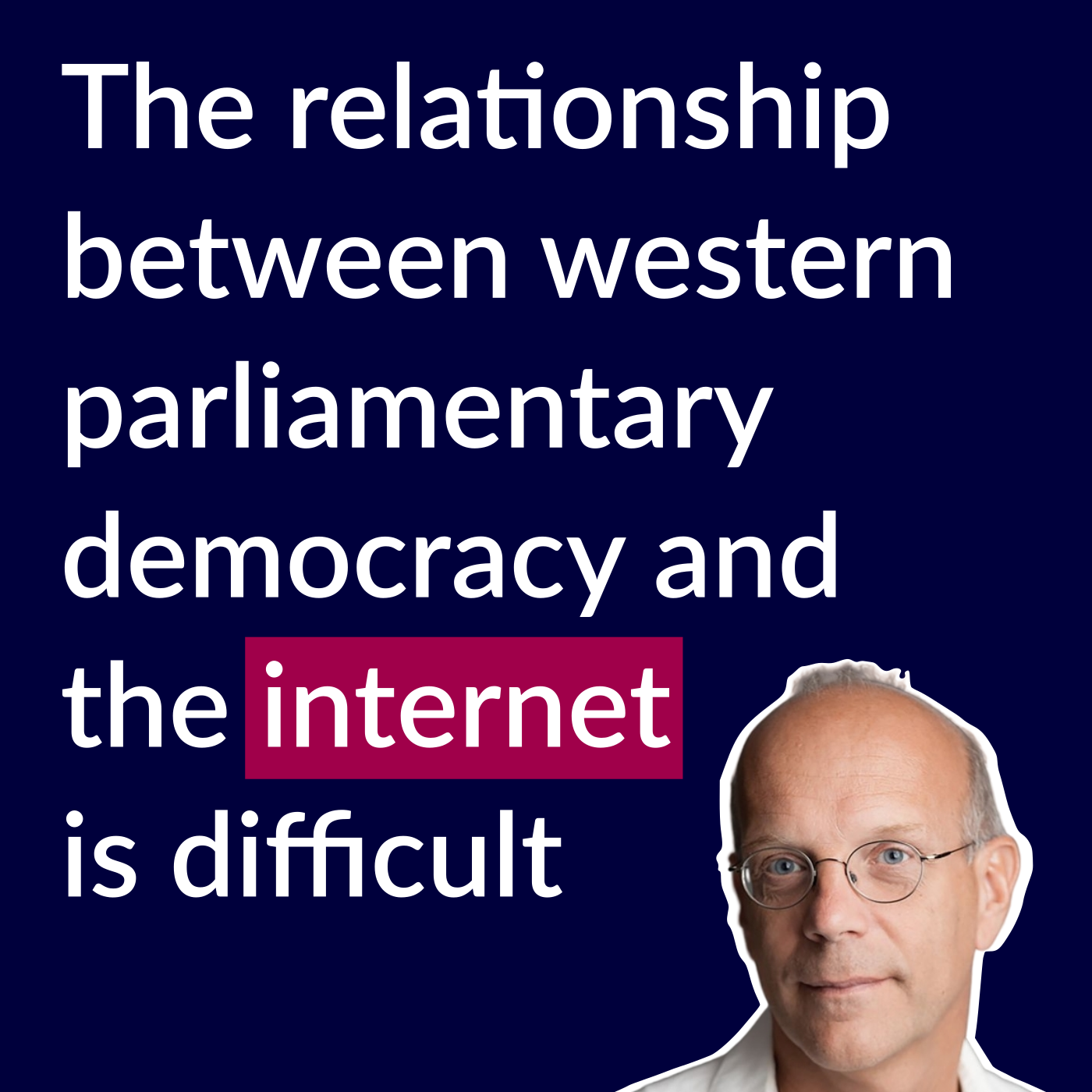
Geert Lovink about Democracy and the Internet. Do internet technologies help or harm?
Democracy Innovators | 2025-04-28 | 1:05:08
Media theorist Geert Lovink discusses the internet’s military origins, its evolution, and its problematic relationship with democracy. He explores how digital networks democratized information while proving dangerous for voting systems. Lovink shares insights from his work with alternative media and warns about AI excluding cultural knowledge. He calls for Europeans to develop alternatives to Silicon Valley platforms while balancing crisis response with building democratic technological futures.
democracyinnovators.com/geert-lovink-about-democracy-and-the-internet-do-internet-technologies-help-or-harm/
Top Keywords
- computer 0.012
- internet 0.011
- content 0.008
- media 0.008
- course 0.007
- computer networks 0.007
- nineties 0.006
- early 0.006
- media theory 0.005
- network 0.005
- eighties 0.004
- english 0.004
Transcript
Speaker 0
0:00 – 0:09
So welcome on another episode of Democracy Innovators podcast, and our guest of today is Loving Beard. So thank you for your time.
Speaker 1
0:10 – 0:11
Thank you. And,
Speaker 0
0:13 – 0:40
I have, a questions regarding Internet. You have a wide experience with Internet and networks, and, Internet is quite a new experience in humans being history. How would you describe the actual Internet and what Internet should be in your opinion? And, eventually, how we can reach that situation in which Internet is, again, a place of hope for all people interested in creating a better world?
Speaker 1
0:44 – 6:42
Yeah. The, the Internet, has a military, background. It is definitely a product of, the Cold War. And in that sense, you know, it is born out of, the rubbles of, World War two. And, it is, you know, a creation of the cybernetic principles, and, you know, early, let's say, computer computer science. The the Internet itself is an early network that was invented, let's say, in the fifties and sixties and started working itself in 1969. And it is based on the early principles of of time sharing between, computers that were, remotely in different locations. So it is really, a computer network. And people sometimes forget that because, yeah, these days, of course, the Internet is mostly accessed to, you know, on smartphones. And, but, yeah, it is basically, an a network between, between computers. And, and then, yeah, later on in the seventies and eighties, by accessing, the this computer network through terminals using, a computer language initially, the UNIX computer language. People started to to, see that they could, you know, not just only, communicate, to another computer, but, that they were, actually through chat and email, etcetera, that they were actually communicating with other people that were, in in different locations. So, they were not just accessing a computer, to tell them what to do, a certain, let's say, you know, computation, but they were actually, you know, talking to other people, elsewhere. And, this was initially, of course, inside The United States then in the in the in the eighties, also between, The United States and, its allies, in, in Asia, in in Australia, and then, of course, in, in Europe. And in the nineties, of course, this network then starts to, become more, privatized. It was no longer a network that was only accessible to the military and then later on, academia. But, in the early nineties, ordinary, people like me, were getting access to it. In the beginning in the nineties, the Internet was, competing, with other computer networks. And there's just there was, bulletin board systems, but there was also America online. There was, CompuServe and a lot of others. But, gradually, in the nineteen nineties, the, the Internet, started to become the dominant, computer network. And, this is also because, yeah, it was quite quite cheap and, kind of, you know, public. And so it was a public computer network because it came from academia after all. And, then, of course, because of the invention of Tim Berners Lee, the the World Wide Web was, created, in 1991, which meant that, you know, it started to have a a very easy to access, interface. And, people, who did not have, let's say, computer programming skills were able, to start, to, to use it. And then the first websites came and, you know, while the rest is history, as they as they say. It grew very fast because of, venture capital that was, added to it leading to the first, you know, .com, boom. And then, of course, in 2001, also the first, .com crash and recession. And we have seen, you know, hyper growth, ever since that period. Around 02/2000, there were about a billion people, and now we are over four, 4,000,000,000 people, using it worldwide.
Speaker 0
6:48 – 7:07
When did it happen that Internet get your attention? I mean, were you excited when you discovered, about Internet, about the World Wide Web? Is there any, episode, any particular moment that you remember about
Speaker 1
7:10 – 10:35
Yeah. Of course. I mean, there is the, the epic, galactic hack party in the in the hippie temple, you know, in Amsterdam, called Paradiso. And, we organized a big, computer hacker conference, there. And, this was in August 1989. Quite an exciting time because, at the time, also the the Berlin Wall and the whole, you know, changes in Eastern Europe were about, about to happen. And, of course, these things are, you know, related because, yeah, this is the the big changes, in the nineties, were not, not only, you know, of, geo geopolitics, but also, coincided with, the technology and the globalization. And so these things, opened up, the possibility for many, many people worldwide, to start to, to to communicate with each other and exchange, materials in ways that, you know, were were almost impossible and very, very slow and expensive, before, before that. Yeah. There there were, of course, possibilities to, let's say, democratize, the the media landscape. And this was the, the initial promise. I came from, the new social movement, from squatting, from the, anti nuclear movement. And, so we had a lot of experience with, you know, building our own, alternative media using, free radio, pirate television, and, of course, a lot of, publishing of books, zines, and so on and so on. Right? And, in all these, media, we already, made use of the of the computer, of course, you know, in because, yeah, in the nineteen eighties, it was already possible, you know, to create music, to to do desktop publishing, to, you know, to create even this yeah. May maybe a little bit more in the nineties, we started to create, of, you know, videos, digital videos. So, so all these, let's say, alternative underground experiences, were, directly connected, to, you know, the the the democratization, of, of all these, tools that made it much, much easier not only to produce, but especially also to, distribute and exchange materials. And then later, of course, combined, you know, we were not only exchanging materials, but we were, you know, communicating with each other.
Speaker 0
10:38 – 11:13
The the access to culture is very important, and I would like to talk, about it, but a little bit later. And I would, would like to ask you, about your background and eventually, also starting from, I don't know, from when you were a child, if you have, something to say about, memories that can, can inspire or also about, of course, your academic background and professional one.
Speaker 1
11:15 – 17:07
Yeah. What's what's defining, maybe it's not so much, you know, my my early experience with the computer that, of course, go back to, you know, the nineteen sixties when, all this was also very much related to science fiction maybe. And, I grew up, of course, with that, kind of, imaginary, started using punch cards into computers, yeah, probably in for the first time in the early nineteen seventies in school. I I I came across, these machines that, you know, for us, were primarily used maybe to make, calculations. And I kind of like that. I I like the idea that, you know, we're ultimately still talking about, let's say, very clever interfaces to machines that ultimately, just make an enormous amount of, calculations, for us. Right? That's a computer and, and and that's a smartphone. These are calculating devices. And, yeah, to, I have I'm also, of course, that that that's inevitable. I'm also a child of 1984. There is no doubt about that, which is not, of course, you know, the the title of the famous, George Orwell book. But, yeah, I I kind of grew up with a very, high awareness of, of the surveillance state and, and the the idea of the computer that, was going to use, by the state and by big corporations to to surveil us. This was, an an idea that probably grew came up already and that was very much aware of us, in the nineteen seventies, when, you know, the the the the Western, police, apparatus and the state were using computers, to control, the population. And so I come from, let's say, the Italian autonomous and German autonomous school in which, this kind of use of the computer, was early, you know, was theorized very early on. So the computer was never really an innocent device. Right? So from the very, beginning, we knew about its military origins, and we knew about, you know, its, its evil intentions. And, yeah, I wanna I wanna take out there one specific book, which is, let's say, German, but very influenced by, of course, the Italian autonomous thinking from the 1977, movement. But, this book, is written by two, two Germans, and it describes the way, the Nazis, were using already, you know, the, the IBM, computers, the very early, ones, which were maybe not so much computers, but they were calculating and sorting, devices. And, this story really deeply influenced me when, when I read, in in West Berlin when I was living there in, in the squats, about, the way, the Nazis were using, the IBM, computers, in their, you know, relentless effort to kill all European Jews in the in the holocaust. So the computer, played an important role, in sorting sorting the population, sorting out, you know, selecting people. And so the computer, as a selecting device, yeah, it's kind of always stayed with me. So when we started to, you know, enter this field of the democratization of the computer, we were always doing this, you know, with mixed feelings, so to say. We knew, of its very, very destructive, nature and, capabilities. And and knowing also that, you know, we had to, intervene there, but also, you know, not doing that with too much, naivety or utopian ideas. We were, very well aware from the mid eighties onwards that, the fight over the architecture of the computer and the computer networks was going to be a very, very tough one and was going to define, the decades, to come. This was clear very early on.
Speaker 0
17:12 – 17:26
And, about your, professional experience and academic background, would you like to share something? How did you, how did it happen?
Speaker 1
17:27 – 23:31
Because I studied political science and sociology, from 1977 till '84. But this was, of course, also very much defined by my involvement and, participation in a range of, new social movements, but particularly, the squatter movement, in Amsterdam, but also, in in Berlin where, where I lived. In my life, I've always, gone back and forth between Amsterdam and, West Berlin, which was later, of course, called Berlin after the fall, of, of the war. Yeah. Initially, this was, very much about, let's say, political philosophy, and theory and and sociology, of course, you know, at the time, of course, the study of Marxism, the history of the, of the labor movement, socialism. But in my case, anarchism, you know, was, was really defining, my own intellectual trajectory. But, we tried early on to, really develop that, let's say, in contrast with our own experience, in the social movements, knowing that, you know, the the big, let's say, stories of the twentieth century, around Marxism and the the intimate emancipatory power, of the labor, of the working class was, you know, going to an end. And, of course, you know, we we then literally experienced that, of course, in the in the collapse of the of the Soviet Union, five, ten years later. So we we kind of, actively contributed to the to the decline of, let's say, the Stalinism and and the rigid, dogmatic forms of, of Marxism. Because of my involvement in the in the whole question of, of media communication, I started to develop, a, yeah, an interest in, what was happening in, in West Germany at the time, which was, called the rise of, of, media theory. And, and, yeah, I kind of developed myself also as a as an as an independent media theorist. And that sounds a little bit strange because I wasn't academic. I never really saw myself as an academic. I saw myself more as a, you know, if you like, a Gramscien organic, intellectual relay, part of the social movements, and, as a media theorist. And that it's basically what I'm what I'm still, you know, practicing and trying to, develop further. This field in my personal, biography is very much related to, two Germans who knew each other quite well from the city of, Freiburg in the South. One is called, Klaus Stavillite, and he is the author of Male Fantasies, a book that really, really defined me, you know, maybe together with, Dolores Gattari, but also with Elias Canetti's, Crowd and Power. A lot of things, in this epic work, kind of comes together. The other one that also, was there at the time, is Friedrich Kittler, and he is a media theorist. And, he has written a number of, books, but, that really defined my intellectual, let's say, biography. But, yeah, you could call him also the the Foucault, of, of the of the media. Right? And so he really kind of completely revolutionized the the initial, let's say, groundwork that, Harold Innes, George Grant, but, but then also Marshall McLuhan late. Right? Which is kind of the the earlier, Canadian media theories from from, the post war period. And, yeah, I started to participate, in in this, in this scene, in this, maybe movement, the German German media theory, which was, quite large, at the time in, let's say, the late eighties and early nineties. And, what then happened is that, I kind of took this experience of, of the hackers and the computer networks and the media theory, and I brought that, to the context, of, the emerging, Internet in the early mid nineties.
Speaker 0
23:36 – 25:08
As I said, you have a lot of experience with Internet. And, as you, reminded us, Internet was created for military purposes. And, unfortunately, it seems that, as a human special specialist, when we develop new technologies, then we use them. We use it to to kill each other. And this is something said. Yeah. But, yeah, eventually, Internet can be used, also, as you said, to democratize access to culture. And so the role of culture. I mean, because Internet challenged maybe the way knowledge was produced and distributed. And, I'm thinking about also copyright. And Mhmm. It's something also very actual because of AI. So if I read something and then I write a book, who is the owner of that content? Mhmm. These are philosophical questions, but maybe as a society, we have to rethink how knowledge is distributed. And, if it's convenient, I honestly think not for society to have this kind of economic barrier, to access culture. And I'm referring also to the, foundation for the advanced advancement of illegal knowledge that
Speaker 1
25:10 – 32:01
Yeah. Yeah. Let me let me first start with that because that's such a great, episode and very important part, of my life, especially in the, in the eighties and nineties. I joined the, Foundation for the Advancement of Illegal Knowledge, in 1983. It's a small group, of, Dutch, let's say, floating, intellectuals. We were all, you know, unemployed. We were not, academics. We, we operated outside outside on the fringes of the, of the social movements. And, our aim was to develop, an independent, media theory, but really focused on the on the question, of, you know, how, this this speculative, field that was opening up, could be, could be, not colonized, but could be could be divined, could be designed, with a subversive and, with independent, concepts. And so we we were really like, yeah, maybe a classic, you know, the Lausanne concept machine, if you like, outside of, academia. And so it it also meant that what we wrote that we also, you know, practiced. We had our own, radio stations and and publishing houses, and, we were also, giving classes and reading groups and so on and so on. And, yes, we were also, writing our own books. By the way, this was happening, the whole, time in the eighties and nineties in Dutch. Right? We did not write, in in English. So, this is definitely, you know, before, let's say, the Internet in that sense. I myself, started to write in English only when I was 35 years old. And, when, it be just became impossible to translate everything. So initially, I wrote only in in Dutch and, and in German. And then, because, of, yeah, the troubles, of the translation, this was just not viable, anymore. So, I switched to English, a language that I knew since I was, you know, a very small kid. So it was not a question of, that I that we were not good enough in English or something like that. But, yeah, we enjoyed, you know, writing, in our own language, which I think, you know, in the eighties and nineties was definitely, in Europe, much more, widespread these days, unfortunately. You know? Alex, really, you know, why are we not talking in Italian? This is really a mystery to me. Why are we having this conversation, you know, in English? But it tells something about, our times and, and also about, the way in which, you know, the production of theory and collective intelligence, has shaped, and also, you know, has shaped, Europe, in the past, decades. Yeah. The the the the group, produced a number of, interesting books. We wrote the history of the Amsterdam squatter movement. It's called, squatting the, the media in in English. But but the maybe in this context, the most relevant is the book that came out in '92 in Dutch and then in German and in, and many other languages, and eventually also in English in '98, and it's called the media archive. And the media archive is is really a book with, an enormous amount of, speculative, figures and concepts. Most famous is probably, you know, the Data Dandy, which is kind of a person related to the early days of, of surfing the web, which, you know, was, it was a strange phenomena for us at the time. But also the idea, of sovereign media was very important. Sovereign media were basically media that were only broadcasting to themselves and had emancipated themselves from any, idea of an audience that you you know, that I'm now talking to you. I'm not talking to other people. Right? We are just having fun ourselves with the medium, that we are using. And in this case, our medium is, is the Internet. And so, yeah. So for us, sovereign media was a very, very important, emancipatory moment, because, broadcasting and distribution can also be be very cumbersome and, boring. You know, if you look at, how, TikTok and Instagram, you know, are producing an an enormous amount of influencers and how boring they are. You can see that, you know, the the the broadcasting or webcasting, is is quite a burden on humankind. We should really get rid of that that idea, because it's really, yeah, not not leading us anywhere. It's it's just very, very boring content that comes out of this. So to to get rid of the idea of, of reaching other people, you know, this kind of, evangelical, impulse, inside us, yeah, is something, you know, that we thought we should make fun of.
Speaker 0
32:04 – 32:25
Yeah. Absolutely. And, it's a good question, the one that you made about why we are not speaking in Italian. And, I know that you also speak Italian. And, but but then, yeah, a lot of people will not
Speaker 1
32:26 – 32:27
No. I spend.
Speaker 0
32:30 – 33:02
And, I also agree about the quality of content on, social media. And, about that, I think about, let's say, independence of both. Like, I mean, yeah, we are having a discussion, then the discussion is going to be published. And an algorithm that we do not control in any way is going to, yeah, I mean, to distribute the content based on Well, the Yeah.
Speaker 1
33:03 – 34:54
But maybe that even, Alex is is an, is an idealistic notion because maybe in secret, we hope that, you know, an algorithm will visit us. But, maybe maybe that's not even, going to be the case. So, in that sense, the whole AI thing is also based on, you know, a very idealistic notion that all content, you know, will be, utilized in one form or, another. I fear that, you know, that, it's going to be much much more bleak, namely that, only very, very selected kind of, group of of content makers and, people who are in in control, over over the databases, you know, will, eventually define, you know, what, knowledge, for for humankind is. And, it's very clear for me that, very soon we will have, you know, a kind of shadow, cyberspace, space, outside of the AI machines, where, people, you know, will still, kind of trade, other types of, of content, because, AI will really, be, so boring and will shut itself down necessarily for for a range of reasons. So it will not, it will not include the thoughts of, of you and me, I can tell you.
Speaker 0
34:56 – 35:18
Yeah. And this is, also a fact connected with why we are speaking English. I mean, at the moment, the most famous social network came from other countries Mhmm. Mainly Yeah. US. Mhmm. And, there could there could also be, some sort of political influence because of that.
Speaker 1
35:19 – 35:20
Yeah. Obviously.
Speaker 0
35:23 – 35:28
Yes. And, yeah, and that's why we are speaking English.
Speaker 1
35:28 – 38:37
Yeah. Exactly. Yeah. So we we have to understand that this is already, an incredible, limitation, in a way. You know? When when we look at it, from, the, incredible, diversity and depth, of of cultural, knowledge, worldwide, you know, when we don't even have to talk about indigenous knowledge, but we can also just talk about, you know, our own. It doesn't really matter. There are so many layers, that will not, you know, that will not be, covered, that will be, excluded, and forgotten. Well, if, you know, if we do not, if we do not act and if we do not actively, organize, you know, counter, databases, counter knowledge, counter libraries of, of the, you know, written, and performed, human experiences. And, they're very rich. In fact, you know, the the the archives, of the twentieth century are are incredible are incredible. And, I I really fear that most of that will just, be, forgotten because not just because it's not, digitized. Right? The idea that, we are going to, save our souls only, through digitization. It's only partially, you know, true. I think, there are anyway, enormous, richness, of cultural memory that, that cannot and will not be digitized. You know? And that, is anyway, you know, embodied knowledge already. You know? And and that's the the knowledge that we already have, you know, stored inside us, not just in our brains, but in our entire bodies, you and me and millions of others. Right? So, so we have to really, really be careful, in the in the coming years, not to reduce all this, in the whole, you know, AI spectacle that, that, is, is ahead of us. But I'm confident that, many of us, you know, will see that, this is only will only represent a very poor, 1% of, of, of all the things that, that we've, gathered and, have access to.
Speaker 0
38:38 – 38:53
Yeah. I'm afraid, about terrorist that, says that from an an Internet of quantities will will go toward an Internet of quality. I share this top of that we will not just produce content,
Speaker 1
38:54 – 38:55
and,
Speaker 0
38:55 – 38:57
we will produce good content.
Speaker 1
38:58 – 45:09
Yeah. But, you asked me before, you know, about, let's say, the the history of content. And, yeah, for me, that is a really fascinating topic that, we don't really, hear, much, about Because, in computer science, but also in Silicon Valley, people have very ambivalent, ideas about content. Content, you know, according to, Marshall McLuhan already, didn't really matter. Right? And so the the really hardcore materialist, media theory already tells us that that content is really it doesn't it doesn't matter. It's it's not what it's about. Right? It's about the way, the computer networks are organized, how they are, how its architecture looks like, what it excludes, and so on so on. But the content itself, is is irrelevant. And, yeah, in the nineteen eighties, I think, when I was really becoming fully aware of this, that was, that was quite a shock. Because in the sixties and seventies, we were still thinking, you know, in in terms of, ideology and in terms of, the gramption, maybe hegemony. When when you have good ideas and you bring them and you share them, you know, among the people. Yeah. These these were all still, let's say, movements that that that were driven by idea that, if you if you have good content and if you can tell the truth, you can convince people and you can make a difference. Right? And the revolution will ultimately, be driven by this kind of rational, motive, that eventually, the truth will, set us free. Right? And, yeah. So this kind of realization that this might not really be, the case or not the case anymore, maybe in the past. You know? It would have been the case. Who knows? But, certainly, in today's world, content, is just is garbage, basically. And for me, that was very difficult because, I've always struggled with this, idea. On the one hand, I have to fully, be, aware of it and, have to understand it and to reconcile with it. On the other hand, I'm a content maker myself. You know, I'm I'm a writer. I'm I'm we're producing books and and videos and so many, you know, weird and good and, and subversive content. Right? And so this is this is a very deep, paradox, in our in in our approach because, our materialist theories tell us very, very different idea. While, our passion and our, creative, you know, energy and and theory and, political debates and everything. Right? All that, is essentially, garbage content. And so, yeah, this is this is very difficult. And up up to today, this is this is, true even, more so in, in AI. You know? The AI, is a very, let's say, expensive and complex, let's say, set of rules and and theories and languages and so on. But, you know, it it it can, just use, the whole, history of humankind in a couple of weeks, to train itself. Right? And there you can already see that the the content, that it's, it's using to train itself. It's basically garbage. It can be anything. Right? And so, yeah, that's, that's, pretty shocking, again and again. To think that, artists will not make a living, writers, any kind of creative worker, you know, will have to be, either supported by the state, or just basically have a have a day job, do something else, and then create all these beautiful things, you know, write a symphony, a novel, film, etcetera, in the evening hours because, with the content, you will not be able to make a living. And, yeah, this slow kind of realization of the of the, let's say, past, twenty, thirty years, has been a really, really difficult one, for for all of us. Because if you are really like us on top of the game in the Internet, this is the ultimate, you know, realization, that those who, create the the the con the content are basically the garbage workers.
Speaker 0
45:11 – 46:41
Yeah. Absolutely. I like the paradox between producing content and, at the same time, recognizing the limit of that content. And, I'm thinking about, you said maybe the word contract before. So content contract. And, I've looked at the Institute of Network Cultures, and it seems a wonderful project. And, also thinking about, I mean, network, could be also network of people, network of devices. Mhmm. Yeah. Network of devices and people, and, how we can, I'm really fascinated by the centralization and decentralization, also related to information, but also power, and the information is power and vice versa. Yeah. And, I mean, now there are new ways maybe for humanity to, relate it to governance. And, I don't know. What is, like, democracy for you? These new technologies can help us to transform the system that we are calling democracy. I mean, liberal western democracies. And, yeah, what are your thoughts about this topic?
Speaker 1
46:41 – 52:19
Yeah. From a media theory and from an Internet perspective, having worked in this field for the last thirty years, I have to say that Internet and democracy, they have very little in common. They then they don't really touch. And if they touch, it's pretty, disastrous. So, we can talk about the democratization, the opening up of the medium itself. That is in itself, you know, an interesting, way. And, of course, I have been working on that for for all this all this time, to to educate people, to show, to have work, you know, on open access, open source free software, creating, libraries, making, you know, alternative content available, etcetera. This this is, the use of, of, computer networks in in education, you name it. Right? So this is the democratization of the medium itself. Now the relation between, let's say, western parliamentary democracy and the Internet is a very, it's a difficult one, from from in fact, from quite early on. The so there is no real, link. Let's start with one, with one very obvious, obstacle. From very early on, the computer networks, have maybe contributed to the creation of, discourse of, you know, of of talking, maybe of, also of discussion or of debate. You know? Maybe maybe. K. There are a lot of, hidden power plays there and inequalities and, you know, things that are but you could say, okay. The the Internet is kind of a a discursive machine. Okay? However, you know, is that feeding into, let's say, the decision making process that is happening in parliament or in government? Maybe not. Right? Very it's very problematic to to, to even point at, you know, where where this this is really, contributing in a constructive way. Right? Nowadays, of course, we know that with the Internet, you can, you know, bring down governments and and subvert all sorts of systems. Right? And the old right, is very, very good at it. And so for the last ten years, we we have, really studied at length, you know, how, Internet, culture and social media in particular, can be used, to undermine, let's say, the state of, yeah, the the rule of law or parliamentary, rules or, you know, corrupt, government apparatuses or or or political parties, you name it. Right? But, most of all, what we see there is that the the Internet has, had no influence whatsoever on something like voting. Is very, very interesting. Internet, is not a tool and has so far not been a tool for decision making processes. Right? You could say, okay. Maybe the, the Internet is used in election machines. But if you have a low closer look and, you know, if you look at the the long history, how hackers look at, the disastrous way the Internet can be used in, in elections, You you will see that, most of the computer hackers, will say, don't use any Internet, if you wanna you organize, an election. Right? And so this is very strange. Already since the nineteen nineties, when you go to hacker conferences, etcetera, the strong advice is don't use any computer networks in elections. Right? Because they can and will be hacked, and the whole, democratic process will inevitably be undermined by our machines. Yeah? So that is in itself is interesting. Right? So computer networks and, let's say, democratic processes of collective decision making, they don't go together. Don't. Right? And so that in itself is very interesting. And this is a takeaway of many, many generations of computer hackers. And I and I fully agree that, you know, we should not, let these two things, even come close to each other.
Speaker 0
52:21 – 52:43
This is very interesting because, at all, I think we have, some technological solution that could actually help people to agree about certain topics. But at the same time, it's very true that, technology can be hacked in some way. And then, the result maybe is,
Speaker 1
52:43 – 53:49
compromised by Yeah. There you go. And so yeah. I'm I've been very interested in decision making processes, using, you know, software, in smaller groups and maybe even in smaller, social movements. But even there, let's say, the the outcome of that was, was a mixed feeling. So, yeah, the fact that, you know, the the outcome can and will be manipulated, is not a good one. It's certainly not it's not what you want. And that's why I'm saying, the the Internet can be used for critical discourse, but, it's when it comes to, probably, collective decision making, it's very, very, dangerous. And it's best to, switch them off, when it comes to, voting and real decision making.
Speaker 0
53:52 – 54:17
I I understand, what you're saying. I hope that, I still have in some way is to, maybe not use anymore, the voting system, but eventually to deliberate just talking as we are doing now, but Yeah. About a certain political social issue. And
Speaker 1
54:18 – 55:55
yeah, consensus seeking is, of course, ideal. But, yeah, let's I'm still very much in favor, you know, that we do more, experiments. And so far, in the last decade, not many, such experiments, have, happened. And, you could say, okay. You know, we're maybe with, you know, the DAOs and the the blockchain experiments, that was, that's, yeah, an attempt in that direction. But, when you start to look at it, and we've recently, you know, studied published a study, about that, by, one of our researchers here at the Institute of Network Cultures. You can see that these experiments, there are very few, and the outcome is, is quite, yeah, let's say, mixed. Yeah. What what you know, does it shouldn't stop us, from, you know, making further, inquiries, in that field. Right? And we're definitely onto that. But it is, quite telling that despite the fact that, the overwhelming majority of humankind is using, now these, machines and devices, very, very few experiments are happening in this direction.
Speaker 0
55:58 – 56:27
Yeah. I agree. We should try yeah. Experiment, and maybe we find something that works. I don't know. And, you decided, and, I mean, the blockchain world. And, I would like to ask you relationship between money and the actual political system, but also because I know that, there is an initiative an initiative called the money lab. Yeah. True.
Speaker 1
56:27 – 58:32
Yeah. I've been, intrigued with the the question of, digital money from very early on. Here in Amsterdam in '92, I already met David Charm, which, you know, is, the the founder of DigiCash, which, please read the the the Wikipedia page about Bitcoin. He's considered, you know, one of the one of the founders or intellectual founding fathers, let's say, of, of Bitcoin, working here, in Amsterdam. Yeah. The the question, you know, how people can make a living, with these computer networks, is completely, unresolved. Most, of the hackers already told me in the nineties, you will not be able to make a living with the with the Internet. So forget about it. You know, you can maybe live make a living, if you're a if you're a designer or a programmer, and you, you know, you work on the actual, infrastructure of it. That there's some money, to be made there. But, yeah, if you if you are, let's say, making music or, writing some, something, let's say, poetry or, you know, a novel or a journalist, for that matter. Forget about it. You know? You can have a normal job, and then you you you can do that in, in your in your free hours, in the evening because, you you will never, get money, for what you're doing. And that and this has been, you know, a decision of the people who have designed, these systems very early on. So it was always, an uphill struggle, and, it still is.
Speaker 0
58:38 – 59:06
Salute. Another question, the last one. Do you have a message for all the people that are actually working, in the civic tech field. I mean, that are experimenting with technology for, yeah, that are building software that should help people to deliberate or to agree on a certain topic.
Speaker 1
59:07 – 64:53
Oh, yeah. No. For sure. Because, I am, you know, in my field, we we had to, at some point, confront ourselves with, with the whole social media, and what we call, you know, the platform, blues. And this is something we have done, not, voluntarily, but only to understand, you know, the deeper, drive and implementations and, premises of this, right wing libertarian, populist movement, that, you know, was, was driven and, was pushed forward, by Silicon Valley very early on. Right? This tendency has been around already. It was there in the mid, mid nineties. Right? So the techno the right wing techno, libertarians, go back a long time. And, if you read, you know, that famous essay called the California Ideology by, Barboock and Cameron from 1995, it's already all, in there. So we had to, confront ourselves with with that movement, with that force, which, you know, now with, Elon Musk and and Donald Trump is is kind of, you know, reaching, kind of Hegelian, you know, world history levels. So, yeah, it makes you also wonder, you know, how if it can can get any bigger than than where we are, at the moment. But, yeah, why not? Maybe it can cause, also, you know, World War three and, and the destruction of the planet as a whole. Right? I mean, that's really the the next level, we are, we are, approaching sooner, rather than later. So, the question there is okay. If if you have to if you if the circumstances, are forcing you to to confront yourself with that because you need to, give an answer, what is then the status, of, let's say, small scale alternatives? Right? And people who are working, on on, you know, the the softwares and, the protocols and the the prototypes that you you are mentioning. Right? And I would say that, at the moment, we really, really should, come together, here in Europe, you know, in Italy, France, in in, Germany, Netherlands, Spain, everywhere, Eastern Europe, and come together to discuss, how we, in the next couple of years, want to, let's say, relate these two, activities, in a completely new way. Because, if we are, not, you know, opening up this discussion, we may as well, you know, follow the news what, Musk and and Trump and Zuckerberg are doing every day. And, what we see also in Italy, is that, the the counter, movement is more and more just confronted with keeping up with the news because nobody can really keep up with it. Right? But this is all also taking away a lot of our own, energy and attention to, the alternatives. And the alternatives are out there. There are a lot of people amongst us with very, very good ideas. Right? And so we are running in a real danger that we have to focus so much, of our mental energy and and collective, anger, towards, what, some call, you know, the poly crisis because it's a poly crisis. Right? They're related to its extraction, its global, warming, its the disastrous effects of AI. The the list of the poly crisis, as we all know, is very long. Right? So, you know, so day in and day out, we can just be, completely overwhelmed, just, by deal dealing, with that. And and thus, forgetting that, you know, we, we have, a whole range, in fact, of quite interesting alternatives that, have been, developed, in the background by small groups, collectives, initiatives. Right? And, so we we really, really need to politicize the the and and find a new balance, between these two, things that, ask, for our attention. And that's really the the challenge ahead for the next, couple of years.
Speaker 0
64:55 – 65:02
Thank you a lot. Really. It was Wonderful. Very, very interesting for me.
Speaker 1
65:03 – 65:04
Greetings to Bologna.
Speaker 0
65:05 – 65:06
Thank you.