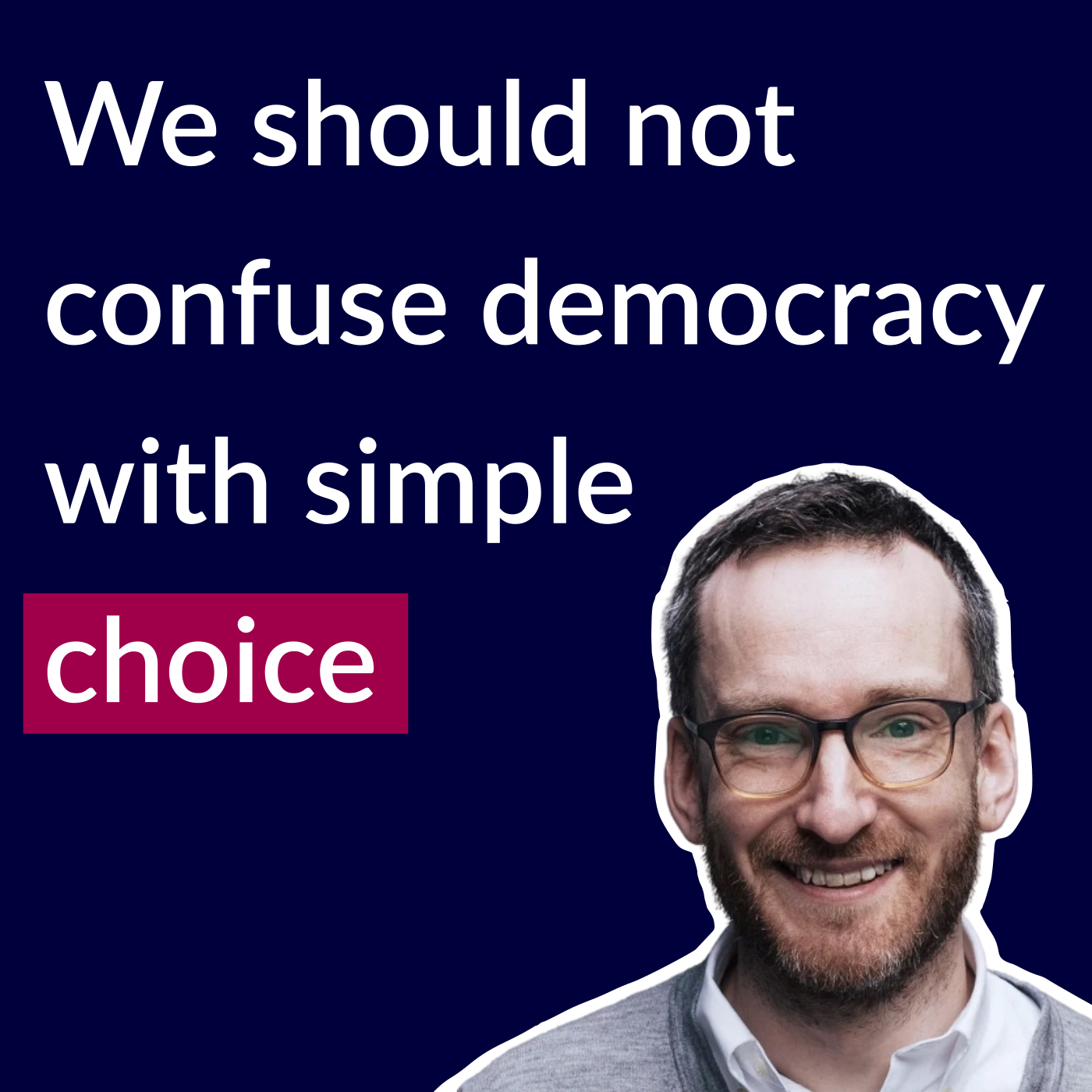
Graham Wetherall-Grujić of the Innovation in Politics Institute about improving political discourse
Democracy Innovators | 2025-10-02 | 1:09:17
Graham Wetherall-Grujić is researcher at the Innovation in Politics Institute. With his background in political theory and a PhD in philosophy, he has a differentiated perspective on contemporary democracy, power and deliberation. He emphasizes the need for a reasoned discussion that needs to happen before any voting process.
If you enjoy our podcast, please consider making a donation. It really helps us to sustain the podcast.
Top Keywords
- democracy 0.010
- platform 0.006
- power 0.005
- public 0.005
- political 0.004
- mean 0.004
- years 0.004
- party 0.004
- local 0.004
- much 0.003
- time 0.003
- thinking 0.003
Transcript
Speaker 0
0:00 – 0:09
Welcome on another episode of Democracy Innovator podcast, and our guest of today is Graham Wetherill, Gruic. And thank you for your time.
Speaker 1
0:10 – 0:13
Hi, Alex. Yeah. Thank you very much for the invitation.
Speaker 0
0:13 – 0:25
And, as a first question, I would like to ask you, something about your background and also maybe what are you, researching on.
Speaker 1
0:26 – 2:58
Yep. Sure. Maybe to start with with what I'm doing right now. So I'm, a senior researcher at the Innovation and Politics Institute, where I specialize in the intersection between technology and democracy, which includes things like, digital citizens participation, but also, questions like open data, electronic voting, the way that AI is used by governments. So, there's there's a whole range of of ways in which tech and democracy are interacting, and it's expanding very, very rapidly. And and part of my job at the moment is to kinda keep an overview of that. As to my background, I spent a long time in the academic world, first studying political theory. Actually, at a time, I would say, where interest in democracy wasn't very strong in that field, I think there was a consensus that, democracy as we knew it at the time was relatively stable, and there were people calling it for more radical forms of democracy, but I would say there was more of a sense of complacency around the issue than there is today. I then went on to study, and teach philosophy. I was very interested in the kind of background questions behind the political theory and it really getting to the bottom of the problem, and spent some time involved in some very, very theoretical, conversations and and engaging with these questions. Then around about four years ago, I I left the academic world and and got this job at the Innovation and Politics Institute, which was very eye opening for me because it was a big leap from the theoretical world into a very practical world. I joined the team initially as an editor, where I was writing up, reports and articles on on best practices and democratic innovation from around Europe. But I was also talking to the people who were really running these projects, in cities or around Europe. So some of them were mayors. Some of them were, people working for administrations or NGOs. But all of them were taking a very hands on approach to democracy, which was which was very exciting for me.
Speaker 0
2:59 – 3:05
And, I mean, what is democracy? I mean, it's a word that we always talk about democracy.
Speaker 1
3:06 – 6:27
Oh, that's a big question. Yeah. I think in some ways, to say, as I said, I've I've spent the last few years interviewing people who really are doing the hands on work, and I have a lot of respect for them. And I think you can spend much too long talking about theories and not not getting on with the practice of this stuff. So, I have the highest level of the respect for people who are out there working in communities to to to really improve the acceptance of democracy among the public because it's such a, an issue at the moment. Having said that, I think having some kind of theoretical framework in view is is useful. And sometimes I think there is a little bit of a lack of that. I think, especially in the tech world, there can be a tendency to confuse democracy just with choice, just with the idea that we should be giving the public a choice. There's also a tendency to conflate it sometimes with, collective intelligence. I think that's a very important, strand of what democracy can be and what it can do, but I don't think it's sufficient as a definition of democracy. I suppose I would go back to the roots and, you know, the the the roots of the word and say that it's about giving power to people, and it's about government, by the people and and for the people. And if if you look at what is going on in The United States today, but also in Europe today, I think you can see how that is floundering in various respects. First of all, because excuse me. First of all, because people, feel disconnected from politics. They don't feel that they have any power. But second, and I don't think we talk about this enough, governments don't have as much power as they used to have either. So the governments that we're putting the people we're putting out that represent us, don't feel empowered to make decisions on a on a big range of important questions. And a lot of political power is being shifted to, for example, big tech, who are taking more and more decisions on the behalf of, of everybody, who have an awful lot of influence in shaping the legislation around these these technologies. And so, yeah, I I think keeping in mind, this question of power and making sure that we're not saying we need to give people more and more choice. Actually, that's a word I associate a little bit with with the neoliberal paradigm. But making sure that that choice actually has an impact, is is a real problem. And I think one of the frustrations people have with democracy right now is their sense that they they are being given perhaps new mechanisms for choice, but the the footprint of those choices is is vanishingly small.
Speaker 0
6:30 – 6:48
And I'm thinking about, how to give power to the people, like, maybe using some, I don't know, civic tech software or platform. And, also, what is power? That is another big question.
Speaker 1
6:48 – 8:41
That's a that's a huge question. Yeah. Perhaps while I think about that one to start with with the first question, I mean, a lot of my work over the last few years has been to to study different, digital platforms for participation. And so, whether you think about things like participatory budgets that sit in the running or you think about large scale consultation processes. So, and I mean, we we should consider the offline ones as well, things like mini publics, citizens assemblies. Some of these have semi successfully migrated online. There's also consultation platforms like, Polis, which, was used extensively during the the the the v Taiwan movement, which is still going, which grew out at the sunflower demonstrations, as a new way of structuring conversations between citizens. And perhaps the the the Taiwan example is an interesting one. It was used to resolve a dispute when Uber first, started deploying, drivers in in Taiwan, and it was used to resolve a dispute between the taxi drivers and the the Uber drivers and the local population. And it provided a way of structuring a conversation that's very, very different from from social media ranking algorithms, which encourage conflict and and, is really based on on an on an algorithm that helps build consensus, among people. So, I hope that goes some way to answering the first part of the question.
Speaker 0
8:42 – 9:13
Yeah. Yeah. No. I I was thinking about, because as an example, I was reflecting. I was thinking about power, because, in Italian is a potere. And, it's like, also something as a potential, the potentiality of doing something. And, Yes. I really like this because it means that we have power also if we are not presidents, also if we are not, the king of a country, but we have a lot of power.
Speaker 1
9:14 – 12:01
Yeah. Yeah. And I think I think there are two edges to that. And and one of when I I like that very much, and I I didn't know that it was the same word that that had this this, the potency, right, would be the English equivalent, but this this idea of potential. One of the things I think that's gone wrong actually is that people feel that potential impact on politics is very, very narrow right now, and that for a long time, there's been a consensus on a broad range of issues. If you think about what's going in the in the housing market, for example, but more broadly on these big economic questions where there hasn't been a big range of of of choice through traditional representative democracy mechanisms, through voting for parties. There's been a a broad consensus. And so the potential to have an impact on on these issues that that affect us all has become very reduced. So so on the one hand, I think people see kind of the narrowing potential of traditional democratic decision making. But the flip side of that, which you just alluded to, I think, is, the potential for alternative mechanisms of of exercising political power. And there, I think, more about, civil society movements or or grassroots movements, which look at, formulating discussions and consensus through nontraditional means. And I mentioned, the the the sunflower movement, but I think also, in in in Spain after the the the anti austerity movement, you had this big, vast movement which which fed into the creation of new models of citizen engagement. I'm thinking partly through the party structure of of Podemos, which tried to open up more to its membership and to to allow the membership to shape their policies a little more, with with varying success, it it has to be said. But also in Barcelona where the the DECIDM platform was launched, another digital participation platform, and where the newly elected mayor, Ada Colau, I hope I'm saying her name okay, tried to gather up the the the energy that came through that grassroots movement and and channel that into her plan for the city over the next four years.
Speaker 0
12:05 – 12:44
Yeah. It was, yeah, also the changes that we can, that we that we can do. As you said, I was thinking about, yeah, let's say personal power, like the fact that I can do something. I can, call you. You can call me, and this is a small power, but then it's, I mean, something that we can do, but a lot of times we don't do it. Or, like, also, we can send a a mail to the mayor saying that, we don't agree about certain about certain things, but most of the people don't do it also if they have the power.
Speaker 1
12:45 – 14:21
And, yeah. Yeah. But I think I think there's also a sense that one of the things that's changed is people get a sense that the mayor doesn't necessarily have that much power to do things about these issues either. Or if if we think if we come back to the question of big tech, there can be a sense that, you know, Europe has been making serious efforts to regulate what's going on, in social media and now with with, the hype around AI. But I think a lot of people are aware that to an extent, they have to cater to, patterns of power that are beyond their control. You know, the big tech wields a lot of power. And now with the Trump administration, who's made it very clear that they intend to protect big tech as a as a national American industry, that that also restricts the power of of Europe to to regulate this technology. And it's it's gonna be really important to see over the coming months and years whether Europe is able to hold its ground and whether it really embraces the mission of becoming a home for where where technology and democracy kind of work hand in hand or whether, nondemocratic forces went out and and and big tech is allowed to run riot in the way that it has done over the last decade or so.
Speaker 0
14:23 – 14:34
Yes. We were saying, before the interview, like, in the future, probably, the political system will change in some way, but still we don't know if it will
Speaker 1
14:34 – 14:35
in which ways.
Speaker 0
14:36 – 14:51
Could be a very good one or a very bad one. And I wonder what are your thoughts about, let's say, how to go for a good system and how to and what to avoid
Speaker 1
14:51 – 16:15
the the gap. Yeah. Yeah. I mean, I wish I I wish I had an easy answer to that question, because I think a lot of people are trying to figure that out right now, and it's, you know, it's it's a scary time for for Democrats. And I think I've always been a big fan of, deliberative series of democracy, of the idea that the quality of democracy, really depends on the quality of the communication or the the discourse that informs decision making. So sometimes deliberative view democracy is used in a more narrow sense to describe things like, many publics and citizens assemblies. But in the broader sense, I think it has to do with the quality of of public discourse, and that's something that we've seen decline rapidly, in the the Internet era. Social media has restructured the way that that communication works partly by taking things out of the hands of traditional media and and putting them into a an unregulated arena, but partly with with mechanisms that encourage that encourage conflict. Yeah. Sorry.
Speaker 0
16:16 – 16:26
No. No. It was, actually, a sort of question, but it's I don't know how much it is related. So if you want to if you wanted to say something else.
Speaker 1
16:28 – 16:32
You go ahead. Go ahead with the question. Otherwise, I I was thinking, like,
Speaker 0
16:35 – 18:01
there were some some attempts of, like, I'm thinking also about the five star movement. They tried with a platform in Italy, but then maybe it didn't work. But also there were some also some individuals that tried with, to to to run from as an example, I interviewed Michihito that he tried to, create this AI major. And, I was thinking I mean, what do you think about this kind of experiment? And also, if you think that, like, a very good platform could actually work. Because at the moment, I see, like, we have a certain political system that's representative democracy in Europe, The US, and and this is a system. And then, I mean, we can also think about other kind of governance systems, completely new, but then they will be a little bit disruptive. And so how to, you know, with the system that we have now to just make some small experiments.
Speaker 1
18:03 – 22:26
Yep. Yeah. I see. I mean, I have to say, I think I'm a fan of of representative democracy, and I I know I think there's there's, a kind of division line within the demographic innovation space, I think, between people who somehow think that the system of representative democracy of of elections is is outdated and needs to be replaced. I fall much more down on the side of, we need to improve the discourse that that surrounds elections, and we need to improve communication between politicians and the public above all. So I'm interested in all kinds of democratic innovation. I think the ones that get me the most excited, are projects that improves that flow of communication. And to give maybe one example, a couple of years ago now, I looked at a project called connecting to parliament, and this was based in, Australia. And, run it was a project that was run out of a a research lab at the University of Canberra, I believe. But what they did was to connect, a member of parliament with a randomly selected group of of their constituents. And, parliament was going to have a free vote, so a a vote where MPs weren't constrained to vote along with their party. Because, you know, in in the Westminster system, if you vote against your party, you can get you can get fired. So, this experiment wouldn't work with one of those votes, but they were having a vote on mitochondrial donation, which which is a a a controversial topic because, basically, it's a, a technique that allows, doctors to identify potential genetic defects in in children prior to birth or, sorry, your parent some some some parents have a predisposition to this, and it's a a treatment that would, prevent this genetic defect in newly born children. But it's controversial because it involves, donation from a third party. So you exactly. Sorry if if that's not clear. But, I mean, the the broad point is is the question of bioethics, and members of the public were invited to discuss the issue with their member of parliament. Now in the end, he said from the start that he wouldn't just vote how these people told him to vote. It would be a discussion. But what I found very interesting about this project was that it was demonstrated to have improved trust between the members of the public and this politician. And it actually was based on a project in The United States called connecting to congress, based on the same idea. And, again, the results there was that, people, when interviewed after the format, said that they had more trust in their representative, including across party lines. So if they were talking to a republican, congressman, they said that they trusted their congressman more than they did going in regardless of their affiliation. They also said they were more likely to vote for that, congressman regardless of party affiliation. And for me, it's in improving this relationship that that I see the most hope because, at the moment, there I think populists are exploiting a lack of faith in the public in our representatives. The relationship has been problematic for a long time. A lot of the communication resembles marketing. You know, it's it's it's a campaigning thing. That's the form that that we're used to communicating with with representatives and and making a space for an honest dialogue between representatives and members of the public is is, is really promising.
Speaker 0
22:28 – 23:02
Yeah. I think that also, as you said, we are used to this kind of, marketing style. And, at the same time, I wonder if, like, a party that try to be honest, and so if it can actually succeed or in some way, it's it's, like, a sort of system that everyone has to follow, if they want to be elected.
Speaker 1
23:03 – 26:18
I think, very much at the national levels, that's true. And when you're running a national campaign, I I think honesty can be can be harmful, unfortunately, and there's there's a reason why, why parties use these strategies. I guess I'm thinking about things on a much more modest scale. A lot of the projects that I look at concern, local council representatives. So it might not even be your your representative in the national parliament. It could just be someone from the local government. But I think it's an important step towards humanizing, the people involved, putting a face on the politicians who who hold power in your area, making you realize that these are human beings facing very difficult decisions. Getting the public involved in these local level decision makings can help them to understand the kind of trade offs that politicians are forced to make, you know, the difficulties that they face in their work. And my feeling my hope is that this can have a bit of a trickle up effect. So if I personally know the representative of the conservative or the socialist party in my local council, perhaps that improves my attitude towards the party at the national level. I go back to, Tocqueville, yeah, Alexis de Tocqueville, who, who, a Frenchman from an aristocratic family after the after the the French Revolution, he traveled to United States in the eighteen thirties, I think, to see why democracy was was working better in in The United States than in France. And he concluded it worked best of all in New England, in the in The States in the Northeast around New York and and Connecticut and and, and Maine because, it the local representatives were people from the community. They had other jobs in the community. There were not there was not an aristocratic structure that preexisted, so they weren't, you know, people with with, noble connections that gave them a particular standing in the community. It was relatively level starting out. And people knew their local representatives. And, now part of this is down to the particular way that that federal government worked in The United States at the time. I think local authorities had a lot more power and the federal government would only get involved, on on bigger issues. But everything I've the the most encouraging things I've seen in the last in the last few years, have all started at this very modest, local government level or with local grassroots movements. And I think this is a great way of giving people an entry point into a democratic mindset, let's say.
Speaker 0
26:21 – 26:53
Yeah. And, because you cited you mentioned, I K. I'm thinking also about the dick dictatorship of the majority. And in some way, maybe with, this new system platforms and so on, we we can also maybe not have it anymore, to have a sort of consensus based or divisions. I don't know, like, to find a new solution.
Speaker 1
26:55 – 28:09
Yeah. I mean, I I think when you asked me to define democracy, I kind of left some important things out because, obviously, we live in in liberal democracies, and that has pluses and minuses. But, obviously, one of the one of the things one of the big advantages of liberal democracy is that it does not allow the majority to dictate, how the minority should live and that it includes provisions to protect minorities. And I think populists, when they talk about democracy and about, empowering their voters, they want a model of democracy that doesn't respect the rights of minorities. They they really want something like a majority rule. So I I I thought it was important to say that. I think you're right, though, that, these platforms, provide provide a space that's an alternative to to kind of people's private bubbles on social media, where instead of, doubling down our own positions, we can we can start to move towards a consensus. Yeah.
Speaker 0
28:15 – 28:37
Yeah. Because in some way, like, this this is my thought, that, the rule of majority sometimes can be also quite violent. And, a lot of times we are used to think about, if the majority agree, then it's a democratic decision also between friends or colleagues.
Speaker 1
28:40 – 30:06
Yeah. Absolutely. But And I mean, if if yeah. I mean, coming back to the deliberative definition of democracy, the idea the idea there is the strongest argument wins rather than the loudest one. Right? And the idea is not, it's not a democracy just because you're giving everybody a choice, and then you're taking the outcome of that choice. What needs to happen before that is a reasoned discussion, where the rights of different groups within a society are given equal equal weight in. It's not supposed to be a a a shouting match where the where the biggest group wins. Taking part in a democracy means relinquishing your own position and and taking account of the needs of other people as well. And I think, again, that's something that that, populists, you know, deliberately overlook. They encourage an attitude of you should be demanding more. These people are taking something away from you, and, you should be angry about this. And that's that's the populist, the populist definition of democracy where they where they even, bother pretending to be democratic any longer because I think even that's questionable at the moment.
Speaker 0
30:08 – 30:27
And and I'm thinking, like, in, let's say in ten years, twenty years, thirty years, like, what what do you think about we will see in the future about, democratic innovations? Or, like, how could it work for you? Like,
Speaker 1
30:29 – 35:53
Yeah. That's interesting. I mean, I think focusing a lot on on on the digital stuff as I do, I am curious to see whether these efforts can be successfully scaled because one of the issues that we've had with these kind of formats before is orchestrating a conversation between thousands or hundreds of thousands and millions of people, is is not something that's been possible in the past. With the kind of digital platforms that that were launched in the last ten years or so, it's become easier to orchestrate these large level conversations with thousands of contributors. There are various platforms at various stages of development using AI analysis with the hope of orchestrating conversations where an unlimited number of people, could be taking part. So on the one hand, I'm thinking of the, the deliberative platform developed by the University of Stanford, which which is used for a particular kind of mini public called, a deliberative polling. But technologically, it already gives you the possibility of staging the conversation with millions of of participants. The problem that they've encountered and that I think a lot of these these formats will encounter is it's difficult to get the people to take part. You have to put something on the table for them, and in some cases with with with the Stanford lab, that's been payments. They did their first on, digital deliberation back in about 02/2005, I think, at which stage they were sending participants through computers so that they could connect to the Internet because they didn't they didn't all have computers. But I'm curious to see more of the results of these these, AI tools and how successfully they can synthesize inputs, and how successful they are at making sure that the the nuances of the debate aren't left behind. Another platform that you might know, I think I mentioned it already, is Polis, which was used, in the vTaiwan project. Earlier this year, they launched Polis two point o, which, I haven't had the chance to see in action yet, but which I'm very curious about because to me, it looks like the most sophisticated AI driven, let's say, consensus forming platform. And in contrast to existing platforms, which tend to be iterative. So in in in in the kind of the kind of digital participation, programs running around Europe at the moment, typically, a government will or a local government will come up with a question which they put to a public, and they can deal with a few thousand responses potentially. There's a window of maybe a week where you can contribute your ideas, and then someone at the local government or from an outside agency works to digest those results and come up with a report. The way that POLICE two point o is set up is much, much more open. First, the fact that it's AI driven means that you can ask open questions. So, you know, traditionally, the way of dealing with lots and lots of inputs is to pose yes, no questions. And if you have a questionnaire with yes, no questions, you can quickly you could you could already in the sixties feed that into a computer, and it would tell you this many people voted yes, this many people voted no. With these newer systems, you can ask very open questions. Another platform doing this is GoVocal, who ran a project with the NHS in The UK, and they were able to start with questions like, tell me about your experiences as a patient at the NHS. And they then used, LLMs to identify common topics and to synthesize the results of these these conversations. The goal, as I've understood it, for policy two point o, is that you could potentially have ongoing conversations within communities that are open ended, and it uses visual mapping to show which topics are showing up, what matters to people most. And it it almost has the potential at least to create something like an alternative social media mapping exercise. Right? Where instead of seeing what people are talking about on a platform like x, where the algorithm is designed to bring out the worst in people, you could be collecting a massive amount of inputs, but structured around an algorithm that's been specifically designed to draw out consensus. And that's something that I find very exciting.
Speaker 0
35:54 – 36:40
Yeah. I also like, I'm very excited. And I'm thinking about, what you said about the abilities of AI to really understand, what's the people are talking about. And, I think that if not I think that at the moment, probably, they are quite good. I'm also doing some experiment on a small platform. But I also think that in a couple of years, we will have, some, very good AI that we'll be able to do it in a proper way. So I'm also excited about the the scaling factor because one thing is having, like, an experiment with 100 people, and another is really trying to deliberate on.
Speaker 1
36:41 – 39:52
Yeah. Absolutely. I mean, I think I'm maybe more skeptical than you. I think I there's a possibility that with LLMs, we're reaching a bit of a ceiling at the moment. I've had mixed results in my own work using AI. Sometimes it's very, very good. Sometimes it it misses the mark. Talking to the people administrating these kind of, participation pro projects, they seem confident that it's giving a fairly accurate summary. What they couldn't speak to as much was whether it was leaving important things out, you know, because if you're synthesizing this many different inputs, really covering all the bases becomes, becomes difficult. I think the other important thing, and I mentioned it in relation to the Stanford project, is is securing buy in for these kind of platforms. So first of all, can you get people to to sign up and to to give their opinions? And, you the the answer has been yes when the number of participants was limited to a 100 or a thousand, although it usually costs a lot of effort and a lot of money to to get those 100 people or those thousand people. Doing that on a much larger scale is very ambitious. To do so, I think you need the other side of the coin, which is buy in from from government. So someone in power pledging to take these inputs seriously. I think that is easier to do when they have control over the question being asked. So if they're using a they've said, we've decided that, you know, we're rebuilding this park, and we'd like your input somewhere. You would like a playground or upon if you're talking about a system like Polis two point o, where potentially citizens can bring up whatever they like and because the the technology facilitates that, getting politicians to say, to commit in some way to taking the results of that seriously becomes much more problematic. But perhaps the answer then is that these technologies return to their kind of grassroots origins because Desiderm and Console, these came out of grassroots movements, and maybe the people consulting these platforms aren't, first and foremost, politicians. Maybe it's journalists who are looking, to get an idea of of what people are talking about, or maybe it is, political parties who want to connect with their voter base, or maybe it is, civil society. And, because they also, in a in a healthy democracy, civil society exercises influence over over decision making processes. And if they can demonstrate that that millions of members of the public agree with them, that can play into their hands as well.
Speaker 0
39:53 – 40:42
Yeah. At the end, there are a lot of power dynamics, behind. And, yeah, I also saw that, participation, like, the fact that, I mean, build a building a platform now, it's easy. But to get people involved, it's quite hard. And, also, I was thinking about the commitment, from politicians. That is also another problem I would say. Because, I mean, some people could, run for an election now saying that we they will use the platform, and they can also say that they will just do what the platform says. So what the citizens Yep. Are talking about. It's been done. It's definitely been done already. There were
Speaker 1
40:42 – 40:56
I'm not sure if they use digital platforms, but in Germany and The UK, I think there were people promising to use democratic innovations to collect inputs from citizens and and to vote accordingly in parliament. Yeah. But what I think is that,
Speaker 0
40:59 – 41:18
because there is not really, commitment. Like, they just say it, and then they can also do the platform in a way where poles are just like, about, I don't know which color to, to choose to to paint the building.
Speaker 1
41:19 – 43:35
Yeah. Yeah. The worst I think we saw was a project in Germany somewhere, and it was you could choose the name of a ship on a playground. They were gonna put the name of the ship on the side of why would people would people take part in something like that? But I think you're right that there's a risk that politicians see this as, either a PR tool or another kind of polling tool. I think if you look at what happened in France, and and Macron has experimented with varying formats of democratic innovation. When he launched on March, the the political party, he first promised a kind of bottom up ideas gathering party structure where anyone could launch a local brand. That was a very clever move on his part because it meant he could very, very quickly grow, a party base. But, eventually, the promises weren't delivered on. The the the the membership basis was supposed to be allowed to select a portion of his cabinet, and that promise very quickly fell away. He also launched the the public notebook, project during the the protests, where you had something like a million people show up either online or to their local town halls to to write their inputs into these notebooks that were left out to say what they think needed to change. And his his initial promise was we are going to use this to develop a new, a new sort of manifesto, and it it didn't happen. And and in fact, he he promised to share scans online of all of the notebooks, and and that hasn't happened yet either. So he he's done other things. They had he has integrated, citizens' assemblies into the the structure of French government more seriously than has happened elsewhere. But I think he illustrates the risk. The first of all, the appeal that this stuff can have to politicians and then the risk that as soon as as soon as, it's propelled them into office or as soon as it's fulfilled their purpose for them that they lose interest.
Speaker 0
43:38 – 44:49
I'm still, like, think about this commitment, thing. And, we said there are some, power dynamics. So, like, we can understand, like, the point of view of a politician that, read the report of a platform, and that report is going against, him or what he wants to do. I mean, I can we can understand the point of view, like, why he's not interested in applying, what has been discussed or decided by the people. And I can understand also, what you were saying before, like, that maybe a platform like, can be helpful. You mentioned, I don't know, organization or maybe political parties that then they can show, like, hey, There are a lot of people that are supporting us, and they want this, maybe they have a list of changes. And so I am thinking, is it like that commit commitment has to go with power dynamics? Like, they have to
Speaker 1
44:51 – 48:50
This is a big question, and I think I think this is where my opinion differs slightly from from some other people in this sector. Because for a lot of them, the key to a successful format is that it has some kind of direct impact at the level of legislation. Right? So so the best example of a citizen's assembly is one where, like, the the Irish examples are always cited, but where you have well, in that case, you had deliberations on topics including blasphemy, but also, same sex marriage and abortion. And these were then put to a referendum, and they led to changes in in Irish law. So, gay marriage was legalized in part thanks to a democratic innovation, and abortion was legalized in part thanks to this. I was chatting with someone from Ireland the other day who who said who pointed out that, you know, for the parties involved, this was a way of getting some very difficult issues out of the evidence. Right? This was for them. I don't wanna have to deal with the issue of abortion. We'll just hand this over to these people and and and let them make the decision. There are other cases where these formats have had a direct impact on legislation, but more often than not, they lead to a set of recommendations, and then it it it fails to gain traction at at the at the parliamentary level. I personally don't know if all of our efforts should really be focused on closing that gap. I think where I see potential is in for these formats to shift public discussion, and this comes back to the deliberative democracy thing that I was talking about. I'll give you an example I've been thinking about a lot. Recently, I live in Berlin where housing prices have exploded over the last ten, fifteen years. And in the last couple of weeks, I started seeing articles in the mainstream media saying, you know what? You know, we've let property speculators run riot in our cities, and and this is a problem for Europe. And I my response to that is to say we know, and and I know that, and my neighbors know that. And this is something that people I know have been discussing in private for a very, very long time, but it's not reflected at the level of public discourse. The conversations that that that are happening in in newspapers and, in parliaments and in political campaigns often fail to reflect the concerns of people at ground level. These tools, especially large scale, digital solutions, have the potential to allow us to listen in on the actual concerns that people have, the actual conversations that they're having. And I'm not sure that it's important that, those conversations then lead directly to legislation. Right? It doesn't have to be, okay. Parliament has has agreed that whatever these people are talking about will be implemented. It's it's far too, complicated to make a promise like that. You have commitments to your party. But my hope a little bit is that you would see, like, a broader shift, where the public have some sway on on shifting the direction of public discourse. And then maybe where we hear very, very loudly, you know, discussions about migration, which I think is something a lot of people are concerned about. Maybe we would also start to hear about some of the the other concerns that don't get amplified by the right wing press. And so this is really where I come from when I think about these platforms.
Speaker 0
48:53 – 50:13
I'm thinking about, what you are saying that, people have, let's call them private political discussions. They discuss about politics, about, what they don't don't like in their city town. And, and so because I thought a lot that, we should in some way, find a way to, give value to the richness of these conversations. Because sometimes they are very deep, sometimes they and, and maybe could be that, like, I don't know. I have a conversation with you or could be also this, like, private call, but at the same time, the transcription, the AI is analyzing and so on. So instead of asking to the people to participate, I don't know, for assembly, on a specific platform and so on, Maybe we should just build a platform that it integrates with their lives and, so they can live and at the same time also participate in the political life. I don't know.
Speaker 1
50:14 – 53:26
Yeah. No. I think I think that's right. And I think the good thing about this is is, it doesn't require political uptake necessarily. It doesn't it doesn't require a prime minister or a president to say, okay. We pledged to do what whatever the people conclude in this. There are newspapers, throughout Europe who are very interested in this stuff and and alternative modes of, gauging public opinion. And there have been experiments, with different, magazine formats and stuff to suit Deutsche and the Spiegel in Germany have both been engaged in in sort of different different modes of collecting public opinion. And I think the press, in a in a well functioning democracy, monitor you know, they they they play that that mediating role between the political class and the public. And and, I think they they can play an important role in feeding back to the public the the political difficulties of just of of realizing every wish that we might have. Right? But they they also should be reflecting those conversations that that have been held in private and the things that matter to people most. And I think most journalists, well, most journal journalists said reputable reputable outlets want to do that. We do have a problem with, populist press that that that, is just spitting out clickbait, and and serving as an amplifier for public anger. But I think the press at its best, should really be reflecting the everyday concerns that people have. And if if if the press succeeds at doing that better, I think we can expect a higher quality of political debate. I think we can expect political parties to listen, and to to start forming their manifestos around, you know, political manifestos are driven by public discourse. You had parties here in Germany, the the the liberal party suddenly turned into an anti immigration party before the next the last elections. And this went against, years of practice on that part, but they saw that it was the dominant topic in the media, and they reacted. Well, I think, if we can find a way of tapping the other again, I'm I'm not saying we shouldn't be talking about migration as an issue. It's clearly a concern for a lot of people. But I think there's a lot of frustration on other issues, on housing, on, public health, right, and and health care, parents who are struggling, with with full time work and inadequate childcare. If if we had a better way of monitoring all of those concerns, then that would feed into a healthier, representative democracy.
Speaker 0
53:30 – 54:30
Yeah. Absolutely. And, I add some thoughts, because, at the moment, there are platforms that, I mean, we can be the platform or brainstorm about the platform that, that can do register private conversation. I mean, private people that wants to publish to to share their conversation and thoughts. But then I think about AI. And and and I think that that is, things that we should actually do, like, as our people in the in the space. And then I wonder, like, if, this AI that is evolving so quickly, if then, like, in some years, it would be just that. You know, like, if now ChargeGPT can, listen to every conversation and so on, then you don't need anymore a platform because that is the platform.
Speaker 1
54:31 – 54:37
Mhmm. But how how do the initial inputs get gathered then through CheckatGPT?
Speaker 0
54:38 – 54:40
Or Yeah. Good question. I don't know.
Speaker 1
54:41 – 56:36
My concern there and, I mean, I think, I said before that I'm a little skeptical about the capacities of AI, and I I do think that the claims are getting less bold from the industry side. Now there's been fewer claims of massive breakthroughs, and I I take that as a sign that things are slowing down because they, they're doing marketing when they make these announcements and and and, you know, they will hype where they can. I think there's also the concern that ChatGPT and and all of these, chat bots will become more and more monetized and market driven, which is a a pattern that we've seen with all of tech. You know, Google used to be a much better search engine before the whole thing, was sold out to to advertising and and you now buy a higher ranking. And it could be very difficult to find, something on Google today precisely because, its primary purpose is not to provide you with answers, but to generate profit through sponsored content. And I think, to my knowledge, that's not such an issue with with ChatGPT. They're trying out membership models, paid memberships. The same thing happened with social media. Social media was a much freer conversation that's gradually been funneled into this this marketing logic. So I would expect I would be skeptical that ChatGPT would be the tool to do this because I think it will be more and more, enthralled to commercial interests over the coming years. But I I share some of your optimism that that that AI could be one of the tools that we use to, to connect to larger numbers of people.
Speaker 0
56:37 – 56:57
Yeah. Like, I think you also, that's maybe, like, if we, build a tool specific for governance, participation, and so on, then, it would be also maybe more explainable. It will not be a black box that is the big danger of, having AI in governance.
Speaker 1
56:59 – 57:52
Absolutely. Yeah. And I think that's one of the big topics that needs to be addressed, at least finding a way of, well, at first of monitoring the accuracy of these these, AI outputs, which is difficult when you're trying to scale big. But also, this this problem that AI poses wherever it's used by governments, and I'm looking at other you know, I'm looking at the kind of algorithms that that that they're using to catch tax frauds or or things like this. There's there's always an accountability problem when the people in government, the people making decisions don't understand what's going on in this black box, and that that creates a a democratic deficit. But
Speaker 0
57:52 – 57:55
A sort of techno fate, I will say.
Speaker 1
57:56 – 58:57
Yep. Yeah. And I think people are also, skeptical, you know, and I think I you you you need to be upfront with people. I think people react differently. If you say, if you write this message on this platform, someone in your local government will read it. If you tell them if you write this message, AI will digest this and spit out a result. People are probably more skeptical, and if they're not already, then they will be over coming years. I think there's still in many quarters, there's still a lot of enthusiasm for AI and that people have a lot of faith in it. But the more, the more it's it's like automated, answering services where you're talking to a robot. I think people will get much more, you know, disenchanted and start to think, can I talk to a person? Is is my voice really significant if it's just, being digested by an algorithm that nobody really understands? Yeah. So that those questions
Speaker 0
58:57 – 59:40
to be answered. Yeah. I agree. And, also, this is something like, like, that I've seen many platform. I mean, civic tech platform that, they, yeah. I mean, they have a chatbot, and I think it's useful, a chatbot. Like, can be, it's it's a powerful instrument, but at the same time, it would be nice to, to think about solution that people can use in the real world like in, I don't know, face to face. Like, we should not talk to a chatbot, but we should talk to another person and maybe having a chatbot that'll listen to us.
Speaker 1
59:41 – 63:36
Yeah. And I think I think the best digital formats that I've seen over the last decade have been ones that include an offline component. And if we go back to vTaiwan and we go back to, Decidim and Console, these platforms were used as an extension of a grassroots political movement that that was really based on going out into the community. I was talking to the vTaiwan, you know, team team recently, and they were saying one of the most important things is having meetings with good food. You know? It's it's about bringing peep making people want to come together and talk to each other. And I think even irrespective of outputs and what happens to the outputs of these processes, that's a definite plus. If you can cultivate, an attitude and a behavior in people where they are used to talking to people from within their community who they didn't know before, who maybe have different views to them, and they get used to, a a conversation structured around seeking consensus, then that's a big win for democracy even if even if, there's no immediate products from that. The key is is to do that in a way that people don't get frustrated and say, you know, this isn't this isn't producing any results, so why am I bothering? But I think in a way, it can also be its own reward. You know? I I think I I'm maybe too optimistic and and have too much faith in in, the good nature of of most people. But I do think that when you talk to people about their experiences, in many publics, say, most people say it was a wonderful experience, that they benefited immensely from talking to people they wouldn't have otherwise met. If you can create an atmosphere where people have more and more of these opportunities. And there are cities around Europe where this is where this is the case. Cascais in Portugal is a great example, and they are my organization has a partner organization called European Capital of Democracy. And and, beginning in November, I think Cascais will hold the title of of European Capital of Democracy. And what Cascais has done over the last, ten or twelve years at least is to implement more and more of these participative formats to integrate them into sort of other government services where people aren't are no longer doing this for the first time. And if they go for a walk down their street, they will see some kind of project that was built thanks to public inputs gathered through a participatory budget. And they will have friends or teachers who are community monitors who are helping, the local government monitor problems in their area. And I think if you can cultivate that kind of community at at the local level, then that's that's maybe almost more important to me than this this this, opinion collecting exercise, right, where, yes, it's important for people to have an input, but it's more important to get people to make an ethical commitment to democracy. And that's something that that, unfortunately, is eroding at the moment, and more and more young people don't feel that connection. So I I would say that's almost more important than than ever more sophisticated opinion gathering mechanisms.
Speaker 0
63:39 – 63:56
Yeah. And, just a couple of questions because, Mhmm. Would you like to share something about you? Yeah. Like, your I don't know, more personal, don't know where you said you live in Berlin, but have you lived in Sure.
Speaker 1
63:57 – 65:38
Yeah. Yeah. Good question. So so I'm from, from The UK originally, from England, but, my family moved around quite a lot. When I was smaller, I spent a bit of time in The States and in in Australia. I've been living in the German speaking world for about ten years now. I moved to Berlin while I was, finishing up my my PhD in in in philosophy. I guess that the I'm I'm I'm a dad. Actually, I have a a three year old son, so I'm I'm learning to reassess, political priorities in the wake of of being a a family and suddenly aware of of how small the voice of of, of families has become in in the political space. It it was announced a few weeks ago that that, among voters, parents are now actually in a minority. They they they, they don't hold much sway. Sorry. I've I've gone back on topic and away from the first effect. Otherwise, I guess, my other big passions outside of of democracy are probably music, and I I I actually studied electronic composition. So I from from from an early age on, I guess, I I was 17 when I started my degree, and I was studying how digital tools could, change how music was composed. So I guess there's always been this kind of this interest in in how technology is changing. I don't compose music these days, but, yeah, music still plays a big part in my life.
Speaker 0
65:39 – 66:04
Yeah. This is interesting how I think he, like, let's let's say people discuss, then there is an analysis, and then music is composed based on the what the people talk about. Or maybe it could be vice versa, like, people be an interesting project. Yeah. Yeah. Like, a a sort of disco where people can also talk and participate.
Speaker 1
66:05 – 66:08
Music is a great way of a a great
Speaker 0
66:08 – 66:18
social bond then. Yeah. Yeah. Because we were saying that the problem is participation and so that the people show up. If there is music Absolutely. Usually, people show up.
Speaker 1
66:19 – 66:21
Yeah. I like that.
Speaker 0
66:22 – 66:28
And, and if you have a message for the people in the space, other researcher, people that are
Speaker 1
66:30 – 69:07
Question. I mean, again, I think I think I said this at the start, but, I just to reiterate, we had quite a theoretical discussion again, and that's sort of my space. But that my ultimate respect goes out to the people who are implementing these these projects. It's it's it's it's fun having conversations about where this stuff is going and and and what problems do you think it solves. But I, I just have tremendous respect for the people going out into their communities and making this stuff happen. And it's been my privilege to spend the last few years studying what they're doing and talking to them. So to them, sort of, I guess, thank you and and and keep doing it. The other message, and I think maybe I alluded to this already, is that, representative democracy is a is a good thing. It's probably the best thing human beings have have ever achieved. It's at at the ballot box, each of us has an equal share in power. You know, a hundred, two hundred years ago, this was this was a very abstract idea. It hasn't been a reality for very long. It was never perfected. I don't think we should be promoting democratic innovations as an alternative to it. At the moment, it's a dangerous time to be thinking about changing anything. You know? And if if you start talking about elections, a failed model, I I think that's counterproductive. So, yeah, maybe my message would be, please please stop doing that. Because in some cases, to promote these methods And I've seen it I've seen it on, on fairly high level interviews and in major publications, you know, people saying elections are broken. Here's why a mini public has a better idea than that. My feeling when I see something like that is always to ask how maybe, like, black American community might feel, you know, a a a community that fought for a long time to have the right to vote and to run for office and to have their vote counted, to tell those people, you know, we're gonna take the vote away, but don't worry. When the decision is made, there will be at least 10 black people in the room. That's a disaster if you ask me. So, so let's not let's not help the populists, trying to undermine representative democracy. Let's find ways of of strengthening it.
Speaker 0
69:07 – 69:09
Okay. So thank you a lot, Graham.
Speaker 1
69:10 – 69:13
Thank you. It's a pleasure.
Speaker 0
69:13 – 69:14
It was my pleasure.