Speaker 0
0:00 – 0:09
Welcome on another episode of Democracy Innovators podcast. And, our guest of today is Steven Buscher. And, welcome, Steven.
Speaker 1
0:10 – 0:12
Hi, Alex. Nice to meet you.
Speaker 0
0:13 – 0:38
And, yeah, thank you for your time. And, I saw from, your LinkedIn, description, that you help government, NGOs, and civil servants become more creative thanks to collective intelligence. And so as a first question, I would like to ask you, what is collective intelligence for you and, how it can be helpful?
Speaker 1
0:39 – 1:06
Sure. Well, my pleasure. This is, after all, one of my favorite topics. So collective intelligence is the ability that groups have under the right conditions to, develop better solutions, better decisions than individual members of the group would, separately. So, basically, it's a little bit like one plus one can be more than two, again, under the right conditions.
Speaker 0
1:09 – 1:25
And, how this can be different, compared to creative intelligence? Because I saw that it's, CI can be creative intelligence or collective intelligence. Is it the same?
Speaker 1
1:27 – 2:07
No. Not necessarily because creative intelligence can be at the individual level. You can and creativity is the ability to develop solutions or decisions that are not only adequate, useful, but also original in a given context. Actually, at Dreamocracy, what we focus on, and this is our motto, it's a collective creativity for the common good. So by this, we mean the ability that groups can have if we help them, be in the right conditions to, develop solutions that are not only adequate but useful and, original.
Speaker 0
2:09 – 2:18
And, about Dreamocracy, can you maybe say something, how it is what what it is? Sure.
Speaker 1
2:19 – 3:01
Well, Dreamocracy is a consultancy. So we help people, when we get contracts with them to, be more collectively creative. And for the common good, that means to develop, solutions to complex collective problems. So we work a lot with public authorities. We work with NGOs. We work with interest groups, sometimes political parties or politicians. And our job is to both understand politics and common collective decision making as well as bring them methods to do this better, to be smarter together, to be more creative together.
Speaker 0
3:04 – 3:15
And, do you have some, I don't know, use case, like, some, episodes related to this, collective intelligence that it was applied?
Speaker 1
3:16 – 5:11
Sure. Yes. We have tons. One example of, a project that I like that we did recently was to work with the, ministry for social ministry for housing of the Southern region of Belgium, Wallonia. The ministry invited us to convene a group of about 60 stakeholders, who work on social housing and to get them to think over a period of a month with three days over that period of, in person meeting to think through the context, the issues, and to develop original policy solutions, new methods, new policies that the the ministry could implement, which they did. They came up with about 20 new approaches, that the participants were very proud of because they said we're we're not used to meeting together across different disciplines, types of organizations, etcetera. And, they're not used to having specific approaches that boost their imagination, helps them think outside as we say the box. That's a that's a case study. We have many other ones. I can think of one of my first endeavors in this sector, and this is more participatory democracy as we call it. When in 02/2007, I, initiated and organized the first EU wide citizens assembly. So this was 350 citizens drawn, by lot. So, representative of the diversity of Europe's population and working together for two and a half days. At the time, we talked about, pensions and and climate issues in Europe.
Speaker 0
5:14 – 5:31
And so Dreamocracy is, a sort of network of people that do consultancy. And so I was wondering which kind of skills, is important to have to do this.
Speaker 1
5:32 – 6:44
Yep. Well, I think what makes our team unique is that the people who work with us have both a very good understanding of how politics work, how decisions are made, the the the institutional system, but also political dynamics, political communication, you know, the realities of working in a public affairs political context. And we combine this with skills, related to the methods, of creativity, convening, facilitating thinking in groups, designing, processes and events that allow people to to think better together. You have lots of facilitators who are, one, very good at doing that, but for instance, they'll facilitate a board meeting of a company. On the other hand, you have lots of people who are very good at understanding, political issues and who are public affairs advisers or whatever. We have both hats and try to be good at both.
Speaker 0
6:46 – 6:56
I saw that, your background is, I would say hybrid in some, some way. Would you like to say something? And,
Speaker 1
6:57 – 8:17
Sure. About Well, indeed, the activities that I described reflect what I did before, because I worked for about twenty five years in, politics in the wider sense. I, I was a public affairs lobbying consultant, in London and Brussels. I was a ministerial adviser in the Belgian government. I was co head of a think tank. I did some local community organizing. So and and I worked for a foundation. So in various ways, I always worked on public issues. And my last position was in that capacity was with a, the European Climate Foundation, so a large foundation fighting climate change. And that's when I really thought, well, I need to be better equipped to understand how we can help groups, shift the conversation, work together more efficiently, be more creative, come up with new solutions, and get people behind them, you know, get, enthusiasm. So that's so for the past ten years, I've written a couple of books on on political creativity, on collective intelligence and democracy, that sort of thing, And that's what I do now.
Speaker 0
8:19 – 8:50
And, yeah, I was thinking also about your academic, background that I see is a sort of hybrid in some way. Mhmm. And so how did you approach to to that? And, and, also, yeah, I mean, when you realized that the political, field, there was it was necessary to bring, I don't know, some creativity or more.
Speaker 1
8:54 – 9:36
So I I'd be curious to know where you think my academic background is hybrid. For me, it's quite classical. I studied political science at, Sciences Po in Paris, and then, ten years later, I did another master's degree in public administration at the Kennedy School of Government at Harvard. And, so, you know, I've always been in that field. What's more unusual is then taking a turn towards creativity and innovation in politics. So, sorry. What was the second part of your question? I lost track. No. No. Maybe, yeah, about the
Speaker 0
9:38 – 9:46
I saw that, you studied math and physics, but maybe that was related to, sort of high school.
Speaker 1
9:48 – 9:59
Yeah. No. Because that's not my strength at all. No. I don't know where you saw that. I I yeah. It was really political science.
Speaker 0
9:59 – 10:12
Okay. Yeah. Sorry for them. No. Yeah. I was thinking when you first thought that, creativity was missing in the the political
Speaker 1
10:14 – 12:53
it was really when I was, in this job at the European Climate Foundation. You know, or maybe not. Actually, it was a little bit before. It was when I was at the Kennedy School of Government at Harvard, where I was already interested in, the political fight, against climate change. And I was struck by how, in the curriculum of the Kennedy School, there was nothing about well, sorry. What happened exactly was at the school, we were allowed to take classes in other schools on the Harvard campus and around MIT, etcetera. So it was great. It was like an amazing, opportunity to learn things. So I looked at the, courses on offer at the business school, for instance, and then MIT. And there I saw that you had things like, design thinking for innovation, making your team more innovative and, you know, driving success with creative thinking, whatever the titles were, but that sort of thing. And I was struck by how we didn't have that at the school of public affairs. Now it has changed, school of government. And, at the time, I was curious. And I went to the library of Harvard, which is one of the largest, in the world, and I typed the words creativity business, and I there were hundreds, thousands of books about, you know, making your business successful with, you know, creativity techniques, developing innovative products, etcetera. And I typed creativity politics, and I remember visually seeing four entries, including what about political theater in The Czech Republic, in the Soviet era, etcetera. So I was amazed. I thought there's something missing here. So that stayed with me when I went to the European Climate Foundation, and I saw how we were constantly facing a barrage of opposition resistance, that people were struggling to get to grips with this challenge. And I thought we need, as a society, to learn the way companies learn to come up with new solutions fast and and get them, get people enthusiastic about them and sell them, we need to do the same with, solving large public problems. That was the the the process by which I got to this.
Speaker 0
12:55 – 13:10
So you think that in some way, politics is lower compared to, to business in adapting to new, situations, technologies, and so on? Yes.
Speaker 1
13:12 – 14:09
Yes. Of course. But it's easy. A company's job is easy. You know, they they sell a certain product, sometimes a single product, sometimes a range of products within a certain domain. You know? So even if you're a Dyson, you know, the the the British guy who invented the bagless, vacuum cleaner. Okay. He's very inventive, but he's only trying to solve a very simple, very narrow problem. Policymakers, civil public administration, politicians, NGOs, whatever, they're trying to solve problems that are super complex with, a huge variety of stakeholders, it's it's incredibly more difficult. You know? Solving climate change is much more difficult than improving, vacuum cleaners, with all due respect, to vacuum cleaner engineers.
Speaker 0
14:10 – 14:46
Yeah. Absolutely. And, how do you think, like, in relation to, climate change, collective intelligence can help? And, is it like collective intelligence more related to, stakeholders, public administration institutions, or also, like, as you said the before, more, related to civic tech in some way, like, to civic participation. I mean
Speaker 1
14:49 – 14:51
So how can it help?
Speaker 0
14:52 – 15:05
Yeah. How it how can it help, and how do you see it? Like, this, collective, intelligence applied to such a big problem like climate change.
Speaker 1
15:06 – 18:14
Well, that's, a very vast question, so it's not easy to answer simply. I mean, a a somewhat high level answer is that a a problem like, climate change is, that we need to change ways of producing and consuming that are entrenched in society. So, basically, we need to invent new ways of living and deciding together and and organizing things. So that requires imagination. That requires the ability to imagine, to think of an a a different world, a world in which things are done differently, and to make that world have come to reality. That is a process of imagination leading to innovation, things that happen in the real world. The political system is not designed to nurture people's imagination all the way to creating, implementing innovations. It is designed to do all sorts of things and some of them very legitimate, organizing, people, organizing decisions, coming up with, parties and representatives and people running for elections and and, organizing stability in the system and, executing the decisions of governments and all sorts of things. It's not designed to foster imagination and nurture it all the way to, things happening. So the system, on the contrary, has many elements that are nurturing what we call path dependency. So things that were done in a certain way keep renewing themselves. They they they, have a tendency to, impact the future of shaping the future. Our political system resists change more than it encourages it. And, again, for very legitimate reasons. You know, we have rule of law. We have respect for established laws and previous decisions, etcetera. There are also not so great reasons, like political parties always seeking, you know, the safest way forward and, and members of political parties not being very imaginative at their personal level, etcetera. This is all very complex and lots of causes and but overall, climate change requires change on our part. If we don't change, it's the climate that changes, and the political system is not built around managing, change fast and and and for, in that imaginative way.
Speaker 0
18:15 – 19:07
So we have to change the way we live. And, I wonder this is a sort of cultural problem. And, maybe you have some thoughts about culture culture, against policies. Now I don't want to say, in a some opposite way, but but I'm thinking if the solution is, as you said, like, changing the way we live and changing also maybe the, the design of, how we take decisions and and so on, or also changing the policies. So one is, I would say, is more, bottom up. The other maybe is more top down. I don't know.
Speaker 1
19:08 – 21:26
Mhmm. Well, certainly, one thing that struck me, and maybe I was influenced here by the fact that I'm half French and half American, is how in France, there's a a certain culture of expecting that the state will solve things for you. There's a certain dependency on, public institutions to take control and manage our lives versus a certain culture of self autonomy and self, you know, management and political entrepreneurship in The US. And it strikes me that, if we want as a society to be faster at creating new solutions to solve public problems, we can't just rely on governments to think for us and and solve things for us. It is a general culture of, being of caring and, thinking together. In the Handbook of Political Creativity I wrote, about ten years ago, I in the conclusion, I said something like, in France, the motto is, liberty, egalite, fraternite, freedom, equality, fraternity. Well, we should add to this creativity. Because the first three are difficult to, nourish and and flourish in these difficult times if we're not also creative. So I think it is a cultural aspect also, and, therefore, it also means helping, kids be more creative at school. We have very noncreative, ways of thinking in schools, very simplistic, very old fashioned, even in many schools. So it's that cultural aspect, being more participatory in the in in the in in business in in teams, in corporations, in public administration is something I think we should do more.
Speaker 0
21:29 – 22:03
And about this kind of depends dependency on public institution, I've seen how people often, do not, seems, they they think that they do not have the power to change, the world, they are living in. Do you think it's because of this, like, that in school, we are not used to be creative. I totally agree about changing the the educational system. And,
Speaker 1
22:04 – 24:05
we have come to equate democracy with a system of delegation of our decision making power to representatives. And many people don't feel they have behind a a synonym for what you described is the word agency. People don't feel they have agency. They don't have the ability to get involved, be heard, say things that are relevant and useful, and contribute to public decision making. So, indeed, a culture of, the state and citizens coming together to be more creative and faster at solving public problems requires on the part of decision makers, the willingness to listen and and and share power. And on the part of citizens, the willingness to get involved, spend time, and and trust, that they they can make a meaningful contribution. And the system the political system should make them feel confident that they can contribute. There was an OECD study on trust in government that came out in October, October 2024. You find it easily online. And it said that one of the first factors for of trust in government is the perception that governments listen to us. I find it striking. If people perceive that governments are genuinely listening to them, they trust governments. It's not so surprising when you think of it. But, actually, when you look at the way governments function today, there's not such a huge investment in actually actively listening to citizens on many issues. They are often telling citizens what the topic should be and what the policies should be. It's very much top down still.
Speaker 0
24:08 – 24:39
And, if we if we think about democracy, now we think about, representative systems. Do you think with, creative with collective intelligence and other kind of intelligence. I don't know if also artificial intelligence, that could help maybe creative intelligent that could help collective intelligence to emerge, that in the future, we will see some other kind of system different from the representative one.
Speaker 1
24:41 – 24:46
So is your question specifically about artificial intelligence?
Speaker 0
24:48 – 25:26
No. Like, how, if you had any thought about, let's say, the future of democracy. If, I I think we are seeing some technology that, I mean, thinking about AI is quite, disruptive. So I wonder, like, in the future, what could change and, if the system that we have now will actually change or not, and this could be very dangerous. Sure. I don't know.
Speaker 1
25:26 – 27:47
Well, yes. I'd be surprised if in fifty years, democracy looks like what it looked like for the past, let's say, fifty years in Europe. And I I I would be hard pressed to guess what it will look like in fifty years. But one direction it can take, and that's what some people favor, is authoritarian regimes, and and we lose the distinctive traits of liberal democracies. But there are signs that we could invent a new system that is more deeply democratic, with more ways of involving citizens and engaging with society in its different shapes and, groups. And for that, the book that I coordinated that came out a couple years ago, the Routledge Handbook of Collective Intelligence and governance. Sorry. The Routledge Handbook of Collective Intelligence for Democracy and Governance, it's a long title, gives all sorts of examples. There's 36 case studies from around the world, from the use of prediction markets to smart crowdsourcing to AI combined with deliberative democracy, to hybrid, mixed forums where politicians, civil servants, and citizens come together and, the use of theater and, different approaches to help lower class, less educated people express their opinions and and grievance if necessary with civil, servants. There's a vast amount of new approaches to governments that is much more democratic and open, but that doesn't necessarily hit the media headlines. We hear a lot about the populists of this world who have a who are very good at communicating and seizing the public agenda, But we don't hear so much about these, govern democratic innovations as we call them in the, political jargon.
Speaker 0
27:48 – 27:56
You were saying that this kind of experiment, they do not hit the media headlines.
Speaker 1
27:56 – 27:57
Mhmm. And,
Speaker 0
27:59 – 28:30
I was wondering if it is just because, you know, newspaper have to sell. And so maybe they want something, I don't know. Maybe talking about an experiment related to democracy is not so interest interesting for readers, that are also customers, or if there are, like, other kind of reasons.
Speaker 1
28:32 – 30:22
So it's interesting because we're actually initiating a, I hope with the support of a foundation in the near future, a research project on this, because it's really striking how, there are some amazing democratic innovations out there, and they're more than experiments. They some of them have been really established and repeated many times and have proven their value. And, but they don't get much, if any, coverage at all. And, this is a concern because all people hear about in when it comes to democracy is, problems and, and, crisis and negative news. So we really feel it's important that they hear that there are some people out there doing good things and trying different approaches, based on the principles of collective intelligence. So I don't know the exact answer. I've heard from journalists that, you know, they're trained to, look for problems more than solutions. Like, they're not I heard a journalist once tell me, we were told in journalism school, if it's positive, it's advertising. You know? You're not here to say, so and so did some amazing stuff. You know? You hear more to identify problems. But on the other hand, the same journalist told me how, there is, increasing recognition that, negative content feeds anxiety and negative, dynamics in society and how we need to be more, journalists need to be more constructive. So but I I don't know. The the root causes of this, and I hope we'll have a better idea soon.
Speaker 0
30:24 – 30:32
And, in relation to, the possibility that, there will be some, out authoritarian regimes
Speaker 1
30:32 – 30:33
Mhmm.
Speaker 0
30:33 – 30:46
I'm thinking about, I mean, the previous century. And, I think maybe when we talk about authoritarian regimes, we can talk also about a sort of collective stupidity.
Speaker 1
30:46 – 30:47
Mhmm.
Speaker 0
30:48 – 31:23
And so I I know that it's hard to think about a solution, and I think that this, collective intelligence and creative intelligence can, of course, maybe find a solution to to this. How do you expect, like, that people can build something that is different from an authoritarian regime? Like, how do you
Speaker 1
31:27 – 35:29
Well, this is also a a very vast question. And indeed something that I I've I've I've been trying to, tackle. So first of all, yes. People are very good at, collective stability. Yes. We we we're very good at that. We can very history has shown how collectively we we can we make often, bad decisions. But it also shows how even in situations of crisis of difficulty, we come up with much better decisions. So, it's it's not a question of, mental capacity, so to speak. It's, a question of how we organize our institutions and our political culture. So I think the the the the the the key issue for the coming months and years is, certainly to resist the temptation of, populism. Populism is a great way, for some policymakers to gain votes. They argue that they speak on behalf of the people and, are the true voice of the people with things solutions that look very much common sense. You know, Donald Trump who says put all the tough guys in Alcatraz. Yeah. Well, that sounds tough, and he's listening to people who are concerned about safety on the street. But on the other hand, what are the solutions in front of this that would be more appealing to people, more effective, that deliver fast? That's not easy. Right? So he's probably not going to reopen Alcatraz as the Alcatraz Prison. It's probably more just for posturing and and and media headlines. The those who are serious about politics need to be better not only in terms of solutions and delivering results, but also communication and appealing to people's emotions, etcetera. And, again, I think that's where creativity can help. Creativity can help us, generate faster, better, decisions that are more appealing. I'm currently writing an essay on six examples of such policies. For instance, Sweden, which, in the year February, decided, announced that it was going to go for zero deaths on roads. So very appealing, very strong message. We no longer tolerate that when you get in your car, it's the most dangerous activity you can get involved with. When you get in your car, you should be safe and get to your destination without being, seriously harmed or killed. And by treating this with a lot of rigor and in a systemic way and actually a lot of creativity, etcetera, they've managed to drastically reduce the, level of injuries and deaths on roads in Sweden, and it's been copied by other Scandinavian countries and, relative to countries that didn't have that same level of ambition. So it's appealing to the heart. Zero debts on roads. I get that. And it's appealing to the minds, and it's it it it got the minds working. So it's, it's the easy way forward for a politician is to be a demagogue and a populist and come up with simplistic solutions. But the only way forward for democracy is to be very smart, collective thinking politicians, I think.
Speaker 0
35:30 – 35:45
Yeah. And I agree. And, I'm thinking about what you said about, the school and the educational system. And many times, I thought that in school, we are used to learn how to compete instead of learning how to collaborate.
Speaker 1
35:46 – 35:46
Mhmm. And,
Speaker 0
35:47 – 35:54
I wonder if you have some thoughts related to school or maybe, like, from when you were some memories from when you were a child.
Speaker 1
35:56 – 37:24
Well yeah. And I I have two daughters, one who's finishing high school this year, and the other one is now in university. So I've witnessed how they were taught. And the schools were good, and the teachers well intentioned. But, indeed, it's striking. 90% of assignments were with, you know, on your own. 95% of evaluations were for work done on your own in front of your piece of paper. Virtually no collaborative work, no learning of how to work as a team, and no education in terms of group interaction, collective thinking, etcetera. So the this science of collective intelligence, which is, you know, deep and and very well documented now, this is not on the curriculum. So it's great to learn history, and it's great to learn mathematics on your own in front of the teacher, but it's it's not sufficient. Plus the competitive spirit, you know, you still have teachers who hand over the grades, from the top to the bottom. So the the guy or the girl at the bottom feels absolutely horrible and hates studying, and and and the one at the top is competitive. And, you know, it's horrible. It's it's really silly. It's quite primitive.
Speaker 0
37:26 – 37:49
Absolutely. And, last question, like, not a question, but do you have, a sort of message to the people that are working on, finding new ways, I don't know, to decide, to brainstorm? Like, people that are searching for new solutions, for new kind of collaboration between people.
Speaker 1
37:52 – 41:33
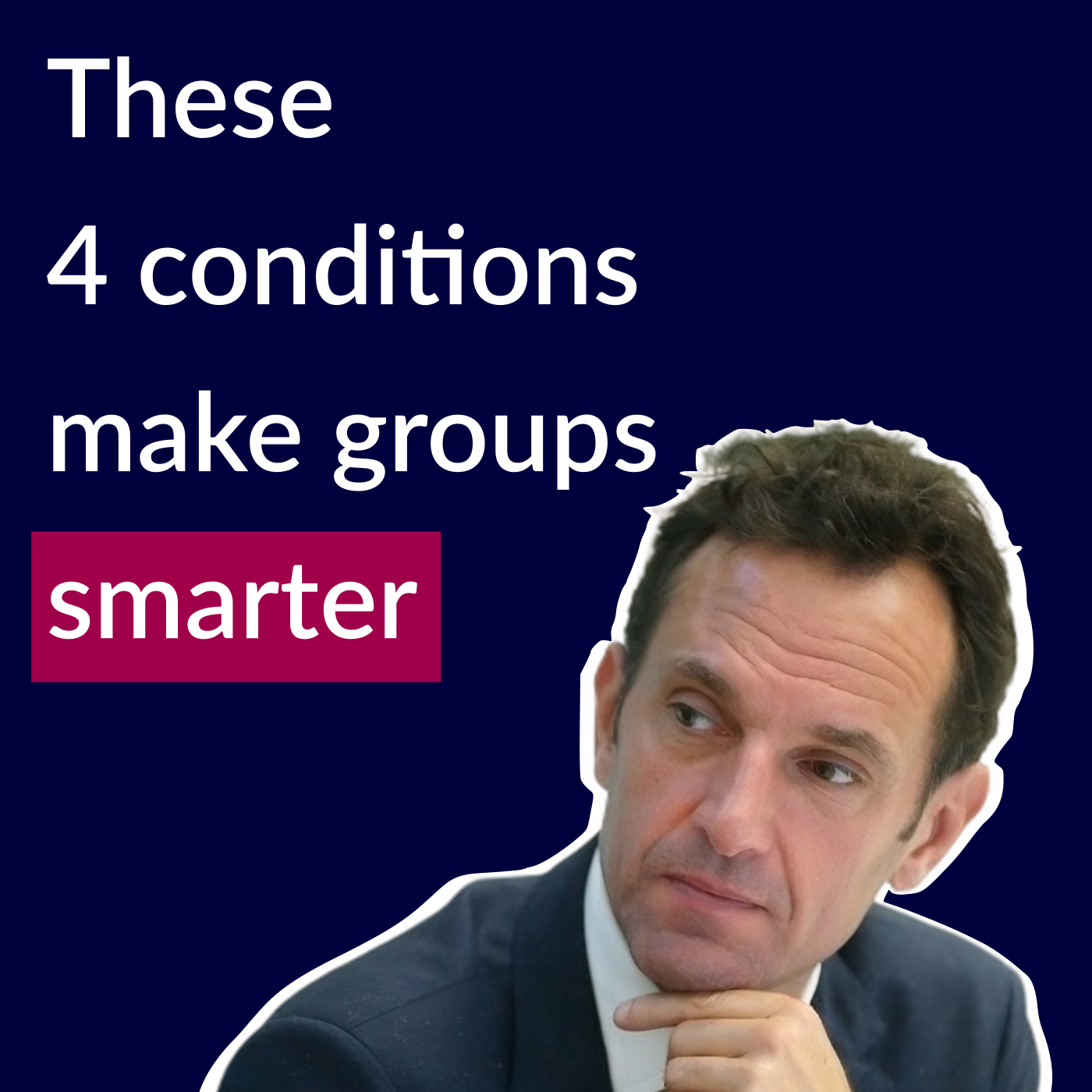
Mhmm. Well, yes. I would have a simple piece of advice. Dare to be creative. Dare to change the way groups work and to allow imagination to come in. You know, as consultants, I I've had that in my life. Every time I was in consultant, you often realize that you you help groups do some pretty common sense basic stuff. When I was a a lobbying consultant, the common sense thing was think of your audience. Don't think of what you want to say. Think of what they need to hear, what they need, what they want to hear, etcetera. People always forgot that. Now as a creativity consultant, the common sense basic, service we provide to groups is challenge your group interactions. And the group interactions are totally unimaginative and the same across all institutions that we work with. People have meetings. People have meetings, that are usually one hour where there's, in the best case, an agenda and where people talk without any sense of time. And they, they do not have any idea of the dynamics of the group of what creates the right conditions for a group to think together. It's it's it's it's own it's also, with all due respect, very primitive. So my advice is allow you to challenge those formats to be reflective on how to conduct your group interactions, whether in person or in the jargon asynchronous when you're not together, and to organize it. Be mindful of what will create the right conditions for a smarter group. And maybe just as a finishing note as this is important, the conditions to make a group smarter are essentially the following. First, if you can make the group larger, do so. You know? Collective intelligence has the word collective in it. You know? If there's two of you, it's great. It's better than one. But if you're 10, you're likely to be smarter. Then more diversity. So it's better two than 10 than two. But if the 10 all look the same, have the same ideas, come from the same background, it won't be as good as if you have 10 people who are very different, age, experience, skills, etcetera. Then allow these 10 people or however many to deliberate well. And that means information. That means times to reflect. That means the ability to listen to one another. So psychological safety. You probably need a facilitator to make sure everybody gets to talk, everybody feels free to disagree, etcetera. And then you need a way to capture what's being said. You could put 10 people, diverse, who deliberate well. But if you don't have a way to capturing the data they produce, the decisions they suggest, to whether it's voting systems or other mechanisms, you need to aggregate this. These are some of the key conditions that that you need. And, so if you challenge the way you do things with these criteria in mind, what do we need? I think you can invite a lot more intelligence and imagination in your interactions, and that can help maybe save the world or your problems.
Speaker 0
41:35 – 41:36
Thank you a lot, Steven.
Speaker 1
41:37 – 41:38
Yeah. You're welcome, Alex.