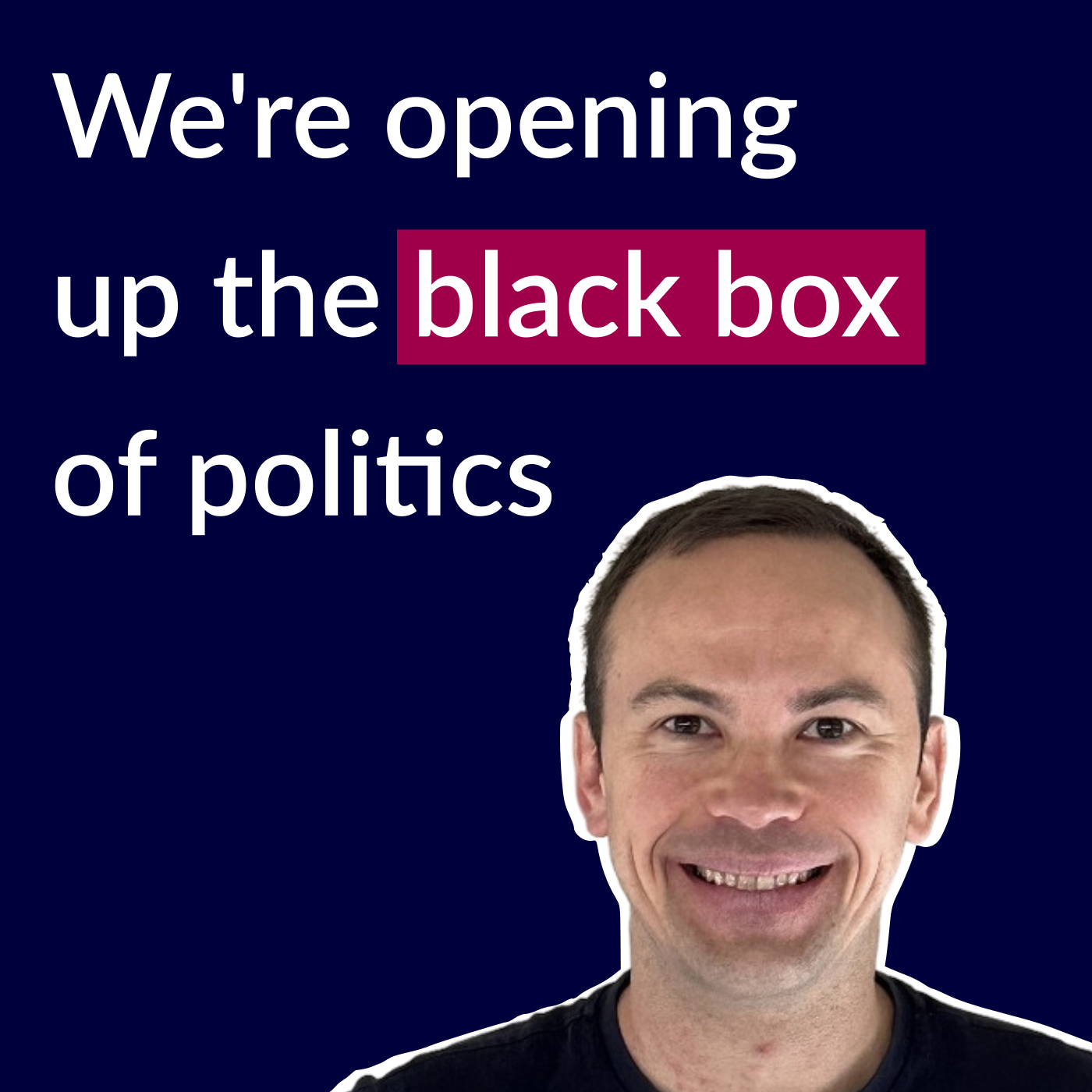
Magnus Strobel about the Future of Civic Engagement: Inside the Nexus Politics Platform
Democracy Innovators | 2025-08-04 | 58:33
Magnus Strobel is co-founder of Nexus Politics, a digital democracy platform bridging citizens and politicians for more accountable governance. Inspired by growing dissatisfaction with democracy, Magnus and his team set out to build inclusive technology that empowers people to voice their concerns and enables political representatives to act transparently.
Top Keywords
- politicians 0.013
- guess 0.009
- citizens 0.007
- politician 0.006
- nexus politics 0.006
- instance 0.005
- problem 0.005
- work 0.005
- might 0.005
- citizen 0.005
- nexus 0.004
- politics 0.004
Transcript
Speaker 0
0:00 – 0:13
Welcome on another episode of democracy innovators podcast. And our guest of today is Magnus Strobel. Magnus is working on nexus politics. And, thank you for your time, Magnus.
Speaker 1
0:14 – 0:29
Well, Alessandro, thank you for having me. It's a great pleasure to be here and finally, being able to join your podcast and talk with you about all the important things that that are going on in our ecosystem right now.
Speaker 0
0:31 – 0:36
I I hope the same. And, as a first question, what is Nexus politics?
Speaker 1
0:38 – 0:40
You want the long or the short answer?
Speaker 0
0:42 – 0:44
You can start with the short one maybe. And,
Speaker 1
0:45 – 1:23
then we The short the short one would be it's a digital democracy platform that is, partially, a GovTech solution, partially a civic tech solution. So we're offering citizens, the opportunity to easily voice their opinions, concerns, problems, and then we are connecting them with the responsible politicians to make sure that they can be accountable and give updates on what they're doing in order to address these problems and also give them insights into public opinion. So that's that's it in a nutshell, I would say. But there's more to it. So
Speaker 0
1:24 – 1:27
And, and what about the long answer?
Speaker 1
1:29 – 9:46
The the long version. Is interesting. Yeah. The the long version would be so first of all, the the problem that we want to address is, like, the growing dissatisfaction with democracy. So that's something which is not just prevalent in Germany, but I guess it's all over, like, at least in all western democracies. And, in our opinion so what is our opinion? So that's me, my cofounder, Christoph Wafler. We, had a long discussion and many thoughts about what is the core problem of why people are becoming more and more increasingly dissatisfied with democracy. And one of the reasons that we came up with was a lack of representation. So many people don't feel represented anymore by their, elected officials. And, I think it's not just our hunch, but it's also, like, baked by data. So there's, for instance, a a study by the Pew Research Center, which was conducted, I guess, in in 2023. And it, there they looked at, citizens for more than 24, democracies and surveyed, like, more than 30,000 people. And they found that, overall, like, 59% of, the citizens are dissatisfied with, like, the way that democracy is working currently. So that's a shockingly high number in our opinion. And, like, 42% of the citizens didn't feel represented by at least one party in the parliament. So that's also shockingly high. And lastly, about 74% of, the citizens did not believe that, politicians care about, their opinions or what what people like them think. And, yeah, all these numbers, I guess, show that, there's a huge lack of, representation, so people don't feel represented by their by their politicians. And, of course, there's also a core problem to this. So this is just the the surface, but the the underlying, core problem is in our opinion that there's a lack of reliable real time data, on public opinion, which is basically limiting politicians and their ability to make data driven decision making and, like, good representative decision making. And this is due to a couple of facts, like, if you look at the status quo, like, how politicians right now form their beliefs about what, what their constituents think, there are a couple of ways they're doing it. For instance, they can use polls, but, polls are quite expensive and are conducted very infrequent. And, also, this might be done on the federal level, but probably not so much on the local, municipal level, or state level. And then there's legacy media. The problem there is, that you have an editorial bias. So depending on which newspaper you read, you get a totally different opinion on on what, people might think. Then there's social media, of course. In social media, you get all different voices, but the problem there is it's very unstructured. It's noisy. You're within your echo chambers and so on. And then, of course, there's citizen feedback. But citizen feedback, the problem with that is that it's very unrepresentative and selective. So if I would be a politician, I get approached by my voters mostly. So that's a huge selection bias and and what I get to hear and what I get to what I get to see. And then, yeah, the solution we came up with is, like, a platform, which allows citizens to voice their, opinions because, people have their beliefs, have their opinions, and they are basically looking for tools where they can express it and where they can reach politicians easily. And, we are empowering them by giving them an easy tool which they can use to effectively reach the politicians that are in charge, that are responsible. So the way it works is we have kind of a chat window where citizens can just voice their opinions, what's bothering them, the problems, issues, etcetera. And then, our artificial intelligence will analyze, the expression of the citizen, will identify the core issue, and will then classify that. And based on the location, based on the category, and so on, it will automatically assign it to the responsible politician. So that's the first problem we are solving here for citizens because, for instance, me as a citizen is if I have a problem, I would not automatically know for sure who's the right person to contact, but we're facilitating facilitating that process by, like, directly sending it to the responsible politician. And then they're aware of the issue, and you, get assigned as a citizen, like, a a problem ID. And based on that problem ID, you can basically track the entire legislative process, like, from problem creation all the way up to it being resolved and probably or hopefully ending up in in the legislative act, which solves or addresses this issue. And, like, this is the whole process. And then once we have all the data on on what, people think, then, we can help politicians make better informed decisions by giving them kind of a dashboard for public opinion, analytics. And on that dashboard, they have different features where they can analyze by category, where they can analyze by time so they can see which problems are trending, for instance, in their constituency. They can see it on a heat map. They can analyze it by socio demographics and so on. So this is all data which citizens can, provide, voluntarily, in order to allow politicians to make better informed decisions. And, yeah, this is, like, the the first step on our in our project. But, of course, we are very ambitious, so we want to extend the whole product, by adding additional features because once we start from the very beginning, like, from the problems all the way to the solutions step, of course, different steps in between. So we we want to add, like, add additional features like, crowd lawmaking, for instance, so we that we can engage citizens more in the legislative process. We offer opinion polls so that politicians can get additional insights on on what citizen thing. And, yeah, for public officials, we are offering a customer relationship management system. So it's a dedicated system for public officials, where they can manage their constituent requests and, yeah, better give better ups updates on what what they are doing, in contrast to how it works right now. So status quo would probably be, like, I send an email to my my politician, voice my concern or issue, then I get a very nice email, as a reply saying, well, thank you, Magnus. It's a very important issue, and then I probably never hear back from them. And, with our tool, you can track the whole process. And for politicians, it makes it much more efficiently because, they can they they have their own workspace, so they can collaborate with other, politicians from the same party, for instance. And, therefore, yeah, get being being closer to their constituents and giving better feedback on what's actually happening. So we are opening up the the black box of politics, so to say.
Speaker 0
9:47 – 9:57
Okay. And I was wondering when you first had the the idea that the technology could be helpful to the political, life.
Speaker 1
9:59 – 10:00
When we had this idea?
Speaker 0
10:01 – 10:12
Yeah. When you had this idea or maybe, like, many years ago, you I don't know. You have read a book. You realize that Mhmm. It was useful to use technology inside the political sphere field?
Speaker 1
10:14 – 11:51
Yeah. Well, first of all, as a as a German, I'm one of the many who are very frustrated with how public administration works here. So just the other day, I spent, like, a whole afternoon in the municipal office, just to register, my apartment, like, for another place. And, yeah. So I feel like there's a lot which can be done more effectively and efficiently with technology. So that has been a feeling for a while, and I'm and I think I'm not unique to this. But in general, like, I came very much in contact with, like, these new technologies like AI, during my PhD. So there I got the chance to sign up for for OpenAI as a beta tester kind of so I could use the the product early on, see what it could do. And, yeah. But but back then, I, to be honest, didn't have in mind that, we can directly apply it to to politics. So that was more like, we came up, together, like, with Christoph, my cofounder. So he's the the tech guy in our team. He's a I tend to call him a child prodigy, because he's, first of all, very young, but also super, super smart. And, he, knows, like, ways to use technology for the better and, help us with, you know, making our products efficiently and apply it there.
Speaker 0
11:52 – 12:05
Yeah. And about the I mean, your PhD, like, will you would you like to share something about, yeah, your academic background? Sure. What have you studied?
Speaker 1
12:07 – 14:45
So by training, I'm I'm an economist. So that probably happened by chance, I would say. So I got my high school diploma in 02/2008. And, back then, as you might know, there was the great financial crisis. And, yeah, I was always interested in what was going on. So I read the newspapers, but to be honest, I did didn't have any clue about, why it should affect me in my small town in Germany if, like, some stock market indices are crashing in New York. So I got interested in economics. Everyone told me, well, if you want to understand that kind of thing, you should study economics. So that's what I did. I got my bachelor's and master's in economics and was always also very interested in the in the human side. So with human side, I mean, the psychology of people, like, why do people behave the way they do? I mean, that's also a big part in in the financial world because you have all kind of irrationalities people tend to exhibit. So behavioral biases, like hurting behavior and and stuff like that. And, yeah, this is what I focused on in my PhD. So I got a PhD in behavioral economics, which is, like, in between economics and psychology. So why do people behave the way they do, and how can we achieve, that people, yeah, make better decisions. So for instance, save more for retirement and and stuff like that. And, yeah, I got lucky, that I was accepted at Technical University of Munich, for my PhD. Studied there for five years. Got a lot of interesting insights. Also worked with with machine learning during my PhD. Became familiar with of the basics, at least how it works. And, yeah, after that, I, worked in finance, got some got some experience there, but I was always very, interested in entrepreneurship. So for instance, even during my bachelor's already, I was working as a student research assistant at the LMU entrepreneurship lab, or center and, yeah, got got my first exposure there. Met some very incredible people there. And, ever since, was, it was on my agenda to, yeah, maybe also become an entrepreneur one day, and finally, it happened now.
Speaker 0
14:48 – 15:23
I was thinking about this dissatisfaction. I mean, that people do not feel represented. Mhmm. And, I was trying to, because this there is this question in my mind every time, why people do not participate in the public life, why they do not why they do behave in this way. And then I was wondering how it can be associated, like, with some, you mentioned, like, a a behavior economy. No?
Speaker 1
15:25 – 15:25
Mhmm.
Speaker 0
15:26 – 15:28
Yeah. I don't know if you have any idea.
Speaker 1
15:31 – 17:44
First of all, I guess people people are lazy, and, you have to make it very easy for them to participate in in the public, life and and to be civically engaged. And I guess that's that's one of the key problems we are we are facing that, there are a lot of formats which, require you to be available at certain times, for instance. So, like, you can go to evening events, talk to politicians there, etcetera, but you also have to be, in the be there in person. And that makes it tricky for people who who are, working regular jobs and so on. So, we should definitely decrease the the threshold or lower the threshold, for people to engage by offering them first digital access, then also making it possible to attend asynchronous, like, not not in real time, but share your opinions whenever it's suitable for you. Because you might come up with with something that's bothering you at one point, but then, you might have forgotten, about it until there's an opportunity to raise your, your voice and, your community cater to your, local representative. And I guess whatever we can do in order to decrease that participation threshold helps to get more and more people engaged. And the more people we we get engaged, the, the higher the representativeness and the better it is for democracy. So, this is what we are trying to achieve. Creating a very inclusive environment, which makes it very easy, for people to participate when they want, where they want, and the the way they want. So either by voicing their opinion publicly or also privately. Because sometimes you you might have issues, concerns that you're not willing to share in public, but which is still very important to you. And, therefore, we have to give citizens, yeah, ways ways to achieve that, and that's what we are trying to achieve with Nexus politics.
Speaker 0
17:46 – 17:54
And, from the idea to the product, how it was the the journey? So all the steps.
Speaker 1
17:55 – 21:44
A roller coaster ride as probably might on most entrepreneur entrepreneurs might might say. Well but to be honest, right now, most roller coasters, start by raising going up very steeply, so it has been the same for us. So I met my cofounder, Christoph, last year through the entrepreneur network of Technical University of Munich, And, then we started brainstorming about our our product, our about our idea. And, towards the end of the year, it got more serious. So we, started applying for funding, and then we got lucky, by, having been selected for the Exist scholarship, Exist Kunduzdipendium. That's how it's called in June. And there we get, support by the, federal ministry, for economics and also the European Social Fund. So we are fully funded for a whole year now. And, yeah, we've tackled most of the obstacles at the beginning. So we, also got office space at the technical university in the incubator. We got all kind all kind of support, from Technical University. So it's a really, really great environment to build your your company. It's, probably one of the best in the world, I I would say. Like, you get startup consultancy, which you can use for free. So we had our own startup consultant. Shout out to them. Big thanks for the help. And, they help you navigate all these steps which you're required to do at the very beginning, like giving you insights on on funding opportunities and so on. Now we got office space. We got funding. Currently, we are, like, enlarging our team, so we get some students supporting us, in our project. And, yeah, we we are currently working on our prototype. So we got some, politicians, that we're working with. So we spoke with lots of politicians from all levels, like in the John Bundestag, like federal level, state level, so the Bavarian parliament, and also, the local level. And, yeah, many of them are sharing insights on what they need, what they would like us to build. So we are trying to approach this whole thing very need based in a sense that, they tell us what their pain points are, and then we are trying to address it directly and, incorporating it in our product. And, yeah, of course, there there are obstacles, but, that's the that's the fun part, I guess. You you wanna challenge accept the challenge and, you know, master it quite well. And so far, it's going well. We have a lot of, getting a lot of traction and attention. So we have been invited at many different events where we, can present our idea. And, yeah, we are already get it getting at this point where we are not just reaching out to people, but people are reaching out to us and, offering their support and so on. So it's it's a great journey. Highly highly encourage it. Highly encouraging others to also embark on this journey and give it a try. And I guess that's the most important thing. You just have to get started at one point. You'll probably pivot another million times, but that's part of the journey. And, yeah, eventually, it will hopefully bring you somewhere and allow you to make some impact along the way. Yeah. Sometimes,
Speaker 0
21:46 – 22:10
we think too much. Maybe, like, doing it can be a way of also I mean, modifying our idea, changing our idea on the way. And, I I was curious because, I remember that you organized Osana with, students. And, how did it work? Like,
Speaker 1
22:12 – 23:43
It was it was a great success. So we're always looking for people supporting us, and one idea was to, yeah, engage students who are very interested in in our idea and give them the opportunity to, yeah, collaborate with us and, provide us with with some interesting insights in how they would solve our problems. So what we did is we partnered with the Public Makers, great student initiative, also, at the Technical University. And they helped us setting up the, hackathon in Heilbron at the, the campus there. And, at the beginning, we were expecting maximum 20 students to participate, but it turned out we got, like, more than 40, coming to our event. And we posted three different challenges, where students could come up with their own solutions, like technical challenges. So for instance, showing different, or just, like, creating a heat map, for instance, where we can exhibit all the issues, which citizens are facing. And, yeah, at the end of the day, we got very interesting, results out of that and, very good connections with the students. It was a great atmosphere and, I guess, helped us quite a bit, in our journey.
Speaker 0
23:46 – 24:17
And, with politicians, you said that you you talk to them I mean, you talk to politician of, every level. And I was wondering, what was their preparation compare, like, to these, kind of technologies? I mean, they were just excited because it was something new. Or do you think that they were, like I don't know.
Speaker 1
24:18 – 28:58
No. So I guess you could get politicians from all kind of walks of life, so different, different backgrounds and so on. And therefore, some are very interested, some are not so much. But, overall, I guess, there's a very, very good feedback, from politicians. They're very interested in our product overall. I would say just because we decided that our business model will be such that we are offering the customer relationship management system, for free for politicians because that gives politicians the opportunity to be accountable to their constituents, and this is creating the largest impact. And, also because it offers us the opportunity to gather a lot of data, like, then, whatever data, city or whatever, citizens complain already to politicians will then be routed via our platform. And before this, data, we can kind of solve the the chicken egg problem of, getting citizens, respectively, politicians in our platform. And, yeah, since we offer this for free to politicians, there's a lot of interest because it, definitely gives their gives them a value add. Because right now, I guess most politicians don't have a dedicated, CRM system, which they are using in their daily work. So some most, I guess, work with, like, Microsoft Outlook for getting emails, inbound emails from citizens. And then some are using Excel sheets maybe to track, like, who complained about what and when. And sometimes they might send them an update, but most mostly they don't. And, yeah, we are basically offering the first dedicated system for politicians that they can use. And, therefore, there's a lot of lot of interest in that. Of course, there are also parts about our product, which, they don't like that much. So the transparency part maybe, where we want to make politics a little more measurable and make it more transparent, for citizens, like, what the, elected, officials are doing. But, of course, that also depends on on the politicians. There are some who embrace it and see it as a big step forward in in, the way democracy should work. But, yeah, it's it's as always in life, the the ups and downs and pros and cons. And, overall, I I would still say politicians, are very eager to see our product, finally launching. And, then, yeah. It's also because we engage with them quite well. Like, we, as as I mentioned, we give them the opportunity to, suggest features and tools they are looking for, they are needing. And, since, we, yeah, work with them so closely, I guess they really feel heard and they feel like, they can, you know, get something out of that collaboration because at the end of the day, it will be a great product or tool that they can use in their daily lives, which saves them saves them a lot a lot of work. So just to give you an example, for instance, within one party, sometimes it happens that several politicians within one party get the same email from the same citizen, then they, by accident, might fight might find out that, they all got the same email. So then they want to coordinate, who's going to reply to that particular email. So they just send each other, hundreds or sometimes thousands thousands of emails, depending on how many people are in the party just to coordinate on who will respond to one single, email from from a citizen. And this is surely not very efficient and would save them lots of hours of work. And, therefore, I guess we are, you know, creating a lot of value add for them in their daily works, and that, gives them the opportunity to deploy this this labor more effectively in other domains where it can have a greater impact than just sending emails around.
Speaker 0
29:01 – 29:17
Yeah. And, I didn't ask, anything about you, about about, I don't know, your your childhood. Like, if you'd like to share something, where did you
Speaker 1
29:18 – 29:31
Sure. I think I touched it, earlier already a little bit. So I I got my my high school diploma. I was always very interested in in society economics. Yep.
Speaker 0
29:32 – 29:39
No. No. I I remember your academic, background. More like, where did you grow?
Speaker 1
29:39 – 29:41
Okay. Yeah. I'm I'm normal family.
Speaker 0
29:42 – 29:42
Okay.
Speaker 1
29:43 – 32:27
Sure. More more the private stuff. Yeah. As you can probably hear, I'm from Germany, by my accent, and, I grew up in in Baden Wurttemberg. And, yeah, during during my childhood, I guess I was always very interested in sports. So I did track and field, was running the 400 meters. So that, prepares you well for life because you're willing to take in a lot of suffering, especially the last, 100 meters on the 400 are quite hot. And, that was a good preparation for life in general, I guess. But apart from sports, I I was always very interested in, in society and and economics, I guess. So my my parents encouraged me to read the newspapers. We had lots of different newspapers already lying around in our house, and I I got interested, mostly in in the economics part because I think economics, is a very big determinant of how society, unfolds. Like, if you're in an economic crisis, then, society takes a big hit, for instance, and therefore civil life, will also go in a much different direction than it would otherwise do. As we can probably see in Argentina right now and and before. And, yeah, therefore, that that was was what I was mostly interested in, but I I already had, like, lots of lots of different interests, also in in technology. And, I like to travel a lot, go to different countries. There you, yeah, tend to talk to people also about politics, of course, and then you eventually figure, more or less everyone is having similar problems at the end of the day. And, yeah, this is also very encouraging because for us, it it means that our product is scalable. So we can not just use it in Germany, but we can also deploy to other representative democracies all over the world. But, yeah, the the way I ended up, where I am right now was, I guess, more or less by chance. Of course, I always have plans and I'm planning ahead, but, in life, you have to take it the way it comes. So, yeah, my my academic, journey was very fruitful and and helpful for what I'm for what I'm doing now. And, yeah, let's let's see where the journey, continues, which way it's it's gonna go.
Speaker 0
32:28 – 34:15
Yeah. I was thinking about the because you said something something related to economy and how it changes it can change, cities and, behaviors. So, like, economy can also be a sort of kind of incentive, maybe. I mean, when they talk about gamification and about, I don't know, giving something to the user that may to the citizen that participate, I I was thinking that this can also be a sort of incentive for people to participate. I know that some people agree, some disagree. In some way, I think that a citizen that, is using his or her own time to participate in the public life can be also compensated as, if he's a politician. Like, I will say a part time politician. And, Yeah. I was wondering if with all these kind of technologies that are, being developed now, I mean, this civic tech software, gov tech software, if in the future, we will see some if everyone of us will become in some way a part time politician, because we participate, and maybe there is some AI that listen and that's that's right to the right person to the right politician. But then, I don't know what are your ideas, if you had any thought about possibilities in the future.
Speaker 1
34:17 – 39:37
I mean, that would be awesome. I guess with with AI, you always have to be careful, of course, but I tend to see the the positive side, as bigger than the negative side. Of course, with great potential come comes great responsibility and great threats. But, I guess AI is definitely something which is very helpful, to see the patterns in the noise that we are seeing right now in in public opinion, because just, starting from, like, the way citizens express themselves, sometimes they have problems, like, expressing the underlying core problem, what they are trying to say. So just to give you an example, like, I might say, like, my my local kebab is becoming so expensive. It's it's doubled in prices. And, what I really want to say is that inflation is hitting me hard. So purchasing power is decreasing. So that's, like, the the underlying core problem or the the meter problem which one citizen is facing. And I guess AI is very good in in identifying this core problem and then clustering opinions of the same of the same category and, therefore, giving politicians good insights into into what's going on. And, coming to your point of, everyone becoming a a a mini politician so to say, I guess that would be awesome. Like, I like, like, the direct democracy component of it, because right now what we are picking is we're picking a whole menu of, of political stances that we are voting for. So we're voting for one party, and, there might be some parts in your party that you're voting for that you like, but also something that you dislike. So in Germany, for instance, we have this, so called Waller Mart, where prior to each federal election, you can rate different statements based on whether you agree, disagree, or see it as neutral. And then, at the end, it suggests you which political party might fit you to a might fit to put your political view. And, typically, at least for me, I get, like, a maximum overlap of about two thirds, maximum 80% with, like, one party that, overlaps the best with with my political views. But still, nonetheless, I have to vote for one party then, which means I have, like, a third or 20% of that particular party, which I don't like. And, therefore, I see it as an improvement if we could, pick a la carte, so to say, like, in a direct democracy, like in Switzerland. Because, metaphorically, you would also not go to a restaurant where you can, just pick one fixed menu of, like, entree, main, and dessert, and then you say, don't like one out of the three, but you still have to take all of the three at once and pay for it. And therefore, I guess it's it's a good way forward if we if we create tools which allow us to express our, views, in in different direct or to different topics because I I guess in the past, it might have been easier, in terms of you you had one view and you fit it very well to one party, but these days, the world is becoming more and more complex. And with this with these complexities, I guess, the different variations of political views that you're seeing increases as well and, therefore, the mismatch of, of, citizens and and and their parties. And, therefore, technical tools provide a a good way or or a good opportunity to address this issue. Of course, technical tools will not, solve all problems because they can right now, they can just be enabling tools, to help with the processes that we set up, the political, processes. And if they are, if they are flawed, like, the the political system in itself, if that's flawed, then there's only so much you can do about, trying to help and fix it, with with your solutions or techno technological tools. But, yeah, maybe in the end, politics is also adaptive, and, maybe we end up, in the future making our voting decisions on on platforms like Nexus Politics or others, where you can voice your opinions and then politic politicians follow follow the public opinion, which is expressed there, to make sure that preferences are better aligned with outcomes in politics.
Speaker 0
39:40 – 40:40
Yeah. I was thinking also about, all possible evolution, like, because there is this, you know, civic tech and gov tech that sometimes they are, very connected. And so in some way, like, if a citizen say something, I don't know, sort of a kind of problem in the chat, to the chatbot, I mean, the software can connect the citizen to the politician, to the right politician, or in some way, if that things, I don't know, require more citizens, their software can also put more citizen, connect all those citizen together so that, and that approach will be more civic tech in some way. Mhmm. But that that is what, you were saying about pivoting on the way that you can always add the or remove future.
Speaker 1
40:42 – 40:42
Exactly.
Speaker 0
40:46 – 40:52
And then, yeah, you mentioned some, features that you wanted to to add.
Speaker 1
40:53 – 40:54
Mhmm.
Speaker 0
40:55 – 41:30
I don't know. You have some sort of vision, like, about in the future. You were we were saying, that, it could be possible that there are, like, part time politicians or, like, small politician, little politicians. I don't know. If you have any idea about, I mean, I'm sure you have, and, also, we talked about it before. How do you expect, like, democracy, like, to be in five, ten, twenty years if you think that,
Speaker 1
41:32 – 47:33
It's a very good question. I think there will be changes coming, for sure because what what I'm personally foreseeing is that, we have as a society, we're facing lots of challenges ahead. First and foremost, the technological revolution. And, what I what I see there is that, so, of course, we always had technological pro progress over time, meaning that new jobs, were being created and, it was always very beneficial for society overall. And, I think, this time, it might be different. The reason for that being is that, in the past, like, we had the, industrial revolution. So first, people were working on the fields, but then the industrial revolution basically, freed them from their labor on the fields, put them in factories, and, they are they they work there. But then in the factories, they also eventually became obsolete because machines did a much better work, than than human labor could do there. So they ended up in the tester sector, so doing cognitive work. And, then now we're at the point in time where also cognitively machines are becoming better than humans or at least are part of humans. And the problem that I see is that there's only there are only so many domains which in which, humans can do work. So there's the one component is labor, and the the other one is cognitive. So physical work and cognitive work, these are the two which humans can do. And, maybe emotional emotional work is a third category, but at least in the physical and in the cognitive, domain, machines are now at par or becoming even better than humans. Meaning, now when humans are becoming also obsolete in the tertiary sector, so the the white collar jobs which are being replaced, then I don't see too many domains left where humans can do any work. And because, like, capitalism dictates that, everything that can be done by a machine faster, better, and cheaper will eventually be done by a machine. And, therefore, I guess, we are running out of of last domains where humans can retreat to. One, as I mentioned, might be emotional work, which also, where I also see, like, entertainment, for instance, so sports and and that kind of stuff, which might become more and more important. I guess we also see it in in the salaries already, where sports stars are earning crazy amounts of money because, there's, you know, people are freed, from from labor. Hence, they have more free time. Hence, they need to consume. Hence, they, want to be entertained. And the more, attention is being directed into this entertainment industry, the more money there is, of course. And, yeah, what what I'm trying to say here is that we are facing challenges because technology will free us even more and more from from work. And then, I guess, the transformational pro process up to a new societal, yeah, setup will be the challenging part. So we have to find solutions, how we want to structure our, yeah, economies and our societies, when there's not enough labor for everyone anymore. So if there's mass unemployment, and in in increases and increases, then, I guess we must, come up with solutions, be it universal basic income, be it, other forms of how people are rewarded for for participating or contributing to to society. So you mentioned earlier, for instance, that you can become a mini politician, and by doing that, you have positive externalities. And then we might have to think about, maybe we can reward these positive externalities that you are having with your work to society. And, yep. So it's it's gonna be very interesting. To be honest, I don't have any solution. Otherwise, I would express it here. But I I can clearly see some challenging challenges coming up. And, yeah, I guess Nexus politics is going to be one way, one platform where we can have a a decent discussion about, how we want to address these issues, what kind of societal setups we want to implement in the future. And, yeah, hopefully, we get to get it operational with everything included in time to to have these, to have these conversations. But to be honest, I think the technological revolution always takes place in nonlinear, relationships. So it's it's not that, every year so and so many percent will will be replaced, but it's more like, not nonlinear exponential growth, for instance. So right now we're talking about it, but we're not seeing any progress. But then all of a sudden, it will be omnipresent, and, many white collar people will lose their jobs. And, then we should definitely be prepared. So better have the conversations now, to make sure the the transformation process will not be that nasty.
Speaker 0
47:35 – 48:09
Yeah. I'm thinking about the agentic AI. That will probably show how much AI will change our society because and, I'm thinking about other, maybe, I don't know, products, software companies that you're following. They are excited because I don't know. Maybe they are doing something complimentary to Nexus politics or, like, Yeah.
Speaker 1
48:11 – 51:09
Well, there there are in very interesting, projects out there. So I'm always open for having conversations with like minded people. So I'm reaching out to lot of platforms that are doing similar work or in in the same ecosystem. I find some very interesting. So crowd insights, for, for instance, are doing, I would say similar work to us. So giving it's a civic civic tech solution where they also give our, citizens the opportunity to participate by voicing their opinions. I guess, go vocal is something, which is related to our work, which is quite interesting. But then, the the most prominent out there, at least in Germany, is probably the Waller Mart, which I mentioned, which gives, citizens the opportunity to find parties, that are matching, for upcoming elections with their preferences. Then there are more established ones, which might be change.org, which is a petition platform. And yeah, I guess all of them what they share is they offer one particular solution to one particular problem. And, the the difference in our approach is that we want to have it all integrated, like, in in one platform such that you don't have a million apps on your mobile phone, which you use for each individual use case, but you just have it all combined together on on one on one platform, which allows you to easily, do everything that is related to politics. And we are very open to collaboration. So, we decided for us that we want to do the whole project open source, because first of all, open source, creates transparency. Trans transparency builds trust, and trust is very much needed because in the political space, we want to make sure that everyone believes us, that, we are non partisan, which is our our our goal or objective. So we want to offer everyone a platform to voice their opinions, concerns, etcetera, to make it very representative because that's, what at the end is needed in order to make it useful for democracy and not just creating one other eco chamber out there. And, yes, since we are doing an open source, I guess there's lots of opportunities for other for other projects to collaborate with us, like, by, us sharing our data and maybe vice versa, or where they can build solutions on top of our platform. And, yeah, happy happy to reach out to other fellow like minded, entrepreneurs who want to make an impact and, help us, yeah, tech tackling the problems that we are facing democracy wise with, good solutions.
Speaker 0
51:11 – 51:31
Yeah. It's always nice to collaborate. And, I I was thinking, are you facing any kind of problem right now? I don't know. There is something you would like to fix, or maybe there is, I don't know. You're searching for a certain kind of personal skill. Maybe someone will listen. And Yeah.
Speaker 1
51:32 – 53:34
So the main problem we are facing is that our days only have twenty four hours, and we are already working like crazy but can't get everything done. Of course, we are using a lot of AI internally as well, but, still, we are looking always for people willing to support us. So I guess there are different forms, of how to to support us. So first of all, we we created this so called democracy ambassador program where mostly students, but also other people who are interested can can support us with, yeah, helping us, for instance, with with our social media accounts or other other stuff, like, voluntarily whenever they want to. And in exchange, we have some perks and benefits which we are offering them. So we're inviting them to different, events or, giving them some some goodies, every now and then, in exchange for the work. So that's would be the first thing. Second thing is, I guess, like, we are very ambitious. We want to grow. So we are always looking for further people joining our our team. So if you have, like, very good technical skills, so this is what we are looking for right now, then, feel free to reach out to us. And, yeah, also, if you are very well connected in the political space, I guess, would be very happy to have a chat. If you can open some doors to us, in terms of gaining potential customers, that would be very much appreciated. But, also, it's the unknown unknowns. So, if you feel like you can contribute, to our project by something I didn't mention yet, feel free to reach out to us, and maybe we find a way of how to, yeah, go in this journey together.
Speaker 0
53:40 – 53:51
And, if you have any message for the people in the civic tech go tech space. I mean, people that are exploring, finding new solutions, experimenting.
Speaker 1
53:52 – 55:49
Well, I guess my main message would be, keep going. So first of all, if you haven't started yet, give it a try. Just go out, try it, talk to politicians, talk to public administration officials. You will find a million problems out there, which are worth solving. And, you might be amazed how much, positive feedback you're getting because I I tend to say we are riding the wave of political dissatisfaction, which is more like a tsunami right now, and not just a little wave. And, I mean, this is good in a in the sense that it helps us, like, coming up with, or getting a lot of support, on our mission. And, yeah, I highly encourage others to do the same because at the end of the day, there are so many problems, that, every one of us can only offer single, puzzle piece to the whole thing. And, yeah, all all the work is needed. Like, all your contributions are needed. So, if if you don't know where to get started, reach out to me, and I can name you some potential avenues. But other than that, keep pushing. I know it's sometimes very bumpy, the the journey, and, it can be very discouraging, every now and then. But, I guess, great satisfaction only comes from great suffering, and, that's that's something I learned from from running the 400 meters. So only if it was very, very painful during the race, you get this feel feeling of satisfaction at the end. And I guess it's very much the same for for entrepreneurship. So keep pushing, tackle the big challenges, and, make an impact.
Speaker 0
55:51 – 56:08
Thank you. And, if you'd like to add anything else, maybe that, I haven't asked you about Nexus politics, if you want to add something else or if you think that, you mentioned all the important things.
Speaker 1
56:11 – 58:02
That's so much. I I guess I could continue talking for for, like, hours. But, I would just say stay tuned. There's more to come. So, we are very early stage as of now, but we are making big leaps forward. So, yeah, there's there's more to come. And, I think I would just make use of the opportunity now to to thank our supporters, who already contributed quite significantly to this project. So first of all, a big thank you and shout out to my incredible cofounder, Christophe. Like, he's an amazing guy, super smart, super intelligent, knowledgeable in the tech space. So it's a great pleasure working with him. Then our sponsors, like, from the Exist scholarship. We're also supported by the professorship of policy analysis at the Technical University of Munich. So that's amazing to have them on board. We have some democracy ambassadors, supporting us. And, of course, the the entire TUM ecosystem with the incubator, the startup consultancy, etcetera, who are supporting us. So big thanks to all of our all of you, also to the politicians with whom we're working already for giving us that trust at the beginning. I know it's, it's very risky for politicians to, support, yeah, for profit projects, which are out there, which you don't know yet which will in which direction it will be developing. But, yeah, we have, great supporters out there. And, yeah, let's hope, that we can continue with the traction we we as ever have as of now.
Speaker 0
58:04 – 58:08
Yeah. Thank you, Magnus. Thank you for the for your time.
Speaker 1
58:10 – 58:29
Alessandro, thank you for having me on this podcast. Great pleasure to, be invited by you talking about Nexus politics, and, keep it up. Your great work. I I love your podcast, and I'm already curious to all the other upcoming participants.
Speaker 0
58:31 – 58:33
We'll see. Thank you. Again. Thank