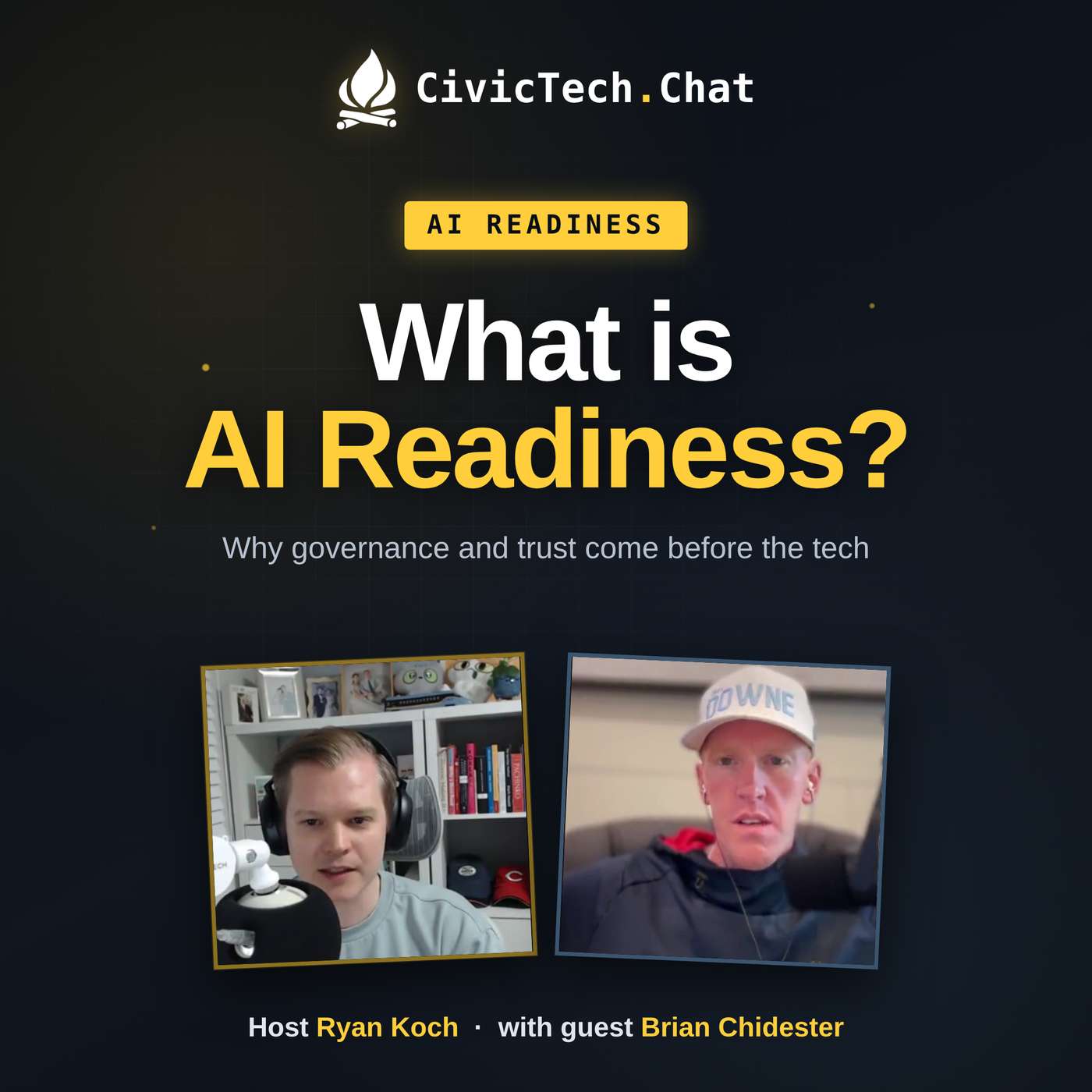
What is AI Readiness?
Civic Tech Chat | 2026-06-03 | 53:03
In this interview, Brian Chidester from Adobe discusses the importance of AI readiness in government, data governance, and the future of AI in public sector transformation. Learn how organizations can start small, build trust, and leverage AI to improve citizen services and drive mission outcomes.
Music Credit: Tumbleweeds by Monkey Warhol
Top Keywords
- government 0.013
- data 0.009
- adobe 0.007
- around 0.007
- mean 0.006
- adoption 0.006
- drive 0.006
- able 0.005
- citizens 0.004
- enterprise 0.004
- value 0.004
- enterprise adoption 0.004
Transcript
Speaker 0
0:00 – 0:30
Hello. I'm Ryan Cook, and this is Civic Tech Chat, a show that looks at the way technology, politics, and policy impacts the world around us. The tools we use, the way services are delivered, and how we talk about and set policy all shape our society. We'll gather around and have a chat about these things together and more. Brian, thank you so much for joining us here on Civic Tech Chat. Could you introduce yourself and tell us a bit about what you do?
Speaker 1
0:30 – 1:18
Yeah, Ryan. Thanks so much for having me. I'm I'm looking forward to this. So, yeah, I work, I work for Adobe. I'm sure a lot of people have heard of Adobe before. But there's a lot of things that we do at Adobe, and it gives me the opportunity to kinda dive deep into a lot of areas of government transformation. I'm the, head of industry strategy for our global public sector business. And it really allows me to kind of sit at the intersection of kinda policy, technology, operational transformation, all the things that really make government kinda drive forward. So what I do is work with public sector leaders around the world and help them understand kind of how technology, especially right now, AI and data and digital experiences, can improve government service delivery and ultimately get to driving better mission outcomes for the constituents that they serve.
Speaker 0
1:18 – 1:25
And, Brian, what would you say is your personal why? The thing that drives you to get out of bed each morning and do all those things.
Speaker 1
1:26 – 2:51
Yeah. I mean, there's a lot there's a lot I could probably unpack with that question. I think working in public sector, I think one of the things that I've always found is, especially when you work with government leaders on a daily basis, there's always that pull to serve. Even my even my father served within Department of Transportation for his entire career, at the federal level. But for me, like, I I really and I enjoy this at Adobe. Like, I sit on a team that, cuts across a lot of different industries. And whenever I'm working with them, they're always so interested in what we're doing in government. And I think the reason why is they understand the same thing I do. It's that, one, the scale is unmatched. Right? I think one of the things that I was talking to one of my counterparts about the other day is, Adobe worked with the census to, census department to create the very first digital census in 2020 during COVID, And it reached 330,000,000 Americans to be able to create what is constitutionally dictated to happen. That scale is unmatched in government, which is unmatched in other industries, which is amazing. And two, it really is touching human beings. It's really making human beings' lives better. And it's it's more of a a need to have than a nice to have. So I think the impact that you can have on people's lives is something that I love about working in this industry and the scale at which you can do it, especially working at a company like Adobe, is just unmatched.
Speaker 0
2:52 – 3:03
I like that, quote you mentioned that, like, the pull to serve. As you're thinking about your own journey, is there a moment where you realize, like, that you felt that pull to wanna serve, in a role like you're in now?
Speaker 1
3:03 – 4:44
So, yes, I had that pull. So my background and any I apologize in advance for anybody who's heard me speak before. So my background was really more athletic driven when I was younger. And I grew up in the Washington, DC area. I played soccer. I grew up I played soccer in college. And I didn't know what I wanted to do other than play soccer. And I got to college and started to explore certain things, especially around the communications and policy area. And that was that started to pull me in a direction that I never knew I wanted to go to before then. And then I always joke, if you grow up in the DC area, you either kind of work for the government or do business with the government. But I saw my dad working for governments, saw a lot of a lot of his friends and people that that served in government. And there was certainly an interest there. I think for me, I always loved the government side of things. Now, I always joke, not politics, but government. I remember taking, AP government my senior year of of high school and and going to the Capitol Building and just absolutely being in awe of, like, everything happening around me. So I always felt like there was a pull there and an interest there, and it really coalesced with the things that I was interested in, which is, like, really diving deep into things and working with technology and working with governments and really grateful for the opportunity that I've had as well to expand that aperture to global government because I think that's really helped helped me understand the challenges are very universal. Sometimes, it's not I always say it's not easy, but sometimes they're simpler than than people would imagine. And I think being able to help bring those patterns of change and maturity to governments around the world, that's what really kind of excites me. Today, we're gonna talk a lot about this topic of
Speaker 0
4:44 – 4:56
readiness for artificial intelligence, as and let's, start or, like, a solid base for that. Why is it important for folks in and around public interest tech to understand and talk about this topic?
Speaker 1
4:57 – 6:20
Sure. So I think I mean, one, it's and it's not surprising we're kind of kicking off with AI. Right? I think it's it's something that is top of mind for everyone. And it has the opportunity right now to really transform every aspect in every industry of the world we're living in right now. But what we're finding is that from a a readiness perspective, especially in government, but even in the private sector, organizations aren't necessarily ready to overlay that technology in a meaningful way. I think we're what we've seen right now, especially in government, is pockets of change. Right? Pilots in in small areas where they're looking to derive some value and understanding of where AI can help them. What we haven't seen is kind of holistic enterprise adoption, and where that really comes from is getting your organizations ready. So what does that mean? It means understanding, like, the different skill sets you need. Right? The the way you foundationalize your data, is it ready to be is it ready to be pulled from from an AI perspective and leveraged from an AI perspective in a more meaningful way to drive those outcomes that you're looking to achieve. So for me, it's it's kind of helping organization understand where their blind spots are from that readiness perspective. So then when they do envelop that technology, they're ready to kind of hit the ground running and get those outcomes that they're really looking for. For a lot of folks out there,
Speaker 0
6:20 – 6:37
AI, when we mention it, to them, it means, you know, it's chat GPT, it's Claude, or those kinda similar chatbot kind of interaction tools. For listeners that are coming in from that perspective, from that being the thing that they've interacted with, how would you seek to define AI readiness for that audience?
Speaker 1
6:38 – 8:37
Through that lens so that's really interesting. Through that lens, I think there's a a number of ways that you could define it. Exactly what I just said. Right? I think it's from a internal perspective, government's understanding that there are skill sets. There are are people that they have to have in place. There's a way they have to foundationalize their data to be ready. But the same way that you described, described AI is probably the same way, like, my mother-in-law thinks about AI. Right? Or even even my my oldest son, I think they have replaced Google with chat GPT or whatever that LLM is that they wanna use. So readiness can be what I described. It can also be understanding that visibility from a government perspective is is fundamentally changing. This topic in particular is so interesting to me right now because we have often seen governments be laggard around technology adoption. I mean, I'm not breaking news here. But this is something that is already happened, is gonna continue to happen, and is gonna have downstream impact. In fact, Gartner even predicts that by 2028, 50% of your content won't be cited invisible on the Internet, which is in which is insane because of the change in search habits. So it's so interesting to me because this is something government has to act. It's not a it's not something they can wait and see what's happening. If they wanna be authoritative in their space, give information out to the constituents that are searching for it, this is the change that has to be made. It's an area that Adobe's really invested in, but it's something that we're we're seeing. We are gonna have we're having to do a lot of education on, especially in government to help them understand the change that is taking place. And it's really cool because when you're in a room with a CIO or or whomever you're talking to, they get it immediately, and they understand the urgency behind it. And they're really trying to figure out, okay. What can I do today, tomorrow, and then in the near term to really make this change for the agency so we are authoritative in the space?
Speaker 0
8:38 – 9:08
I think something key in your answer there that maybe is easy to to have kind of float under the radar is it's not just about your own data and how you then decide to use tools in your organization. Your public facing side is itself also affected by these tools because, as you mentioned, people are using the tools to look up stuff. Am I kinda, like, following on with some of what you're saying there? It's it's not just your use, but you also need to be mindful of how you're expressing your organization's will out to others based on the fact that others will use the tool to maybe find you.
Speaker 1
9:09 – 11:13
Yeah. I mean, 100%. And you think about, like, even fundamentally, our search habits are changing. Right? I I will tell you, most everybody has an iPhone right now, and the two easy quick buttons I have on my home screen are my camera app and Claude because I don't really use Google anymore. I will search through an LOM. And because it gives me a more prescriptive answer and it gives me a faster answer, so I get to exactly what I'm looking for. And, like, that prescription narrows the aperture so I get to probably even more information than I probably wanted initially. So that that's fundamentally changed. But let's say even if you are continuing to use Google, right, generations do certain things differently, there's still a Google Gemini readout at the top of your page. You may not even get to something that's clickable, and the information there is kind of what you're going to derive as accurate. So how are you as a government understanding that everything's changing and we need to be cited? One of the things that that I think about around this is if you go back to the pandemic, there's unequivocally a lot of polarization around things like vaccines. Right? And it was a time when it was very important for government to get information out to the public in a very authoritative way because the entire Internet was littered with people's opinions. Right? Whether it was factual based or not. And this was an opportunity for government to come in and say, this is this is the science behind it, and these are the actions we're taking. Now let's say for for instance that that was happening right now and we're going through this search change. Is the information that government is sending out to constituents gonna be that authoritative information, or is something else from Reddit or another site gonna be what they're reading in those readouts? So I think it shows you how important it is for government to be an authority in the space. And that's just one extreme example. Obviously, there's others, but I think it's understanding that what government does matters on a daily basis to us as human beings, and we rely on them as being the authority.
Speaker 0
11:14 – 11:34
As you think about organizations that are in the space of, hey. Like, we noticed this tool's here, the space of things, we're experimenting with it, versus those that have taken some of the steps you've talked about and maybe others to be, you know, what you might call AI ready if you could throw a stamp on something. What do you think are the key differences between those two groups of orgs?
Speaker 1
11:35 – 13:27
Yeah. I think, for one, if I think there are those organizations, right, that you I think you even use the word that are experimenting. I think you see pockets of pilots, around AI. So different tool sets and they think about it from just a a technology perspective. I think there's very limited governance around the tools that are being used and the way they're governing their data, which I think is an an important, distinction. I I was having this conversation with somebody, the other day where, I mean, AI has the potential to kind of create shadow IT on steroids, right, if it's not governed in the right way. So it's it's a very different world we're living in. But the biggest distinction for me is they are very unclear on what their ROI is going to be around it. Right? It's not necessarily outcomes based. It's tool and technology based. So I think that's that's a really important distinction. I think when you look at some of the organizations and as I'm saying this, any organization right now that are is feeling pressure to push more AI out to their enterprise and derive more value out of their enterprise, I think it's important to understand you're probably more the norm because what we're seeing is really less enterprise adoption wide scale. In fact, we I think we've seen something like 16%, across global government's enterprise adoption. But those AI ready organizations have that enterprise wide governance model in place, so they're ready to envelope. Right? They've understood that to really derive the ROI, it's it's use case driven. So how are they gonna use AI from from their mission perspective to really derive what that ROI really is? So I think that those are some important distinctions and ultimately looking to measure the outcomes to understand if what they're doing is is working, if it's not being able to make adjustments and and move forward.
Speaker 0
13:28 – 14:06
I think there's a a trap in there for for some organizations that, like, they want to give the this might be not be a great way to put it, but, like, the veneer of being AI ready. And that it's like, oh, well, I told everyone they have to use AI. Mhmm. And then, therefore, adoption rate will go up. Right? Like, kinda like making adoption rate the goal versus I think what I'm hearing you describe, which is like, oh, like, let's create governance structures. Let's give access to tools. Let's create the environment with which innovation's possible, and folks will, like, find the way to, like, make the to use the tools creatively. If you build Do you kinda see that in your experience?
Speaker 1
14:07 – 16:01
Yeah. Exactly. Like a field of dreams. If you build it, they will come. I I think, yes. And for two reasons. One, I think and I'm probably stating something a lot of people already know. I think one of the reasons why AI has kinda proliferated the way that it has in such a meaningful way and sort of taking over the narrative mainstream is that ChatGPT was really released, and it was consumer driven. Right? So it it's there's a lot of tools that I use on a regular basis that if I mentioned the name of it to my wife or my kids, they would have no clue. I mean, saying some Adobe things like Photoshop, which my kids obviously know, but but they're not gonna know Workday or they're not gonna know some of the the tools that I'm using. But when you say ChatGPT, they immediately understood it because they've they've heard it everywhere, and we had access to it as consumers, as citizens to be able to use it as we wished. So I think when you have that level of consumer access, it really allows us to kind of dive into it and understand it more, and then we wanna do more with it. So I think that's one. I think the other in government, one of the things that's really inhibited adoption historically has been compliance. And I think what I mean is, like, security, cloud governance, a lot of those things. And these companies were smart and understood that and really dove into the the protocols that were necessary to make this something that could go government mainstream fast. So I think now these tools are ready and can be leveraged. It's a matter of how they're going to be leveraged and what's the ROI that you're going to get. Like I said, going back to to earlier, a lot of this is really use case driven. So have you understood and identified the use cases where you wanna deploy AI in support of what you're doing, and how are you gonna track and measure that?
Speaker 0
16:02 – 16:38
I think your answer is really interesting there and how it leads to the next question I had. And that, I think in your prior answer, you mentioned this notion that I've heard expressed in many a technology circle about government lagging behind. So I think in AI, it might be, like, a little bit more complex than that. So, like, as you example, a lot of the companies in behind AI tools have tried to get ahead and get into, for example, like, GovCloud as an environment. Or I believe, like, Gemini, for example, has a version that works in the DOD. Claude, the same. But in this space, do you think that notion that the public sector lags behind rings true, or or do you see something else in your experience?
Speaker 1
16:39 – 18:23
Yeah. I I mean, I I think unequivocally is government lagging behind? Yes. But not at the rate they have historically. I think we've seen government agencies all over that are leveraging AI, again, in pockets of isolation in support of very, very narrow aperture goals. But I think from an AI perspective, we're seeing an unusually high level of executive attention across government, which is sort of kinda what you were talking about. You have these executives that are trying to mandate, use AI, leverage AI for what you're doing. So I think that has kind of pushed some of the expectations around it. I think right now, from a research perspective, what we're seeing is the understanding of the value AI can bring to government agencies is there, fundamentally so. And leaders are getting smart now on kind of what is going to allow AI to drive those outcomes for them, which is the data. So they're getting I like to say they're getting their data house in order. Right? They're aligning governance. They're getting the data ready to be able to now overlay AI into it to support whatever the mission is. So I think we I think I I mentioned the stat that we had around 16% right now we're seeing around enterprise adoption, but we have nearly 70% of government leaders that are focused on getting their data governed in a way that can leverage it. So we know that that it's moving in that direction. It's just a matter of when. And I don't think there's gonna be a floodgate that opens. I think it's gonna be a crawl, walk, run across all levels of government. But I think what they see is unequivocally, there's a there's a lot of value there. And how do we maximize how much value we can get out of this tool? And they understand it's the data, and that's where they're starting.
Speaker 0
18:23 – 18:49
That's a a great segue kinda maybe into our next big topic around data and governance, which in our part conversation, you mentioned this figure, that 80% of government leaders are currently spending some amount of their focus time as you just mentioned, like, getting their data into, like, that proper governance and usability posture for artificial intelligence use. In practice, if you do that well, what what what does that really end up looking like?
Speaker 1
18:49 – 19:38
Yeah. I think it looks one, obviously, data hygiene. Right? Like, what's the data quality that you have and going through certain initiatives to make sure that data quality is there? I think creating governance around kind of who owns the data, kind of how to use the data, etcetera, is important. Classification and tagging is important to make sure it is usable in in in that smart meaningful way through that kind of or cataloging process. I think all of that is is really important. And I think some of the questions that I found leaders are asking right now is kind of what is the data that we have. Right? Where do where does it sit? Who owns it? Is it secure? Making sure all of that is ready so when they do fold that in and they allow AI to access it, is it gonna, again, drive them forward in kind of the mission and critical needs that they're looking to, get ROI from?
Speaker 0
19:38 – 20:01
Something that pops in my head is that I imagine that there's folks that like DBAs or Davis administrators, data engineers that are like, oh, wow. These are things that I've been wanting to do for the past ten years. But now there's, like, this, like, extra incentive, and now the executives wanna do it too. Do you kinda see that in the environment? It's like, oh, like, these are actually pushing us just towards general good data management practices.
Speaker 1
20:02 – 20:50
I think there's a lot of those types of conversations happening right now that AI has driven. I think data is one. I mentioned that shadow I shadow IT challenge, kind of like shadow IT on steroids. I think IT is trying to get their arms around what are the tools. I mean, we look at Claude, for example, and the way you can build apps across an enterprise is unlimited. So what is that gonna look like? How is that gonna be governed? These are all questions that are being asked before they sort of roll out the red carpet and let all of this go. So I think there's a lot of questions that are being asked right now, and the IT team and and the data team are having to kind of rethink a lot of the things that they probably thought they understood previously around how the data is being used, how the workforce is gonna leverage these technologies, etcetera.
Speaker 0
20:51 – 21:02
And one of the things you mentioned was governance as a key thing. So, why is governance something you'd consider a a key factor for one's ability to get value out of artificial intelligence tooling?
Speaker 1
21:02 – 22:09
Yeah. I mean, the the word that comes to mind there is sort of sustainable adoption or sustainability. Like, to make sure that when we get to a point, like, we government agencies get to a point, we're not just continuing to experiment with the technologies, but we're using it in a sustainable way, right, to drive adoption, to make it meaningful across the enterprise. I mean, I think we saw, again, nowhere near the scale of what we're seeing with AI right now, but you look at kind of workflow automation. When that first rolled out, a lot of the things that we saw were they were overlaying technologies on really bad processes. Right? So it it forced them to really rethink what is a better process, what's a better way to do this, and then let's leverage technology at that point to to streamline it and become more efficient. I think government's doing that or, AI's doing that now at a whole new scale, and it's one of the reasons why government's going a little bit slower because they have more process, but they also have more at stake, like we talked about at the very beginning of the show. So I think government will absolutely get there, but it's a rethinking and a rewiring of how they used to do things from both a personnel and a workflow perspective.
Speaker 0
22:11 – 22:30
I imagine your role that you have some visibility on a lot of different governments and organizations where we're talking, like, nonprofits or otherwise out there in the world in this space. And I wonder, are you seeing any pockets of maturity out there? And in those cases, what are they doing differently that lets them leap ahead to that place?
Speaker 1
22:31 – 24:22
So first of all, yes. Absolutely. I was just I was talking to, to a buddy of mine about this the other day because one of the things that we see, especially across global governments, is sort of north stars. Right? Like, some a place we wanna get to, and I think some some countries have larger north stars than others. One of the interviews I did on my podcast was with a guy named Ott Velsberg, who he actually just recently, left the role, but he was the chief AI and data officer for the country of Estonia. And his vision was to get to a point where every citizen within that country had their own agent that interacted with government on their own on that their behalf, and there was an agent on the government side that would interact. So it's an agent to agent interaction from that standpoint. And the level of efficiency is massive, but to get there, obviously, it's a challenge. I think countries the size of Estonia have the ability to create north stars like that and maybe get there a little bit quicker because, there's a smaller constituency, kinda a little bit less bureaucracy. And I think they're more technologically savvy because they've been able to develop technology foundations over time. Whereas countries like The United States, we struggle because there's a lot of institutional and foundational technology that has been in place for years and years that we have to shift and move and adapt. So I think the maturity will come, but that's where I think we have a lot of smart leaders in place right now that understand it is that foundation that'll ultimately drive ROI. It's not the shiny new object, which is something that historically has been the case where they kinda point to that next thing and said, let's just do that. They understand now what it takes to really derive ROI and value from it. So that's why I I have a lot of a lot of faith that we're gonna get to a point where you're gonna see some really cool use cases leveraging AI and other technologies in government fairly shortly.
Speaker 0
24:23 – 25:00
Your your mention of The US in this case is kind of interesting because, you know, federalism creates the situation where, you know, states and even cities are, laboratories of democracy, as you'll hear a political science scientists say. Our you know, they take various approaches to different situations, and then the others can watch and see what happens. And they either do it because it goes well or choose something else if it doesn't. Given your experience with global smart city alliances, why do you think that there are certain municipalities? I think you mentioned, like, in our prep conversation, like, small to medium are particularly sick successful. Why are they more well positioned to quickly find these kinda valuable use cases?
Speaker 1
25:01 – 26:23
Well, I mean, there's a there's a few reasons. I mean, one is one I just mentioned, which is the smaller the city, the more they can kind of trial and error around around how much it's gonna touch certain constituents. So they're able to kind of test out certain things and especially policy. I think that that's the thing that people don't necessarily think about is the policy behind the technology is actually the hardest thing to get right. They governments don't always get it right because it's really hard. But I think that's one. I think, another thing is when you look at the city level, they are the closest to the citizens on a daily basis. Right? Not only on the impact that they can get and drive for those citizens, but the data that they're actually getting from us in return. So I think what you can do with that data from a from a connected perspective, even a real time data perspective, to create better experiences for your citizens is astronomical. And when you scale that with the value that AI can bring across these use cases, I think it continues to, continues to mount on on what you can certainly do for citizens. So I think the future of what smart cities look like, one, is gonna look very different than what we thought they might look like twenty years ago, but I think it's gonna be far more meaningful in a faster way than what we probably thought was possible at this time too. So I'm really bullish, really excited about AI in that space for sure.
Speaker 0
26:24 – 27:13
I think that bullishness is well warranted. It's actually, funny enough, today even. So I'm here in Busan, South Korea, with my partner. And, she was showing me a video of there's a mayor's election going on. And, actually, one of the key questions in a debate they had was about, hey. What are you gonna do about AI? This, like, thing that's going on in the world that, obviously, like, we're here talking about now. And I imagine, you know, in a lot of other cities, that's the thing that as you were talking about, like, policy leaders are thinking about. If you just had the chance to sit and there's, like, a a person you know is gonna be mayor of a city, you know, someone at that level. And they're just like, I know this is important, and I wanna do the right thing about it, but I'm trying to figure out what that is. What would what kind of advice would you give them as they're, like, just starting to figure out where to go policy wise?
Speaker 1
27:13 – 29:07
Probably similar to what they're already thinking about. I mean, people that get into those get into those roles for the most part, because I I like to think the best of people, get into those roles because they wanna serve the people that are part of that part of that area. Right? So I think it's it's probably the same advice that we've been giving to the the customers we meet with on a regular basis, which is at the end of the day, it's not about technology. It's a it's a it's a person thing. It's a human thing. And if you put the citizen at the center of what you're doing, in my opinion, you really can't go wrong. Because ultimately, what you're trying to do is you're trying to drive outcomes for those individuals. The means by which you do it might change. So you take a look at the technology that we have, like AI, like we talked about, or or a number of different technologies out there. That's just the medium in which you're looking to drive the outcome for the citizen. Right? Hopefully, what this technology is gonna do is drive it faster. It's It's gonna save us time. It's gonna it's gonna make that level of meaningful impact, and you're gonna be able to scale it out in a more personalized way, which is gonna make our lives easier. But, ultimately, it's about us. It's about the people that interact with government. So I think making sure you're not losing track of that and it's not becoming something where you're saying, I wanna use AI because everybody's talking about it, so let's use AI for AI's sake. I think that's the wrong approach. I think put the person at the center of what you're trying to achieve. Drive the outcomes for those individuals because that's where you're gonna make the most meaningful impact. I mean, you think about, I mean, the spirit of your question earlier kind of about the why and the change that we can do. I mean, these are people that rely on government for basic needs. And when those things go away, that those are literally life and death situations. So as long as you keep that in the focus and you're not thinking about other things, I think you'll be fine.
Speaker 0
29:09 – 29:33
As, folks out there are listeners, they've probably also spent a lot of time thinking about their own interactions as humans with AI. And one of the kind of newer developments in the space is AI that can kinda do something for a while with minimal interaction, often referred to as agentic AI. When we use that term, beyond that, maybe that first little bit that I gave, what are we really talking about?
Speaker 1
29:34 – 31:03
When I think of AgenTek AI, obviously, agent is part of it, but I think of AI with agency. Right? The ability to not only predict kind of certain things and kind of create order around certain processes, but then take action. Leverage that and use agency to take that action. So that's sort of the way that I define AgenTek AI. I think one of the things that I think Adobe has been a little bit different in how we've approached AgenTek AI, whereas we similar to kinda what I was just talking about, putting the citizen or putting the individual at the center of what we're doing, we really looked at who is our end customer. Right? What are they leveraging? What are the use cases that they're leveraging AI for in creating, agentic tools in a an entire platform around those individuals to make their out of the box, make their lives easier, right, to drive more efficiency, to be more effective in what they're doing. I think there's a number of ways that that companies look at it. Some of them look at it as platforms you can build on, which is certainly another avenue as well. And and I think interoperability becomes very key when you are looking at AgenTek AI, when you could take that action and you pull the data from third parties and internally. But, ultimately, at the end of the day, again, I think it's being able to, with human in the loop, leverage the data that you have to make the best decision possible and automate those decisions on a a frequency basis.
Speaker 0
31:04 – 31:43
One of the things that, we've talked about in a prior episode is the idea of using an agent to help out with legacy software modernization. The idea, you know, you take the tool, you pointed out this part of a legacy system that maybe someone hasn't touched it in, like, ten years. Right? And so to ask a software engineer to go in there and try to get the context, get up to speed, it's expensive and time consuming. But if you have this tool, maybe it can go in and start to generate some engineering specs. Maybe then it can even go further and generate some specs that your engineers and your program folks can review together. Is that kind of activity something you've come across in your experience in this kind of nascent field as it's developed?
Speaker 1
31:43 – 33:17
I think it's certainly I think it's certainly a use case that could provide a lot of value for government. I mean, we've seen AI do some incredible things. I think there was some promise around not transforming kind of what that modernization looks like when, when RPA came out, like, robotic process automation, if you're if people listening aren't familiar. I think there was a lot of promise there because of the interoperability aspect of what RPA could do, where it could plug in the legacy systems and still be able to provide that same level of value across all of those systems. I think the idea that you can use AI, antigenic AI, to be able to modernize what your legacy software instance really looks like is certainly is certainly interesting. If you think about before we before press play, we were talking about or press record, we were talking about, like, some of the agents we use in Claude and things like that. Some of the the coding that you can do on those platforms, even at a even at a nascent level, is is incredible. And the analysis you could do around the code and the remediation in such a fast way, I think is important. I think understanding and documenting systems and figuring figuring those things out where those gaps are are all part of that that process. So I think there's a lot of value that can be derived there through that through that modernization effort that we're probably just touching the scratching the surface on and could certainly accelerate where where government is over the next decade, I would imagine.
Speaker 0
33:17 – 34:17
That that makes a lot of sense. I think that jives with what I've seen in my day to day, whereas we're, like, in the process of modernizing a large legacy application, kinda doing it piece by piece. Mhmm. And one one of the things we'll run into is, like, well, as we gain understanding of a piece of it, does it actually even do the thing that the program folks thinks it does? Or does it do something and they have some process that makes up for a mistake, but it's just what they do every day. So they don't think of it. Like, if I go and ask and go, hey. Like, does this do what you need to? It's like, well, sure. Like, we get to the end we get the outcome. Right? But it's like, well, there's actually a bug here. And then I go to a spreadsheet. And then from the spreadsheet, I figure out there's a calculation that's wrong, and then it gets me to the place. Right? Mhmm. But as we're kinda doing discovery, I feel like there's a the energy to get to that place where you find out that there's that workaround can be very expensive. Whereas maybe, you know, if you use a tool like this, maybe you can get to the place to ask that question a little bit more efficiently.
Speaker 1
34:18 – 36:53
I think that's really interesting because it it it starts to get back to what we were talking around readiness, right, for an organization. Are you ready to have a tool like AI so you can work more efficiently? I I think it I think it was, Jensen Wong that was talking about I think it was in reference to asking about how AI is going to replace jobs or does he think AI is gonna replace jobs. And he said, I mean, ultimately, there are some roles that AI is ultimately going to replace and change. It's it's gonna create jobs too. But what he really was talking about was how it's gonna reimagine how we work. Right? And I think it's important for us as individuals, not just enterprises, to understand that AI had can place play a huge role in how we do our work on a daily basis and not only make us more efficient, but allow us to drive more value in our roles as well. So things like that I mean, just what you're talking about. There are steps to that process that you can leap forward on without having to go through them, and now you're on to the next problem without having to spend whether it's a a day, a week on trying to figure out what is that bug. How do I how do I figure this out, or how do I reconfigure this so that it works in a more efficient way? You can do that in in minutes and get to that outcome faster and then move on to the next thing. So I think how we think critically as individuals and how we use these tools in that critical way, it definitely needs to change. And it's something that we talk about in our house because my wife is a STEM educator and just when we talk about the future of work and she works in the kind of the k through five space, understanding that coding as a skill is gonna look very different than maybe what it looked like when she first got into a STEM education. Right? So how do we change the way students think foundationally around how AI is going to help them approach these problems and get to those outcomes. So then when they do reach the workforce, what they can do with these tools already and the way they can think critically and how to use them is gonna be amazing. It's why we're about to, at Adobe every summer, we pull on summer interns, and I'm super excited to be able to obviously work with them, but understand how are they using AI. Like, what are they being taught? What are some of the things we might be able to learn from them and how we approach certain problems? Because I think how we learn from other people is the way that we're gonna be able to scale this, in at least down one avenue.
Speaker 0
36:53 – 37:18
As we think about the a little bit further. So, like, the the technical folks, but then there's also kind of the the folks that use the the tools that come out of that. Right? For folks that are doing those, like, public service roles, how do you see their day to day work changing as they start thinking about, like, you know, how am I interacting with delegating to orchestrating agents as they kind of emerge into their environment?
Speaker 1
37:19 – 38:52
I I mean, I sort of touched on that in the last question, but, I mean, the shorter answer to it is, I think it's gonna depend on the agency and what their outcomes are and kind of what those roles are. Right? I think the really cool part about what AI can bring is it is gonna impact every role. So, I mean, one of the things that that we hear from government regularly is that they have really big problems with contact center. Right? Whether it's people through chatbots, whether it's taking on phone calls, they're just constantly slammed with certain things. So we look at it as one, how can we leverage AI to drive better self-service for the citizens so they're not having to contact the the contact center representatives. So that's one. Two, if if we're not able to accomplish that and the problem is more severe, how do we give the value or the efficiency value to those contact center representatives through AI to hear at the same time what these problems are, be able to not only prescribe what the solution might be so they can pull that out and give that to the citizen in real time or maybe dial up certain documents that they're already they already know they're gonna need throughout this process. I think it's using AI in a really smart and efficient way, and in a real time way to drive these outcomes for citizens. I think that, like, that's just one example, but I think there is again, going back to what we talked about earlier, it's all use case driven. So understanding the use cases and where you can overlay and and support it with AI is really the key.
Speaker 0
38:53 – 39:19
Related to that outcomes to citizens piece you mentioned, in our prep conversation, you expressed a lot of excitement about the potential for proactive engagement in government services where it's like, hey. Like, we noticed you're qualified for this program over here. So we'd like to go ahead and take this data we've got and get you started on that. Get you, like, into the place where you're ready to interact with that service. How do you see that sort of thing kinda looking like in practice if we get there?
Speaker 1
39:20 – 40:55
Yeah. I mean, I I think of it, and it's it's probably, a kind of a a beaten down analogy at this point, but it's sort of talking about, like, an Amazon like experience. Right? Just in a more meaningful way, because I know I might go buy something on Amazon and I get served, hey, you might be interested in this. I'm not interested usually in any of them, but it's usually things I get served. When I think about government looking at it kind of in it being in a more more proactive posture, I think about someone who might have lost their job. Right? And you put all the they're going through the process. They're putting their information in. And maybe what that has done is made them eligible for other services that they wouldn't have been aware of. And I think the way it stands right now, it's really incumbent on the citizen to be able to go to each area to put in their eligibility information and say, hey. Am I eligible for this? Can I get this level of support here? I think being able to automate something like that based on all the demographic information they might be giving already or what government already has on them previously, I think, could serve things up. So did they lose their job? Do they need food and housing assistance? Are there other areas where government can support them? I think getting to that posture is gonna be absolutely game changing for for governments and how they can not only support citizens, but ultimately drive what they're trying to do, which is getting to mission outcomes for their constituents. And I think AI, obviously, along with, again, along with another set of technologies, is gonna be able to make that a reality, in my opinion.
Speaker 0
40:56 – 41:17
Here in The US at least, data sharing amongst government agencies has not always been without controversy. So I one of the things I think about is, you know, what needs to happen to get kind of the right themes around, you know, building trust, folks feeling like they have data autonomy when it comes to supporting success in the kind of proactive government we're talking about.
Speaker 1
41:18 – 44:01
So I I'm glad you preface that by saying in The US specifically, because as you're probably aware and maybe a lot of the listeners, data sovereignty becomes a real challenge when you get into, like, the, the EU and and other countries, not only around data residency, but data usage and etcetera. And when you go across country lines the same way we do state lines, it it becomes a real challenge on how you're governing that information. At least as it pertains to The US, I think I like to think of them as more common sense rules. I mean, there are there is some governance and and some laws around certain things, but, ultimately, it's to me, these are really common sense. Right? Citizens just need to have visibility, right, around the data. They wanna understand how is their data being used, what date of theirs do you do you have, I think, is important. So that level of transparency. And what are you gonna be doing with it? I think that's that's the other side of it. Now we know government isn't gonna be selling data, so it's a little bit different than some of the third parties. But what will you be using my data for? I think this speaks to something we saw on a research report we we released last year where citizens are more willing to give their data to government if they know that they're gonna get value on the back end. So talking about that proactive posture we were for, for example, if we know that the way government is gonna set up is that they're gonna try to become a more proactive entity for us in support of us, I definitely would sign up for that, and I would be more willing to give my data. So I think understanding and being transparent and the explainability around what you're gonna be doing with it, I think, is absolutely key. The last thing I would say, and this is something that you and I probably take very much for granted because we work in the space, we know the level of security that happens with certain data layers within government. Right? So we take that for granted. We know what a challenge it is to even get through those hoops when we're trying to work with government. So it it's it's both a blessing and a curse. I think as citizens, average citizens, if I went to ask my wife and if I asked her what FedRAMP was, she would have no clue unless she's overheard me using that term on a call sometime and looked it up. I think the average citizen that doesn't work in this space doesn't know the level of security. This is where it becomes important for government to share and and help citizens and educate citizens so they understand the loves level of security they've invested in on their behalf. I think all of that goes into play when you're thinking about kind of how do you build trust with citizens and how they're using their data. But at the end of the day, it becomes a value exchange. If if I give you my data, what value am I getting in return? And if it's a value I find valuable, I'm going to do it. So I think that's the way most citizens think.
Speaker 0
44:02 – 44:13
When we talked ahead of this recording, I recall you expressing that you see there being, an eighteen month adoption curve that's coming up on the horizon. When you say that, what does that look like to you?
Speaker 1
44:14 – 45:13
I think that the spirit of that is really around enterprise adoption. I think that's ultimately where we're moving towards and where government is gonna get the most value out of the technology that they're they're developing. But it's getting the right people and process in place, the right governance in place to be able to layer on top of that foundation the technology to to drive success. So I think you can't do that overnight. And if you're trying to get to a place where you can drive measure measurable ROI, that's sort of the the gap that we're that we're looking at. Honestly, it's been as newer technologies came out, that gap has been a lot larger. And I think AI has a more increased pressure on some of the executive leaders in government to make this enterprise adoption a thing, and I think that's what's driving it. So it it could be larger, but I think this is a pretty quick pace for government to get to enterprise adoption on a technology, which is why I'm so bullish on what what the outcomes are that AI can drive in government will be.
Speaker 0
45:13 – 45:34
Something I have to think about is in our space is, is something difficult to adopt because it's government, or is it difficult to adopt just because organization is big? And I wonder, as you think about that, for your adoption curve, do you see there being a meaningful difference in the pace, or do you think it'll be somewhat similar between public and private in that regard? That's such an interesting question. So
Speaker 1
45:34 – 47:27
I was standing in my garage the other day talking to talking to one of my neighbors, and I mentioned I think I mentioned Claude or something, and how I had just built a skill or an agent in there to to support a process that I was going through and how much time it saved me, almost like a day and a half. And it was just a a really cool use case. And he had never heard of Claude before, let alone understanding that you can develop skills and or agents on these platforms to be able to do that. I think, again, being in this space, we take for granted sometimes understanding the technology. And even myself, like, working at Adobe, the level of enablement and support that we get to be able to learn and leverage AI I mean, having access to these tools like Claude and ChatGPT and others, Copilot. I mean, there's numerous people on my team regularly building applications that we use on a daily basis in support of our ecosystem to make things faster, easier, more transparent. So the level of innovation we have at Adobe, obviously, in our the tools we sell to our customers, but also internally and that we're building is, I would say, really, really high. Now that comes because of the investment that Adobe's made, and I don't just mean in dollars, but I mean in enablement, in education, making sure that we understand the value that can be pulled out of it, but how to do it. And if you don't have that exposure and that education, you could be in government. You could be in private sector. You could be large and small. It'll never come. So I think the intentionality behind driving that adoption is what's really key, and that really gets to the spirit of that readiness side of things that we really open to show up with. I think what I'm hearing from you there is it's that classic, like, folks don't know what they don't know. So there's a little bit of just an awareness,
Speaker 0
47:28 – 47:46
gap or maybe even, like, a critical mass that when you hit it in organization, maybe then you start to see some momentum. And folks might be start proactively asking you about, hey. Can I use this for this activity I'm doing? Hey. Like, what I don't know. What's possible? Am I kind of along the the line of thinking you're going further? I don't know if I'd call it an awareness gap,
Speaker 1
47:47 – 48:49
because I feel like you could trip over something, and the sidewalk might say AI. Like, yeah. I mean, you you know you know it's out there. I think there's a little bit of the fear of the unknown and intimidation around it. That to me is why education and enablement and just proximity to technologies is so key to it. And putting the the type of people in place across your across your team that have the right fluency is the wrong word because that that would assume there's a level of education already, but the willingness to dive in and learn and understand. I think the agency behind that is something that can be taught, and there could be support there as well. So I think there's a number of factors. Again, I don't I don't know if I'd call it awareness, but I think it's an intimidation factor that you as an organization, again, whether it's private or public sector, have to help your workforce overcome to ultimately get to the value that you can drive.
Speaker 0
48:50 – 49:03
If there are folks out there that are starting to feel anxious about just being left behind by all of this that's going on around us, what advice would you give them if you had a chance to talk to them? I mean, one, you're not alone. I think no matter
Speaker 1
49:03 – 50:58
no matter where you are on this journey, it's it's not one that you're alone in. Whether you're, like, extremely nascent, I've yet to come across an organization that is extremely mature, but I think it's the same advice that I would give any government agency when they're looking to modernize, which is don't try to eat the elephant all in one bite. I think it's it's a crawl, walk, run maturity phased approach and figure out what those phases are for you, where you are in that journey. Again, I I I think some of the advice that I give when especially when we're talking around AI is what are those use cases? What are you looking to ultimately achieve with AI and not just getting to AI for AI's sake? There's a lot of education that needs to happen too around the type of AI that you're using. Right? Is it predictive AI? And what are those use cases? Is it generative? Is it agentic? We'll talk to customers and then say, hey. I need I need to leverage Agentic AI to do this use case to get this outcome. And we'll say, oh, no. Actually, that's predictive AI. You can do that using this tool, and this is already in place on what you're already using. So I think there's a level of education understanding that still needs to be in place, which is why I say wherever you are, you're not alone. And I think it's just understanding, again, where you are and where you're trying to get to, that, that becomes so important. And then the other piece of advice that I'd like to say is, especially if you're in government, lean on your private sector partners. They are resource there to be able to help you. I mean, I'll speak specifically about Adobe. I mean, that's that's part of my role is I mean, that's a lion's share of my role is working with customers, helping them become successful in what they're doing. And I think every private sector vendor out there is gonna be resourced to be able to support you. So I think lean on, lean on your ecosystem there for support, and I think it's sort of a journey that we all take together.
Speaker 0
50:58 – 51:14
For that listener out there that's maybe they're on the edge of their chair right now. They're like, man, I really like what Brian's had to say. I'm in this. I wanna I wanna do something. Mhmm. Over, like, say, the next week or a couple weeks, what's something they could try to go after at Ticket Started?
Speaker 1
51:14 – 52:19
Well, one, if you're that type of person, then you're my kind of person, and we should go get a beer together because, I one, I love these conversations, but I love listening to them at the same time. I I think identify where you are. I think kind of what I was speaking to around that that maturity aspect of it. Identify where you are and and maybe pick one workflow that you think could be optimized with AI and start there. That's where most organizations are right now anyway. It's those pockets of pilots that I talked about, and don't try to try to proliferate this out too far. Find success. You'll do two things. One, you're gonna learn from your mistake mistakes in a small way, and you're gonna be able to iterate and adjust and do that. But two, you can then showcase this and get buy in across the enterprise as you are looking to drive adoption. So you wanna be able to show those small wins if you're gonna get full on adoption across your entire team. So it becomes almost a necessary state or step as well, but I think start small and then work your way up. I think that's the best way to go about it.
Speaker 0
52:20 – 52:30
Brian, thank you so much for joining us here on Civic Tech Chat. I had a love lot of fun with this conversation. I'm sure folks got something they can bring into their day or into their work.
Speaker 1
52:30 – 52:39
No. This has been fantastic. I appreciate you, coming on and talking to me all the way across the world. Like I said, I love having these conversations, and, hopefully, we do this again sometime.
Speaker 0
52:42 – 52:49
Visit us on the web at civictech.chat, or subscribe to us for content updates wherever it is you download your podcasts.