Speaker 0
0:00 – 0:31
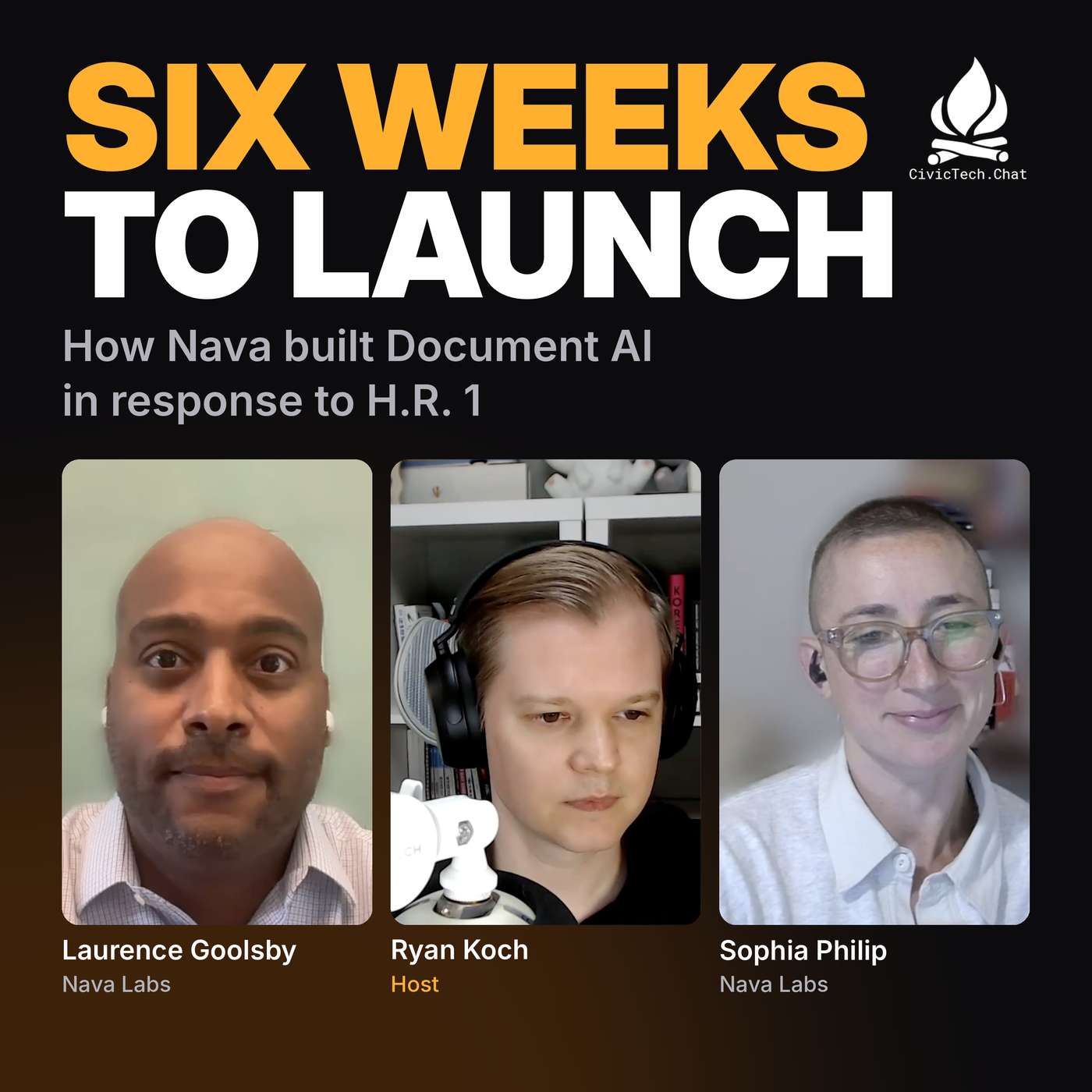
Hello. I'm Ryan Cook, and this is Civic Tech Chat, a show that looks at the way technology, politics, and policy impacts the world around us. The tools we use, the way services are delivered, and how we talk about and set policy all shape our society. We'll gather around and have a chat about these things together and more. Lawrence, Sophia, thank you both for joining us here on Civic Tech Chat. Could each of you introduce yourselves and tell us a bit about what you do?
Speaker 1
0:32 – 0:39
Great being here. I'm Sophia Phillip, a product manager at Nava, specifically in its r and d arm, Nava Labs.
Speaker 2
0:40 – 0:47
And I am Lawrence Goolsby, senior software engineer, also part of Nava Labs working with Sofia.
Speaker 0
0:49 – 0:57
And for each of you, what would you say is your personal why? The thing that drives you to get up every morning and do what you do.
Speaker 2
0:58 – 1:23
Yeah. I think for me, it's solving challenging problems, right, and helping people and delivering technology that has positive impacts on people's lives. I know it sounds kind of, you know, rehearsed, but that's the absolute truth. Right? So doing something that I love, programming all day every day and also helping, people. That's that's my why.
Speaker 1
1:26 – 2:14
I think building off of what Lauren said, definitely plus one, but I think also being able to work, with a variety of individuals, organizations that are mission driven to not only just providing services to people, but how might we improve the experience of the delivery of that service? How might we ensure we are cutting right through to the outcome that we're building toward. And just as Lauren said, getting to engage in those messy problems, but also getting to collaborate across not just, specializations whether in software engineering and product, but also expertise, whether that's deep knowledge and policy, those responsible for the program, to collaborate and and find the solutions that, will work best for the problem we're aiming to solve.
Speaker 0
2:16 – 2:39
The mention of expertise there is a nice segue to my next question, which is about the fact that y'all work in practices that are well known for rapid change, you know, software engineering for product, especially these days. Sofia, with product management, what's something, that has changed, and what's something that's been a consistent foundation
Speaker 1
2:39 – 4:25
as you've kinda lived through that? Yes. I think with product management, something that I'm grateful for is by inherently leaning on the pillars of methodologies like agile. We really have it built into our ways approaching the work to adapt, to respond to sudden change, whether it's expected or unexpected. So I think it complements, really well with, waves of new technologies available, whether it's, I think we're all very familiar with the integration of AI into both workflows, but also what we're building. I think as well this... Something like using more, AI capabilities or building it for customers, really helps, everyone tackle the blank page problem. I I think oftentimes we hear demos over memos, and this just accelerates our ability to, once we apply our expertise on honing in what is the problem to solve using prototyping, using quick turnaround to validate that understanding, and also get it into user's hands as soon as possible to learn from them, to understand are we solving their problem. That is is the most important to prioritize. I think no matter what, never compromising that data is always gonna drive our decisions. No matter how much we are, our velocity has increased. It's always ensuring we have the feedback loops from the qualitative or quantitative to understand, are we actually moving in the right direction? So, for me, that's that's really been something that I've embraced in the surprise of how product management has changed in its speed. But at the same time, we... We've had some really, some really time tested true methods and fundamentals that are are sending us all up for success to move through it and acclimate.
Speaker 0
4:26 – 4:30
And, Lawrence, I'd wanna ask you the same regarding software engineering as well.
Speaker 2
4:31 – 5:57
Yeah. I mean, rapid change can't really talk about that in software engineering without mentioning AI. And it's been huge. It's everywhere. Right? But I think the important thing there is, you know, still understanding the fundamentals through things, being, you know, at the... Behind the wheel and driving a lot of the decisions and not handing everything over to AI and just say, hey. Build this thing and don't make any mistakes. I think that's one of the jokes that that we use internally. Right, because if it was that easy, then everyone would do it. But it definitely takes a critical eye to look at some of the things that AI does and, you know, to have conversations and, you know, bounce things off back and forth, I think, is what's really accelerated. You know, whether it's a new framework that's out there or, you know, something, you know, a new tool that maybe, you know, one's not aware of, like, that's where AI can come into place and... Especially if you're asking, you know, how should I handle this? Or I implemented it this way. Do you see any issues with it? And I think that's probably the the biggest thing, and it's really sped up the development life cycle. And I think people expect things to be delivered faster. Right? Like, taking a year to deliver something is a long time, and I think the expectation is now with AI that it's going to be, certainly, significantly faster than that. And I think Sophie had a great point there. Right? Demos over memos. Right? Like, show me what you're building. Let me see the thing, you know, as soon as possible. So that's kind of how, in my opinion, things have accelerated, software engineering wise.
Speaker 0
5:59 – 6:17
You each mentioned AI in some way. So, Vy, you mentioned it with prototyping. Lawrence, you mentioned with with speed and kind of the ability to change fast. That's, in the context of your own practices. I'd also be curious if each... If either of you have a take on how it's affected how you'd work together kind of across practice.
Speaker 1
6:17 – 8:32
Yeah. I think, an experience that immediately comes to mind is one thing, that we'll be talking about shortly is the service Document AI that we're, working with Maryland to... And have recently launched, in a pilot. But, on the journey there, something that we've realized and learned again from the data and talking to stakeholders, who are trying to understand what does does the future look like with those service like Document AI is how how are a bunch of people in offices gonna use it? How do you manage it? How do you scale it? And so something that using AI enabled us to do is, in ensuring Lawrence was able to focus on delivering for Maryland in, I think, just one morning, also with supportive access to tools like Claude and Chat GPT in Nava's workspaces and tool suite. I was able to spin up, a interactive front end prototype of how might we create a management layer, how might we help configure tenants. And, even though it was not something that could immediately go from zero to one, it helped address that blank page problem. And Gabe, Lawrence, and I not only just, shared understanding. Yes. We have. We always defer back to what's the core problem statement, what's the scope, who are the users resolving for. But it actually allowed us to play out in real time what are the features we wanna prioritize building first that help achieve this outcome. And it was by saying, hey, Lawrence. I know you've been deep in the weeds of helping stand this up for Maryland at 1PM today. Can you just here's a a URL. Can you just click on this, poke around? Where are the gaps? What's some... Does this give you enough to work off of? And so I think it also really helps quickly close the back, the gap between abstraction and concrete implementation. And, frankly, it's also a ton of fun building things. I think, yes, we have our respective capabilities, but some of the favorite work we've done... My favorite work we've done around evaluation, we've had designers, software engineers, product managers, and evaluation expertise at the table to figure it out. So I think it actually only, deepens the, the impact of collaboration because of that abstract to concrete in such a quick turnaround time.
Speaker 0
8:33 – 9:09
I can definitely get behind the statement that it's it's fun to build things, and it's fun to get to test your ideas like that. And your mention of, the service we're gonna talk about here throughout this episode, Document AI, is a good segue towards our main topic. I wanna start a little bit base level and talk about kind of the challenge that this project's meant to go after. You know, we're here to talk about challenge that comes with handling and processing documents for for programs, like those that might handle social well-being or other very important functions in folks' lives. Why is document processing a challenge worth solving for?
Speaker 2
9:11 – 10:14
Yeah. That's that's a great question. I think when you look at, you know, whenever someone is applying for benefits or just in general, right, processing a document, you know, there's the person uploading the particular particular document and receiving feedback in real time whether or not the document is good or not. And then there's also kind of the back end, like, caseworker side. So, you know, are they looking at documents and then typing things in manually? Is there something we can do to help kind of ease that burden? And I think there's a lot that kind of factors into it. Right? Like, how do we ensure that good documents are getting through, the documents are of high quality, and are readable? And, you know, if there's a way that we can extract some information from the document and, you know, help prepopulate things or give someone, you know, maybe they don't have to type as much or we can, give them some sort of visual cue that, you know, yes. We extracted this, but this is something maybe you should take a look at. I think that definitely makes it a problem worth to solve.
Speaker 1
10:15 – 12:22
Absolutely. And I think all of us have experienced iterations on systems that are just trying to keep track of the information that they need about you as an individual. And so we have watched forms digitized. We have watched, maybe not watched, but back ends integrate that make us, not have to watch so many things on our own accounts or across respective platforms. So I think document processing is is a means to an end, and so some of the work that we are doing now is, looking to the public and, private sector and figuring out how can we pull in, opportunities so that we are raising the floor of pub... The public's expectations for how benefit programs might function, how government services in general. I think it is not just benefit programs whether you're applying for a driver's license license or a permit to build an extension on your home. You're going to have to submit a document of some kind. So it is again about, raising those expectations for how public services can perform and bringing in pretty standard and expected practices that have already been, tried and true in other industries so that it can be a seamless digital experience regardless if you're engaging with a public service or a private entity. And I think as well, humans are complex, and that's wonderful and also can make for a lot of paperwork. And so so one of the things that we're really, is very core to ensuring we're doing human centered design is that complexity does not cause a deterrent for the way the sure... Service should work. It is about saying, let's make it a little bit easier on you so you don't have to con... Constantly justify or explain unique terms of your life every time you engage with a public service. How might we make that experience smoother so that you can just come as you are and get the service that you intended to apply for without unnecessary, jumping through hoops. And, also, it should feel as seamless as the way you might access your online, online bank account.
Speaker 0
12:22 – 12:59
Real quick. It's editing Ryan here. I just wanted to give a note of thanks to NAVA Public Benefit Corporations for sponsoring this episode where we talk a lot about document processing and about their tool, Document AI. So with that said, let's go ahead and get you back into that conversation. In the fight against administrative burden or the fight for good user experiences, sometimes we're saddled with responding to a burden that's imposed by purposeful policy change, whether we're talking state laws or federal laws. What do you think about these situations where we find ourselves needing to make a by design requirement easier to comply with?
Speaker 1
13:01 – 15:12
Thanks for that. I think, I always remind our teams to keep top of mind what is our answer if we were asked in order to do what. And I think it... When it comes to complex policy or ambiguous policy implementation, it's ensuring we have the internal alignment, which, again, huge shout out to Nava for anticipating the need and role of policy strategist on delivery teams. This has gotten... Nipped this in the bud at least for our work with Maryland. We have immensely benefited from having Snap policy expertise to really talk through, even if I am not a policy expert, how might I understand, the way this is structured in order to do what? And so that helps us create a shared definition of the outcome we're building toward and in turn building back of, okay. If this is where we're going to... If this is where the policy wants to get to, how can we build this into the design? But, also, where's the wiggle room just as you said to ensure the user is not accidentally left out of the experience that we're building toward compliance? So I think a great way that we've navigated it, this is collaborating with jurisdictions like Maryland where we understand what is the current benefit application experience and given their AI policies around requesting consent, how can we always, ensure not only an option to opt in or out, but how do we build a path... Pathway to create reversibility for consent? Because I think it's always important to ensure that the user has autonomy as you adapt a service or introduce new capabilities. And so something like that, really helps ensure that we are honoring compliance with the state's policy, but also building in steps of consent in a way that isn't surprising to user, provides just in time plain language information of what's the service that they're consenting to, and then the ability to revisit that should their mind change, but really just to, ensure that they have confidence that they can control the experience that they're moving through that has certain policy required steps.
Speaker 0
15:15 – 15:30
Y'all have been working on an open source solution to address some of the challenges we've talked about so far called, Document AI as I think it... The name has floated into our conversation already. For folks out there, maybe they haven't come across it yet. What is Document AI?
Speaker 2
15:32 – 16:24
Yeah. If I were to summarize Document AI at, like, the highest level possible, it is, a service where you upload a document, and the document... Or the service rather decides whether that document is clean and legible or if it's not clean and legible. So that is the simplest explanation for it. Right? Is this a good document or a bad document? But there are a whole host of other things that go into that determination. But, again, at the most simplest terms, I've uploaded a document. Is it good or bad? Provide that feedback to the person uploading the document and give them the option to proceed if... Or, I guess, upload a new document if it comes back with a nonpositive response.
Speaker 0
16:26 – 16:29
And why did this project kick off?
Speaker 2
16:30 – 18:10
Yeah. So this project started back last year, 2025, right around this time, as a rapid response to the HR one, legislation that was passed. So we started it here in Pennsylvania. We were on-site, early on. We had six weeks to implement this process from beginning to end. We did not have an architecture yet defined. We worked really closely with folks from AWS, and others to figure out how we were going to do this in the time allotted. Certainly, you know, it was a challenging time, a lot of long hours, but, we implemented it officially on 10/01/2025. And, again, the goal, as mentioned previously, was to, help improve the quality of documents that are coming through. So if someone's uploading a cat picture, for instance, flagging that and saying, we don't believe this to be a document. We're also doing some extraction, from the document. So if someone uploads a driver's license, we'll extract name, address, anything we can from the document, really. And it's kind of morphed into this open source initiative that we have, where we recognize that this problem isn't specific to Pennsylvania or Maryland or anyone really or even the type of document. Right? It's very generic. I have a document. I need to upload it. So this is a problem I think that a lot of places are trying to solve. And if we can help accelerate that, then, you know, that's why we're here.
Speaker 1
18:11 – 20:07
And I think, this... Identifying this problem but also opportunity speaks to what we discussed earlier where states, have been tasked with reducing their payment error rates. And I think this is a great example of looking at the data, within states to understand what might be the most feasible and impactful area to start that might help reduce those payment error rates. And so the form that it took in this case was a intelligent document processing service at Document AI. And I think the opportunity that really presented itself is, as Laura said, this is a shared problem across states. And, yes, it is in response to new policy requirements and compliance, but in the way that it was set up to be open source, to be a reusable service for document processing, it can be reused in... For different policy needs or different program objectives. So like I mentioned earlier, you know, we may be submitting an application to... For a permit or, even for a public university application as a student, and we're using our mobile phone to take photos. We check these are the ones I wanna upload and accidentally in there is that photo you took of, let's say, a very cute dog on the street, which never stop yourself from appreciating the little moments while you're walking through life. But sometimes it's difficult when you're doing paperwork to make sure you're including everything necessary and also removing those things you don't need to upload. And so something like Document AI helps reduce, those unexpected uploads or unintentional uploads, so that you can really get, to the thing that you want through this public service, whether that is, submitting your application to pursue higher education through a public institution, or, I would just like to build a porch on my house and make sure it's in compliance.
Speaker 0
20:10 – 20:22
It sounds like y'all definitely didn't waste a crisis there as that big policy change was coming through. That kinda core thing you started with, did you find that that payment error rate ended up being affected by the work?
Speaker 2
20:23 – 21:18
Yeah. I think payment error rates, it's a very complex thing. So, there are multiple ways that it can be addressed. Right? Document AI is just one of many ways that it can be addressed. Right? And the hope there is that the quality of documentation that we're receiving goes up, and that in turn should have a positive impact, on the error rate. There are also things that can be done, upfront. Right? Like, doing some, you know, analysis or, like, pre quality checks on the existing data to see things that may be flagged. Right? So, yes, I think document processing itself had an impact, positive impact on payment error rates. But, again, it's it's such a complex thing that, you know, one thing in and of itself probably isn't going to move the needle significantly, but a lot of things in combination with each other can really, you know, help kinda drive that number down.
Speaker 0
21:21 – 21:34
And in in in the answers before, the term open source was used a a couple of times there. What do you mean when you say open source in the context of this project, and why did you all set it up that way? Open source in this regard,
Speaker 2
21:34 – 22:13
is that the code itself lives in GitHub. It is publicly available for anyone to take a look at, see how we've implemented it, see what services we're using, and, you know, basically just take the code. They can fork the repository if they want to. They can follow along by starring the repo if they want to. And that way, as, you know, we make changes and updates to it and improve the service, Anyone available in the public can, take a look at it, see what we're doing, open up a PR in theory if they wanted to, and help contribute, to make it a really better solution.
Speaker 1
22:15 – 24:23
I think as we've discussed many of times, document processing comes up in a lot of different offices for a lot of different, objectives. And I think with open source, one thing we were anticipating is that, given, dare I say, a very universal need for a little help to make document processing easier easier, why not, prioritize an outcome that we are not going to create vendor lock in with Document AI? Having it as open source enables, different jurisdictions, different offices, to be able to look at what is an option we could consider to improve our document processing. So it enables, much like we are anticipating for the user of Document AI that autonomy, that ability to understand what's within the realm of my control. How can I make an informed decision given the outcome that I'm driving toward? So, again, thinking of the perspective of an office jurisdiction as they're evaluating what tools they might want to procure, build in house, and in this case, fork a branch from to then bring into their own system. And I think something that's, really key about open source, it's... And the way that we set up the repo specifically is it provides the clarity on how a government might provide the service, but it does not require that government agency or office to compromise their security or privacy standards. So we've, made it visible what security checks are built into Document AI, but at no point does our public repo store private information require agencies or offices to pass PII or PHI. Rather, they can fork the service into their system, stand it up so that it remains in a secure environment. They can adapt it to to their security and privacy requirements. Again, ensuring and prioritizing the safety and needs of the end user, but also, again, helping, remove those blockers and burdens to finding the most appropriate tools for their mission for the problems that they are trying to work through to improve public service delivery.
Speaker 0
24:25 – 24:34
And you mentioned folks that would ultimately interact with this. Who are those main personas, the the types of people that would interact with the service?
Speaker 2
24:35 – 26:21
Yeah. I think there's probably, like, three main categories. First and foremost, it's the individual uploading a document. Right? So getting that real time feedback, you know, is this document a good document? Does it have the information that it should have, or is it missing something? Right? So for example, if I upload a driver's license and for whatever reason, let's say the address is unreadable, you know, letting me know in real time that, hey. This document isn't readable. You're you're missing something here. So, you know, either take a new picture or upload a new document. So, again, first persona, someone uploading a document. Second, I think is, you know, whoever is receiving the document and evaluating it and looking at it and saying, okay. Does this document contain the information that I need? And the hope there is that the documents that come through have all of the information that the individual needs right then and there without having to reach out to the individual who uploaded it and then have back and forth cycles, which can take time. Right? So we wanna reduce that. And I think lastly, you know, anyone who's managing document AI, and I I think Sofia mentioned this earlier, but, you know, looking at any sort of metrics. So how many documents have we processed or what types of things are we, seeing or how many documents are being rejected? I think those are the three main three main, people. Again, those uploading the documents, two, number one. Number two, those receiving the documents and evaluating them. And three, people who manage the service so they can, you know, quantify it and have some numbers, about how it's actually performing or what it's actually doing.
Speaker 0
26:23 – 26:32
For those folks uploading, who... I imagine an agency might refer to them as, like, a customer or something of that of that nature. What is the experience like for them as they interact?
Speaker 2
26:33 – 27:52
Yeah. So the places where we've implemented it so far, it's been a synchronous experience. So the document is uploaded. The user customer, receives a message that says, you know, your document is being processed. And I and I should say also, you know, we've given the applicant or customer the ability to either opt in or opt out of Document AI. So if they don't want to go through it, then they don't have to. But if they choose to go through it, it is a synchronous process where document is uploaded, document AI runs twenty five, thirty seconds or so, and then the uploader receives a message that says your document is good, green, or we've detected an issue with your document. Again, I'm summarizing, those words. But I think the important thing to note here is that we're not preventing anyone or the goal is not to prevent anyone from uploading a document, but rather to give an option. So if the document we detect something, there's a message that's, you know, provided that says, would you like to continue with this document or upload a new one? So in that case, you know, Document AI isn't making any decisions about whether the document should be uploaded. That lives with the person who's uploading the document.
Speaker 0
27:54 – 28:11
And it's been mentioned that there's some layers of consent for a person that's interacting with this. What's the experience like for someone... Let's say someone doesn't wanna give their consent and they're interacting with a service that uses Document AI. What kind of fallback ends up being recommended?
Speaker 2
28:12 – 28:38
Yeah. I think, you know, from what we've seen or we don't process the document, and it's the same as it always has been for that user experience. Right? It's a no op, essentially. Right? Doesn't do anything with Document AI, isn't evaluated, or anything. So it's the exact same process that exists, before Document AI was ever implemented anywhere. So
Speaker 0
28:41 – 28:50
And let's talk about for the folks that are receiving the documents, caseworkers as a term often here for that. What is it... What's it like for them as they interact with it?
Speaker 2
28:51 – 30:05
Yeah. I think it's... So I'm not a caseworker. So I can only generalize. But I know that our expectation or our goal is to increase the quality of documents that are coming through and also extracting information from the document so that a caseworker or someone can quickly look and validate that, yes, this is correct. And, again, I think document AI, there are multiple stages in in the pipeline. So the first one, again, depending on where someone is in the life cycle is, is this document good or bad? That's it. Right? That's step zero. Step one, step two, step three, etcetera, is actually extracting the document, which we're doing. And then further down the line, actually using that information to populate, you know, a form or an application, if you will. And, you know, that I think is the ultimate goal, to help prepopulate things so that people can do a quick check and say, yes. That's correct or, no. It's not and edit it and not necessarily spend as much time again assuming that people are typing things in. Or, for example, if someone, faxes something or scans it in. Right? That's something that may need to be typed in from that upload to the actual form. So if we can simplify that, then fantastic.
Speaker 1
30:07 – 33:24
Earlier, we were talking about, I mentioned how humans are complex and their paperwork can maybe, make it difficult to understand exactly what that complexity means for where they are today, what is the service that they need. And so... But that shouldn't necessarily mean it's an immediate blocker for them getting that service. And so something that we've considered in building Document AI that, is... Isn't set up in the code base to support is it can process anticipated forms or standardized forms such as w twos, but, or, identification cards like a passport or driver's license. But, there might be some more unexpected documents like an handwritten invoice. So something that, especially in light of HR one, we wanted to make sure was supported is, types of work that may not have formal documentation or standardized forms. So thinking of gig economies, thinking of people who might be driving Ubers and being able to support submitting those invoices from, gig economy formal businesses to also, hey. This is someone who mows my lawn every week. And that handwritten invoice or documentation is acceptable because it includes the required data fields that Document AI is looking out for. So I think it's something really important to note that we've... Again, how do we keep the human at the center of the service, is anticipating, the conventional and maybe unexpected ways people will document, or try to comply with policy requirements, and support that effort. Additionally, we, are able to process documents that are in different languages like Spanish as well. So supporting bilingual documents is, again, something that we understood early on from data. We needed to be able to support. And I think shifting gears to the caseworker perspective as well, reducing the caseworker needing to put effort in going back and forth with the customer. Maybe it's sending out a notification that a document needs to be reuploaded. They don't always have the control to specify which document, why does it need to be reuploaded. So that can create a lot of... Or not create, but cause a ton of... Cause a lot of time to be lost in just getting that clarity alignment. So just as Lawrence said, by providing that real time feedback upfront so the customer can immediately respond to it, that enables them to go on with their lives, provide the things that are required for compliance, but also for the caseworker to have that high... The documents that they need to check for that compliance right off the bat, not have to go do that back and forth. And if there is maybe additional attention needed, more, more effort put into potentially complex cases that need their support, they're able to prioritize that work over back and forth and time lost to just saying, I don't know if you realize, but you uploaded a photo of a cat. And it really needed to be a w two, and that happens. And that is understandable, but we can provide support earlier on at the right time to reduce, time loss for caseworkers and customers.
Speaker 0
33:26 – 33:50
A sort of failure mode that comes to mind is, thing... A lot of things could be coming in. Right? And I might, as a caseworker, enter a state where it's like, you know what? I should just a 100% trust what the machine's doing and just stamp the thing. Is that something y'all have seen? And, I guess, how would you advise an agency in feeling out whether that's something to be worried about?
Speaker 2
33:51 – 35:06
Yeah. I think that has to do with where they are in the life cycle. Again, if it's just validating document quality, then no issues there. But if it's looking at the extracted information, we provide confidence scores currently, along with the data that we extract. Right? So that gives us some sort of indicator. And, again, it's not foolproof, but it gives us some sort of validation to say that, hey. You know, this was extracted, but maybe it's not as confident as some of the other fields. Right? Some of the other things that we've talked about as well is potentially, you know, if we were to do this, you know, highlighting something in a specific color to give someone something to look at, to say, hey. This is something that needs to be evaluated. Right? Whether it's yellow or red or green or whatever the case may be. But, yeah, I I think that is something that can happen, right, where you get used to a service being in place. It's pretty good most of the time, so you just stamp it. But I think, ultimately, that's not something that we would want. Right? We still want the human in the loop. I think that's a phrase that everyone uses, and we want to make sure that that still happens. Right? Things should be validated and looked at. But if we can, you know, reduce that time, that's something that certainly we would
Speaker 1
35:08 – 37:34
Something I've really appreciated in, being able, to both see Document AI used for Pennsylvania and then work with Maryland on implementing it is, understanding what are the, objectives that need... They need to make sure they're upholding and implementing a service like Document AI and what are, compliance then they need to be aware of and constraints that we need to work within. And so right off the bat, both, states made it very clear that, with Document AI, it is not making a determination. So something that, in the way that we have created Document AI is we have not, coded in policy to the service. And that was very intentional, both as I mentioned in realizing a lot of different offices use document processing. So an intelligent assistance would be useful across many different policy needs, but also to anticipate that risk and support states so that they can confidently use Document AI and still preserve the necessary compliance and keep the control and decision making within, those Merit employees, those caseworkers to make the decision on assessing whether a case should be approved or denied. And so those boundaries have been extremely helpful in, understanding what's within the control of Document AI to make an assessment on, which is just document quality. It is not making a determination on the case, and that in turn preserves the expected compliance and process that the policy was designed for states to follow. So it preserves that decision making with the case manager. I think something that is always available to states is to explore an accompanying rules engine if they want something that's more policy specific, and that's something Nava has explored with Oscar for Medicaid and something that we are very intentional again in not making the product brittle. Because if you start hard coding in policy, it's gonna be really hard to reuse and maintain as policy can evolve and change. So, again, thinking of those three different users that Lawrence mentioned, we made sure to uphold that third year's user of those managing the service and keep in mind what are the requirements that you need to comply with and how can we ensure we uphold those constraints in a way that sets you up for success with your mission without compromising. Our groups went into those those users and the caseworkers supporting them.
Speaker 0
37:36 – 37:47
A tool like this inevitably becomes a veritable wish list of neat stuff you could do or you could build. How'd you go about developing a vision for what it should be?
Speaker 1
37:48 – 39:20
Yeah. I'll I'll jump in here. I I know I spoke to it just a little bit earlier, but I think as as Lawrence has mentioned, Document AI was set up to be a decoupled service. And, again, we... This is not a service to respond just to HR one forever and always. In the way that it was designed, it was very intentional so that it could be paired with any type of officer policy to support document processing and and the relative mission that they needed to respond to in requiring customers to submit documents in order to the classic question or to do what, and that's not for Document AI to answer. That's for the program to say, okay. Now that we know it is the right type of document, it isn't blurry, and includes the data fields that we're expecting, then we can take it and move forward with this. And they no longer need Document AI for the steps that follow. So I think, again, where this also really sets up agencies for success for using tools like Document AI is it can be reused and scaled across an enterprise, across a state. So, So, again, as I mentioned, different examples, even now thinking of, other federal agencies where you're asked to submit a document, whether it's for passports, whether it's for, claims, health benefits. So service a service like Document AI can be reused across it. And I think I'll pass it to Lawrence to, I think, crack open the hood and talk a little bit more about how we chose to use API to help, support that.
Speaker 2
39:21 – 40:41
Yeah. I mean, as as far as the vision is concerned, you know, this is a back end API. Right? And I think whenever we've demoed it, you know, we use a developer tool called Postman to perform those demos. And while those are okay for a developer, you know, most of the time, people who want to see Document AI don't want to see me go through Postman. And here's a post request, and here's the API response. So that kinda helped drive our thought or vision. Like, we need a way, a better way to demo to show what this thing actually does. So part of that helped drive some of the user interface where, you can upload. We have a demo site where you can upload a document and watch it process in real time. And then when it completes, you get, the image, and then you also get what we call bounding boxes over that. And you can hover to see where Document AI extracted the information and what the values were. So that helps give some sort of visual to an otherwise very back end heavy service. And that was something that, you know, wasn't part of our initial implementation, but kind of grew organically out of... We need to demo this quite a bit, and Postman probably isn't the best tool for...
Speaker 1
40:42 – 41:30
Thinking back also on, what I mentioned earlier of Lawrence and I using AI both in collaboration and internally across the different capabilities on our team as we're listening to what jurisdictions expected to do with Document AI, that in, enabled us to see the need for an administrative or management layer. And so that was something we evaluated to determine, is this within scope? Does this serve, many mean... Or many objectives? Is this flexible enough for the problems that people are trying to solve with intelligent document processing? And by evaluating, prototyping, bringing it back to jurisdictions as well as across NAVA, we were able to realize, ah, this is how we evolve a standalone decoupled service to a scaled enterprise level capability.
Speaker 0
41:32 – 41:42
With any software, you tend to learn things as you build it. When you learn something surprising, how do y'all handle that with your workflow for this?
Speaker 2
41:44 – 42:48
Yeah. I think it's it's evolved. So when we first started, it was, you know, a singular document being uploaded in real time. Right? And that was the use case. And as we've, you know, gone down this journey, we realized that there are significantly more use cases. Right? So there's... I have a stack of documents that I want to run through Document AI. And by stack, I just mean, like, a folder somewhere. Right? So that's a different input. Or I have a zip file that needs to go through. Or someone's uploading, you know, a single page at a time, and they want us to be able to combine that into a a single document. So I think, you know, it's... These are things that are, you know, obvious as we look back on it. But given the, you know, initial six weeks that we had to build things, we didn't... You know, our main focus was getting this up and proving that it works. But now we've seen the need to expand it and continue to expand it based on, you know, all of the things that we've learned throughout the process and working with other people, and having people use the service.
Speaker 1
42:49 – 46:01
Yeah. And taking, a step back about how, Nava teams might approach, complex problem spaces or introducing a new service or, updating one, a a legacy system, We definitely... I, you know, I jokingly say this, but I do love this idea, which is fundamentals are the building blocks of fun. So we use agile, the fundamentals of agile and scrum. I I I... I'm a nerd for it and love it so... Because it anticipates exactly that, that surprises will come, things will break unexpectedly, but that shouldn't mean your team... Every every time that surprise or break happens, it is an all out fire drill. And I think that's where remembering we have these methodologies that have been tried, tried and tested for decades and work very well in exactly the space of software development and also navigating just the unexpected. So something that as as Lawrence noted in a very tight turnaround, of those just a few weeks with Maryland, we have launched... We stood up the service and launched a pilot within, let's see, February to end of August, so about six months, and are planning to scale it across the entire state by December. We were able to do that because we leaned on the things that work best through agile. And so it was both having, clue... Clearly defined sprint objectives over two weeks, having those regular touch points both internally as well as with our partners. So we're constantly sharing out where we at in the work, explicitly asking, are there any blockers? Is there anything that's unclear? Referring back to our shared definitions, what's the problem solving for? What are we focusing on now? What's for later? Having those sources of truth, and then also in those moments of surprise, of the unexpected, using those sprint ceremonies and also touch points as needed to make sure, do we have the right people at the table to understand what went wrong, what we can learn from it, and also does this... Do we need to adapt the way we're working so we can mitigate the risk or likelihood of this happening again? And that's been something... It is always, an honor to have time with people who are tasked with incredibly challenging policies to uphold and programs to implement, but it makes it that much more impactful when we can have them at the table, not just to define the problem, but work with them along the journey so that they understand what we're building, why we're building it, and we can stay aligned with the... What their, outcomes that they're driving for. And it's enabled us to deploy an intelligent document processing service in six weeks, redo it again, but adapted for Maryland system. And alongside all this, bring back those lessons and actually continuously update the code base in novice open source repo. So it is not static in any way. We are constantly updating it and refining it so that not just... Okay. Can it... It can process more documents, but, hey. We need to make it clear how we're doing quality assurance so that it can be picked up and integrated as a capability with any, jurisdiction that might wanna use Document AI.
Speaker 0
46:05 – 46:39
This business of trying to pull useful information off of a variety of document formats, the images people take with their phone and the, obviously, very perfect lighting and then upload it, I imagine there's a lot of technical challenge to this kind of thing. So I'd like to talk a little bit about how that works. The name DocumentEye itself implies AI use in there, but AI is kind of a term that means a lot of things these days. You know, it's generative. It's machine learning. It's all kinds of fun stuff. In this context, what do we mean by AI and how it's used?
Speaker 2
46:41 – 48:45
Yeah. That's a great question. And, I think one of the things that is important to flag here is that the documents that are being uploaded today are not being used to train any models anywhere whatsoever. So each document is evaluated independently, and nothing is aggregated. We're not learning from it or or anything, at this moment. But in terms of AI, I think one of the things that we're doing is when we evaluate a document, it is a very difficult task to understand the content or context of a document through just pure code. Right? So if someone uploads a w two, I mean, yes, in theory, you could OCR and say, is there a w two in here or whatever? But then you get into some really heavy, very brittle logic as we've talked about. So one of the things that we're doing is we're using Amazon Bedrock, and also Amazon Bedrock data automation to use their vision model to tell us what type of document it is. Right? So one of the first things we do is we say, is this... You know, what type of document is this? Right? And for that, again, we're using a large language model or vision model, I should say. Amazon Nova Pro, I believe. And then once we have that, we're also using Amazon Bedrock data automation in the background to match that document against a predefined schema, a predefined set of fields that we want to extract. So for a w two, again, we've defined 30 some odd fields that we expect to be in a w two, pass it over to Bedrock, which is, again, an AWS service. So how it works behind the scenes, I'm not privy to. But, again, there's some AI component there which takes the... Or extracts the information from the document, puts it into a nicely defined schema based on what we've defined, and then returns that information to us.
Speaker 0
48:46 – 49:02
You mentioned that the the model used is able to identify different sorts of documents. Is that something where an agency might find themselves, like, trying to fine... Tune that for, like, they have some hyper specific form one zero five b six q thing?
Speaker 2
49:04 – 50:10
Yeah. Yeah. Exactly. And I think that's one of the really great things about, Amazon better off data automation is it gives us the ability to define the types of documents that we are looking for and describe those in plain language. Right? So for the document that you mentioned with all of those letters, you know, we would have a high level description of the document. So this document contains x y z. We're just describing it. And then below that, we would also define the fields that we would want to extract along with, just plain language of the document or the fields that we wanted to extract, for example. So if it's a first name, we would say, you know, extract the first name. And we're not specifying where in the document it's located. We're just giving it a description of it, and it's able to make the associations for us and return it to us again in that structured format. So as long as it... We get the same exact structured output for the similar type of document. So every w two that we process comes out the exact same way. There may be data, there may not be data, but if it matches it, it gives us in that same format every single time.
Speaker 0
50:12 – 50:26
And to connect back, you mentioned earlier that these things come with a confidence score. I would imagine that kind of probability of, hey, did this model get that this is actually the first name correct is kinda where that confidence calculation starts to come from.
Speaker 2
50:27 – 51:10
Yeah. Exactly. And confidence is tricky, because we've seen, you know, 90% confident. And, yes, that's great. We've also seen, like, 60% confident. And I think it's more important to note that confidence isn't necessarily accuracy. Right? So we've seen some of our sample documents where the first name was actually first name, and it extracted it perfectly, but that's not a legitimate name. So the confidence was a little bit lower because that's probably not someone's name. Right? But it was accurate. So I think it's very important distinguish... And important to distinguish that confidence does not mean accuracy. It means how confident the model is and what it
Speaker 0
51:13 – 51:33
Earlier, we also talked about languages. I think in... It might have been the Maryland example, or it might... Or the other state that you, had a bilingual requirement. I'd be curious when the model hits something where it's saying language you haven't prepared it for yet, what what is the kind of fallback in a situation like that?
Speaker 2
51:34 – 52:50
Yeah. So I don't know the exact number offhand, but I know Amazon Bedrock data automation supports several languages out of the box. Spanish, certainly, English, French. I think Russian might be in the list. Portuguese. Portuguese is also on the list. So if there is a document that is uploaded with a language that we don't, or that Amazon does not support, that's a good question. I imagine, you know, what we will do is we will not necessarily find something to match to, but we'll identify that there's, like, text in the document and that it's not an image. And one thing we don't want to do is penalize, you know, an upload. So if if we upload something and we don't have something defined for it, we don't reject the document. We said we know that this is a document. We haven't defined or we're not expecting whatever this is. We're not going to punish you for it. So... Or we're not going to be punitive and say, well, we're rejecting this. No. Like, it it is a document. It's not, you know, the person who's uploading it... The person who uploads it's fault that we haven't defined it. Right? There are many different document types that can be uploaded, and we're continuing to build out that corpus of of documents as well. So we understand that we may not always match, but that is not a negative.
Speaker 1
52:51 – 54:05
And something that we've set up the repo to support is exactly that. We're go... We understand that Document AI is... Or any document processing are gonna get like, we didn't know that was a document that one could submit to satisfy this requirement. And, again, just as noted, not designing to force people to comply with what we thought at the time were the appropriate guardrails. They'll always be able to submit, but rather than it sets us up, we, have set up the repo so that people can contribute back to it, can submit PRs. But, additionally, it's, also encouraging for those using Document AI, how might you be reviewing the documents that are coming in, setting up evaluation so that you are building in a feedback loop of... Okay. We're noticing the same document keeps getting rejected, but we're learning from case managers this is actually acceptable. So, again, building in both quantitative but also qualitative feedback loops and continuing to normalize that practice, I think, is pretty standard in in most, approaches to software development for public services, but not losing track of those in something like Document AI, which can move at a pretty high speed of adaptation.
Speaker 0
54:07 – 54:30
I'm hearing that, we get a lot out of the box from the fact that, Amazon tools are being used. The other side of that then also is then like, well, you gotta use the Amazon tools in order to get that benefit. So I can imagine there could be an agency or organization where they might see a concern with kinda being stuck on that. How would you address someone bringing that up?
Speaker 2
54:31 – 55:55
Yeah. That's something that we've talked a lot about internally. And so far, we've, only built an AWS as mentioned. And I think that gives us a really good baseline in terms of, expectations. It is our goal, certainly to make this, cloud service provider agnostic. So whether you're on Azure or, Google or some yet to be named, service that you can pick this up and use it out of the box. For now, we've been really focused on pilots and proving out that this thing works. And then once we have that, that'll give us the ability to really validate other things. So do we want to use Azure? Do we want to use something that... You know, do we wanna use an open source model, for instance? Again, I'm not saying we will or we won't, but at least we'll have a baseline to compare to to say, yes. We think this is good enough to, you know, use alongside. And I think that's kind of the other thing. So while we are using, Amazon Bedrock data automation, we're also using Amazon Textracts. So we do have the ability to configure based on the type of document what we use. And, again, I I think, in summary, it's... We have something that works, and that gives us the ability to iterate on it and apply it to other CSPs, as necessary. But, yes, certainly, we've heard that, and we're we're actively talking about it.
Speaker 0
55:57 – 56:12
Here in openness for the idea, but maybe it's like a question of where does it fit in the vision, which I think would lead to the question, like, what what would be the signal for y'all to say, like, oh, like, it's time to bump that up versus other things?
Speaker 1
56:17 – 58:38
So I think in regards to when... What informs our decision of what provider to use, what architecture to lean into, we are very much keeping our eager to the ground of what are states and jurisdictions currently using right now. Because I think, of course, we are always trying to model, I think especially with DocumentEye, what are, tools or approaches that are setting up public entities to be, again, raise the floor so that their quality of seamless service experience like that of the private sector. So we always wanna encourage opportunities to improve that maybe a state hasn't considered, but we also do not want to shock the system by bringing a service that would require an incredibly, infeasible investment in something or completely change the, infrastructure that they have been using in a way that wouldn't set their teams up for success. So, the reason we've used AWS so far is that is actually what the states we've been working with have been using. So, really, it's about understanding where, where are states at, what are the systems and tools that they are using, and meeting them there in a way that, again, will still ensure the flexibility that, we believe makes Document AI most effective. So something that we're doing now, alongside the Maryland effort is participating in a multistate cohort with, led by the American Public Human Service... Services Association as well as Social Finance. And that actually is a multistate cohort, and so we're using that to understand what, what service providers are you all using? What... From their technical teams, how is architecture set up? And the intent is so we can anticipate us building and iterating on Document AI in a way that is flexible to it. So even in Maryland, we, made a decision to adjust our architecture approach so that it would best complement where their team is at. Because it's one thing to say, hey. We have this thing. Well, that'll help. But if you have to completely gut the house that you're gonna put this new service into, that makes it really hard to convince everyone this is an effort worth investing in. So we definitely, again, are trying to keep the human at the center of this design. In this case, the human happens to be a statewide organization. They were entities. So, a little bit of a a larger abstraction of that analogy, but, one that very much is driving our decision making.
Speaker 0
58:39 – 59:11
The services that would rely upon something like this often require documentation that has pretty sensitive stuff on it. You know? It could be a driver's license. It could be a payslip. You know, all the stuff you would need for one to take your identity. As we think about, like, safeguards and and kind of things like that for the security of something like this, I'd like to ask, you know, some questions on that on that topic. For example, when, if at all, would data leave the bounds of an agency when using a service like this one?
Speaker 2
59:13 – 60:32
Yeah. The goal is never, really. So this... So far, we've stood up in, each agency's existing AWS infrastructure. So it is secure to the standards that they have set up, and we've worked closely, I think, to understand what that is. You know, everything is private. You cannot get to the AWS environments unless you have the proper credentials. And, also, I think from an API perspective, we default to not returning data that we extracted. So for instance, if... Once a file is uploaded, you can get the information back about what was uploaded. And by default, we do not return it nor do we store it anywhere besides s three, and those buckets are locked down and no one can view it. So by default, you know, if you just ask for the response, you will not get the data. And we also, you know, have auditing and a whole bunch of other things. But... Yeah. So in summary, built within the existing infrastructure alongside of the agency's infrastructure teams, and I've worked closely with many of them, to make sure that we are compliant.
Speaker 0
60:35 – 60:50
Not returning the data from a a work is... Work through is interesting because it occurs to me that that means that in a way you're kind of closing off in a vector for something like a prompt injection into the into the model. Is is that kind of thing what you're what you're after?
Speaker 2
60:51 – 61:36
Yeah. I think there are a lot of things. So as you mentioned, it is sensitive data, and we recognize that everyone is in a different, part of the journey with document processing. So by default, if you just want to upload a document and see whether or not something was extracted, not necessarily the values, but, like, what was extracted, we do not return that. You have to explicitly say, please give me the results of this document and include the extracted data, at which point we will look over to where the extracted data lives and hydrate the response that we give back and also keep track of a record that, like, yes, this was requested, you know, etcetera.
Speaker 0
61:37 – 61:49
As an agency seeks to implement Document AI into its stack, what kind of impact do you think it has as the agency tries to govern their software that then would seek to use it?
Speaker 2
61:50 – 62:25
Yeah. I think the ultimate goal for us is that agencies are able to take Document AI and manage it and customize it and update it as they need to without us necessarily. Right? So the long term goal, is this is a starter. And if you find that there are other things that you need to change to meet your architecture or add additional document types that folks are able to do that and manage it on their own without, need for for us.
Speaker 0
62:26 – 62:37
As we get to the close of our conversation, if folks are listening and they're like, man, I wanna get involved. I wanna contribute to this thing. How can they go about contributing to Document AI?
Speaker 1
62:38 – 64:06
So for contributing to Document AI, we encourage, everyone to check out, again, the open open source GitHub repo. This is a publicly accessible website, so you do not need a specific login to access it. You can peruse it on whatever browser you'd like. And so as you go through it, there in the code base, you can absolutely, submit a PR. If you're noticing something, you can deploy it in your own environment. We have, both guidance that includes, even videos on how to deploy this on your own machine, as well as what's already gonna be running once you do it, what was... What are things that you can adjust. You are also welcome to request access to our demo sites as well. So we encourage you, if you're not quite ready to actually build the whole thing, in your own environment or device, you can check out, our interactive demo sites for both what might be the customer experience with a little bit of insight into what the caseworker might see should Document AI be integrated as well as the management layer. So, again, that that third user group we kept in mind of those managing or overseeing Document AI. Additionally, you are always welcome to reach out to, to Nava. We'll be sharing out, the contact information for that if those want to learn more about Document AI. And, Yeah. Lawrence, anything else to add for how folks can reach out?
Speaker 2
64:07 – 64:08
You nailed it.
Speaker 0
64:10 – 64:15
And what's one thing y'all hope folks will take from this conversation we had today?
Speaker 2
64:16 – 65:22
Yeah. I I think that, you know, we certainly continue to learn as we go through this process, and we have a solution that we believe meets the needs of document processing. And with that, we'll continue to iterate on it as we learn more, and we're going to continue to improve it as we go along. This is something that, yes, we've delivered, two pilots so far in production. But, you know, that doesn't mean the work is completed. Right? There are always things that we can do to improve. So if there's... You know, I I think that's probably the biggest takeaway for me is that, you know, two pilots in production, actively working on it, understand that there's more to do, and we're happy to take input from anyone's suggestions. That's it.
Speaker 1
65:24 – 66:36
Definitely something I hope everyone takes away from this conversation is no one is alone in figuring this out, whether it's figuring out how to respond to the new policy requirements of HR one or whether it's understanding what does it take to introduce a new I... New AI capability or just AI at all in a public service program. And I think those are questions that we've grappled with and iterated on both with Pennsylvania, with Maryland, but also across other projects and internally as well. So I think just reminding everyone, you are not in a vacuum. You are not, stuck in a cavern. You need to figure out how to get yourself out. You have... There are tons of resources available and other individuals, organizations that are trying to solve this problem or what a way forward looks like. And so we encourage you, please reach out, please engage, with, something that I appreciate about product development is it only gets better if we get feedback and if we are talking about it and questioning things and wondering what if. And so I think just remember, you can ask what if with others, and I think many are ready to to have that conversation.
Speaker 0
66:39 – 66:47
Sofia Lawrence, thank you both for coming on Civic Tech Chat and sharing about your work, trying to address some challenges in document processing.
Speaker 1
66:50 – 66:53
Thank you so much, Ryan, for your time today. It's been great.
Speaker 0
66:57 – 67:05
Visit us on the web at civictech.chat, or subscribe to us for content updates wherever it is you download your podcasts.