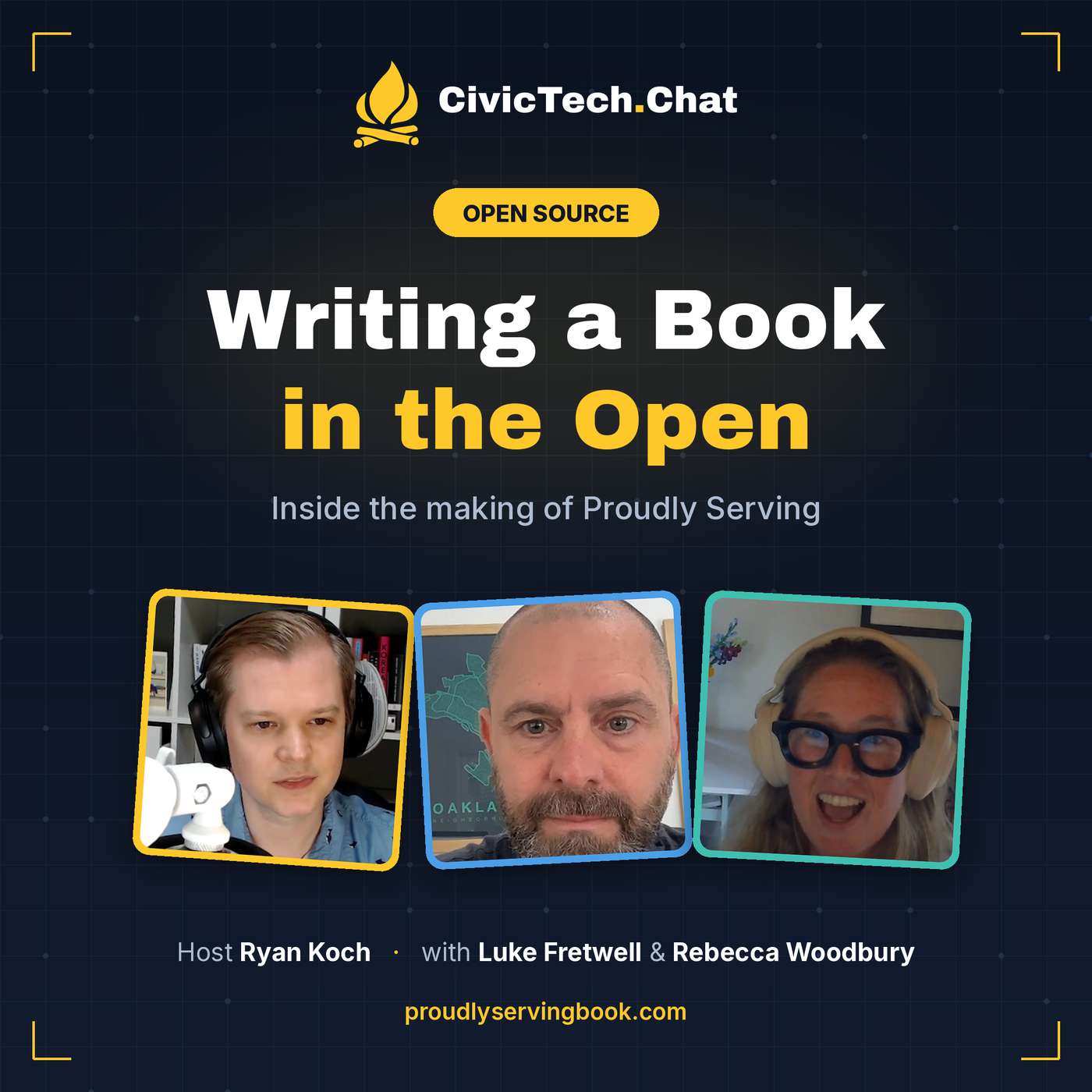
Proudly Serving: Writing a Book in the Open
Civic Tech Chat | 2026-09-10 | 1:04:36
Rebecca Woodbury and Luke Fretwell discuss their collaborative process in writing 'Proudly Serving,' a book aimed at making civic tech and government more accessible, responsive, and effective. They share insights on open source principles, the importance of plain language, and fostering a culture of transparency and public service.
The Book: https://proudlyservingbook.com
Key Topics
- The origin story of civic tech and government responsiveness
- The collaborative process of writing 'Proudly Serving' with over thirty contributors
- The importance of working in the open and transparency in government projects
- The role of plain language in improving government communication
- The concept of everyone being a public servant and fostering collective responsibility
- The challenges and lessons learned in remote, asynchronous collaboration
- The significance of guiding principles and shared values in public organizations
- Strategies for balancing innovation with accountability in civic tech
Chapters
- 00:00 Introduction to Civic Tech and Public Service
- 00:22 Rebecca's Origin Story in Civic Tech
- 04:04 Luke's Path to Civic Tech and Digital Government
- 07:06 Personal Why: Making Government Better
- 08:03 The Inspiration Behind 'Proudly Serving'
- 12:29 Target Audience for the Book
- 16:05 Writing the Book Like an Open Source Project
- 19:23 Collaborative Process and Contributor Engagement
- 23:40 Design and Accessibility in the Book
- 26:45 Working Remotely and Asynchronously
- 33:57 Chapter Review and Quality Gates
- 40:12 Reflections on Personal Challenges and Growth
- 42:14 Plain Language and Clear Communication
- 47:31 Everyone as a Public Servant
- 55:36 Living Up to the 'Why' in Civic Tech
- 01:00:37 Key Message: Default to Open and Say Yes
- 01:02:51 How to Access the Book and Final Thoughts
Top Keywords
- rebecca 0.014
- book 0.012
- chapter 0.011
- government 0.010
- chapters 0.010
- luke 0.008
- public 0.007
- open 0.007
- mean 0.005
- work 0.005
- folks 0.005
- plain language 0.005
Transcript
Speaker 0
0:00 – 0:37
Hello. I'm Ryan Cook, and this is Civic Tech Chat, a show that looks at the way technology, politics, and policy impacts the world around us. The tools we use, the way services are delivered, and how we talk about and set policy all shape our society. We'll gather around and have a chat about these things together and more. Before we get really into it, Rebecca, from our prep conversation, I recall your origin story for Civic Tech is one folks out there might relate to. Would you mind telling us about that as you introduce yourself?
Speaker 1
0:38 – 3:53
Sure. So I think I fell into Civic Tech by accident. I entered government as an intern while I was getting my master's in public policy. So I worked on policy and what I'd call kind of organizational effectiveness, at city hall. But I was also the young person at city hall, so a lot of tech or, like, tech adjacent things were often assigned to me to kind of figure out. So as I and then as I kind of made my way into more senior roles, I ended up with some projects, like overhauling the Citi website where I met Luke, actually, and implementing a CRM. So I ended up with these kind of tech projects that had to do with organizational effectiveness in a lot of ways. And these projects kind of I somehow ended up at a Code for America summit, without really knowing what I was getting into. And I had only ever been to government management conferences before, so I was pretty blown away by how all these civic tech people were talking about fixing government. I felt like I had found my people and, you know, people weren't shy about talking about government's shortcomings, but also with such a strong sense of purpose and public service. So anyway, I started to kind of understand how tech could help government serve people better and I started getting more obsessed with how to improve people's experience of government, you know, from just, like, the small micro interactions to the bigger policy debates. So that kind of started to inform my career, and that led me to actually, starting a new department at the city where I worked for, which is a department of digital service and becoming the first director. I remember, like, you know, before all that, I remember a friend called me one day and because she had she lived where I worked, and she had reported that a stop sign in front of her house had fallen down. And she called public works and told them about it or sorry. She reported it on the website, and someone from public works called her with with less than a minute of her reporting that issue. And the CRM that I had implemented had enabled that responsiveness. That that level of responsiveness was now possible because of that new technology. And so I think that kind of story, I remember it just kind of got me addicted to finding ways to make government more responsive, effective, fair, more human in a lot of ways. So that's kinda how I fell into civic tech from the policy side of things.
Speaker 0
3:56 – 4:03
And, Luca, how do you relate to that story? As and as you introduce yourself, could you share a bit of your origin story as well?
Speaker 2
4:04 – 6:42
Yeah. I mean, so for me, right, like, I I I'm, you know, in many ways in many, many ways, the opposite of Rebecca. I never actually have worked for government, and, you know, sort of my journey into where I am today, you know, started I grew up near DC. I went to school near DC, in Virginia and studied government and politics and international relations. And I was on the newspaper at the school, and I was editor in chief and thought I wanted to do journalism and then realized that journalists don't get paid anything. So I did write for a while inside of DC, but what I learned, especially as the Internet back in the day in the nineties, started to, you know, be accessible to people, I started to be curious about how it was made and started teaching myself how to code. And what I realized that it wasn't so much the writing and journalism as much as it was the designing and building. When the Obama administration came to power, the first thing that Obama did was release the open government directive, and, you know, what that called for was open data, open source, and generally just an open culture, and that really resonated with me as someone who had been working. You know, I think developers in general, have an open ethos, and just the work that I was doing was around open, without calling it open. And then just started writing about sort of what I knew from being in DC and studying government and what I knew from working and living in the San Francisco Bay Area and the tech culture. And very few people at that time were talking about digital, the intersection of digital and government, so I was able to meet a lot of people virtually, and then just started writing more about it, and then building projects and then support open source projects, and then working with entrepreneurs and starting a few government technology startups, that supported local governments. So that's sort of my, you know, path to civics. And, again, you know, I've never worked in government, but, certainly have worked for a lot of folks, in government, working alongside them.
Speaker 0
6:43 – 7:08
Longtime listeners know there's a a why question coming. The book y'all wrote that we're gonna talk about today even has a whole chapter that's all about remembering why one serves. So let's get the personal version of that early on in this conversation. For for each of you, what is your personal why? That thing that drives you to get out of bed each morning and do what you do. I get so much satisfaction
Speaker 1
7:09 – 8:00
from seemingly small changes that I know add up to making government work better for the people it serves and for the people delivering the service. So I find, I get a lot of joy out of the small things that add up, and helping governments see what those are and and make those changes. Something my dad said about life when I was young has always followed me. He said, it's hassle, hassle, hassle, die. And I so I'm I see myself as just trying to get rid of a little bit of hassle every day for people in government.
Speaker 2
8:03 – 8:50
We can't top that, Rebecca. For me, you know, it's really, I don't know. It's just, you know, it's, it's it feels it doesn't sound silly. It just feels inherent to me to be kind of civic, or community minded. I think if you kind of deduce it down, it's really just this idea of people, you know, getting along and working together, to have kind of a functional society that, and we talk about this in the book, but, you know, that has a sense of togetherness and joy to it. So, you know, it's, I mean, it's kind of as simple as that for me. It's, you know, it's just creating harmony within, you know, communities.
Speaker 0
8:51 – 9:09
So in asking that question, I alluded to a book, and y'all have been collaborating with a whole bunch of folks to get this thing written over I believe it's four years to get to where the iteration you're on now is is complete. Why did you all take this sort of project on?
Speaker 1
9:11 – 9:45
Well, my boring answer is that I just say yes whenever Luke asked me to do a collaboration. But, really, I mean, I I get inspired by Luke. He makes me think differently about things. He pushes me. He makes me better. You know? So when he said let's do a book, I said okay, and I I I really didn't think about it very deeply. So I, Luke wanted to do this, and when Luke wants to do something, I hop on board.
Speaker 0
9:46 – 9:53
Rebecca, that's a very say yes to life kinda attitude. That's that's a that's a nice one. My naivete has taken me very far.
Speaker 2
9:54 – 12:11
I mean, I you know, a 100%. Like, I think your, you know, Rebecca, like, your willingness to say yes has definitely taken you taken you far. So, for me, right, like, I felt like there was a disconnect between the conversations that were happening with technologists and, you know, bureaucrats, right, or public servants or people who work inside of government. And I knew that, you know, there a lot of times they were talking past each other, or over each other, and felt like there was an opportunity to create a book that was just, accessible to as many people as possible, but still could broach these topics, whether it was technical or, you know, technical ish or culture, related to digital, that would be, what would serve, you know, government better to adopt. So it didn't get I mean, I was trying thinking about writing a book, didn't outline to this. It didn't happen. So I reached out to Rebecca and said, Rebecca, you know, do you want to write this book with me? Thinking, you know, if we wrote it together, it would happen. And then it didn't happen. We were making some progress, but it didn't really happen. And then it just dawned on me, well, why don't we treat this like an open source project, and that we can, you know, get other people to collaborate with us and maybe that will, you know, get us to the finish line. So that's, like, really kind of how how it all got started. I just felt it was important to have a book that was accessible, and, you know, as a product, just have, like, a sense of design and, that felt accessible, but the content behind it as well. And, of course, you know, I my the first person I thought it was to reach out to Rebecca, not because I think or know she's gonna say yes, but because, you know, she is truly the best person to work with on a project like this, and she was. And I'm actually realizing
Speaker 0
12:12 – 12:28
we've just said the book a whole bunch of times. We haven't said the name of the book yet. The book's name is Proudly Serving that Rebecca and Luca both, worked on together with others, which leads me to the next question, which is, who is this book for?
Speaker 1
12:30 – 14:12
It it's not really for people that are probably listening to this podcast right now, in that I mean, it's it's not we didn't write it for the civic tech community. Many people in the civic tech community can write this book themselves. For me, it was really for people who are working in and adjacent to government, for community members who wanna help make government better. In my opinion, you know, coming from my background and my experience, to me, it's what every city manager and department director needs to know so they can be effective in the age we're living in. Because, you know, we're not even in the digital age anymore. We're, like, past that. And so I don't think it's any it's no longer an option to kinda throw your hands up and say, well, I'm not a computer person and Yeah. Not take the responsibility to understand some of the basics that have to do with the age that we're living in. So as a leader in government, I think you need to know some of the basics of privacy and security. You need to know what proprietary vendor lock in means. Like, we no longer can not understand some of these concepts. So for me, you know, the lens that I took in kind of ushering this book through, was I was always looking at it from that audience. Like, does this help a city manager understand this topic more? Not that they have to become deep, deep experts in any of these things, but they need to know enough about these things so that they can lead in the age that we're living in. Yeah. I think also, like, you know, and Rebecca mentioned this, but it's the community men are members,
Speaker 2
14:13 – 15:39
you know, also. Right? It's like the people inside of the, you know, the government building, but also, you know, giving, you know, it's sort of a book for for for, folks studying civics. Right? Like, this could book could be easily something required reading for, you know, college students, and helping them understand, you know, how communities or people can engage. Right? Like, so, you know, how can I dial into government? And then how can I share this with government so that they can, you know, adopt these principles too, and then we can work together? Right? So I think it's a it is to Rebecca's point, right, like, many people in the civic tech community could probably flip through this and then throw it on, you know, their books book pile, throw it on the book pile, the red book pile, you know, within, you know, a few minutes or an hour or whatever. But really, you know, focusing on folks who need an entree into, sort of thinking about civics in a different way. And that's the the spectrum of sort of the community member, and the people that are getting paid by tax dollars to serve those that community. So if they both had a book club, proudly serving book club, then they would all we would have better government.
Speaker 0
15:40 – 16:04
And, Luke, something that stuck out to me as we were getting ready for this, and, actually, I believe you also pointed to as you were talking about kinda your your why and your origin and that sort of thing, is that you talked about or I'm sorry. Why for the book is you talked about wanting to build it like an open source project. Can you walk us through a bit about what you mean by that when you say to write a book like an open source project?
Speaker 2
16:05 – 19:03
Yeah. I mean, I think, like, you know, so an open source project typically is, you know, generally, right, like it's accessible by anybody. The code can be downloaded, and reused, if people want to contribute to, code that that I'm building and Ryan wants to you know, Ryan has an issue and says, oh, this, you know, this color is not accessible, and I can you can submit an issue and telling me, and I can fix it and let you know, and you can check it again and say it looks good now, and then I can close your issue. Right? So it's like this collaboration that can happen or you could just take the whole code. You could fix the issue and then send it back to me and say, hey, I fixed it. And then I can say thank you and bring that code back into the original code base. And then it's a better product. Right? So I think, like, fundamentally, open source is is is very democratic. It's fundamentally democratic. I mean, we can peel the the onion a little more on that, and there are, like, places where it isn't or isn't as as democratic as it could be. But generally, right, the idea of, like, open source communities is a very democratic process that allows for people to build and engage with with the communities in different ways from, I just I noticed an issue. I'm gonna submit a report, like Rebecca was saying, a three one one issue. Or I'm gonna go, you know, there's a pothole, and I don't know I'm not encouraging anybody to do this, but there's a pothole. It's not getting fixed. I'm gonna go put some rocks in it and fix it myself, and then, you know, it'll be, a patch for when the city does it. But I think it's this idea of, like it just dawned on me that, you know, a book is just is data and code is data. So, like, why don't we just build this out in the open, and then it allows us to scale the process and then, in many ways, share, like, what we're building and how we're building it and get people interested in it in a different way than sort of, like, posting to social media or emailing, you know, our friends and family, please help us write this book. But the idea of working in the open and working, as an open source project was just kind of, you know, anybody who knows me, I just kind of default to opening up a starting a GitHub repo and getting to work. And as soon as, you know well, I mean, early on, I I felt like that was important to do. But, I think, you know, fundamentally open source and open communities is really, you know, sort of the at the forefront of, kind of how government should be working.
Speaker 0
19:05 – 19:21
And y'all ended up managing to bring together almost 30 people to become contributors to this thing. And I recall in our, starting conversation that y'all described it as, like, conning people into writing chapters. 100%. How did that start up?
Speaker 1
19:23 – 21:44
Well, I I mean, it started with it it started with a table of contents. When Luke and I were thinking about writing this together, we kinda started with this table of contents. And then as we started to realize, like, we could bring more expertise, more perspectives, more diversity of thought into the process, you know, we started to go through that table of contents and think through, like, who do we know or who do we know of that are, you know, in these topic areas, that would be a good fit. So there was that initial just like reaching out kind of within the network and the extended network, but we also kept the process open that people could suggest another chapter topic. Like, you weren't confined to the one we think you should write or the one in the table of contents. You could also suggest something that isn't in there at all. And then as we kind of got a few chapters in, we started to promote the opportunity to contribute more broadly through social channels and things like that. And then also, like, asking people to think about their networks to so just kind of, like, expanding things out. And so we ended up having, a a lot of chapter writers came found the project either, you know, on social media or through someone else. And so we met a lot of the contributors through the process of the book, which is really cool. And, you know, I I still like, now that we're on the other side of it, kind of it's done. And I I I look at all the list of contributors, and I look at the list of chapters, and I'm kinda, like, blown away that we got such great people, half of who I didn't know before this project, or more than half. And, it's just really cool to see the level of expertise that we brought all the levels of expertise that we brought into the the effort, and to see the the chapters that are covered throughout the the book are just, it it's really cool. It's it was it's a very different experience when you're in the middle of it, and then now that we're on the other side looking back, it's, it's really cool to see them altogether.
Speaker 2
21:45 – 23:26
Yeah. I mean, I'm looking at the list now, and it really is, like, half of the people I had, you know, never met before. But to Rebecca's, you know, echo what Rebecca said. Right? Like, it's initially, it was kind of people we knew, and then, you know, it was us and then people we knew. And then, you know, some folks started coming out, or we identified folks to, who had written a blog post, and we thought there was an angle for them to contribute, you know, something related to that to, you know, this book. Some people we reached out to in the beginning and then one, you know, they were busy or whatever, and then they came through in the end. So and then even, you know, working on the design. Right? Like, I didn't even know Adam, and, ultimately, we, really got in the weeds on sort of design, book design, print design, e pub design especially, don't advise it. But, you know, we really, like, and I thought that I was, you know, sort of being annoying to him, and he was really excited and working on it. We both sort of wanted to to be perfect, perfect ish. And I you know, we had never worked together before. We had we I don't we've never even met each other in real life. But, you know, it was fun to just, like, have that connection with them. And I think just sort of, you know, it's kinda back to what you're saying with Rebecca saying yes. You know, being open to the possibilities really created, you know, this book and the chapters, and the design that it is you know, that it came to be.
Speaker 0
23:27 – 23:39
Rebecca, as we prepared for this episode, I recall you talking about it being important to create something that could be replicated. What what why was that a key thing that you wanted to reach for?
Speaker 1
23:40 – 26:02
I mean, I think that a lot of that goes back to what Luke was saying about open source in a lot of ways, that fundamental, connection between government and open source. I think one of the special qualities of public service is the idea of replicating, sharing, iterating good solutions, scaling. It's why proprietary vendor lock in is just so wrong. Like, we wanted to model running a project in the open as Luke was saying. So, you know, hence, putting everything on GitHub. I think a lot of distrust in government stems from people feeling like things are done behind closed doors. It's a perception. It it can be perception. It can be real. And a lot of folks in government don't get that distrust because they're having the public meetings, and they're posting the draft reports online. But that's not the same as working in the open and working in a way that can be replicated. And so I think that part of doing this the way that we did it was to show what working in the open can look like and maybe inspire folks to think about working in the open in the government context and what that look like. So I think that that kind of was on my mind. And I also think, like, there were just elements to how we got the project done that, like, you know, we had a chapter template, and so that made each, like, working with every contributor a replicable prime replicable process. And so there were just, like, also elements of the project that made it easily easy to work through, and and the checklist that we had, kind of the operations that we set up to get things done. And I just fundamentally believe similarly, I think, to Luke with open source is, like, what you do in the civic space should be shareable, copyable. I mean, the book is Creative Commons for a reason.
Speaker 0
26:04 – 26:43
The, the mention you made about public meetings is what is, an interesting one. It it immediately took my brain back to, not to go on a random anecdote, but, there's, like, a fun thing. When I when I lived in Chicago, I met some folks that worked with the city bureau, which is, like, a local journalist nonprofit there. And what they discovered is, like, yeah, there's public meetings. But even we, full people who spend maybe full time trying to figure out where they are so we can cover them, have a hard time figuring it out. So then they then spin up this, like, volunteer project to build web scrapers to then find the meetings in these, like, buried websites to bring them together, you know, as an open source project kinda thing.
Speaker 1
26:45 – 27:25
And the public meeting often represents, like, the end of something. It's not the process of how you got there. And that's why I think, like, there's often there's this breakdown where people think, oh, we're having this public meeting about something. But for many of the folks coming from the public, it can feel like decisions are already made. If it there can sometimes it can feel like a charade at times. And I think that that's something that's a bit kind of broken about the process, that it it can just it can feel like, yes, we're having a public meeting, but you've already made up your mind.
Speaker 0
27:26 – 28:05
That's a that's a really good point. And, actually, as I think about y'all's process, you kinda had your own, like, steps in that they were in the open. Right? Like, yeah, there's the poll the issue at the end that maybe has the link to the chapter you've already worked with the person on, and it's there, and there's been comments. But there's those steps that maybe I just, like, spoke through in between where, you know, folks could interact with it. They could see it. They could before it turns into a thing that becomes a resolved issue and and into the book. So it sounds like you're kinda saying, like, much like how we did that, you would like to see public services show each like, showing your work for math class. It's a lot of it is showing your work. Yeah.
Speaker 1
28:05 – 28:26
Absolutely. The checklists. This is how we're doing it. This is, you know, this is the process. Looking underneath the hood, I think is a big part of building trust. And I think if people understood what is underneath the hood, they might have a better time trusting it.
Speaker 0
28:27 – 29:04
And it actually it may be indicative of even our our own call here today, time zones. We're all over the place, even now. I imagine your contributors also have that going on, people all over the country, maybe even all over the world, and also, like, different occupational focuses as we talked about, different perspectives on what the work means, a lot of different to to kinda facilitate. And to and you all did it, remotely and asynchronously. What did you see as things that worked well as you sought to take on that challenge, and what were things that didn't work so well?
Speaker 1
29:06 – 31:04
I think, like, our capacity ebbed and flowed. This project took, like, four years. And so that was you know, there were times where our personal lives or work lives made it so that we couldn't spend a lot of time on this project. So that kind of ebbed and flowed, and we just had to go with that and realize that, I think there were moments of frustration because I think we wanted to get it done sooner and faster. But I think Luke alluded that to that earlier. At some point, we just had to, like, go with the flow of the project and say it will be done when it is done. And I think that part of what worked really well was that we tag teamed really well throughout the process. We played to each other's strengths. When one person was busier than the other person, you know, we took on different things. And so I think that that the nature of working to not just the two of us, but the other folks that came on board to help with editing, to help with promotion, to help with design. I mean, just everyone worked asynchronously really well. I think us getting over the finish line, I purely credit to Luke's ability to operationalize anything, and also to make decisions and project manage. So, I mean, if it was like, if I was in charge, we'd be, you know, in the backyard making daisy chains and, like, chasing butterflies or something. Luke Luke knows how to get things done, and so that that helped put structure around things, create checklists, get things, you know, into the done column. But I think just the async tooling that we used, to communicate with folks, and to share docs and everything. It just we just got set up well from the start.
Speaker 2
31:05 – 33:35
Yeah. I mean, I think, you know, the tooling. Right? Like, I mean, this is, you know, standard for a lot of people, but, at least in civic tech. But, like, you know, using Slack to communicate asynchronously. I mean, Rebecca is in Sweden. I'm in California. You know, people were everywhere. So, like, you chat in whenever you have the chance. But, also being transparent with the process and what was happening. So, you know, tying in workflows into Slack. So if I publish something to the website, it would give a notice in Slack so people would know that I did it and I didn't have to, like, say anything. But even on GitHub, we had our project board and, you know, GitHub is essentially a way to project manage, a building of a product. So we followed you know, we had a project board. You know, all of our tasks were templated, so we knew what steps for each part, you know, sort of onboarding an author, editing the chapter, communicating that we wanted feedback from the public on the chapter, finalizing the chapter, publishing that it's now available, and then, you know, closing it out. So, like, everybody knew what the steps were. The authors knew the rules of engagement, and we were honest about, you know, we, you know, we wanna get this done in a time frame, you know, if you have issues or, you know, sometimes we push the authors to do, you know, get a little bit deeper, and, you know, on a chapter and making sure that it was the way that we thought it should be. So it went without, beyond the time frame. But really just being honest with each other. Right? Like, are you able to you know, I'm gonna jump in. Understanding that, like, if somebody wasn't getting to something within the expected time period that it was licensed for other people to jump in, let them know that they are going to jump in and keep the ball rolling. Right? It's not, an insult to your character. It's we are being intentional about how we work, and this is how we're gonna do it. So, so it was really just sort of, like, creating that creating the tools that enabled it, but also the culture.
Speaker 0
33:37 – 34:00
And I think I hear there's, like, some natural gates in there at different steps of the process. When you when, say, a chapter or or a part of the book hits one of those gates, how do how does it go through? Can you talk me through, like, what's the what's kinda, like, the contract between contributor and project for getting through a check like that? Yeah. Yeah. I mean, we kind of worked our
Speaker 1
34:00 – 35:53
worked through that with each chapter author. But, yeah, we definitely had a workflow for the chapter. It started with a kickoff meeting, discussion of the topic. We gave them a timeline for the first draft. We took we did a first pass at review, and then if it passed to your you know, if it passed that gate, then they could make changes according to our review, and then it would go on to public review, and we would promote it that way. So it kind of went through, went through that process. So I think there were times where we were reviewing chapters, and it ended up not feeling like the right fit for the book. Not that it was a bad chapter. It just wasn't gonna fit with the rest of the chapters. And so there were a couple chapters that we had to make decisions on during that process with the with the writers where it didn't get end up end up getting published in the the final book. But overall, you know, everyone was great to work with, and so it was it was pretty easy to work through issues as they arise. I think the thing that was interesting was some chapters went through the process, like, flew through the process, and then others took longer, and we had to kind of extend deadlines and rework things. And some things we even reworked way after the fact because, like I said, this book took, like, four years. So there were times where, like, we would look at a chapter that was written, like, two years ago. We'd be like, do we need to look at this again? You know? And so there were times where we kind of had to come back to chapters, and and rework some things with some of the authors as well. I I heard you mention,
Speaker 0
35:53 – 36:09
like, the temporal nature of our work. Right? Things change. Sounds like one reason to revisit something. But you also mentioned, you know, there's a difference between some make it through easily, some require more back and forth. Were there any patterns between kind of those two outcomes
Speaker 2
36:09 – 40:12
that you recall? I think, like, the you know, in thinking about it and I have never really, like, actually thought about a pattern. So thank you, Ryan, for helping us do that. For the next book it'll be easier. It won't be it'll be three years instead of four years. I think, like, you know, in thinking about it, right, like whenever there were two whenever there's co authors, it definitely provided a little bit more friction, because, you know, people have different takes. You know, it's like Rebecca said, somebody wants to write a lot, we're limiting them to 500 words and 200 words or whatever for each section because it's a standardized section. So two people wanna say, you know, have things to say. And then you have kind of the different, you know, approaches to writing. Right? So how do people so there was that even though, you know, there may have been two people that were, like, really good, you know, like, experts, perfect people to write the chapter on their own because there were two of them now. They just kind of have a different perspective. But in cases where people had been working together, you know, side by side, it was less of an issue. So for, like, Joe and Dustin writing the innovation chapter, you know, they just knocked it out because they work together and they talk about this stuff all the time. And there were other chapters where people were kinda doing things, doing that chapter topic in different ways or different context, and also just probably different writing styles. And for us too, the element in some of them was we we want to like, we have elements of it that we think are important. For example, the civic hacking chapter, right, Carlos and Laurie, you know, they come from different contexts, but they're both sort of leaders in civic, you know, hacking. And then you have me who is gonna be a pain in the ass because I have a perspective too. And, you know, so that was a little bit more challenging because, you know, I was mostly because I was a pain in the ass, but because, you know, we just had different perspectives on it. And not perspectives, but just with they were word boxed and there were three different concepts that, you know, three different people had concepts that wanted to do it. But, you know, there were chapters that and then there were chapters, like, if you were really if you were really dialed into what you did, and we said this is what we're looking for, you know, it was done. Like Joy, right, Joy Bonagoro, we I talked with her about data and data rights and, and she was probably, like, sitting at her dinner table, you know, and she just knocked it out and it was perfect. And then there were chapters where it was just the individual, but it was a concept that was newish for them for the community and we're all kind of learning, you know, as we go. So I think if you were gonna, like, do a book in a year, right, or, you know, in in shorter time, you know, and you didn't wanna sort of live the sort of thrill of being a pain in the ass to everybody and causing, you know, time delays, you would say, alright. Have you all been working together on this topic? Okay. You can write this chapter. You know? Are you an expert in this? And we're gonna even like as Rebecca said, we're gonna be very specific on what we want. You write this chapter. But, you know, that was, like, the fun part about it was I mean, I don't know. Laurie and Carlos probably think different, but, you know, it was just, like, through that process, I think the at the end, everybody was real it seemed that at least they said, they acted like it, that everybody was really happy with how the chapters came out. So if it took a long time, it was frustrating. But, ultimately, I think everybody was you know, whether it was, like, easy to do, or difficult, you know, that process was everybody was proud of their, their end product.
Speaker 1
40:12 – 40:54
Because I think, like, many of these chapters could be their own book. I mean, if you think about My Ling's chapter on design for everyone, I mean Yeah. I think the challenge of that chapter was that she could write a whole book on that. And she should, My Ling. So I think, like, that that was also some of them lent the the topics lent themselves to the format really easily, and then some was, like, a struggle to, like I said, scope it down and say, like, what can you say, you know, about this topic in this context? And then what do you have to edit out? There was a lot of editing. That that probably was the thing that was took the most time was figuring out what's the most important thing to say.
Speaker 0
40:56 – 41:04
Yeah. And even, like, Dean keep an eye out for the spin off books to invite them Right. On the show. And, look, I I think you were you had a response there too.
Speaker 2
41:05 – 41:23
Yeah. I mean, even I mean, I think, like, one of the chapters that was painful to get out was mine and the last it was the last chapter, and it was, you know, it was the Feed the Machine chapter, and it was just like me being a pain in my ass to myself to like, think it through,
Speaker 1
41:23 – 41:42
you know, because I wanted it to be perfect. And then Rebecca, you know, I think Rebecca had a lot of patience with me, and then I finally did it. Why is going on, Luke? Like, why are you not done with this chapter? Like, it's like No. It's all like it. Could write it in your sleep, and you just took forever. You were being the a pain in your own ass.
Speaker 2
41:43 – 41:54
Wow. Yeah. Inside, I was, and I was it was like both. It was like, get this perfect, but also get it done.
Speaker 1
41:55 – 41:57
What a painful existence you lead.
Speaker 0
41:58 – 42:11
I know. That that that there's a lot of tension in those two statements being in the same Right. Yeah. In the same room. But, look, I'm picturing yourself kinda living that, like, you are your own worst critic to the maximum in that moment. Totally.
Speaker 2
42:12 – 42:12
Yeah.
Speaker 0
42:14 – 42:38
Yeah. Rebecca, you mentioned plain language as part of your your process. I've also found that it's often one of those things where it's, like, easy to be like, yeah. Plain language is good. But then sometimes kinda hard to, like, actually make sure that people do it or that it ends up in your product or that at the end, you know, the pen writes the simple thing that's easy to read. What's been kinda your lived experience trying to make that happen?
Speaker 1
42:39 – 42:45
It's so hard, and, like, we could spend the rest of this podcast talking about it.
Speaker 0
42:46 – 42:47
Maybe another book.
Speaker 1
42:48 – 43:49
One so one, I think that people feel like it's not professional. And they so, therefore, they feel like they're not allowed to use it in a professional context. So a lot of people feel like they're supposed to use certain words in professional settings. Like, they have to say utilize. They can't say just use. They have to say utilize. I mean, there's these words that are just, like, ingrained into the, like, professional setting, and I think people feel like that's the professional way to say stuff. And so you have to kind of break through that and give people permission and show why those are problematic to do, especially when you string them all together. And I think there's also this myth that plain language dumbs things down. It doesn't. It makes things clear. And sometimes that's really hard to do. Sometimes it's really hard to make things clear.
Speaker 2
43:49 – 43:50
Yeah.
Speaker 1
43:50 – 47:18
But it's very, very, very worth it. I will tell you this. When people understand the rules, they are more likely to comply with them, and they are less likely to submit an incomplete application that takes longer to process. Right? There are these efficiencies that come from this. So we talk about now. It's what do we what's the new phrase? The time tax, or, you know, wasting people's time. And we waste people's time when we make things confusing. And I think often when things are hard to understand, it also reflects an underlying process problem. You can't write your way out of something that is poorly designed. Right? And I often find this in with the work that I do with website content, which is that sometimes I can't fix it with words. This is a broken process. So it's really an interesting way to then, you know, look at your service design through the lens of plain language. And then kind of the the other thing that I will say, most of the time, obfuscation is unintentional, but sometimes it's not. And I do think that sometimes it is intentional that there is this, you know, to different degrees, but I think that sometimes we use words to protect. And, you know, as they say, knowledge is power and power corrupts. I I don't know. But I I think that plain language is such a critical piece to unlocking trust, unlocking efficiencies. It's just such a critical component to government. When I teach plain language, I use lots and lots of examples because I find that when you show rather than just tell, it that's when people can have those moments. Like, when you can show, like, doesn't this read a lot better when you say use instead of utilize? You know, and when you show these examples, I think it really unlocks things for for folks. So that's a really important part of plain language work is showing examples, and giving people the permission and maybe going a step further than permission and also making it a directive. I've been really encouraged because I've actually gotten a lot more requests from people these days that wanna make plain language training mandatory for their employees. And that to me is so encouraging and exciting because, you know, when we think about our you know, most people are communicators in some way in their job. Not everyone, you know, manages website content or writes press releases, but they write emails, they write reports, they they communicate, they write notices, they communicate information in a lot of different ways. And I think if we give people permission to write a public notice in plain language, wow. I mean, I think the world would become a little bit better of a place.
Speaker 0
47:20 – 47:50
And, Luke, that that framing on, like, everyone is a communicator in in their work actually connects to a section that you wrote about kind of pertaining to public service where, to me, it was a it was a chapter that really stuck out. And I believe you said something like Thank you. We're all public servants. We all do public service. Could you kinda expand upon that? Is that I think the theme from the communication and how it touches everyone and what you're talking about here maybe kinda connect to each other a bit.
Speaker 2
47:52 – 51:46
Yeah. I mean, I think, like, for especially for me. Right? Like, never worked in government, but have done a lot of stuff related to government, civics, over the last fifteen, twenty years of my life. I feel like a public servant. Right? And I think, like, stepping back and how we design it, my own experiences, you know, especially, like, interviewing government folks and people say, you know, you say, like, you know, people will ask, you know, you they will say, like, we're doing it for the mission and, you know, some of these things that feel cliche and it's only unique to them because they are getting directly paid by the taxpayers. So somehow they are the public servants. And then as a, you know, as a gov tech entrepreneur or founder of companies, somehow because you are the vendor, you are not a public servant because you are indirectly getting paid by taxpayers. And that's just the, you know, the the narrative around that is something that I think we need to reframe as I wrote because, you know, it it forces government you know, a lot of times you see government treating the vendor like a vendor, or you see the vendor treating the government like the government, and you see government treating the community like, you know, the annoyance. And I think it's it's important for us to realize sort of our collective contributions, how individual contributions, you know, impact the collective. And if we start all labeling ourselves public servants or think of each other as public servants, then we will start, working in better ways. And, you know, vendors, maybe not all of them, but, will start to think about the work that they do in the context of, you know, the people and not the the government or the contract that they have. And, you know, I was talking with a vendor about something, and they had made a change. And I said, you know, you didn't make this change for government. You made this change for a million people, you know, with some service that they provide that they, you know, contract with government and government uses. So essentially, they're the face. And it's just the con and, you know, one of them on the call said something like, I never really thought about that, which is kind of shocking to me. But I think this idea of everybody, you know, thinking of each other as a public servant would, allow us to sort of work better together and also, you know, treat treat each other better, but also especially, like, you know, raise expectations for one another. You know? If a vendor is not acting like a public servant, they can be known, but they still have you know, they've been given the permission to call themselves a public servant. And if they're not acting like one, then they should be held accountable, just like we would for what we traditionally call a public servant. So I think it was just I don't know when that chapter came about. It wasn't in the beginning, but it was at some point when I realized, like, you know what? I feel like just a vendor, and I'm not. So don't think of me as just a vendor. And I know that there are other people who, feel the same way, but also on the government side, you know, there are really great public servants, but there are also bad public servants. And just because they get directly paid by the taxpayers may not mean that they are a public servant.
Speaker 0
51:47 – 52:39
Rebecca, one of the chapters you contributed to, resonate with me as well. In the, set guiding principles chapter, it talks about the importance of referencing those guiding principles and talking about them. That pushed me to reflect back on the places I've journeyed through in my own kinda career journey. And what I realized is the places I was at where it actually seemed like they behaved, like, the way their website said they did, like, the value stuff, they're the ones where they actually talked about it somewhere that, you know, they had, like, a synchronous space where you could, like, shout out people for doing something cool that related to one of them or a Slack space where you could say, hey. This person did a great job. You know, they were, very truthful or candorous or whatever the value is in question. What have you seen kinda work well, at places with this kind of thing?
Speaker 1
52:40 – 55:09
So, when I worked in government, I was part of developing an internal workforce engagement program. And one of the best things we did together was develop guiding principles for our organization. And so we did this as a collaborative effort with employees of all levels, all departments, were involved in writing these principles. So once we had them defined, which is a very iterative process, took us a while to kind of work through things, then we asked employees to help us create the narrative or the legend behind each one, so that each guiding principle had a story behind it, not just words. One of them that I remember, it was a principle about being mindful of taxpayer dollars And some staff in the public works department, they made this hilarious video about this groundbreaking that, where a consultant had suggested that we buy these golden shovels for a photo op that cost, like, a thousand dollars each, and we needed, like, 10 of them or something. Right? And so the guys in the maintenance crew, they just went to Home Depot. They bought some regular shovels and a can of gold spray paint. And they told the story of how to be mindful of taxpayer dollars through this hilarious video of being mindful with taxpayer dollars. And it was through these, like, videos and also just engaging employees at any level of the organization to be a part of making these principles that just gave them so much power. And so people in the organization, they felt attached to these principles because they had written them, they had built them. And not only had they written them, they were also living the stories that became the lore, living the stories behind them. And so it was this really powerful experience for the folks that were involved in in writing these and then, like, giving the narrative to them as well. And so, yeah, that that would be my my favorite experience related to to guiding principles for sure.
Speaker 0
55:11 – 55:33
As we've touched on some of the the book content, the chapters kinda give you things you can bring to your work, practices you can do. It gives you advice, kinda helps support folks that are actually, like, out there doing the thing. So it brings me to a question for each of you, which is what's a chapter you've personally struggled to live up to and why?
Speaker 1
55:36 – 58:01
Well, for me, the the remember why you do this chapter is it's a bit bittersweet. For me personally, during the pandemic, I, like many, is working in government. We experience burnout pretty severely. And it led me to quit my twelve year career in government. I was exhausted, and I had definitely lost my why. And my why before burnout was so strong, but I lost it. I also think I lost my who, what, where, when, how. I, like, lost it all. But I think a lot of people working in government are exhausted. It can be really exhausting. Most of my customers are exhausted, and I've been in their shoes. And it's hard to remember your why when you're really, really tired and you keep hitting, you know, brick walls. So I got my why back, and I think the silver lining is now my why is kind of, like, more powerful than ever. I think I'm more effective at what I do. I have a larger impact. I think that, you know, my why is now my own. It's not my bosses. It's not the councils. It's it's my why now. And so also now part of my why is to support others that are doing the work that I, you know, the shoes that I used to be in. And so I try to inspire them when I think they need it because they inspire me still doing the work. And I think, like, part of the joy in working on this book with all these amazing contributors was getting to be inspired by each contributor who came in with their perspectives, their experiences, their wisdom. I think, you know, every chapter, we just got to get inspired by them. And so that chapter while I think I found my why again, I definitely lost it. And I think that that's probably a lot of the experience of a lot of very tired public servants. I think that it is hard to remember the why when you're really, really tired.
Speaker 2
58:02 – 60:26
Yeah. Yeah, I'm looking over the the chapters as Rebecca's talking and, it's funny because I think like every time I see this and it's been a minute because you know since I've looked at these chapters just to sort of separate myself. But, it's funny because if I was going to write a book by myself and get out all of the things that I feel like would have been my book, I look at all these chapters and I'm like, this is what I would have written. This is just how I roll. It's kinda weird to see that now, because I think, a lot of this I I live, you know, I live my life this way, my professional personal life this way. So, it's a tougher question for me, but I think, like, thinking deeply, about it. And I think this is a challenge that, you know, a lot of us in civic tech have is just, like, really speaking plainly. Right? And we think we're speaking plainly about the digital concepts, or, you know, saying digital things, or technical things in a way that feel accessible, but we're still not reading the room and understanding, you know, that the peep the concepts that we're trying to explain are still very technical. And even for me, like, I value plain language. I know the importance of it and incorporate it into a lot of the work that I do. But I think still saying things that, you know, even if I try to explain them, you know, like, in context of what I'm working on these days or advocating for is, like, everything should be a JSON file. Right? And, like, explaining what a JSON file is and why it's important and then, you know, getting feeling like getting the understanding around it, being taking the time to explain it. But then people are like, I'm sorry, what is a JSON file? Right? And, like, really thinking about it, like, don't say JSON because people are gonna, you know, look at you like you're trying to teach them the code. But I think that they're, you know, definitely, like, really being, you know, when you think that you're being intentional and playing about communicating technical or digital concepts to people, check yourself and go a little bit more playing on it because odds are you're not. At least I'm not.
Speaker 0
60:28 – 60:35
As we get closer to our end here, what would you say is, like, the one thing you want folks to keep after they read the book?
Speaker 1
60:37 – 61:38
For me, and I hope this comes through in some of these chapters, especially, like, Reframe Public Service too. You don't need permission to make public service a little better. Whatever your role is, wherever you're positioned, there's probably something within your control that you can do to make the experience better and easier for somebody on the other side. So I think working within government, sometimes it can feel like you need permission to do anything. And I wanna kind of challenge people to think beyond that a bit, and and realize that there are some things in your control that you can make better and improve even if you feel like there's not. And if you don't have permission, I think you need to challenge that and figure out why and and push push on that.
Speaker 2
61:40 – 62:42
Yeah. I mean, I think, like, I'm a broken record on this, but I think, like, just defaulting to open, right, and being open to possibilities. And, like, we started this conversation with just saying yes. Right? Like, default into open, say yes. At the end of the day, like, whatever you do when you default to open or say yes to, you will wake up the next morning and realize that that was the choice they you know, that was the right choice. And a lot of people in government don't do that. Right? It's no or deep default to, you know, closed, then it creates this constraint. But, like, if you wake up in the morning and make a decision to default to open or default to yes, you will, start to experience a different form of the work that you do for the people, whether you're a public servant or a vendor or whoever, you will feel better about that, and you will see more flow within the civic system.
Speaker 0
62:44 – 62:50
And in the spirit of saying yes and making right choices, how can folks read the book?
Speaker 1
62:51 – 62:58
It's free. It's on our website. So what's the website? Proudlyservingbook.com?
Speaker 2
62:59 – 63:10
I think I said it right. Rebecca. Yes. You got the domain right. Yeah. You can go to proudlyserving.com. As Rebecca said, it's No. Proudlyservingbook.com. Probably servingbook.com. Dang.
Speaker 0
63:10 – 63:18
Don't worry. I'll put the I'll put the correct one in the show notes. Don't worry. Yeah. There there it's multiple formats. And as Rebecca said, it's Creative Commons.
Speaker 2
63:19 – 63:51
The, you know, it's an EPUB, PDF, HTML. You know, it's it's an accessible PDF, Rebecca plug plug PDF, accessible PDFs. But, and, there is a print version that's available and it's, you know, at cost. We sort of figured out, like, what it would cost, to print it, and it's print on demand. So, you know, you can get a print version for I think, it's $15, and then, and then there's multiple versions that are free.
Speaker 0
63:53 – 64:11
Very cool. Well, folks, you've heard where you can go get at that book. I I do recommend it. It's a it's a good read. And, Rebecca and Luke, I I appreciate y'all both coming on the podcast to talk about the book, how you wrote it, and some of the advice in it. I'm sure folks will get a lot out of it. K.
Speaker 2
64:11 – 64:13
Thank you, Ryan. Appreciate you.
Speaker 0
64:15 – 64:23
Visit us on the web at civictech.chat, or subscribe to us for content updates wherever it is you download your podcasts.